Wednesday, July 29, 2015

The Gates Of Azyr

The Gates of Azyr by Chris Wraight. The first Warhammer Age of Sigmar novella, originally published by the Black Library, July 2015. Approx. 90 pages.


I had come to pillory The Gates of Azyr.

For every perceived transgression committed by Games Workshop with their Age of Sigmar release against my inner child, I was prepared to show the world that there was no way that this gimmicky nonsense would translate into good fiction.

In short, I was ready to hate The Gates of Azyr.

I cannot say I was right. I also cannot say I was wrong.

The Gates of Azyr is a decently written novella with a paper-thin premise. Chris Wraight has always been a solid author, so I wasn't expecting total rubbish. It's just that in the end, he was handed a square wheel and tasked with making it roll. Let's take a look at what we have here.

First things first. I am not writing up a primer on this ridiculous Warhammer: Edgy Reboot. All you need to know can be told to you in a much better and more eloquent fashion than I would be able to convey by the nice folks at 1d4chan.

In short, Nagash, the AntiSigmar, rose up and everything got End Timesed. At the last moment, Sigmar himself plucks the worthiest warriors from the hellish near-apocalypse, bringing them to his celestial realm. Everybody else is.....wait for it......

Warhammer: Age of Rapture begins.

Sigmar has a plan though: he will rebuild these warriors. He will armor them in gold and cobalt overkill. He will give them all mighty warhammers and convenient comet fire to shoot from their palms. Behold! The Reforged!!!!

And I shall render their visages in my own glorious image!

So, anyway, the time has come for the Reforged to Retake the charred remains of the world, now renamed Aqshy, because don't even get me started, from the blood saturated minions of Khorne. And so, the forces of Sigmar teleport from Asgard, and ride the Bifrost Bridge down to Earth (I'm not typing Aqshy again in my life).
It's just...ugh, nevermind.

Alright, now that I've had a few paragraphs and puerile images to sate my dissatisfaction with the Age of Sigmar concept, let's look at the actual novella.

Everything I said already, plus due to a need for even more convenient/illogical gimmicks, the Gate of Azyr (which is the portal needed to reenter the sundered world) needs to be hit with magic from both sides in order to open. So, a smaller force of Reforged are teleported worldside in order to hold the line against the obligatory pre-massed horde of Khornites (named the Goretide, proving that 'excess' and 'cornball' are two words never introduced to Games Workshop employees), while some of their comrades "magic the Gate". 

With this in place, the book essentially becomes a battle report. I mean, let's be honest: this book isn't meant to introduce us to the literary possibilities of the Age of Sigmar setting, it is really just a tie-in novel to the box set, like Island of Blood or Dark Vengeance were for their respective sets (a bit of advice; if you aren't familiar with how the units and such look, take a gander at the set itself. Trust me, all the units are in the novella). Reserving yourself to that fact, and lowering your expectations in turn, will heighten your appreciation for what it is. Again, Wraight is a solid author, who writes vivid, bold scenarios. So let's look bit by bit at what he put together.

World Building:
Like I said, Wraight writes in colorful strokes. The world is a dismal, sundered landscape. Everything is saturated in red, the water is poisonous, vegetation in desiccated, ominous lightning crackles perennially overhead, etc. It's a post-apocalyptic wasteland. And Wraight portrays it all well. So, good marks here.

Characters:
What characters? Anyway. This here is the crux of the problem. Warhammer Fantasy allowed for characters to live and thrive. Even when there was the constant threat of war and evil, there was civilization, industry, etc. And thus, characters are born. Here, everything is about the mission. The Khornites are thoroughly evil. Wraight is wise enough to put any humor in the book into the conversations between the Goretide executives. There is some fun banter. 

The Reforged, on the other hand, are as dry as burnt toast. Our leader, Vandus, is understandably focused solely on his duty (another potential hamstring to future works featuring the Reforged: Space Marines of Future Past). To compensate, Wraight inserts scenes where Vandus' "previous life" hiccups some distant memories. It's pretty silly and generic, but something needed to be introduced to let the audience form an emotional bond with him. The rest of Sigmar's army, forget it. There is the Chaplain type who grunts out cryptic observations. He is also known as the Cryptborn. There is the leader of the sky units, I mean the Skyhost. The limit of his characterization is that his heart soars as he does. And that's it.

There are also some arbitrary humans scurrying about. They are standard post-apocalyptic types; there is a tough, grizzled female leader, a whiner/worrier, and some others. They offer little overall contribution other than ushering the bad guys towards where the action will take place. Once the hammers and axes start swinging (from about a third into the story until five pages from the end), these apocalypse urchins literally lay down to take a nap. 

Action:
I want to say this category is a home run. The mechanics of the fighting is portrayed very well. However, Wraight is again hamstrung by the materials. There are only so many ways you can talk about killing people with warhammers before careening ass over appetite into redundancy (he swung the warhammer in a wider arc, his warhammer scythed out, etc.). Any time a Reforged starts prepping for a comet-fire hadouken, the tendency is to groan, not become excited. Again, subject matter, not writing skill.

What I do have a problem with is some of the in-battle dialogue. Most of the time, it is harmless, standard growls, taunts, threats, and rallying cries. There was just one moment where Vandus made a declaration to a leader of the Goretide and basically told him "If you leave now, you will live to see another day. If you stay, you will surely die." Hold the phone, the entirety of your being transported from another goddamn realm is to purge these creatures from the scorched earth! Why are you giving options to daemon-spawn????

Other Issues:
Not much. There's some obvious padding. More than a few times we here the same thematic elements of how this is the start of the true battle, and how for the Khornites they had gotten bored living for a few thousand years off of refugee scraps, and their zest is now renewed. It gets tiresome, but given the world setting, what does Wraight really have to use to evoke emotion from the reader?

In the end, it has been a lot of fun ribbing this novella. Hubris may eventually sink Games Workshop, and Age of Sigmar seems an accommodating iceberg. Then again, I am known as a perennial pessimist. 

Pictured: Your humble blogger.

But I don't want to come off like I am insulting Chris Wraight as an author. Again, to stress the merits of this novella, the very distinct world concept is portrayed very well. There is a lot of action, and it is written in an exciting manner. The villains are very enjoyable. And we all know that a fun psychopath can more than compensate for a white bread hero.

Here's what it is:
The Gates of Azyr is a bit better than you would expect for a box set tie-in novella. The premise is paper thin, the action is non-stop. The fact that the good guys are pretty much devoid of emotion promises to be a hurdle for future authors and stories, but hey, I can still enjoy a yearly viewing of March of the Wooden Soldiers, so there is always hope, right?

For Sigmaaaaaaar!!!!!!

Wraight obviously does the best that he can with what he has to work with. I am not saying he is absolved of any blame associated with the final product, but he did take some garbage ingredients and serve up a palatable dish.

Final Score:

5/10


Cover Score:

A snippet of the box set art for the Age of Sigmar set (although if you buy the set, you get a spiffy little hardback). I can't really deduct points for it not jiving with my personal aesthetics; the composition, artwork, and color saturation are all strong. Wise choice to crop it to showcase the duel between Vandus and Khul.

Cover Final Score:

7/10

Sunday, July 26, 2015

The Enigma Of Flesh

The Enigma of Flesh by  C.L. Werner. An Adeptus Mechanicus short story, originally published by The Black Library, May 2015. Approx. 31 pages.


Continuing along with the recent batch of Adeptus Mechanicus fiction releases, today we look at The Enigma of Flesh, an offering by veteran Black Library scribe C.L. Werner. Werner, as we all know, is perhaps the most influential Warhammer Fantasy author, but his 40K outings have all been solid.

Enigma focuses on the Kastelan robots. A few points first; unlike the recent Skitarii-centered stories (Skitarius, Vanguard, The Zheng Cypher), the Kastelans fall under the purview of the Cult Mechanicus. Also, the Kastelans are not mechanically-augmented units; they are actual robots, which need to be controlled (or moderated), by a nearby datasmith. Yeah, the logistics don't necessarily add up, but common sense only flies so far in the Imperium of Man, plus, they can unleash holy hell on enemies. Now, one subject that will inevitably arise when discussing Kastelans is their design. Being constructs of the 30K era still in use in the 40K canon, the Kastelans boast a sort of "future-retro" design. Some love it, some hate it, either way the end result looks like the bastard offspring of Robby the Robot and a Cobra Viper.

An infinitely better love story than Twilight.

The setup of Enigma is fairly standard, a fitting template for a short story. Captain Marhault of the Cadian 32nd's Fifth Company is desperately trying to hold the planet Thain against an endless horde of Tyranids. As the story opens, a ship carrying much needed reinforcements is arriving.

Suffice to say, this being the 40K universe, nothing is as cut and dry or benevolent as it seems. These reinforcements are in fact two of the aforementioned Kastelan robots, and, as alway, the Adeptus Mechanicus has their own agenda. Also, as always, it doesn't take into consideration the worries of the average foot soldier.

The Enigma of Flesh benefits from a strong foundation. Each brick laid in making is well placed. Werner has paid attention to all the details; local topography, and how it factors into troop dispositions and defensive positions. As far as the combatants on both sides; both the Kastelans and the Tyranids are rendered well. What I particularly enjoyed were not just the descriptions of all the players, but the focus on the fierce weaponry employed by the Kastelans, and the brutal havoc they play upon the chitinous 'nid swarms. This is a very smart move; since even in the hands of the best scribes, 'nid stories can get a tad redundant. There's only so much to say about them, they are horrors to behold and they move in huge swarms. But colorful details of them getting blasted to gooey bits, always a plus. And whether or not you are a fan of the Kastelan design, it is a lot of fun to see them going on destructive romps like Sanda and Gaira.


The few characters we get in Enigma are well-realized. Marhault is a good human lead; a tough Cadain veteran with genuine concern for his charges. Datasmith Livia gives a slightly human face to the Tech Priests of Mars, while the coldly practical Magos Procrustes embodies their philosophy entirely.

It is intriguing to see these varying mindsets clashing, since each carries a weight of legitimacy in their respective logic. As the battle plays out, Werner shows us that it proceeds very much like a chess game; and while Marhault is nobly, yet possibly foolishly, trying to save his pawns, Procrustes has not for a moment forgotten what the true goal of the game is.

As much as I liked the set-up and the battle scenes, my favorite part of Enigma occurs towards the end. Shifting away from the battlefield, we get a lesson in the validity of the story's title, set against a backdrop reminiscent of a 50's movie mad scientist laboratory.

It is no coincidence that the primary industrial value of Thain is the export of grox-dung; in the Imperium of Man, a cake of dung is pretty much a man's net worth.

Here's what it is:
The Enigma of Flesh is better than it had any right to be. Using a standard story template and focusing on some of the goofier looking recent models from Games Workshop, Werner built a strong foundation and gave it life with well-rounded characters and blistering action. And personally, I love it when the book's title has a profound resonance with the tone and moral of the story.

Final Score:

9/10

Cover Score:

I'm guessing this pic comes from the Cult Mechanicus Codex, no? It's not a bad pic; it just makes the Kastelans look like an infantry unit. There's nothing wrong with them recycling an existing pic for a short story cover, but I think they could've found one that "sells the robot" better in terms of menace or potency.

Cover Final Score:

6/10

Sunday, May 24, 2015

HachiSnax Interviews: Peter Fehervari (Part I)

Today I am excited to introduce a new segment here at HachiSnax Reviews: the author interview. I realized that it has been close to two years now that the blog has been going, and I haven't had a single interview yet.

Our first interview will be with Peter Fehervari, author of Fire Caste, which is one of the best (and certainly deepest) novels put out by The Black Library.


Mr. Fehervari has been very supportive of the blog since it's beginning, and I am honored that he was gracious enough to take the time to open up and answer some questions.

Better yet, he provided some fairly intense and in-depth answers to the questions I pitched. Therefore, I will be breaking this interview into two or three parts. Enjoy!


H.S.: First of all, prior to your works being published with the Black Library, what was your personal background with the Warhammer/Warhammer 40,000 universe? Which armies did you field? And, going from this, how did it feel to have your first novel released by them?

P.F.: In one way I was there right at the beginning, but in another it took me a long time to get involved. Throughout my teens I’d make regular pilgrimages to Games Workshop’s original retail store in Hammersmith to pick up D&D related stuff, including the first wave of lead miniatures from Ral Partha and Grenadier. Though I collected the models obsessively it was the RPG aspect of the hobby – the stories and characters - that had me hooked, so I didn’t pay much attention to the wargaming side. I’m a little embarrassed to admit that I dismissed Warhammer Fantasy as just another generic fantasy universe at the time, mainly because I was caught up in my own world-building, so it passed me by completely. But there was no missing the advent of 40k.

That first set of plastic Space Marines and the Rogue Trader book that accompanied them were total game changers for me. Even after all this time the picture that adorned both the model box and the book remains the iconic, perfect 40K image for me. Those embattled warriors making their doomed last stand against an unseen, but undoubtedly numberless horde caught my imagination as nothing had done since Star Wars overran my childhood. I had no idea who these guys were or why they were fighting, but I knew I had to find out.

So I read the book and in that labyrinthine, often chaotic – almost primordial – first incarnation of 40K I found the twisted evil brother of Star Wars who’d left his lightweight sibling whimpering in the playground with a bloody nose and a harsh dose of dark future shock. There’s so much about that book I could talk about, but I’ll content myself with the gloriously demented quote that crystallised this new background for me: ‘In a mad world only madmen prosper.’ Hellfire, this was the grim and grandiose SF mythology I’d been waiting for without even knowing it!

And yet… I confess I never actually played the game. At least not as it was intended.

I took what I loved from the background – along with as many models as my gaming group could afford – and remixed it into a bizarre fusion of RPG and wargaming where every model had a personality and a backstory and combat used D20s (because they were cooler than D6s!) and the plot always overruled the rules. Every game took days to play and the over-arching campaign… dear god, that’s still running almost twenty years later, though it’s a miracle if we play once a year these days. The first casualty of getting old is time so we probably won’t finish the arc we started in our teens until we’re pensioners!

So, from a gaming point of view I’m a heretic and would be at a loss if I attempted to play by the official rules. Besides I’ve never been anything but a games master because it was always about stories for me.

I guess my ‘heresy’ towards the game also comes through in my approach to the background because everything I’ve written has tended towards the eclectic, pushing at the edges of the traditional IP, but hopefully always staying true to its mad, dark spirit. And having said that, I’ve made a point of researching any faction I write about with a fastidiousness that borders on the obsessive. When writing within a shared universe, especially one as long running and intricately constructed as 40K, respect and due diligence for what’s come before must be a writer’s starting point. And I’d be lying if I didn’t say fear also plays a part in that equation. There are a great many passionate, highly intelligent people out there ready to send a storm of vitriol your way if you get something significant wrong - or for that matter something insignificant, because that little detail you missed or misrepresented or plain screwed up will matter to someone.

But it’s not just fear, there’s also a sense of responsibility. You don’t want to let those people down because you’re one of them and always will be. You just happen to be one of the lucky few who’ve been given the chance to put something back into this universe you all love so much. And in your heart you know there are countless talented people who’ll never get that precious chance so you really, really don’t want to squander the privilege. It’s a matter of honour to do the opportunity justice.

Which answers the last part of your question: how did I feel about getting something published by Black Library? Honoured and terrified in roughly equal measure pretty much sums it up, with the highs and the lows vacillating back-and-forth with every bit of feedback I got, even when it was a throwaway comment on an obscure forum. When you’re a new writer (and quite possibly long after) everything gets through to you because you go looking for it. You know you shouldn’t, but how can you not when you’ve sweated blood over getting that story out there? I’d be very surprised if most newcomers don’t feel this way and make the same mistake. And though I understand this intellectually I’m still doing it!

H.S.: What was your favorite Black Library title?

P.F.: Perhaps unsurprisingly I have a particular fondness for Simon Spurrier’s ‘Lord of the Night’. It’s an intense, often disturbing novel that’s bleak and bitter to the core. Consequently it’s not always an enjoyable read, but for me it captures the madness of 40K in a way that few other BL novels have done. There’s a grubby authenticity to the hive world and its seedy, broken inhabitants that grounded the action and made everything feel visceral and believable. I don’t mean to imply that this approach is the best or the right way to approach 40K, but it’s the one that resonates most with my perception of the background.

H.S.:Your debut novel, Fire Caste, is quite an exceptional book. There are so many aspects to it, which combined to elevate it to that level. Let’s talk about a few of them…

A cursory review of Fire Caste might term it as “Heart of Darkness (or Apocalypse Now) in Space”. Now, even though there are some similarities in structural elements, the notion of a man’s slow boat ride to Hell goes back to the most ancient of mythologies. Why was this theme such a linchpin to the narrative?


P.F.: It’s difficult, perhaps impossible, for me to speak objectively about ‘Fire Caste’ because I’m still so close to it, but it was certainly written with passion and conviction. I was given a lot of creative freedom with that book, which accounts for its eccentric style and individualistic take on 40K. Other than the title (which isn’t the one it was written under) not much changed from the first to the final draft so the responsibility for it’s success or failure, including the controversial ending, is entirely mine. And for that I’m very grateful to BL, because whatever else it is, that novel is personal.

Which kind of brings me to the ‘Heart of Darkness’ question.

OK, I have to hold my hands up here and admit I’m not a fan of Conrad’s novel. Despite its brevity I found it virtually impenetrable when I first read it in my teens. I revisited the story years later, but once again the dense slabs of prose and paucity of paragraph breaks made it a chore and I abandoned it halfway through. My third visit to Conrad’s Congo was prompted by the comparisons (both favourable and mocking) that ‘Fire Caste’ drew, which made returning an obligation of sorts. If nothing else, I had to know what people were talking about.

This time I saw the novel through to the end – finally - but try as I might, I still couldn’t click with it. Beyond my continued dislike of the style, it was the Kurtz figure (the original Kurtz in this case, so perhaps I can’t say ‘Kurtz figure’) that left me cold. He repelled me, but never disturbed me. He didn’t make me stare into a dark mirror and think ‘But for the grace of god, there go I’, which was surely the point.

So Conrad’s ‘Heart of Darkness’ wasn’t a direct influence, but the theme of his novel – the journey into a darkness that’s both physical and spiritual, a journey that’s really a downward spiral that both repels and attracts, yes, that’s definitely something the books share. Like ‘the Fall from Grace’, the ‘Journey into Darkness’ is one of the great archetypal stories of our dark side. In essence it’s a true story, which is what makes it worth telling over and over again.

But why did I set my version on a river?

Well of course ‘Apocalypse Now’ was a loose inspiration for that, along with a more obscure film by Werner Herzog called ‘Aguirre, Wrath of God’, which was about a band of demented conquistadores travelling up the Amazon in search of gold (I highly recommend it if you like dark and strange films), but ultimately it came down to the specific qualities of a river journey – the notion of a path that will carry you deeper into the unknown even if you stop trying, a path that can twist and turn back on itself – into itself - going everywhere or nowhere and challenging you to see a difference… which is how I interpret the ‘downward spiral’ of the human soul. That delirious geography makes for a striking metaphor for the long, dissolving fall into darkness, which is why the drowned wilderness in the book was called the Dolorosa [or Sorrow’s] Coil.

Reflecting on all this – and particularly writing it down! - I realise I’m running the risk of coming across as pompous or pretentious, and undoubtedly some readers saw the novel exactly that way (and tedious to boot). If you buy a book called ‘Fire Caste’ you expect a story focussed on tau warriors fighting courageously for the Greater Good, hopefully with some insights into their culture along the way. What you definitely don’t expect is a story about the Imperial Guard going insane along a river haunted by ghosts, daemons and fungoid mutants to cheer them along. Hell, this isn’t even a regiment you’ve ever heard of! And anyway, is this the kind of story that’s even appropriate for a 40K tie-in?

Well, I can offer no defence for the title, though I take no responsibility for it either. The novel was pitched as ‘The Long Road to Hell’ and written under the name, ‘Thunderground’ (the spiritual testing ground that underpins the Arkan regiment), but the final title was out of my hands. The rest of it, as I’ve said, is entirely my responsibility so I want to say a couple of things on that.

First, I’d suggest that the dividing line between pretension and depth is drawn by sincerity. If a writer’s exploration of ‘the deep’ is driven by a genuine desire to make sense of things then it’s a valid journey, even if it ultimately fails. However, if it’s only a veneer of pseudo-intellectual sparkle then it’s just bullshit and deserves only contempt. Of course I don’t have many – any! – real answers to the Darkness, but ‘Fire Caste’ was a journey I made in good faith. The criticism that hit me hardest wasn’t from the Amazon reader who was outraged by my use of civil war imagery (apparently he was waiting for Lincoln to pop-up in a stovepipe hat…), but from a very measured reader who felt the book was ultimately ‘409 pages of misery and suffering without a real point.’ I’m still thinking about that because if he’s right then I failed utterly.

Second, is a 40K tie-in the right place to tell this kind of story? Hell, yes! My love for 40K wouldn’t have lasted over twenty years if I didn’t believe it could embrace such stories. The scope of its mythology, cultures and characters is virtually limitless and the metaphysics underpinning it all – Chaos – is a masterwork of twisted psychology. It’s a universe steeped in darkness, within and without, therefore it offers the perfect canvas for weighty, challenging stories, as the best of BL’s authors have demonstrated many times. Equally it can accommodate lighter, more action-oriented tales (and the overall balance should probably tilt towards those), but it would be a tragedy if writers didn’t make risky forays into its depths, even if they occasionally drown. Sorry, I’m overdoing the metaphors…


H.S.: Fire Caste has an undeniably emotional tone throughout it, and I would wager that it is a very personal work. There is an old story that when members of KISS stopped by Marvel Comics to check on the progress of a comic book being made about them, they donated some of their own blood to mix with the red ink. How much of your own blood did you leave on the pages you wrote?


P.F.: Honestly… a lot of blood. ‘Fire Caste’ was written during a very challenging period of my life and I’m sure that shows through on every page, which is probably why some readers found it hard going. Getting it finished was my ‘Thunderground’ (one reason why I passionately wanted to retain that title) and Commissar Iverson and I became very close during that struggle. I don’t know whether that’s a good thing or a bad thing, but it’s how I know the journey we made was true, if not necessarily real. And why I’ll have to continue it someday, somehow. There’s unfinished business between Iverson and myself.

Well, that's it for Part I. Hope you enjoyed it!

Peter's debut novel, Fire Caste, was released by The Black Library in 2013. He has also released various short stories with The Black Library, many of which are set on the hellish jungle world of Phaedra. His latest story is Vanguard, which focuses on an elite detachment of Adeptus Mechanicus Skitarii warriors, sent behind Tau enemy lines to retrieve a precious asset.


Legal Disclaimer: The views and/or opinions expressed in this interview and in all articles of this blog are entirely the view of the author and are NOT in any way representative of Games Workshop PLC. All names, insignias, illustrations, et al. are the property, copyright, and/or trademark of Games Workshop Ltd, PLC. All names, titles, and illustrations used without permission, with no challenge to copyright/trademark status intended. All rights reserved by the proper owners.

Saturday, May 23, 2015

Hammer & Anvil

Hammer & Anvil by James Swallow. A Warhammer 40,000 Sisters of Battle novel, originally published by The Black Library, November 2011. Approx. 416 pages.


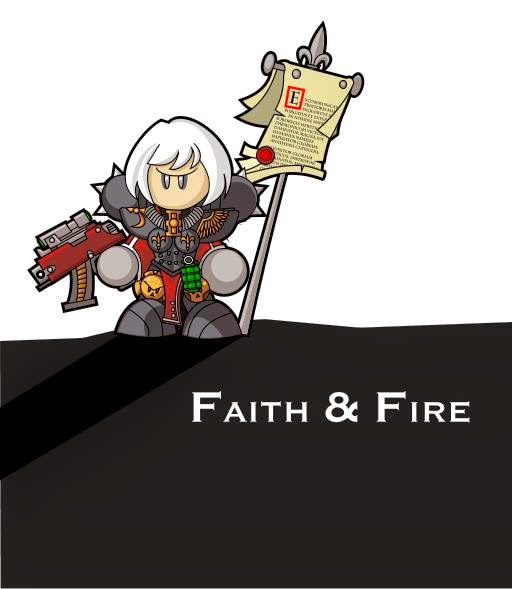
Last July, I reviewed Faith & Fire, the first book in James Swallow's duology centering on those lovable warrior nuns of the 40th Millenium, the Sisters of Battle. It was a decent book, with great world building, solid action scenes, and spotty characters and pacing. Also, I wasn't too enthralled with the cover.

No no no. This is the alternate cover which I endorse 100%.

All joking aside, Faith & Fire was an enjoyable enough read to warrant the second book, Hammer & Anvil, grabbing a spot on the mountainous "to read" pile. And, it just so happens that its turn came up. So how does this second book work? Is it more of the same, only different? Has the quality dipped down, as is so common with sequels?

Actually, Hammer & Anvil outdoes its predecessor pretty handily. Let's break it down piece by piece, but first, let's look at the story so far:

The Sisters of The Order of Our Martyred Lady are heading towards the planet Kavir to try and piece together the events that transpired which ended in the massacre of every living sister garrisoned at Sanctuary 101. It has taken them over a decade (Terran time) to head back courtesy of bureaucratic obstacles and red tape. The chance finally comes, orchestrated by an Inquisitor with ulterior motives (what other kind of Inquisitor is there?). And so, with an attachment of scheming cogheads from the Adeptus Mechanicus in tow, they head planetside to discover the true horror of what happened. Hint: it's Necrons.

Characters:
Much better than in Faith & Fire. We have some carryovers from that book, namely Miriya and Verity. Their personalities are pretty much the same, which is to say that they are, hmmm, what's the best word to describe these two?

Yes! Exactly!!!

So while their core characteristics haven't changed much, there is a much more confident stride in their depiction. Yes, they have been hardened, they are a bit wiser, but they are still the same. But again, their is only so much leeway you have in giving personality to zealots. I mean, they're zealots, after all.

I think that one or two of Miriya's old squad members survived as well. They are still window dressing with names. One might be dark skinned. Another might have a specialized weapon. Or are those the background Sisters introduced in this book? Can't recall.

In Faith & Fire, we had the stern but fair Canoness Galatea. In Hammer & Anvil, we have the stern but fair Canoness Sepherina. She's bald. She's tough. She's actually pretty cool.

I should've formed this entire review out of visual aids.

Filling the role of Sister Superior, the position Miriya was demoted from, we have Imogen, who is constructed of 100% anger and absolutely zero common sense or tactical acumen. She still gets some kick-ass scenes though.

Leading the Adeptus Mechnicus is a conniving, snarky questor named Tegas. He excels in his part as "the troublemaker you love to hate especially since he weasels out of trouble as slickly as a greased pig." It makes it even easier to hate him since Tegas spelled backwards is Saget, so if you imagine his vocalizations as sounding like Bob Saget....aaarrgh. But seriously, Swallow gives us an excellent portrayal of the mentality of the cogheads. It provides the bulk of levity throughout the book. Consider your main combatants: Sisters of Battle and Necrons. Yeah, not a lot of personality floating around in there. So, the Mechanicus are a great touch throughout. Trolling in binary.

 Basically.


I admit that I am dishing out a fair amount of ribbing so far, but the characters all gel well for a cohesively enjoyable experience. There is also one very strongly developed character in the book; a broken young woman named Decima, the last survivor of the obliteration of the original Sanctuary 101 outpost. Swallow fills her character with sorrow, anguish, nobility and strength in fairly equal terms. I would say that she is hands-down the best character in the book.

But what about bad guys?
The cogheads are enjoyable villainous troublemakers, but they are not actual "bad guys". The main baddies we have are none other than the dreaded Necrons. It's always a tad tricky writing for Necrons, since there is effectively zero individual personality in your given line trooper. Never fear, Swallow writes for them beautifully.

Well, not that beautifully.....

What Swallow focuses on in writing for these metal skeletons are spot-on physical descriptions, meticulous attention to detail in weaponry, and vivid portrayals of deployments and their basically implacable advances. 

He also gives us two sentient Necrons; a cryptek and a nemesor. There is some discourse between the two, and it is well done, if sometimes a bit too "human" sounding. All in all, of all the 40K stories I've read featuring the Necrons, Hammer & Anvil is far and away the best. I can't stress enough that the average Necron soldier is more fleshed out (hurr hurr) than the average Battle Sister.

Sorry sweetheart. I have no hand in what cards are dealt, I just call what I see.

World Building:
Swallow hits it out of the park once again on this front. Kavir, where much of the action takes place, is a desert world. There are only so many ways you can describe sand and heat, but Swallow does it in a way that you feel it. Plus, he employs a decent vocabulary. For example, I never knew these things were called "ergs":


But what truly astounded me in Hammer & Anvil was the intricate, excellent detail of the Necron Tomb World. I mean, the attention to detail made this representation vivid and authentic to the source material. Enough credit cannot be given.

The other aspect of world building which Swallow did well (as in Faith & Fire) is in presenting canon technologies: the weaponry, tactics of each faction, etc. These are all done exceedingly well throughout. You get a real feel for the different kinds of havoc that can be caused by either a gauss rifle or a melta-gun, and be sure you'd never want to be on the business end of either.

Action:
Plainly put: lots of action throughout. Pretty much all of it done very well. Towards the end, there are a few too many "just in the nick of time" instances, but the skirmishes never cease to be thrilling.

And that's pretty much it. I really don't have any complaints this time around. There was some potential, hinted at early on, that the Inquisition might have a more direct hand in all the wrong things going on on Kavir. While we know throughout that they can't be trusted, there was a ripe chance to really cultivate the genuine tension between the Sororitas and the Inquisition.

Ahem...well. I didn't mean like that. Although this would've been a perfectly welcome addition to the narrative....

Here's what it is:
Hammer & Anvil is a riveting novel focusing on the Warhammer 40,000 army that everybody loves but does not get enough love, the Sisters of Battle. If nothing else, this book should be cited as a reason why we need more Sororitas books. Great action, solid characters, and an excellent portrayal of Necrons. 


Final Score:

9/10


Cover Score:

While I was none too crazy with the cover for Faith & Fire, I really like this cover, featuring Miriya, done by Hardy Fowler. Even James Swallow gives a special thank-you in the acknowledgements to him for designing it. The composition, pose, detail, everything is good.

Cover Final Score:

8/10

Monday, May 18, 2015

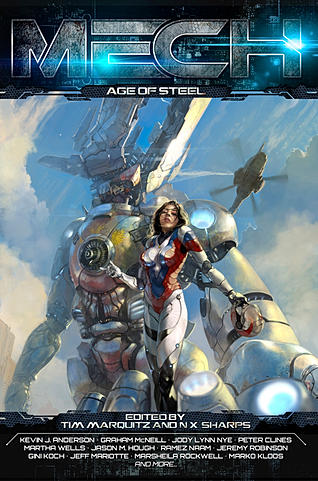
Mech: Age of Steel anthology on the horizon

A little bit of a different post here. I just saw on Raganarok Publication's website that this year's Kickstarter anthology will be a collection of short stories centering around a "mech" theme. The working title is "Mech: Age of Steel". Check out this awesome cover and head over to their site to read the info and and the tentative partial author lineup (some real winners there):


The reason why I'm promoting this here is because I was a backer on Ragnarok's previous two anthologies, Kaiju Rising and Blackguards. And let me tell you, on a $25 level, you get a real good deal. These anthologies are big ol' doorstops, with contributions by great authors, plus you get great add-on goodies (I think at my backing level I got like 6 or 7 ebooks with Blackguards as well as a print copy). Plus the subject matter is near and dear to me. I mean, kaiju, rogues, and now mech tales? How can you go wrong?

Keep an eye out for when the Kickstarting opens. Hopefully a review of this and the previous two are in the cards, although it seems I am in a semi-retirement now....

Sunday, May 17, 2015

Vanguard

Vanguard by Peter Fehervari. An Adeptus Mechanicus short story, originally published by The Black Library, April 2015. Approx. 37 pages.

Although the Adeptus Mechanicus have been around since the advent of the Warhammer 40,000 universe, this year Games Workshop finally introduced a figure line for the Skitarii (the military arm of the Adeptus Mechanicus). The figures look great, and seem to be generating a lot of positive buzz. Coinciding with the release, Black Library has unveiled a bunch of Skitarii stories. There are some great looking titles there, but of course the one that stoked me the most was Vanguard, a short story that promised a return to Phaedra, that hateful little slice of hell that Peter Fehervari introduced us to in the most excellent Fire Caste.

Things have most definitely changed on the brutal landscape of Phaedra. With the passing of the Wintertide movement, and the death of the Sky Marshall, all that remains (apart from the indigenous, nightmare-fuel flora and fauna) are the tattered remains of the Tau army, and the Adeptus Mechanicus holed up in their fortress, the Iron Diadem (readers of Fire Caste will remember that that book also featured Skitarii, and one rousing fight scene in particular involving them). Within the confines of the Diadem, Magos Caul, the highest ranking tech-priest on the planet, has decided that it is high time his tenure on Phaedra come to a close. However, to get back home to Mars, he needs to retrieve a high-value asset from behind enemy lines, known only as "Skysight". To achieve his goal, he sends out a sizable force of his best Skitarii.

This is a fairly basic, yet direct, premise, and it works just fine for a 40K short. What Fehervari gives us is an excellent story that truly showcases these militant cyborgs. Now, I will say this; Vanguard is a bit of a departure from the other titles in the Phaedra Arc. This title showcases less of the mind-bending, emotional resonance that were the cornerstone of the previous works. What remains is well-rendered armies, superb world-building, and a ton of blistering action.

If it seems that I am insinuating that Vanguard doesn't measure up to other Phaedra stories, allow me to explain. There is, logically, less of a chance for emotion present, as our combatants are the memory-wiped Skitarii and the Tau, who eschew individualism for the perpetuation of the Greater Good. Fehervari still "gets" the feel of the 40K universe in a way that most other authors don't, and it is still rendered well on the pages. Phaedra is still a seething, hateful world that serves as the real antagonist. There is still a strong bleak, grimdark vibe to the whole proceeding.

Readers of Fire Caste will also remember how well the action scenes were presented there. Fehervari maps out some grand skirmishes in Vanguard as well, which move along with a brutal choreography. He incorporates a nice array of the Skitarii weaponry, as well as infantry types. Attention is also paid to cohort hierarchies and troop deployment. It is pretty interesting to see how troops are utilized and expended in accordance with their inherent usefulness. It's so honestly, brutally practical.

Now, just because Vanguard doesn't have the emotional impact of Fire Caste, that doesn't mean there isn't an emotional underpinning susurrating throughout the narrative. At times of stress, we can sneak fleeting glimpses at the people these warriors of the Omnissiah used to be (remember, most of the Phaedra Skitarii were cobbled together from Imperial leftovers). It is in these moments that Fehervari inserts welcome nods to people, places, and things from previous Phaedra works, giving us some inkling of the fates of some of them. These are, by and far, the best parts of the story (too bad we couldn't get an update on the fate of the battleship Puissance and its captain, the odious Sea Spider, but in all honesty it would've been superfluous to the Skitarii vs. Tau narrative).

In the end, the only problems I have with Vanguard are with how it is presented by the Black Library. First of all, there is no way you can convince that the working title of this short was actually "Vanguard". This is not a story focusing on those ultra-irradiated soldiers of the Adeptus Mechanicus. Other troop types play a far more integral role here, including the rangers and the Alpha Primus. In fact, the show is arguably stolen once the Ballistarii lope onto the scene.

Also, this picture makes a horrible cover for this title. It was simply cropped out of the pic used for the Skitarius cover:


I get it that not all short stories warrant custom covers, but nothing about this snapshot sells the idea of  "Soldiers of the Omnissiah on a hellish jungle world".

In closing, Vanguard is a great read. It ties up some loose ends, and gives us a rich portrayal of two great armies in action. Reading Fire Caste is not a prerequisite, but it will enhance the enjoyment immensely.

Here's what it is:
A welcome return to a very unwelcome place leads to a happy reunion with some very changed friends.


Final Score:

9.5/10


Cover Score:

I can't fault this picture by Bagus Hutomo for not matching well with the subject matter. It is a well-enough rendered pic of a Skitarii warrior, although it is the least dynamic portion of a very solid picture.

Cover Final Score:

6.5/10

Thursday, February 19, 2015

Shaggy Dog Bridge

Shaggy Dog Bridge by Glen Cook. A Black Company short story, originally appearing in the Fearsome Journeys anthology, published . Approx. 31 pages.

Just when I thought I had presented a complete synopsis of the legendary Black Company series in 2014, I find out that I let one short story slip through the cracks. Shaggy Dog Bridge, first appearing in the Fearsome Journeys anthology (edited by Jonathan Strahan of Swords & Dark Magic renown), is the third of the (so-far) quartet of short tales that will segue readers into the long awaited, much anticipated Port of Shadows.

In Shaggy Dog Bridge, we find our favorite Annalist, Croaker, attached to a recon patrol scouting ahead while the angry Taken, Whisper, pursues with a clutch of angry Imperials. Along the way, they find a massive glamour (illusion), one of a perfectly mundane chunk of forest. The thing about illusions of normalcy is that they are usually there to mask things markedly out of the normal. Being a recon group, it falls on them to see what exactly that is. What they find are parts of the puzzle which Cook has in store for us in Port of Shadows.

Out of the four Black Company shorts released over the past few years, Shaggy Dog Bridge is definitely my favorite. There are a few reasons for this. Firstly, once again, Cook shows us (again) that not only can he still write for "earlier books" Croaker, but he can still capture specific moods and attitudes. In this story, Croaker is pissed off, ornery, and in a generally foul mood, due to being attached to this tedious task (which he himself had volunteered for). The writing is cranky, full of expletives and vitriol.

Another high point of the story is the addition of a few more "grunts". Other stories in this arc have introduced wizards and concepts for "bad guys", but here we can meet a few more personalities of the rank and file. These additions, namely Rusty, Robin, and Whittle, have a lot of potential.

Finally, and most importantly, we get a real whiff of the type of evil that will be faced in the upcoming book. For example, the most intriguing bit of geography mentioned is not the titular Bridge, but a scar on the earth known as the "Rip", a cleft in the landscape possibly caused during a battle between formidable nasties. We also find out about the "Master", who will serve as the Dominator type in Port of Shadows. And, lastly, we get to meet Blind Emon, a "Taken" of sorts in thrall to the Master (the fact that she is a concentrated ball of agony is a great touch).

As in most other Black Company titles, the joy is not in the violence, but in the characters, the dialogue, and the authenticity of the battlefield tactics and situations. There is no clanging of swords, but more of what makes the Company who they are; planning, resourcefulness, sabotage, and a lot of luck.

So, as I've said before, I shall say once more; I am overjoyed that Cook is getting closer towards a new Black Company book, and, while I am happy that he can still write for the crew circa Books 1-3 as well as before, I'd rather see other Company stories. Perhaps A Pitiless Rain, if it ever sees the light of day, will focus on Suvrin, Tobo, and those that survived Soldiers Live. But how about some coverage of the original Company? Those of renown that first marched from Khatovar and put so much fear into the Taglians? Ah well, it's still a business, and I am sure the majority want to see more Croaker. And, as the quality of these four shorts testifies, it'll be a great read.

Here's hoping I'll get a chance this year to review the other titles in this anthology. It looks like a solid one.

Final Score:

96/100