Showing posts with label Classics. Show all posts

Saturday, April 9, 2016

The Heirs Of Babylon

The Heirs of Babylon by Glen Cook. Originally published by Signet Science Fiction, 1972. Approx. 183 pages.

Last year, for my birthday, I decided to get myself a little treat, and so I tracked down The Heirs of Babylon, Glen Cook's first published full-length book (he already had his porn novel, The Swap Academy, released under the pen name Greg Stevens, and some short stories and Clarion contributions published by the time). Of course, with the TBR pile as high as it was, I haven't really had a chance to read it. Actually, no...that's not 100% true. Like many other books by Cook, I tried a few times to read it, getting a few pages in, before I could actually sit through it. It's a strange thing; I'd put him as my favorite author; and yet, it's like the stars need a certain alignment for me to be able to commit to the long haul of finishing one of his books.

Well, I decided I would get it done by this birthday. 100%. And, of course, that passed over two weeks ago... But hey, this is as close to being on schedule as I can get these days, so I'll take it.

The Heirs of Babylon is an interesting little novel. It is set in a post-apocalyptic world, two hundred years after nuclear and chemical warfare has annihilated almost the entirety of the global population. And yet, for some reason, maybe the inherent madness of man, the war continues. Every few years, there is a Gathering; where the remaining territories must cobble together a Tribute: man and naval power, and trudge off the the "Meeting", and do battle with the phantom enemy. Few, if any, ever return.

Our protagonist, Kurt Ranke, is a young man that lives in the Littoral, the ragged remnants of Germany. Impulsive action and obstinate pride have committed him to participation in what High Command (the ruling force for the West) has deemed the "Final Meeting". We meet him as he is bidding farewell to Karen, his new wife. Before leaving, she hits him with two curveballs; one, that she is possibly pregnant, and two, she is contemplating absconding to Telemark, Norway, to join a pacifist faction up there. She begs him to join, but he commits to duty. And so, he boards his ship, the Jager, and sets off on his appointment with destiny.

For the most part, the book details life aboard the ragtag destroyer. This is what Cook has always excelled at; taking something seemingly normal, and adding fantastic elements to it. Due to the loss of the technology of two centuries past, those attending the Gathering can still put mighty ships in the water, but they are often patchwork craft, often running on steam power.

This part of the story works because of the authenticity of the naval portrayal. As Cook even mentioned recently in an interview, a lot of what was written here was drawn upon from his Naval service a few years prior. So, if the day to day actions of a Quartermaster don't appeal to you, a good chunk of this novel won't work.

Now, as these things are wont to happen in a militaristic system of government, High Command has a sort of "propaganda police bureau" known as the Political Office, to make sure that everyone keeps marching in step. These feared agents are clad in black, and inspire fear and command respect wherever they go. Think SS officers or Warhammer 40K Commissars.

In such a totalitarian society, it comes as no surprise that the undercurrents of dissent are evident on a broader spectrum than those fleeing to Telemark. On the Jager, and, we find later, most other ships participating in the Gathering, there is an underground movement. The seeds of mutiny that they sow create an intense amount of tension on the ship.

Our protagonist, Kurt Ranke, finds himself smack dab in the middle of this ideological maelstrom. Cook has, in Kurt, presented us with a very real, human lead. He is a young man who is not non-violent, but simply not violent. He is not anti-war; he just cannot quantify hating an "enemy" that he has never seen. He is not pro-High Command, but he understands that life is much easier when one follows a set path (even though in the back of his mind he realizes that this path is probably a one-way trip). He also recognizes the goals of the resistance; he even finds excitement in them, and a desire to help bring about change. Of course, he ends up committing again to the path laid out for him, and hating himself for his laziness. Kurt is very much like us in this way; we can rage over political and social issues in the news and on social media, then finish our coffee and head off to our work pods.

Even though Babylon borrows from other anti-war and anti-totalitarian works, it is not a propaganda piece. It is, like so many of Cook's other works, a story seen from the everyday soldier's point of view.

Towards the middle, Cook borrows a page from 1984 and has Kurt visit a small shop, where upon him is bestowed a book which illuminates some of the mechanics of the current societal structure. He picks up some rudimentary English skills, and sets about translating the tome.

As the rickety armada trudges off to its final rendezvous, the clamps from High Command are tightened, and the seeds of mutiny truly begin to blossom. At this point, it all becomes a matter of time....

There's really two main ways to look at a book like The Heirs of Babylon. If you are reading it today, it's most likely because you are a Glen Cook fan, and perhaps a completist of sorts, and are interested in seeing what his earliest works were like. Perhaps you want to see if you can see parallels between older and contemporary books by him, and see if you can chart the evolution of his writing prowess.

Or, you can look at it as a standalone. Imagine you plucked this off the spinner rack at a bygone drugstore, or found it in a used-books box at a flea market. In that case, you can appraise it on its own merits as a standalone book.

On its own, The Heirs of Babylon is an enjoyable enough book. It is post-apocalyptic, but not in an insane, "Mad Max" manner. Given this, it might come off as a tad boring for some. In fact, this may be the first instance of Cook "self-critiquing" himself in-book (remember when Croaker savaged Murgen for how he recorded his Annals?). As Kurt is translating the forbidden book, he notes how it is much more boring than he expected, and after a certain point he was just continuing to turn pages in the hope that something exciting would happen. Babylon isn't boring, but it isn't chock full of explosions either. The action scenes, when they come, are fast, furious, and intentionally confusing. Terrifying, too. You know, just how they'd be in real life.

I'm not going to give away too much in regards to the climax. Suffice to say, Cook surprises us by not giving us what we expect, and yet delivering something entirely believable. If you are hoping for either a lofty, heroic ending; or an overly dramatic, sad one, you will be disappointed. Cook knows that in the end, soldiers do what they need to do to survive (remember, soldiers live and wonder why). Ergo, this story ends the moment that the war ends for Kurt. This yields a finale which is both immensely frustrating and completely satisfying at the same time.

In the end, I'll just say that The Heirs of Babylon was much better than I expected. Cook exhibited smooth polish even as a young writer, although I wonder if he would've written from the first-person perspective if he had written it later in his career. If you are a fan, and have $5-10 kicking around, it's totally worth hunting down a copy.

Final Score:

8/10

Cover Score:

Not bad at all. The ships are beyond basic, and the faces in the mushroom cloud remind me of the onionheads in the original Don't Be Afraid of the Dark movie, but it's still fairly evocative.

Cover Final Score:

6.5/10

Sunday, March 13, 2016

Almuric

Almuric by Robert E. Howard. Originally published in Weird Tales, beginning in 1939. This edition published by Planet Stories, 2008. Approx. 148 pages.

When one looks at all that Robert E. Howard accomplished in his 30 years, it is astounding to see how many original characters he created, and we marvel at his voluminous bibliography of short stories. One thing also stands out though; for all his hundreds of short stories, there are so few works by him of novella or novel length. Of course, this is a reflection of the market at the time as well.

Of Howard's longer length works, Almuric is one of the most famous (technically a novel, it was originally published in three parts in Weird Tales). It can best be described as a take on Burrough's John Carter of Mars (Barsoom) series, but with Howard's indelible fingerprints all over it. Almuric is the very pinnacle of the kind escapist fantasy and wish-fulfillment that so defined his body of work.

Our hero in Almuric is Esau Cairn, who of course is the man's man of men's men. He espouses every virtue which Howard embraced; he speaks in declarative soundbites of salt of the earth nobility, he is in prime physical form, and of course, the great equalizer in his repertoire are his superb boxing skills. As you may have guessed, there is no known match for these twin dealers of justice. One night, an altercation with a corrupt politician prompts Cairn to finally unleash the full power of one of his fists - which immediately kills the man. Now a man on the run, Cairn beats a hasty egress.

He runs to the sanctuary of a scientist friend - who is narrating the prologue and gives us what amounts to Cairn's chronicle on Almuric - who just so happens to have perfected a method of interplanetary transportation. This scientist uses this amazing technology - which he outright refuses to explain to the reading audience the details of - to send our noble pugilistic protagonist to the far off world of Almuric.

These things working out the way they do, Almuric is a planet with an atmosphere strikingly similar to, you guessed it, Earth. Their is safe water for drinking, and sustaining food to be found. The wildlife is similar too; if not a bit bigger and scarier.

Then there are the Gura. The Gura are the human equivalent on Almuric. They are a warrior race; the males are large, hairy, belligerent, yet honorable (for the most part) types. They have a simple form of civilization. They know enough about building to erect sturdy fortifications, and can fashion fine blades and serviceable carbines. However, they live a very in-the-moment, hunter/gatherer type lifestyle. They have no need for the recorded work, or displays of artwork.

The women of the Gura race, however, are hairless and demure. This is due to the fact that the men do all the physical labor and fighting, and the women stay home and do....women's stuff, I guess.

 In accordance with "how these things work", Cairn finds that he can communicate with the Gura; at first he attributes this to them also speaking English, then he realizes it is due to some phenomenon which never gets explained.

And so, rickety foundation of logic in place, we move onto the story. Basically, the book follows Cairn as he hardens his body in the wilderness of Almuric, then, as he assimilates into Gura society, where he always surpasses the natives through sheer grit, tenacity, or inherent greatness, earning himself the moniker of "Ironhand". Later, we have some adventures as he falls prisoner to some rival Guras, and, finally, we get to a climax in which he must face off against the dreaded Yagas. The Yagas are cool in that they are basically those old DFC black gargoyle figures come to life.


And there you go. There are no surprises at all in how the narrative unfolds; you can guess right off the bat how any given scenario will unfold. That's just the thing, though. This was the age of pure fantasy, and the heroes we wanted to be, saving the damsel we wished we could save. Call it dated, misogynistic, marginalizing, or whatever nomenclature assigned to these concepts by the Mom's-basement-dwelling ranks of the Perennially Offended.

While I can poke fun at the absolutely ridiculous (lack of any coherent) logic that binds this story together, it really doesn't matter. What it comes down to is how it is written. Almuric is not Howard at his finest, but it is Howard at his best. True, many scenarios are resolved by the appearance of events of convenience that go beyond the pale. It's a given that any sentence that ends with an exclamation point is going to be a bad one. Also, the prose is more purple than Grimace's autopsy (and now I hate myself for Googling to see if there was already a corresponding image for that term. Because there absolutely was one). But, the earnestness with which Howard has fleshed out this world is near palpable. The finished product has a taste of sci-fi with a huge flavor of prehistoric times, with Cairn being a heroic fantasy barbarian type on par with Conan and Kull. The world isn't only populated with souped-up versions of Earthly creatures, either. There are mythical beasts, and hints at monstrous, near-spectral creatures. The end result leaves the audience wishing that either more Almuric stories had been penned, or that options for a shared universe would have been explored.

It is so plain to see the Howard put not only his whole heart into this story, but also his entire imagination. Another thing I want to mention - so often when people introduce a story from around this time, they feel the compulsion to apologize for some of the beliefs and values of the people at the time. I don't really go in for that. Especially when you realize, as silly as some of the concepts here are, Howard was such a fiercely intelligent and well-read young man. These pulp stories come alive with a quality of language that brings into stark focus how far the English language has deteriorated in the last few decades. Perhaps, instead of demanding that dead men apologize for what they believed, we should apologize for how much the spoken word has suffered under our poor stewardship.

But that's just my opinion. Check out Almuric; it's a lot of fun. You can read it on Australian Gutenberg here.

Cover Score:

I love this cover by Andrew Hou. It really captures the mood and tone. Cairn is not made into an overly-muscled creature, and Altha is rendered beautifully. 80's style fantasy cover work at its finest.

Cover Final Score:

9/10

Thursday, November 19, 2015

By This Axe I Rule!

By This Axe I Rule! by Robert E. Howard. A Kull the Conqueror story, appearing in The Best of Robert E. Howard Volume 2: Grim Lands. Approx. 17 pages.

Note: By This Axe I Rule! is one of Howard's posthumously published Kull stories. It was re-written as the Conan tale "The Phoenix on the Sword", which appeared in Weird Tales in 1932.

The burdens of kingship weigh heavily upon Kull once more, making the former slave feel a slave again, bound by grander chains. His free spirit is tethered by bothersome, archaic laws; plus, although he has supplanted a despot, he finds that the fealty of the common folk is easily swayed by well-articulated words of malice....

As Kull toils under the weight of the crown, a quartet of usurpers have cast their lot with an outlaw named Ascalante to hatch a plan to murder the king. 

In a separate sub-plot, a local noble petitions King Kull to allow him to marry the love of his life, a beautiful young slave girls. Kull is again rendered impotent to the mandates of Valusian law, much to his frustration.

Taking inventory of all these ingredients, and knowing that it is Howard penning it, there is little doubt how events are going to unfold. The prose here is purple enough to leave bruising on the pages, but the action excels. The "dramatic" scenes have setups and dialogue that vary from meandering to cringeworthy. However, the opening scene is masterful and rousing, as the plotters solidify their intent and plan. Even though the bad guys are paint-by-numbers tropes (a scarred mastermind, a mad minstrel, a simpering fat lord, a brutish giant, and a dwarf with long arms whose reach overextends his stature - get it?), Howard lends this scene an emotional ferocity. In this scene, the crazed minstrel Ridondo utters what is perhaps one of my favorite quotes from a Howard story:

"My songs are nails for a king's coffin!"


And, of course, for all the peaks, there are the valleys as well. There is one moment, when the assassins are poised to strike, and Howard decides then and there to go into a lengthy expository diatribe as to how Kull knew to get ready for a scrap. What could have been summed up in a line or two, for those split second of action, instead read more like Occurrence at Owl Creek Bridge than Kull the Conqueror.

There are also examples here of the unique cultural observations of Howard's day. One prime example of this occurs when King Kull visits the young slave girl betrothed to Seno val Dor, who is distraught over the law's prohibiting her marriage. He extends the courtesy of an ear to listen and a shoulder to cry on, and, well, let's just let Howard explain it:

"What's the matter, child?" he asked, and because a woman in extreme grief is likely to pour her sorrows out to anyone who shows interest and sympathy she whimpered: "Oh, sir, I am a miserable girl!"

I mean, I think it's a prime example of how hot-blooded youths thrive on the concept of a damsel in distress in dire need of a man's man to save them. It's the pinnacle of escapist fantasy. At its worst, we can chuckle at its cultural antiquity. Sadly, though, in this day and age, dialogue like that needs to come with trigger warnings and safe spaces.

Well, it seems puerile to nitpick on the literary merits of action yarns in vintage youth magazines. The fact is that the characters here are well conceived, as is the standard for Howard's works. In its dormant sections, the story suffers, but when it comes to action, or rousing declarations, there is great stuff here. Stuff that has stood the test of time - eight decades old and still thrilling. 

By This Axe I Rule! has a superb opening, and an exhilarating climax in which Kull makes literal mincemeat out of his would-be assassins. A great way to pass some afternoon reading.

Sunday, October 25, 2015

The Valley Of The Lost

The Valley of the Lost by Robert E. Howard. As appearing in The Black Stranger and Other American Tales anthology. Approx. 19 pages.

Although I was raised on Robert E. Howard's sword & sorcery epics, the older I get, the more and more I can appreciate his Western tales. Especially his weird Westerns. The Valley of the Lost is a horror Western, taking cues in its basic framework from another Howard masterpiece, the Bran Mak Morn epic "Worms of the Earth". But don't get me wrong; this story is much, much more than a literary palette swap. The Valley of the Lost is one of Howard's strongest yarns, in terms of tone, terror, and ferocity.

In Worms of the Earth, we had the tension stemming from the Roman occupation of Pictish lands. In Valley, what we get is a good, old-fashioned early Texas family blood feud. This one involves two clans; the Reynolds and the McCrills (plus a slew of cousins, friends, and hired guns). As the story opens, John Reynolds, one of the last of the fighting Reynolds, is on the run from a mob on the McCrill team following an intense shootout in town. His egress leads him into hiding in an area that the Natives term "The Valley of the Lost", which the white man had truncated to "The Lost Valley" (it's amazing how a small alteration changes the meaning entirely). As he waits for the McCrill clan to regroup and resume their pursuit of him, Reynolds ventures into a mysterious cave where his enemies have left one of their fallen members, in an attempt to retrieve the dead man's ammunition. What he discovers in the cave is a horror beyond his imagination.

This point is where the similarities between and differences in execution arise between Worms of the Earth and Valley of the Lost. In Worms, there were subterranean creatures which Morn sought to contract to enact his revenge. These were abominable creatures, who had degenerated badly from their once human stock.

In Valley of the Lost, there is no employment being pursued. Reynolds stumbles upon the lair of the remaining threads of a serpentine race, whose once thriving civilization had fallen victim to tide after tide of marauding hordes. This last vestige of that once proud, magical race has also suffered genetic blows due to the many years in exile below ground. In essence, they are shorter, beady-eyed versions of Sleestaks...

One of the many things that terrified 5 year old me.

They also still retain some of their magical prowess, including a terrifying ability to control the dead, giving us a taste of remote control zombies (there are two scenes with these; one an action sequence, and one a flashback, which are done very well). 

Also, in one vivid scene with a nice Lovecraftian touch, Reynolds is treated to visions of these creatures' history across the panoramic eons of time; their rise, their fall, and their degradation. Of course, the instant accumulation of such base knowledge is beyond maddening, and for the second time in this story, Reynolds has to mount a ferocious escape. Will he succeed?

I will say that The Valley of the Lost has some of Howard's strongest writing. Note: I don't know when this story was first published, but the editor's note in this anthology states that the text was taken from REH's typescript. Reynolds is a fierce character; here is a man driven solely on rage and anger. Howard's Western tales always have this strong vibe to them - it might be argued that his Western yarns are of an actual stronger quality than his sword & sorcery ones (quite a statement given the immense impact of his fantasy work). Perhaps it is also the benefit of writing what is near and dear to you. Whatever the reason, native Texan Howard makes this Wild West Texas come alive. 

The creature effects are fairly well done here. The darkness, permeated with an eerie green glow sets an effective mood. The action scenes are fast and furious. Best of all, these culminate with a very strong ending. 

With a few genuinely chilling moments thrown in to boot, The Valley of the Lost is a superb Weird Western that is perfect for Halloween Season reading!

Score: 9/10

P.S.: You can enjoy an audio reading of this story here. Personally, I'm not too crazy on the voice acting, but it still makes for a good hour of background noise.


Tuesday, October 20, 2015

Nightmare At 20,000 Feet

Nightmare at 20,000 Feet by Richard Matheson. Originally published by Ballantine, 1962. Approx. 21 pages.

Ah, now here we have a true classic. It is unlikely that you have not seen at least one of the screen adaptations of this, one of horror Grandmaster Richard Matheson's most popular stories. Whether you prefer the Shatner version or the Lithgow one, they are both terrifying in their own rights.


But how many of us have actually read the story that serves as the basis for this tale? And what exactly makes this yarn so enduring?

The fact is that Nightmare at 20,000 is more than a story of what may or may not be an actual monster tampering with the works of an airplane. It is about fears, phobias, and frustrations.

Our protagonist, Wilson, is traveling coast to coast on a business trip. we get the sense that he is pretty harried; no big fan of flight, irritable stomach issues, a general dissatisfaction with his life in general, Even his job comes with the fear of attack from looming youth gangs; hence, Wilson has taken to carrying a gun with him for safety.

But are these boogeymen real or in his head? The true test comes when, during the storm-tossed plane's flight, Wilson is sure he sees something, something very much like a man, tampering with one of the plane's engines. Not only that, this hunched, hairy creature is taunting him; taking advantage of the apparent fact that only Wilson is aware of him.

Wilson's calls for help make him seem, of course, all the more irrational. But, the creature's tampering is upping the stakes more with each minute. Who will ultimately win this battle of wits?

Matheson starts this story off extremely well. He uses a situation most of us can sympathize with: wariness of air travel, as the basis for understanding the danger. Along with this fear is the crippling claustrophobia of being in a plane, and the utter impotence of not being able to help in any way should anything start to go wrong.

The plane roils, so does Mr. Wilson's stomach. Even his mental state is tossed and turned. This really sets the overall tone.

The climax, however, is a tad bit rushed. It could be argued that the endings to either the TV episode or the movie version tied things up in a more satisfactory manner. Each of those end with a "kicker"; there is some evidence that shows something odd did, in fact, happen to the engine. The close here is a bit ambiguous; which is fine as well. We are left more to ponder whether Wilson lost his sanity, or made a desperate grab at something meaningful in what he already felt was an meaningless existence. Or, was there actually a creature on the wing? An actual gremlin, like the ones the men returning from the War talked about.

Track this story down and give it a whirl, it makes for a nice half hour of reading in the days before Halloween. Or revisit one of the film versions. The original Twilight Zone series is on Netflix, and this is Season 5, Episode 3. The movie version isn't too hard to find, just skip to this story (the last one, because the other ones kind of suck).

Final Score: 8/10 


Friday, October 16, 2015

Hobgoblin Is Getting Republished!

It is very rare these days that a snippet of news gets me truly excited. You know, those announcements that stoke a new excitement, or tap a nostalgic vein and yank you forcefully down memory lane. On a recent saunter through some familiar sites, I spotted one such example.

I think I made it abundantly clear in my review of it how much I love John Coyne's 1981 fantasy role-playing inspired horror yarn Hobgoblin. If you haven't read my review yet, please give it a look here.

Well, on a visit to John Coyne's website (where my review is generously linked), I saw the news: Dover Publications is repubshing Hobgoblin, to be released on November 18th! Check out the great new cover:


Isn't that neat? I mean, I love the cover on my old copy, but this really taps into the influences of Celtic Mythology that is utilized in the book.

You can pre-order the new edition of Hobgoblin on Amazon here.

Wednesday, October 14, 2015

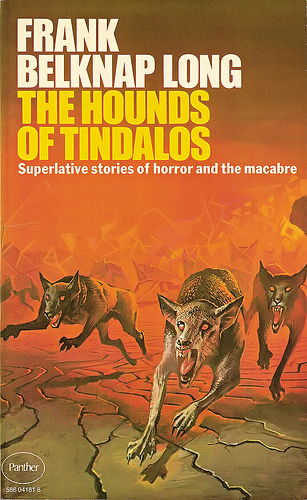
The Hounds Of Tindalos

 The Hounds of Tindalos by Frank Belknap Long. Originally published in 1929. Approx. 14 pages.


Today we take a look at one a classic Lovecraftian tale that has had a massive pop culture impact, Frank Belknap Long's The Hounds of Tindalos.

Hounds tells the tale of a tragic author named Halpin Chalmers, who decides to undertake a foolhardy experiment. By obtaining a mysterious East Asian narcotic, be plans to achieve a mental state in which he can perceive what is referred to as the Tao - which apparently is not a philosophy, but a way of seeing the true spectrum of time. To Chalmers, the concept of true time transcends so far beyond Einstein's concepts of curved space. Chalmers believes our present time is just the limited view available to the average person, a tiny slit of a glance into the real truth. Chalmers believes that with the help of the drug, he will see and experience all of the pasts, and futures, along with the present, running concurrently. And so, with his friend (and our narrator) Frank attending to him, he embarks on his narcotics-induced voyage.

Chalmers gets to see all the he dreamed, and more.

Chalmers also discovers nightmares he never expected, and worse. And, as is the true threat of these scenarios, sometimes when you look into the eye of evil, evil looks back.

The Hounds of Tindalos is a perfect primer for Lovecraftian myth. In fact, it had such a lasting impact that the Hounds themselves were incorporated into Cthulhu Canon. These creatures, born from a dark deed that transgressed in the infancy of time, move, as do other dark denizens, along angular time (not the curved time that we pass through). Once they have caught your scent, they are tireless in their pursuit, and they can reach their quarry through angles. Just think about that; look around whatever room you are in, and count all the right angles, and think of how you might best avoid the dread demonic dogs.

Frank Belknap Long writes this story extremely effectively; it moves along at such a brisk clip. The concepts posited here are both astounding and terrifying. Like some of the best horror readers, he leaves the actual conceptualizing up to the end user, and just crafts the accommodating mood. The reader is left in doubt of exactly what is there; the only constant is terror.

There is wonder here as well. Perhaps the most thrilling scene in the story is where Chalmers recounts his journey through time, bearing witness to so many major historical events. For those raised on classics and not Twitter feeds, how grand that concept must have been.

As mentioned, the hounds pop up in many other stories, and have influenced other pop culture genres as well. Take a look at some of them on the wiki page here.

The Hounds of Tindalos reside in the public domain, which is full of angular space. So watch the corners of your computer screen. Read the full story here.

Or, need some nice Halloween listening? Why not enjoy an audio reading of the story?


Need more tunes? How about the classic song by Beowulf?


Or the Metallica song influenced by The Hounds of Tindalos?


Or maybe the group that took their name from them?


Enjoy! And remember, "They are lean and athirst!"

Wednesday, October 7, 2015

Into The Wood

Into the Wood by Robert Aickman. As appearing in The Wine-Dark Sea collection, Approx. 40 pages.

Approaching the Halloween season, I began harassing friends (as usual), whose opinions I hold in high regard, for horror recommendations. Not what would promise or guarantee the most fright, or shock, or blood and gore. Just what they thought was the apex of the genre. One friend's recommendation was to try Robert Aickman, whose stories fall much more firmly into the category of "strange" than horror. He also recommended that I begin with the short story "Into the Wood" which appears in The Wine-Dark Sea" collection. So, how did it fare? Well, again, it is not what you might think of as "horror". But I can say this...even though I finished reading it a day or two ago, it still hasn't left me, and I don't think it will any time soon.

Margaret Sawyer is a middle-aged Englishwoman, whose husband owns a construction firm. She is seemingly happy, and seemingly relegated to the mundane lifestyle of the housewife of decent means. This all changes when her husband takes a road-building contract in a remote area of Sweden.

On an outdoor excursion with some business associates and their wives, Margaret takes notice of a peculiar lodge in the woods. She is informed that in older times, it was a Kurhus, a sanatorium. Now, however, it seems to be inhabited by rather normal folk. With her husband heading off to Stockholm for more business dealing, Margaret opts to spend some time there, and finds that in fact nothing in there is normal, and, quite possibly, she might not leave there as what she might have termed her normal self.

For, you see, the Kurhus is a care center for insomniacs; true insomniacs, those who, from a certain point on, have never slept. At all. The tendencies and personality traits of these people make them pariahs in normal society. Most peculiar of all, the spend their evenings traversing a labyrinth of paths that surrounds the Kurhus. For what purpose, it is not clear.

A tale of insomniacs. That doesn't sound too chilling, right? So what makes Into the Wood stick with you? Aickman's English mastery, and his ability to weave a layered, intricate, moody tale. From the beginning, we don't find ourselves comfortable in Margaret's English home, and as soon as the narrative shifts to Sweden, the atmosphere becomes gloomy, and barren, just as the panorama is described. It is that same uncomfortable chill that clutches at your chest and doesn't let go. Events that transpire in and around the Kurhus feel insulated by the dense woods around them; isolated, and cut off from normal society. Completely intentional and meaningful.

My personal favorite aspect of Aickman's writing here is his intelligent wit. The best example is seen on the first page. Talking about Margaret's husband's business card (remember he is in construction), it lists his title as "Earth Mover"; even though, "he seemed to have neither the back muscles of Atlas nor the mental leverage of Archimedes". I mean, really, how can you top that.

Aickman uses clever tricks as well to make Margaret a much richer character than her outer appearance would imply. Pay careful attention to any physical cues when he is describing her movements. One good example is when her frustration over how she is supposed to dress leads to an offhand remark about the lack of eroticism in her marriage. You can see that repressed under the English housewife template is a simmering spirit. It makes you wonder; who are the ones that are actually asleep here? And, once one becomes truly awakened, will sleep, in the conventional sense, ever be had again?

The concept of insomnia itself is handled brilliantly. The average person would most likely find nothing wrong with the concept of perpetual wakefulness, but, strip away all these preconceived notions, and consider a lifetime without the respite of rest. It is no big surprise that Aickman can hint that perhaps this truly chronic insomnia may be at the root of legends of vampirism.

There are even some moments that are chilling in the classic sense. Any of the times we find ourselves on the twisting paths around the Kurhus, it taps into rooted fears of the dark, of the unknown, and of being lost.

If you like your horror with a catchy cover, a definable boogeyman, and an ending with a ribbon on it (even a bloody one), well, there's nothing wrong with that. But probably Aickman's work won't be for you. However, I definitely recommend everyone give one or two of his stories a whirl.

And so, I leave you with this line from the story, which seems to sum it up so well:

"Losing one's way was largely an act of intention."

Side Note: Just an odd mention, and I don't know if this appears like this in the British printings. For some reason, after the first few pages, the name of Margaret's husband changes from Harry to Henry. Is this an editorial oversight or a dimensional shift? We may never know.

Score: 9.5/10

Saturday, October 3, 2015

Nekht Semerkeht

Nekht Semerkeht by Robert E. Howard. Unpublished story fragment, edited by Steven Tompkins. Approx. 14 pages.

I had been planning on reviewing a different horror tale by Howard to kick off the October reviews, but when I was leafing through the introduction for this anthology, I stumbled on the synopsis for the story fragment Nekht Semerkeht. Having been on the lookout for a good conquistador tale ever since getting hooked on Aguirre: The Wrath of God a few months back, I decided to give it a look.

Just a quick disclosure before the review: this is a story fragment, not a complete tale. Editor Tompkins states that he combined the two existing drafts, along with outline notes, to get what we read here. I understand now that there is a version of this same tale, completed and released in 1977 by Andrew J. Offutt in his "Swords Against Darkness" anthology. I will definitely have to grab a copy of that in the future to take a look-see, but for now, we work with what we got.

Nekht Semerkeht is the story of Hernando de Guzman, an aged conquistador who has been separated from his group, and, in his lost meanderings, stumbles upon a village full of mysterious sorceries, and, possibly, the thing that truly stokes a fire in the wandering Spaniard's heart: gold. Somewhere in there as well is the titular sorcerer; an Egyptian wizard who is obviously very far from home, but possessing of immense power.

Now, I have no idea when Howard actually worked on this story, I have read that it was indeed one of his later ones. That explains a lot of the emotion contained herein. For, while what story we have is stretched across a paper-thin premise, this is one of the, if not the, most heart-felt Howard piece I have read.

The whole thing kicks off with an intense fight scene between de Guzman and an Apache warrior. The scene is taut, and well-done, showing much maturity over classic REH brawny, bloody scuffles (not that I don't love those as well). What follows from here, up until de Guzman discovers the village, is a pilgrimage of personal despondency which I cannot help but imagine somewhat paralleled what Howard was feeling in his life. There are repeated themes of not belonging, death being a true answer, the new land being too strange, but the home of your youth being an evaporating dream. Some truly heart-breaking stuff here.

When the story falls back into being more of an actioner, it does so in strong form. De Guzman is a compelling conquistador; in no ways a nice man, he is cunning, resourceful, and extremely lusty. Nekht Semerkeht has got to be one of the more sexually charged Howard shorts I have read, and that is a good thing.

Unfortunately, it is from the middle on that we can see that this is, indeed, just a fragment of what could've been. Whatever the capability of the magic being employed by those in the village, not explored. What brought Nekht Semerkeht to Mexico, and what was his rise to power like? Not expanded upon, sadly. I read some speculation that the foundation of the idea of an Egyptian sorcerer in Mexico was Howard's concept of how both areas have pyramids. That would've been great. As it is, the story climaxes with a routine duel between our primary combatants, and a long paragraph outlining what will happen next.

So now, you might be thinking, "what does any of this have to do with horror?" Well, not much. More like historical fiction with bonus sorcery, to be sure. But, there are two scenes near the climax which feature some nicely done creatures. There is a grand scene with an altar, a very naked and nubile young lady, and feeders from the sky. And, right before that, there is a very brief scene, only about a paragraph long, which presents a very creepy exchange in a pitch black corridor.

And there you have it. I am not rating this, since it is just a fragment. Maybe next year, I'll have a review of the completed Offutt version, and we can look at them side by side. Anyhow, you get one of the more emotional Howard tales, some sorcery, a little horror, and a bad ass conquistador lead. Enjoy!

Thursday, February 19, 2015

Shaggy Dog Bridge

Shaggy Dog Bridge by Glen Cook. A Black Company short story, originally appearing in the Fearsome Journeys anthology, published . Approx. 31 pages.

Just when I thought I had presented a complete synopsis of the legendary Black Company series in 2014, I find out that I let one short story slip through the cracks. Shaggy Dog Bridge, first appearing in the Fearsome Journeys anthology (edited by Jonathan Strahan of Swords & Dark Magic renown), is the third of the (so-far) quartet of short tales that will segue readers into the long awaited, much anticipated Port of Shadows.

In Shaggy Dog Bridge, we find our favorite Annalist, Croaker, attached to a recon patrol scouting ahead while the angry Taken, Whisper, pursues with a clutch of angry Imperials. Along the way, they find a massive glamour (illusion), one of a perfectly mundane chunk of forest. The thing about illusions of normalcy is that they are usually there to mask things markedly out of the normal. Being a recon group, it falls on them to see what exactly that is. What they find are parts of the puzzle which Cook has in store for us in Port of Shadows.

Out of the four Black Company shorts released over the past few years, Shaggy Dog Bridge is definitely my favorite. There are a few reasons for this. Firstly, once again, Cook shows us (again) that not only can he still write for "earlier books" Croaker, but he can still capture specific moods and attitudes. In this story, Croaker is pissed off, ornery, and in a generally foul mood, due to being attached to this tedious task (which he himself had volunteered for). The writing is cranky, full of expletives and vitriol.

Another high point of the story is the addition of a few more "grunts". Other stories in this arc have introduced wizards and concepts for "bad guys", but here we can meet a few more personalities of the rank and file. These additions, namely Rusty, Robin, and Whittle, have a lot of potential.

Finally, and most importantly, we get a real whiff of the type of evil that will be faced in the upcoming book. For example, the most intriguing bit of geography mentioned is not the titular Bridge, but a scar on the earth known as the "Rip", a cleft in the landscape possibly caused during a battle between formidable nasties. We also find out about the "Master", who will serve as the Dominator type in Port of Shadows. And, lastly, we get to meet Blind Emon, a "Taken" of sorts in thrall to the Master (the fact that she is a concentrated ball of agony is a great touch).

As in most other Black Company titles, the joy is not in the violence, but in the characters, the dialogue, and the authenticity of the battlefield tactics and situations. There is no clanging of swords, but more of what makes the Company who they are; planning, resourcefulness, sabotage, and a lot of luck.

So, as I've said before, I shall say once more; I am overjoyed that Cook is getting closer towards a new Black Company book, and, while I am happy that he can still write for the crew circa Books 1-3 as well as before, I'd rather see other Company stories. Perhaps A Pitiless Rain, if it ever sees the light of day, will focus on Suvrin, Tobo, and those that survived Soldiers Live. But how about some coverage of the original Company? Those of renown that first marched from Khatovar and put so much fear into the Taglians? Ah well, it's still a business, and I am sure the majority want to see more Croaker. And, as the quality of these four shorts testifies, it'll be a great read.

Here's hoping I'll get a chance this year to review the other titles in this anthology. It looks like a solid one.

Final Score:

96/100

Friday, November 21, 2014

Bone Candy

Bone Candy by Glen Cook. A Black Company short story, originally appearing in the Shattered Shields anthology, published October 2014 by Baen. Approx. 25 pages.

While I am loathe to review individual short stories from anthologies, today we have a special case. Shattered Shirlds, a military fantasy compilation published by Baen last month, features a brand new Black Company short by Glen Cook. So, while I will most likely finish this anthology at a later date, it is imperative that I review this short story.

Now what do we have here? To start, Bone Candy, like the previous two shorts (Tides Elba and Smelling Danger), takes place in the city of Aloe, at some point on the timeline between the first book and Shadows Linger.

Before I get into what is good in this story and what I have issues with, let's look at the premise:

Things are rather uneventful for the Company in Aloe. However, they have an officer from Charm attached to them to contend with: Two Dead, a wizard dispatched by the recently minted Taken Whisper. Two Dead is no friend of the Company. Whisper does not hold them in a very high regard either.

One day, nuisance turns to legitimate problem. Two Dead grabs Croaker and Silent to help investigate some odd furry creatures that have turned up. These furry mysteries are packing a nasty secret inside, which lays Two Dead up. Meanwhile, Two Dead's hulking bodyguard, Buzz (who is actually well-liked by the Company), is contending with sudden health issues of his own.

It falls on Croaker to keep these two in the realm of the living, since their passing would cause some waves with people you don't want to cause waves with.

Ok, let's start with the good. Cook shows us that he is still in perfect form with this story. He is able to tap into the vibe of the Company from around that time seamlessly.

There is also an added bonus here: Bone Candy actually makes reference to the Port of Shadows. Black Company fans will of course recognize this as one of the potential new Black Company books announced years ago. So does this mean that a new novel is actually in development? This is quite exciting indeed. But, also, a tad anti-climactic. Why? Read on, as I present my issues with the story.

Look, I am as grateful as the next Company fan for anything to nibble on from Cook. But, let's be honest. Croaker's tale is done. He got one of the best endings in a fantasy series. I understand that he is the fan favorite (with good reason), but, as Cook said in one of his rare interviews: "The Company itself is the character." So, how come we can't get a book with Suvrin as Captain? Or one from pre-Croaker times? Part of the suspense in reading Black Company books is that anybody's number can be up, any moment. You can't do that, going back to circa book 1.5. If you've finished the series, you already know what's happened to all these guys. We've met some new faces in these shorts, but that means they are the only ones at risk. And the fact that the Port of Shadows is no more than another Dominator Resurrectionist tool is deflating too. Obviously he doesn't come back before Shadows Linger.

One other issue I have is with the usage of modern terms. "Wait a sec..." you might say, reminding me that way back I defending the usage of modern slang and colloquialisms in what is a "fantasy" setting. I still support that type of dialogue. What I have an issue with is technology. One of the later books, I don't remember which, had a scene in which rock melted "like plastic". That jarred me out of the moment. I have no problem with fantasy characters saying "Go f*** yourself, a$$hole." instead of a faux-British "Bugger off, you arse." (Note: this assessment does not pertain to actual British writers; it is directed at those who try to emulate what the speech of a time period might have sounded like rather than focus on how the conversation would proceed in modern discourse). But plastic is not part of their universe. In Bone Candy, someone uses the term "live ammunition". It doesn't read right.

Ok, gripe's over. Bone Candy is the most solid of these Black Company shorts (so far), and hopefully this is the segue into the next novel. If you have a chance, get a hold of this and check it out. I hope that soon I can finish the whole anthology and let you know how the other entries fare.

Final Score:

93/100

Wednesday, October 15, 2014

The Very Old Folk

The Very Old Folk by H.P. Lovecraft. Originally published November, 1927. Approx. 4 pages (2,700 words).


The Very Old Folk has long been one of my favorite Lovecraft stories; not because it in any way deviates from his tried and true playbook (setting, rising action, indescribable horrors from the dark recesses of the universe appear), but because it does so in a well-rendered period setting (Spain under the banner of the Roman Empire), and, with its concise word count, conveys the message without meandering.

I am a bit unclear as to the origins of this story; it apparently was not a magazine story entry. Wikipedia chronicles it as a letter sent to Donald Wandrei, a member of Lovecraft's inner circle (Cthulhu Club?). The letter is addressed  "Dear Melmoth", so, I don't know if that was a nickname for Wandrei, or if this whole this tale was a story written in letter form and mailed to his friend.

Either way, The Very Old Folk centers around the author of said letter relaying to his friend a most vivid dream of his, taking place in Roman times. In this dream, the author finds himself in the body of a Roman quaestor, in what is now modern day Pamplona. This official, named Rufus, finds himself in debate with the Roman officials in the area, regarding mysterious, and quite terrible Sabbath celebrations carried out by the denizens of the surrounding hills. These reclusive people are rarely seen, except in limited trading ventures, and bad news usually follows in their wake. Whenever these dreaded masses occur, townsfolk go missing, and a pervading terror envelopes the land. With the Sabbath approaching, the local officials think the best action is inaction; yet Rufus believes it would be best to quell these masses, seeing the benefit to the current masters of commerce and productivity outweighing the heretical celebrations of the indigenous folk.

The vote goes in favor of taking out the troublemakers, a cohort is dispatched, and what makes this story a Lovecraft tale happens. In my opinion, it is executed in a superb manner.

The Very Old Folk is a tale that I think would work extremely well as a theatrical production; it has some of the best rising tension in a short story that I have read. The climax could be executed perfectly on a stage; the lights going out entirely, all sound stopping, then the ear-splitting screams of the guide and the horses. The shapes forming on the hills, all those things that reach in and strangle your soul.

What also works in this tale is a knowledgeable application of Roman terminologies. Lovecraft writes a believable rendition of the local power structure, and a debate within as it might have occurred in those times.

Highly recommended for a ten minute chiller. Since, like most Lovecraft stories, it is in the public domain, it is available to read for free in many places. I read it here, the background aesthetics worked for me. There is also a decent reading of it on Youtube here.

Final Score:

10/10


Wednesday, October 8, 2014

Prey


Prey by Richard Matheson. Originally published in 1969. Approx. 8 pages.

If you were going to try and compile a short list of Richard Matheson's most iconic contributions to the horror genre, it would be a guarantee that Prey would make it to the Top 5. Better known for its film adaption: "Amelia", story three in the Trilogy of Terror television movie, Prey follows Amelia, a timid woman who gets trapped in a horrifying encounter with an African fetish statue come to life. Based on how old you were when you first saw it, the segment was either the scariest or most hilarious thing you had seen in your life. I'd estimate, under 10 years old, scary, over 10, or if you just listen to the sound effects, hilarity. If you have never watched it, take 16 minutes and check it out here:


It's kind of required Halloween viewing. I fell into the under 10 category when I first saw it, plus I was terrified by any movie with evil little things running around, so I was scared pretty thoroughly by it.

These being the other little critters that traumatized me. Damn you 1970's made-for-TV horror movies!

Point being, "Amelia" is still effectively scary today, partly because of a great Zuni fetish prop, and more importantly because of its pedigree as a work written and adapted for the screen by Matheson.

So, without that evil little "He Who Kills" doll running around, does Prey deliver on the chills? Very much so. Matheson makes the best of an economical word count here. In the first paragraphs you know all that you need about Amelia; she is something of a pushover, someone easily controlled. Thirty-three years old, still single (essentially a spinster for the day and age), and living under the absolute control of her mother.

Matheson's focus in writing for the Zuni fetish hunting doll, AKA "He Who Kills", is to play up what makes it scary. When writing about a homicidal, seven inch tall living doll, there is an absurdity that cannot be avoided; the author's duty is to make it a horrifying, incongruous nightmare, instead of a laughable oddity. The scary parts the Matheson centers on are all the "sharp edges". The focus is always on the doll's rows of shark-like teeth, and on the appropriated kitchen knife which is always in play, whirling like a cyclone. The comedic aspects of a half-foot tall doll chasing you diminish greatly when it keeps carving your feet and ankles to ribbons. Also, to make the danger of the doll surpass its size, Matheson infuses He Who Kills with the strength of the entombed spirit, allow it to go beyond physical limitations.

There is a brutal chase, punctuated by painful moments which will make the reader wince in sympathy with Amelia plot.

Best of all, the story ends with a solid ending, as Matheson is smart enough to adhere to the theme of controlling forces.

So, if you haven't enjoyed these two horror classics, you can probably both read the story and watch the clip in around half an hour. And there are few better ways to spend half an hour during the Halloween season.

You can read the entire short story here, even though there are some typos. Enjoy!

Final Score:

10/10

Sunday, June 29, 2014

Soldiers Live (Black Company Book 9)

 Soldiers Live by Glen Cook. The final book in the Black Company saga, originally published by Tor Fantasy July, 2000. Approx. 419 pages (Tor omnibus edition).

Where we left off:
Water Sleeps was a book comprised of two very separate parts: the sneaky, guerrilla war waged by the Company within Taglios, and their journey south and onto the Plain of Glittering Stone.
The Taglios campaign culminated with key Taglian figures being captured and/or taken out of the picture (including the Radisha herself), along with that perennial Company foil Narayan Singh (along with the Daughter of the Night). When a deal was brokered with Singh to retrieve the Nyueng Bao Shadowgate Key (remember the Lance of Passion still lays with Murgen in stasis), Sleepy knows that they can finally make their move.
As the story shifted its focus southward, it was time for some long-overdue exposition. The Captured were finally freed, as there resting place was revealed to be in the cavernous expanses under the throne room of the protector-golem-god Shivetya. Those labyrinthine chambers also yielded vast treasures, as well as the original three Books of the Dead (which Sleepy and Swan later burned). Far below, however, a true terror awaited. Tobo, heeding some inner call, ventured nearly a mile down into the bowels of the Plain, and discovered the sleeping Kina, who made an attempt at awakening. This was only halted by a brave charge by veteran mage Goblin, who sacrificed his life by burying the Lance of Passion into the awakening death goddess, temporarily halting her rise.
Topside, the throne room of Shivetya was revealed to be a diagram of the Plain itslef (actually a diagram inside a diagram). It turns out the the Plain is a major transportation hub, and along with keeping Kina at bay, Shivetya also acts as the eternal air traffic controller. There were many other Shadowgates, and all lead to other worlds (or variations of or different eras of the same world), and groups like the Black Company and the Nyueng Bao have been traveling them for ages, seeking the best way to raise Kina to bring on a universal Year of the Skulls (or something to that nature, this all gets a bit mind-boggling). Currently, the Gate to Khatovar is out of commission, but Sleepy strikes up a relationship with Shivetya, in which the god-golem imparts information at his leisure to key members of the Company (and give us more much-needed exposition).
At the end of Water Sleeps, the Company crosses the only other open Gate, and enters the Land of Unknown Shadows, where they are greeted by a welcoming party comprised of folks that resemble the Nyueng Bao in appearance, as well as dialect. Which brings us to....

Where we are now:
I cannot believe we are already here at the end of our journey with the Company. Or, maybe, I did not realize how emotionally invested I had become with this group. We all know that journeys end. People go. Soldiers Live. And wonder why. That is the mantra here. And, if you have become as close to this crew as I have, this book may stay in a special corner of your soul forever. It is immortality of a sort.

After crossing through the last working Shadowgate at the end of Water Sleeps, the Company finds themselves in a world that is a sort of clone of their own, inhabited by a race resembling ancestral Nyueng Bao. This land is known as Hsien.

It's been four years in this new land. Four years of peace, a complete anomaly to the veterans of the Company. The only recorded deaths in this time are veterans Otto and Hagop, passing on naturally with no fights to fight, and one risk taking recruit that took the wrong risk. Speaking of recording, for this last trip with the Company, Croaker has taken up the quill again. This is only fitting. And, as it should be, what makes Soldiers Live what it is is less the events that transpire, but more how this world looks to this aging veteran, now feeling every bit the antique in the only family he has ever known.

Just a few notes before getting into the actual story: yes, Croaker is again the Annalist. But, there are also a slew of third-person chapters focusing on the events involving adversaries and different locations. Speaking of chapters, not only is this the thickest book so far, it also boasts the most chapters at a whopping 148 (can you believe the first book only had seven chapters?). What's good about the format here is that, like in Shadows Linger, the chapters tell you where the events are transpiring, and are also named (quite cleverly too, I might add).

As mentioned, Soldiers Live opens during the peaceful times in Hsien. We get some needed background on the people and places, the system of government, etc. A lot of focus is on Tobo, and how much he has grown. He has bonded with the indigenous spectral creatures of Hsien known as the Unknown Shadows, patchwork critters reminiscent of the denizens of the Plain of Fear.

There are local feuds and such; everyone in Hsien is wary of the Company as they take no partisan stance. All the Company wants is for the information needed to repair the gate to Khatovar so they can complete the mission Croaker began. Well, not just that. Sleepy (still Captain) is killing some time so that she can keep retrieving all the treasures contained in the caverns under Shivetya's throne. But Sleepy is a conniving, duplicitous little number. Which is what makes her a good Captain.

When there is sufficient cash and a decent army arrayed, the Company begins to move back into the old world to start settling scores. Meanwhile, Croaker has a score of his own to settle. That would be with one Lisa Bowalk, the shapeshifter stuck in forvalaka mode who has finally exacted her revenge upon One Eye (no spoiler there; at the end of Water Sleeps, Sleepy notes that One Eye dies four years after that entry ends). Again, Sleepy has ulterior motives for Croaker's mission as well.

Keep in mind that Bowalk makes her retreat in what lies past the gate to Khatover. I won't divulge too much of what Croaker and his crew find there, but it involves a new race (the Voroshk, a very pale people with a loose family hierarchy system, interesting technology, and limited talents in sorcery). Some of these Voroshk end up traveling back with them once accounts with Bowalk are settled.

Back in the regular world, well, things fall into a regular routine. Some readers might get frustrated or exasperated at this point, since 90% of the proceedings still focus on the logistics of harassing Soulcatcher and Mogaba, and hunting down the Daughter of the Night and her guardian. Seriously. Even with the whole Kina/Year of Skulls angle still unresolved with fewer and fewer pages left, it is still focusing on Tobo and tactics. But there is a reason. There is always a reason when you look at it.

Cook has always been a patient and deliberate author. He is one of the very few that I can truly say rarely puts a word in his stories that does not have meaning. Cook is also known to plant the seeds of ideas that don't sprout until a few hundred pages later, leaving you madly flipping back through pages once understanding hits you.

And so, it is quite possible that some readers will be pretty disappointed with what they are reading as they are reading it. Soldiers Live marks Croaker's narrative return, but, after One Eye's death, his perspective becomes understandably more melancholy. So even though the book starts off with those trademark cynical, clipped sentences, it all lapses into exposition and disenfranchised battle reports. But can you blame him? How many decades has Croaker been soldiering for? At this point, the battles are just sad wastes of life. And for what? The whole Taglios aspect has ballooned, and, we all know that the religious angles are of no importance to him. As he points out, he was just passing through.

Croaker still does his work dutifully, though. He applies due diligence to reporting the tactics used, and makes note of fallen sworn brothers. That is his job as Annalist. This way the Company of the future can reference the victories and losses of the past. But there is no flamboyance in the battle scenes. I doubt that war is very flamboyant for broken senior citizens.

So, the battle scenes may seem anti-climactic. Some say the same for the reporting of the multitudes of deaths. There is no secret, almost everyone dies in Soldiers Live. Name a remaining Company member or affiliate, there is a 90% chance they die here. You almost never see the death scenes. It is mentioned, and recorded. As is Croaker's job. You might feel at first that this is a bit of a disservice to characters that have been evolved over several books, but consider Croaker. At his age, deaths of friends become more common. The occurence can be stated as fact no matter how it tears you apart inside. Plus, many of those that go are simply attached to the Company. He is actually doing them a favor by recording them. It is an immortality of sorts. If you think about it, it is perfectly significant when he gives a lackluster eulogy to a Nyueng Bao that passes. Remember, Croaker never trusted that group, and always considered them an additional burden foisted upon his considerable logistical workload.

And finally, what might be taken as the final disappointment is how so many important loose ends are hurriedly tied up. The Year of Skulls, especially. Don't get me wrong, the final showdown with Kina is impressive, but the Year of Skulls is kind of treated as, "Oh, so that's what it was? Ok, moving on...". This is not lazy writing, to repeat, Croaker is not big on religion. He cannot deny a god when he sees one, but he doesn't need to subscribe to the philosophy. Plus, the Kina stuff was never in his contract.

Personally, I was expecting the Year of Skulls to be the Company themselves. Their little jaunt in the South ended up causing tens of thousands of deaths anyway.

Reading this, you might think, "Well, if you keep saying the exciting bits are kind of boring, and the other stuff is rushed, this final book must suck, right?". It doesn't. Without giving away the very ending, let me put it like this: remember when you were a young student and wanted to go somewhere really badly, and had to finish a report for school before you could leave? That task, although necessary, or even being something you would usually be passionate about, suddenly becomes a mundane obstacle. And that's what happens at the end. There is a huge transition about to take place, and the assumption is that the Annals have to be brought up to date first.

There are parts in Soldiers Live that are written with some real emotion. These are the scenes involving Booboo (the Company nickname for the Daughter of the Night), Croaker's deep love for his aging wife (Lady no longer has the power to maintain her beauty glamours), and the parts regarding Tobo's evolution. This is an interesting aspect; most of Water Sleeps and the earlier portions of Soldiers Live seemingly fawn on Tobo as a sort of all-powerful, all-good wunderkind, but Croaker shows us how easily a wizard can go down dark, scary paths without proper grounding and a moral compass. These scenes are handled very well. A very good reminder that there is a very thin line between being a force for good and becoming the next Dominator. Croaker even manages to find a place in his heart for his enemies, Soulcatcher and Mogaba (remember, he was always more sympathetic to him than the other Annalists). And lastly, the most emotional aspect focuses on friendship. Not just camaraderie, but the true bonds of a unit that is family. There is a touching scene where Croaker reflects on the extents of One-Eye's friendship for Goblin, and wishes someone had cared that much for him. Then he realizes that someone had in fact done it for him as well.

Croaker's melancholy at his own aging sets quite an emotional tone for Soldiers Live as well. Maybe I am just a little more sympathetic to this plight as I am feeling a bit of an antique as well, but you can sense the frustrations of physical limitations. Of being humored rather than listened to. Especially when your observations and gut feelings might be helpful to a Captain who is very capable, but who also forgets the small details sometimes.

And yet, sadness and futility aren't the only messages of this final entry in the Black Company saga. Faces change, but the Company survives. Soldiers Live. And wonder why. There will be new Captains, new lands. New pairs of feuding wizards (I personally loved the Voroshk girls).

Best of all (bit of a spoiler here), Cook manages to come up with the happiest ending conceivable. Not to give it away, but he creates a true heaven for a non-religious man. What better reward is there?

Soldiers Live is by far one of the best "final entries" I have ever read, and I will place The Black Company high on the list of Best Fantasy Series read. Even though some things remain unanswered (like why so many extraordinary things happened to an ordinary man like Croaker), the story is completed and the door is left open for future tales. I know, Port of Shadows and A Pitiless Rain were announced long ago, but I hear varying reports as to whether they will be prequels or further stories.

For now, goodbye Croaker & Company.

Here's what it is:
Glen Cook ends his signature series with a grand finale that rates a hair short of the first book. So many have come and gone, but memories remain. Memory is immortality of a sort.


Final Score:

97/100


Cover Score:

This piece by Jainschigg is easily my favorite of the old covers. The arrangement is nice, and the color palette is truly evocative of the tone. Love the idea of a faceless conglomerate of soldiers fulfilling their natural destiny. If anyone would be so kind as to give a gift to your favorite reviewer, there is an original painting of the cover here. I'll just hold my breath waiting....


Cover Final Score (Swanland):

91/100

Tuesday, June 10, 2014

Water Sleeps (Black Company Book 8)

 Water Sleeps by Glen Cook. Originally published by Tor Fantasy, March 1999. Approx. 348 pages (Tor omnibus edition).


Where we left off:
After a few books where little progress was made on the road to Khatovar, She is the Darkness saw some major pushes by the Company on the way to the Plain of Glittering Stone. First was a win in the battle of Charandaprash Pass, which was highlighted by the revelation that the enmity between Croaker and Blade was simply a ruse, leading to a large number of Longshadow's forces being taken out of the game before it was even played. 
Past the Pass, the Company began its siege of Overlook. For a good while this went on, and it was revealed the Croaker was working along with Soulcatcher to expedite Longshadow's downfall. Meanwhile, the Howler and Narayan Singh worked to protect their own posteriors. 
On and on it went, with more double-crosses and almost had 'ems. 
The end result:
Longshadow was taken down and brought to Company custody, as was the Howler and Singh.
Soulcatcher screwed everyone over and started helping the Radisha Shah renege on her obligations to the Company. The Prabrindrah tried to double-cross the Company as well, and was taken into their "care".
Soulcatchaer, under the guise of Sleepy (who is revealed to be, in actuality, very much a young woman), infiltrates the Company camp and assassinates Smoke, taking away one of the Company's methods of near omniscient spying. 
In other big reveals, something that was hinted at in Bleak Seasons turned out to be true: Murgen's Nyueng Bao wife, Ky Sahra (Sarie) is still alove, tucked away as a widow in a temple, and pregnant with their child.
She is the Darkness ends with a contingent of the Company, mostly old crew members and prisoners (including Soulcatcher), finally crossing the Shadowgate and entering the Plain of Glittering Stone. A few days into their journey, they happen upon a fortress in disrepair. Within, secured to a wooden throne by a series of silver daggers, is a colossal golem, who the Company figures is Shivetya, a guardian charged with preventing Kina's resurrection.
As the Company tries to make heads or tails of what is going on, it is revealed that even though she has been bound up pretty tightly, Soulcatcher has been able to place everyone in a sort of trance. She traps the Company in a sort of stasis (the caverns of frozen spiderwebs and old men that Murgen often saw in his dreams) in the lower chambers of the fortress and makes off with the traitor Willow Swan, seemingly victorious. Which brings us to now....

Where we are now:
Fifteen years. It has been fifteen years since the group that entered the Plain became trapped in their stasis. The Captured, they are called now. 
After they disappeared, the remaining Company was routed by both traitors within and Mogaba from without. 

Now, the Radisha rules in Taglios, along with an insane dictator known to the people as the Protector. The Protector is known to the reader as Soulcatcher.

But what of the remnants of the Company? 

What remains of the Company, some two hundred-odd members, are scattered throughout Taglios. Leading them is none other than former Company mascot, and Annalist in training Sleepy. Sleepy, like Murgen during the siege of Dejagore, is acting as Captain, as well as maintaining the Annals. She is joined by the last two remaining old crew members not trapped under the Plain, the ancient sorcerers Goblin and One-Eye (although fifteen years later, even One-Eye is too ancient to continue his usual antic feuds with Goblin). Another addition to the Company (though not an actual brother) is none other than Ky Sahra (it is never explained how and when she joined up with them). Sahra and Murgen's son, Tobo, is now a petulant teenager, although one with a proficient inclination towards the magic arts. It is generally agreed upon that he is the "future" of the Company, especially with the resident magicians on obviously limited time.

This reduced shell of the Company has two primary missions; first being to topple the traitorous Taglian establishment, and the second, of course, to free their Captured comrades. And so, the two halves of Water Sleeps are dedicated to the execution of those directives.

The "shadow war" against the ruling class is some of the best stuff Cook has put to paper; he has always had the knack for writing these sneaky battles. Sleepy makes an adept leader for orchestrating moves that sow dissent and fear in the populace and the government. Pyrotechnic charges strategically planted throughout the city flash in crowds, displaying the Company sigil and those prophetic words "Water Sleeps". 

In the meantime, Sleepy and Sahra (serving as a spiritual pillar for all), do their fair share of hands-on spy work. Donning various disguises, they infiltrate the Palace, gathering intel, and recovering pages from the lost Annals which were left in the wizard Smoke's old room. All this is done right under the noses of the Radisha and the Protector, which lead to some truly tense moments.

In the latter part of the novel, we have the journey southward which culminates with our intrepid band treading the same path as their lost predecessors. 

I really can't give away too many of the secrets revealed in this final arc of Water Sleeps; suffice to say they come at you fast and furiously. Many of the answers that have eluded and confused Black Company readers since the Books of the South started are clarified here; and of course, many more are posited. But as to where the Company originated, where is Khatovar (and is it still accessible), what in fact the Glittering Plain is (hint: it's a huge transit hub of sorts), and who are the spectral walkers who tread the Plain at night, we get some closure. There is even a pretty scary face to face encounter with a god, which is handled excellently.

The real question is, as always, how is the narration in Water Sleeps? Here we have yet another Annalist. Personally, I really like Sleepy. She might be Cook's most fleshed-out Annalist (since I am assuming that there is a whole lot of Cook in Croaker). Sleepy is a strong, tough, sharp, and shrewd. You also have to remember that when she was younger, she suffered terrible, prolonged sexual abuse at the hands of family members. You can sense the mental scars even though she mentions nothing directly. She has a high amount of respect (culturally) for her elders, and reveres them accordingly. This leads to some of the most heartfelt moments in this entire series. Another interesting quirk of Sleepy is that she is the most outwardly religious Annalist that we have had. Throughout the novel, she says quick prayers as a mental reassurance, and these become more frequent towards the climax of the book.

The pacing of Water Sleeps is fair enough. Sleepy spends a lot of time chronicling her and Sahra's infiltrations, always recording their names as the false faces they don. It is very easy for Sleepy to become absorbed in the characters she creates, undoubtedly this is a coping mechanism that helped her through her terrible past. For the bulk of the novel Cook retains the first person point of view, with the scenes featuring Soulcatcher and Mogaba being accounts as seen by Murgen's still-detached spirit (he was out of body when Soulcatcher trapped the Company in stasis and his spirit still continues spying). But towards the end of the novel, we get a few random third person chapters showing what is going on in Taglios, not courtesy of Murgen. Also, Sleepy's narration in these last chapters deteriorates into overly expository theological info dumps. Her account up to this point had a very "spoken" versus "written" quality, and so this felt a little off to me. Perhaps the implication is that they were written at a later time incorporating information granted her by Shivetya. 

Bear in mind that this novel is very much the "in between" novel for She is the Darkness and Soldiers Live. For any meandering you may have thought the past few books do, these last three are keeping things moving at a brisk clip. There are no grand battles in Water Sleeps, but also no endless verbal tangents. There is confusion and closure; for as this is one of the most original series going, there is really no way to predict how things will turn out.

Water Sleeps is a solid Black Company novel, but not a distinct one. Just remember it is here to move the action closer to a conclusion. Too bad we couldn't have had another book with Sleepy narrating.

Here's what it is:
We are almost at the end of the journey. A new Captain and Annalist tries to hold the last threads of the Company together as they stay focused on their ultimate destiny.


Final Score:

85/100

Cover Score:
I have mixed emotions on this Swanland cover. To put it plainly, I love the foreground and hate the background. I am assuming that is Murgen holding the Lance of Passion in the front, with an awakening Kina in the back. Now, I had no solid picture of how Murgen looked, and this character looks more as how I imagined former Company member Elmo, but it is still well done. As for the Kina rendition, that looks like an alien. This cover would have worked better for the last omnibus, to be honest.

As for the original cover done by Nicholas Jainschigg, all I can say is that I am not crazy about his covers that feature people/figures. An odd take on the Shivetya character is crucified upside down. good placement, if not accurate, and a nice color scheme though.

Cover Final Score (Swanland):

91/100