Showing posts with label Peter Fehervari. Show all posts

Thursday, June 13, 2019

Requiem Infernal


Requiem Infernal by Peter Fehervari. Originally published by The Black Library, April 2019. Approx. 300 pages.

HachiSnax Note: I believe I need to start this review off with an apology. I had so wanted to be one of the first to get a review of Requiem Infernal up; and here we are, two months later. The positive to this is that, in the meantime, I have seen a deluge of well-composed, thoughtful, intricate reviews posted for this masterwork. It shows, I believe, that Peter Fehervari might finally be getting the acclaim and recognition that those of us who have been drifting through the Dark Coil for years know he so definitely deserves. I see people being made into true believers;dashing to pick up his earlier works. In a pleasant way, it makes one think of his first book, Fire Caste, with all of its bizarre, psychological twists and turns, as a work akin to The Thing; shockingly brilliant, but perhaps so shocking that it was overlooked upon first release. However, time has proven to solidify, and validate, the mettle of the masterwork.

Moving the rant along (so as to keep a bit of my personal views out of the review proper), there are some observations I need to make about The Black Library. As long-time readers will have surely noted, there has been a precipitous drop in the volume of BL works reviewed (well, reviews in general, but BL in particular). A lot of the recent BL offerings (aside from the omnibus reprints of back titles) don't really grab my interest; and AoS fiction will likely never find a place in my heart. Also, I've always been pretty vocal regarding the odd ways in which BL seems to treat Fehervari's works; be it in changing the titles of his works to generic/misleading ones (Fire Caste, Vanguard, Genestealer Cults), or giving a book of his the same cover (and name!) as a recently released Codex (GSC). 

With Requiem Infernal, the quibbles are not as intense, but they are present. While we get the author's preferred title, as well as a kick-ass cover that is relevant to the content, there is absolutely no reason why RI should not have been released under BL's new Warhammer Horror imprint. The cover screams 'horror'. The book itself should have been held up as a benchmark for all aspiring BL horror scribes to aim for. Requiem Infernal is, without a doubt, a horror novel through and through (as was his short story, The Thirteenth Psalm, which appeared in Inferno! Vol. 2). Also, it doesn't help that the only physical copy of this book (the Hardback), until the paperback comes out this fall, is available only on the BL website. The book is worth the hardback price ($27 USD), and I think this cover looks great in hardback, but for those of us in the States, if we aren't ordering $50 or more, we get murdered on shipping. If BL can sell their e-books through Amazon, why not the hardbacks as well?

I really don't want to dwell on these things; but I think they need to be mentioned. This is such a fantastic novel, and it deserves a proper amount of marketing and promotion. Well, in the absence of such actions on the part of the publisher, it falls to the us, the readers, to tell the world just how great this book is. 

Thanks for sticking with this rant. Now, onto the review...


Strap yourselves in. The Grand Weaver of the Dark and Esoteric, Peter Fehervari, has released his third full-length novel, Requiem Infernal. I will post the publisher synopsis in a second; however, it goes without saying that this, being a Fehervari novel, does not adhere to any semblance of a linear narrative. Not in the least. In fact, Requiem Infernal benefits immensely from two factors: firstly, the sheer amount of intersecting storylines and character arcs ported over from previous Dark Coil entries. Second, and most importantly, it benefits immensely (and I mean that in no uncertain terms) from Fehervari's evolution as an author. His prose, usage of literary techniques, intelligence, well-hidden Easter Eggs, and even humor help make this into a magnum opus of psychological horror sci-fi.

Here's the synopsis:

An Adepta Sororitas novel

On a distant world, an obscure order of the Adepta Sororitas study their founder's visions. They live in solitude… which is about to be broken as danger approaches.

READ IT BECAUSE
Peter Fehervari brings a tale of an unusual order of the Sisters of Battle, a sister breaking her self-imposed exile and an Astra Militarum unit seeking respite from their woes… and it's every bit as weird and wonderful as you'd hope.

THE STORY
The Adepta Sororitas of the Last Candle have stood vigil over their sanctuary world for centuries, striving to decipher their founder's tormented visions. Outsiders are unwelcome… yet still they come.

Decimated by an encounter with a lethal xenos entity, the survivors of an elite Astra Militarum company have journeyed to the Candleworld in search of healing, escorted by a woman who is no stranger there – Sister Hospitaller Asenath Hyades, who turned her back on the order decades ago.

As the seekers near the sect's bastion, malign forces begin to stir among the planet's storm-wracked spires, but the most insidious shadows lie in their own souls.

That, in and of itself, would serve as the groundwork for a solid novel. In the case of Requiem Infernal, it merely scratches the surface of what's going on.

A healthy chunk of the story does focus on the Sister in question, Asenath Hyades, aka Sister Darkstar. Each chapter begins epistolary style, with a journal entry penned by her (and, as we progress from chapter to chapter, we bear witness to the erosion of her already tenuous mental state, but more on that later). After a lifetime of service, including service she turned her back on, Hyades has returned 'home' to Vytarn. Her entries are addressed to her canoness, as it appears she has been sent to Vytarn on a mission to root out any presence of taint within the Last Candle, the reclusive Order which rules the Koronatus Ring.

For my fellow Coil Pilgrims for whom that name rang a bell; you are correct. Vytarn is indeed the planet which will come to be known as Redemption-219, that bleak, desolate world which served as the backdrop in Genestealer Cults.


As we all know, the Koronatus Ring is a landmass all its own. Meaning, one must journey to get there. It might be good to mention now that Requiem Infernal can be broken down into sections; and the journey to the Ring is the first portion.

On Vytarn, entry to the Ring is only allowable via travel by ship across the treacherous, storm-wracked Exodus Gulf. Traversing this deadly body of water is the magnificently-named barque The Blood of Demeter; upon which travels Hyades, as well as the other key players in the dramatis personae.

As mentioned, Requiem Infernal is not solely about Hyades journey (descent? ascent? ascending descent?) into madness. Like in all Fehervari works, we have a robust cast of players; all of whom could carry an entire novel on their own.

First and foremost among these is Jonah Tythe, a cryptic Imperial Preacher. We bear witness to his "awakening" in the book's mind-blowing prologue, which shows his roots on the harsh, dark world of Sarastus (yes, we are returning to where it all began!). The bearer of a mysterious tome; he travels under the guise of research, and has arrived on Vytarn to answer the hail of the Theologus Exegessor there.

Rounding out the players on the Blood of Demeter are the remains of the Darkstar Company of the Exordio Void Breachers (remember them? From the frightening as hell opening of The Greater Evil?). Darkstar Company find themselves diminished and dying; suffering from a massacre doled out by an anomalous xenos entity which they were commanded to explore. Their paths crossing with Hyades on their egress, they are being brought to the Order of the Last Candle to seek succor from the Hospitallers there. Watching over them is Commissar Ichukwu Lemarche; a stern, stalwart man trying to hold his dying unit together. The commanding lieutenant is a tad feckless, and the sergeant who holds the troops' hearts and minds is dying a slow and terrible death.

For me, this first segment, the journey aboard the Blood of Demeter, is the best portion of the book. As mentioned, this is a horror novel through and through. And Fehervari knows how to cultivate horror. Horror is not solely jump scares and blood soaked sequences. It is the pervading, ever-present anticipation of dread, lack of safety or escape, claustrophobia, inherent wrongness, etc. Fehervari pens these scenes masterfully. Insulated on the mysterious ship, bizarre and ominous events begin to unravel. A spate of brutal murders, the introduction of an invasive type of fly (the introduction of which was one of the most uncomfortable - in a good way - scenes I've read in recent memory), the loss of sanity, never-ending stairways to....nowhere. Fehervari even plays merry havoc with notions of time and spatial distortion. Beware! Never look at anything that transpires directly...that's what makes it real.

After a storm-tossed trip across Hell, the cast find themselves within the Koronatus Ring, which redefines the notion of nothing being as it seems. The parties go their separate ways; the Breachers being tendered to the Hospitallers of the Bronze Candle, Jonah continuing his quest, and ending up entangled with the Sisters Dialogus of the Silver Candle along the way, and Asenath doing some investigative research outside the watchful eye of a dark phantom of her past, the sadistic Palatine Chirurgeon Bhatori.

It is in this segment that the storylines grow legs (and tendrils). Character arcs and overarching events take turns for the bizarre, turns for the worse. I cannot safely go into too many details without teetering into spoilers, but suffice to say that things are indeed even worse than they seem. Throughout, Fehervari maintains a constant, oppressive level of palpable dread and discomfort. There are some truly outlandish events which transpire here.

The third, and final, portion of the book brings us to our climax. This is truly the juncture at which all points converge (collide). Perhaps, we can term this sequence the 'storm', as it does unfold against the backdrop of a most unique storm.

It is in this segment of Requiem that all the voices heretofore relegated to the shadows come strutting out into the light. Whatever shall pass for answers in this insane universe is unveiled; and perhaps never has wisdom brought so little profit to the man who is made wise.

The most greatest shock in reaching the third segment lies in the utterly drastic shift in tone from the previous portions. While the first segment focused on claustrophobia and dread, and the second on the waiting wrongness around every bend, the climactic third act is lit with dazzling, blinding, obscene colors and images as our players step into the very heart of Chaos. It is here that the groundwork is laid out by Fehervari's inner Escher; and the answers which are revealed are the answers that had to be....not necessary the answers that were sought or hoped for, since we all know that one cannot make order of Chaos, although, as we also know, "Nothing exists without order."

Again, to indulge in too much detail would reveal too much, and we will avoid spoilers. I will say that the sheer volume of detail that Fehervari packs into every moment of this portion (the relentless descriptions of the appearances and colors of everything) almost triggers a sort of sensory overload. The visuals flashing so vividly before your eyes threaten to overwork the retina of one's inner mind's eye.

Now, let's take a look at the individual elements of the book.

Characters:
As mentioned, masterful. Fehervari has imbued his core protagonists, Asenath and Jonah, with a full, rich palette of emotions. They are complete characters; as is his forte. They have their fears, failings, and foibles, which temper their strengths. For all of her regrets, all her missteps, Asenath remains, at her core, a strongly honorable force. For all of his strength, Jonah is equally haggard; for his brilliance, he is as mentally weary. This pair has traveled too far, seen too much, been burdened with individual loads too great to bear.

Rich backgrounds, revealed through evocative flashbacks, are provided for them as well. We learn of Asenath's previous 'lives'; of how she was chosen to be a Paladin for a legendary Confessor named Father Deliverance, of her time spent as a Repentia, of how she learned to keep the voices inside of her on a short leash.

The same holds true for Jonah, whom me meet as a resourceful criminal on Sarastus. It is there, after a fateful delivery of a stolen book, that Tythe becomes tethered to a tome of unparalleled importance; both to the story, and to the reader as well.

I mentioned earlier about Commissar Lemarche's personality. Fehervari always has a good touch when it comes to penning Commissars, and Lemarche is no different. He is a pragmatic man, who knows that the motley crew under his charge are a wild group, yet extremely potent killers. With a weak head, and a dying hero to contend with, he handles the situation in the best manner possible. Also, he is gifted one of the best completions of a character story arc in the book.

All of the Breachers are enjoyable to read about. Fehervari has given each of them a core character trait; without simply relegating them to the status of one-trick ponies. Of course, the most significant of these is the misshapen giant, Sergeant Toland Feizt; the one who all the men look to. The one who is simply too stubborn to die.

Most of the other characters we meet are various Sororitas, and care is given to each of them. Even the examples where it is made clear that the Sister in question wouldn't pass muster on most other worlds, we are eventually shown their redeeming qualities. Other Sisters stay with you, especially the feisty Hagalaz (whose demeanor perfectly matches the rune for which she is named).

Also, in Requiem Infernal, we are treated to a few precious scenes of the Angels Resplendent. Yes, as they were. They are truly a sight to behold, and Fehervari captures this in their manner of speech, as well as the dazzling, fluctuating colors of their artisan-crafted armor.

Finally, it should be mentioned that a special character makes a poignant guest appearance - Athanazius; here a boy, but whom we all know will grow to be the Chief Librarian of the Angels Resplendent (Crown of Thorns). His scenes with Asenath are intimate and beautifully written.

Writing:
I've always been an immense fan of Fehervari's style of writing. He blew my mind with Fire Caste, and his skill has only evolved, and improved, since then. Coupling this with all of the accumulated incidents revolving around the Dark Coil, you have a brilliant final product.

Fehervari's prose remains tight, dark, and foreboding. He never wavers towards the purple, or excessive. While his writing has always been intelligent, the level of vocabulary utilize here was impressive; keeping my eyes darting to my phone to look up definitions. I also particularly enjoyed his usage of literary devices. Rhyme and alliteration are used to great effect throughout the work; reinforcing the passages which feature them.

Moreover, it is his ability to match the correct tone to the right scenario that lets Requiem Infernal succeed as a sci-fi novel, as a Sororitas novel (of which we have precious few), and as a true, terrifying horror novel.

World detailing and action scenes are, as always, superb. The level of detail put into even the most (seemingly) mundane of objects is intricate. Then again, in a Fehervari work, there are absolutely no wasted/unintentional words, ergo, nothing is mundane. Some examples to look for: the descriptions of the armor of the Angels Resplendent, the ornamentation of the Blood of Demeter, and, my personal favorite, even though it was a minor moment: the sheer beauty of Asenath's bolter gun, Tristesse (name ring a bell, anyone?)

The action scenes in Requiem Infernal are also commendable. Fehervari has stated in other places that the action is not his primary focus; and that's understandable, especially when crafting such deep, dark stories. The thing is; I've never read an action scene of his which was a disappointment. This is also the case here. The action scenes retain the pulpy, balletic majesty for which he is known.

Another thing; and I mentioned this in Genestealer Cults; for all his original takes and interpretations, Fehervari also details units as they appear on the table (in GSC, for all the intensive lore he poured into it, I was amazed to see basically the entire model lineup perfectly described in the climactic battle...pretty impressive). This is also the case in Requiem Infernal. I won't mention unit types by name, but Fehervari made the models come to life along with delivering a rich story. I suppose you can have your cake and eat it too.

Name Games, Easter Eggs, and Word Play:
Requiem Infernal is saturated with references to all of Fehervari's other works. A good reason for this can be that the Koronatus Ring, and to a greater extent the Shadow Orrery, serve as a tangential transportation hub for the events playing along the Dark Coil. I've found a fantastic map of sorts which diagrams some of the connections between Fehervari works; I will put it at the very end of the review so as to avoid spoilers.

Readers will rejoice at many of the connections to previous works. We expect it, to a degree, but it doesn't make it any less poignant when a character steps on a world we have not seen in so long. Not only that; scenes in this book seem to hint at some of the origins of the events associated with those places. Perhaps. Perhaps not. Through the obfuscation we may glimpse hints, or hopes, but clear answers are in short supply.

As for wordplay, there are lots of playful references peppered throughout Requiem Infernal. You'll see words like "puissant" dropped casually, which will instantly bring you back to Fire Caste. There are also references to other horror works. Within the first few pages I caught some nods to Aickman and Bradbury, and there are more to be found for the industrious prospector.

These references will range from the fairly obvious to the frustratingly obscure. There's one I was pondering as I read; I wonder if I'm on to something. We've known since Fire Caste that the number 7 figures prominently along the Dark Coil. Also, the number 8 holds significance throughout this book as well (hmmm, seven spires plus the Perihelion....). Finally, at a critical point towards the end of the book, there is a scene where a choice out of 9 is to be made (sorry, no spoilers). Going back to Genestealer Cults, we recall that Vytarn is reborn as Redemption-219. (9-2=7, 9-1=8, 9=9). Is it coincidence? Perhaps, perhaps not.

One of the great gulty pleasures in reading Fehervari's works is unraveling the mysteries behind the names he gives. Sometimes they contain a clue as to a character's importance, sometimes they are an homage to a friend, and sometimes they reference a movie/book character; which of course usually circles back to a clue as to importance.

I've already speculated as to implications behind Asenath's name. What of the others? Well, for one thing, there is a huge vampire motif running rampant through the names here.

Let's start with Jonah Tythe. The first connection is, of course, to Jonah of Biblical reknown. We know that there is validity here because our Jonah also has a run-in with a giant fish (of sorts; in a scene which is told incrementally over a series of flashbacks). On the other hand, and this is a stretch, we might say that Jonah is close to Jonathan Harker, of Dracula fame; which makes sense when we remember his frail sister Mina.

Jonah finds himself on the Blood of Demeter; and in the mix is one of the Breachers named Rynfeld, who sees the significance in the ever-present flies dancing about his dying comrades.

Other vampire nods can be seen in Sororitas Genevieve, Camille, and Marcilla.

Further naming devices included (but are in no way limited to): Slavic folklore (mythological creatures), and Japanese geography - Akaishi and Aokihara, which is one character removed from Aokigahara.

In Closing:
I figured I would insert some closing thoughts here; taking a cue from Peter's very personal 'Afterwyrd' which closes Requiem Infernal.

This is a fantastic book. It has all of Fehervari's hallmarks- it is dark, cerebral, murky, prophetic, and condemning. It teases answers, while feeding us more questions. By engaging in this author's work, we've damned ourselves to an eternal voyage along the tangled strands of the Dark Coil. It provides fantastic visions, tempered by frustrating periods between glimpses.

Also, this book is more than a story. It is both a memoir and a dedication. Jonah Tythe becomes a living metaphor; the book he carries so close to his heart, written in his own blood (wasn't that something the author admitted to, so very long ago?)

Some online have speculated that the closing of the afterwyd is a farewell of sorts. Perhaps it is; although we all hope such is not the case.

However, if it is, what a way to close the tale. At the very least, we have fragments of a map scratched out, written in blood and at the sacrifice of what we would call comfortable, convenient norms. It is a map which charts a bizarre, arrhythmic, circuitous, looping path. Paths that cross themselves, pierce themselves, even choke themselves. We cannot chart a beginning or an end; we are in the Coil, and must simply continue our upwards descent.

Thanks for reading this. Get the e-book. Get the hardcover; it'll look magnificent on your shelf. Get the paperback when it comes out. And thanks again, Peter Fehervari, for the journey.


Here's the chart I mentioned earlier.

Cover:
Yes! Fehervari finally gets a cover which is representative of the content! And what a beauty it is. Really. Going by the description in the book; I'd say that that is a pretty darn good rendering of Asenath. It's also a nice touch to have the spire and Orrery rising below her; a nice play on 'what lies beneath', or 'what lies in shadow'. The smoky tendrils dancing around the image punch up the background. A savvy font choice is used for the title; I guess my only complaint would be that I think it would've looked better to introduce some texturing into the letters, rather than just leaving it with a simple inner shadow. However, if that's the only complaint, then it isn't a detraction at all.

Great cover.


Tuesday, January 8, 2019

The Thirteenth Psalm


The Thirteenth Psalm by Peter Fehervari. A Warhammer 40K short story, originally appearing in Inferno! Vol. 2, originally published January 2019 by The Black Library. Approx. 42 pages.

HachiSnax Note: Happy New Year Everyone! Hope all of you out there reading this are doing well; and all the best to you in 2019! The first 3/4 of 2018 were pretty dead here on the blog, but I tried to get back into the rhythm of review writing at the tail end of the year and punch out some reviews.

Will the trend continue this year? Here's hoping so. What I can say is; I cannot imagine a better review to kick off the new year than one of a story written by personal fave author, as well as good friend, Peter Fehervari! This story, The Thirteenth Psalm, appears in the recently released Inferno! Vol. 2, by The Black Library. I love the idea of resurrecting the Inferno! brand; and seeing it used as a showcase for some new talent (pulled from the pool of 3500+ submissions to BL's open callout last year). Yes, Inferno! features a lot of authors I'm not crazy about, as well as a ~50% share of dreaded AoS stories, but, you can't have everything.

Alas, this means that I am picking this story out (for now) and reviewing it singly. If I ever go back and read all the other entries (doubtful), I'll add this review to that. Don't hold your collective breaths...

~Cheers, Hach.

August 2019 update: The Thirteenth Psalm has been given its standalone digital debut; buy it here. And check out the cover:


The Thirteenth Psalm, from Black Library's Inferno! Vol. 2, marks the most welcome return of the Angels Penitent, the morbid Chapter introduced to us (along with their original iteration, the Angels Resplendent) by Peter Fehervari in his profoundly deep, heart-wrenching story The Crown of Thorns.

Side note: This is for those who, perhaps, are reading a story by Fehervari for the first time. I mention this since part of the appeal of Inferno! is outreach to new readers. Peter Fehervari is, in my opinion, and in the opinion of many others, the finest, deepest, and darkest author in the Black Library stable. Throughout the course of his body of work, he has masterfully woven a bizarre, mind-twisting tapestry known as the "Dark Coil". Ergo, each of his stories are interwoven with all the others, and all contain both important bridges between them, as well as cryptic, nuanced strands and references. 

If you are going into this story as a first-timer, I'd highly recommend, at least, reading The Crown of Thorns first. That is your best primer for witnessing the fate of the Angels Resplendent, and the current state of the Angels Penitent. On a side note, a reading of the outstanding novella Fire & Ice will introduce you to the planet Oblazt, upon which the action in Thirteenth Psalm transpires. 

And now, back to the review proper.

Formerly unparalleled artisans and craftsmen, the brothers of the Angels Resplendent fell into brutal religious zealotry with the arrival of the Undying Martyr, a mysterious and terrifying figure who espoused a regime of piousness and penance. Reborn as the Angels Penitent, the brothers have adapted an iconoclastic stance - going to far as to dispatch teams to expunge the artifacts crafted in their 'former life' from points across the galaxy (their creations were highly sought after in days of old).

Heading up one particular team (Absolution Company) is Bjargo Rathana - a former Artisan Illuminant turned Chaplain Castigant (a member of the dreaded 'Crown of Thorns' - the brutal conclave of Chaplains which oversees the draconian tenets of the Angels Penitent with an iron hammer; errrr, crozius.

In The Thirteenth Psalm, Absolution Company is tasked with the censure of a particularly heinous artifact; a massive, magnificent mirror crafted by one of the most-esteemed (former) artisans. What causes their mission to be markedly more onerous is the fact that this artifact in particular is a prized piece in the the collection of an Oblazt aristocrat, one Konteza Esseker. Esseker's tastes run towards the baser pleasures; suffice to say her manse is named the 'Concupiscent Hearth' with very good reason.

Now, if you know 40K stories, then you can guess that those with carnal desires have usually brokered deals with carnal beings. And, if you know Fehervari, then you know that whenever a mirror appears, some dark, painful truths are bound to be revealed.

The Thirteenth Psalm is Fehervari in top form. As bizarre, deep, and twisting as it is, it is still remarkably accessible. Also, what helps it stand out is that it is, bar none, Fehervari's most outright 'horror' story (to be honest, I am extremely perplexed as to why Black Library did not place this under the umbrella of their fledgling 'Warhammer Horror' imprint; in my opinion this would have been a fantastic inaugural work for it).

So how do all the parts stack up?

Story:
As with most Fehervari stories, The Thirteenth Psalm unfolds via a nonlinear narrative. We open in front of the reviled mirror, as Rathana recounts the events of the mission to the double who stands before him.

The mission, of course, had been a rapid descent into madness, as Esseker's insidious presence hounded the stalwart Astartes from the moment they stepped foot in her cursed estate.

To say more would risk spoilers. This is a short story, and Fehervari, as always, makes every word count. In short, The Thirteenth Psalm is a true Warhammer 40K Space Marine haunted house story. To put it like that makes the premise seem ludicrously incongruous; yet through Fehervari's masterful writing, it is an effective and terrifying slice of horror.

Characters:
Exceptional. When dealing with Space Marines, an author has to be creative to accommodate their particular emotional palette. Fehervari works within these parameters, and still imbues his characters with gravitas, with passion, with despair. Always despair. Despair which knows no bounds; constrained by no falls, allowing emotional tumbles which are never rewarded with even the catharsis of hitting bottom.

The Angels Penitent walk the endless path of perennial contrition; their grim raison d'etre the search for absolution for their past 'transgressions'. Of course, simple censure will never remedy these vain crimes, as the pride upon which their passions were predicated remain a fixed smear upon their souls.

Of course, the Konteza, as well as her vile mirror, find fertile ground for manipulation within these troubled souls.

Action:
Fehervari has stated elsewhere that action is never the focal point of his stories. That may be true, but in each of his stories, the action, when and where it occurs, is always top-notch. I've stated before, Fehervari has a director's eye for orchestrating action setpieces, and the results are as brutal and ugly as one would expect of combat involving genetically-enhanced humans encased in ceramite armor, and wielding wicked weapons of mass destruction.

There is one blistering action scene at the climax of The Thirteenth Psalm. It is all things mentioned above; and the ramifications are disastrous for all involved. The descriptions of all that transpires in this scene are palpable, real, and terrifying.

Name Game:
One of the highlights of reading anything by Fehervari is connecting the dots between stories; as well as searching for hidden meanings (or outright Easter Eggs) behind character and place names.

The primary connection in The Thirteenth Psalm is, of course, the return to Oblazt. Oblazt is still, as we saw in Fire & Ice, in the throes of revolt as those who've opted to throw in their lot with the Greater Good are in the process of overthrowing their aristo overlords.

As for names, Fehervari chooses those, especially for the brothers of the Angels Penitent, which carry connotations of beauty as well as religious significance.

However, there is one 'name-string' which I found particularly well done; both meaningful and clever. It involves my absolute favorite character in the story, Brother-Redactor Anselm (the main reason why Anselm became a fast favorite should be absolutely no surprise at all 😁). Anselm, a beautiful name on its own (an Italian name which emerged from Germanic roots), means "with God's protection". However, it also links to to painter Anselm Kiefer, who created a profound piece named "The Hierarchy of the Angels", seen here:

...which is roughly the same size and shape of the mirror in the story. Also remember that a true "Hierarchy of Angels" stands before the mirror in the story, as we have Brothers, a Sergeant, and Bjargo, a Chaplain Castigant (the ruling faction in the Angels Penitent). Pretty cool, right?

There's a tad more. Taking Anselm's last name, Kiefer, we saunter over to Kiefer Sutherland, who starred in a movie called Mirrors, which featured a pivotal character named....Esseker.

See, not only do you get a fantastic story; you get bonus word games as well.

Get your copy of Inferno! Vol. 2. If for no other reason than to experience this story, do it. You won't be disappointed.

Here's What It Is:
Peter Fehervari finally gets to unleash his horror chops in a terrifying, atmospheric, emotional haunted house tale.

The fear is effective, keeping us peeking around every corner, pondering what horrors might lurk there. The terror becomes real when we realize the horrors have nested in our very souls.

Also, as with The Crown of Thorns, there is an oppressively pervasive sense of sorrow permeating throughout the narrative. Perhaps the true horror here is the prospect of art, of dreams, of beauty, lost forever, scorched away from the eternal annals of time.

Cover:
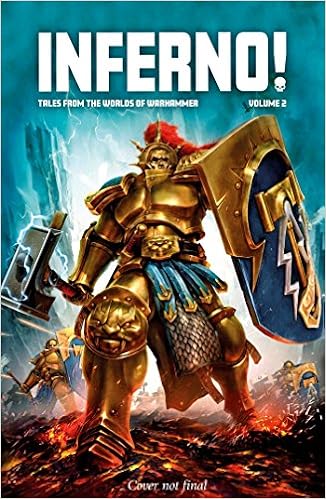
No real use in critiquing the cover, as it is for the Inferno! collection and not solely for the story. I personally like this picture though; it has a nice, classic flair to it. I think it ties in to Guy Haley's serialized installment story, but I'm not sure.

The reason I even mention this is because I knew this was being used as the UK cover, but Amazon US was floating this atrocity as the potential US cover:


And yes, I can read the "Cover not final" note. Just, and no offense to lovers of Sigmarines, I can't stand them, and my distaste begins firmly with their aesthetics.

So, cool cover. Great story. Take care, everyone!

Sunday, November 19, 2017

The Greater Evil

The Greater Evil by Peter Fehervari. A Tau short story, originally published by The Black Library, November 207. Approx. 52 pages.


As you all know, I've been keeping my Warhammer 40K reviews going up at my new blog; however, a new Peter Fehervari short is such a momentous occasion that I had to take a few minutes and post it here as well! Thanks as always for stopping by!

There are few greater causes for celebration than the release of new material from personal favorite author Peter Fehervari; so this week began on a blissful note. On Monday; The Black Library released Fehervari's newest short story, The Greater Evil, which is a Tau-centric tale that weighs in at a whopping 52 pages (nearly twice the length of the average short story; so you're definitely getting more bang for your five bucks).

Now, I will tell you right up front; this story is spectacular. I am seeing a lot of comments within the Facebook groups I frequent that cite The Greater Evil as Fehervari's best short story to date. In all honesty; I am somewhat inclined to agree. I'm pretty sure, as well, that if you read my past reviews of his works, you will see similar sentiments being expressed. This speaks to his overall evolution as an author; certain tales of his have been more dark than others; some more complex with his endless puzzles and riddles. Others are more character driven; while others come up as more accessible to the general palate. The Greater Evil, on the other hand, combines the best of all of these qualities. This is a wonderful, dark, vivid tale that serves as a testimonial that Fehervari has established himself as the best author for writing certain factions.

Now; a note before I continue: there were be a lot of commenting on the merits of the writing here; rather than on the story as a whole. The reason for this is that the blurb for The Greater Evil deliberately leaves the 'bad guys' (well, the faction the Tau is fighting here; 'bad guys' has a lot to do with geography and what side of the fence you are standing on) in the shadows. So, before I go on, here are the details from BL's website, so you have an idea of the basic premise:

A T'au Empire story

An expedition to discover the fate of a long lost Water Caste ambassador and bring an Imperial world into the T'au Empire faces grave peril…

READ IT BECAUSE
Peter Fehervari continues to build his little corner of the Warhammer 40,000 universe in a tale of mystery and danger that will leave you guessing right to the very end.

THE STORY
In the far reaches of the Damocles Gulf, an expedition of the T'au Empire heads for the system known to the Imperium as Yuxa, there to bring the influence of the Greater Good to humanity – and investigate the reappearance of a Water Caste ambassador thought lost years before. Joined by a mysterious Ethereal and defended by gue'vesa auxiliaries – soldiers once of mankind's Imperium, now devoted to the Greater Good – the expedition's leader expects a trap/ But what he finds may just change his perceptions of the galaxy. 

That being said; let's dissect this fantastic story.

Characters:

PF is a meticulous, thoughtful, and insightful author; and his characters directly benefit from this, all of them becoming imbued with true gravitas and authenticity. In any Fehervari work; almost any one of the characters could arguably carry a solid novel on their own, and this is certainly the case in The Greater Evil.

In The Greater Evil, we have a trinity of characters at the fore. First off is Voyle, a former Guardsman currently serving as a Gue'vesa auxiliary. He is a formidable warrior; and has subscribed fully to the philosophy of the Tau. However, like most of the leads in Fehervari's stories; Voyle is a man with a burden hanging around his neck like an albatross. In this case; it is the events that led up to his becoming stranded upon a derelict ship. He carries the guilt of allowing his comrades to die; as well as a festering rage against the Imperium for abandoning him. But, Voyle is also plagued by voices. Voices that keep dragging him into the past....into those pivotal moment. Are these murmurings voices from the past; or the future?

In this short, Fehervari also gives us a new type of Ethereal, known as a "Seeker", here represented by the intriguing character of Kyuhai. Personally, I like the concept of Seekers; who are more Shao Lin monks in comparison to the traditional wizened Confucian sage types that Ethereals are normally portrayed as. Granted; this might prompt some discontent among Tau purists; but I believe the logic underpinning the concept is sound enough to not only justify, but also validate its inclusion. And, Kyuhai is an interesting character. He has the wisdom; as well as the bottom-line pragmatism necessary for his position; but his martial skill allows him more front-line, hands-on involvement.

Also, another nice touch to the concept of the Seeker is that Kyuhai eschews a traditional Honour Guard; opting instead for the assistance of two exceptional kroot warriors. Anyone who has read any of Fehervari's works knows how he excels at writing for these avian conscripts of the Tau Empire - from the skrab infected horrors of Fire Caste, to the determined shaper of Fire & Ice.

Finally, we have a Water Caste ambassador named Adibh. She is yet another example of a well-realized, balanced female Tau character crafted by PF. Always seeking a proper balance in her approach to problem resolution; especially considering their position in being part of seeking a non-violent concordance with the gue'la.

Adibh has all of her personal feelings and values challenged when she is tasked with getting to the bottom of the issue regarding a face from the past - the 'lost' ambassador mentioned in the blurb - who also happens to be a longtime friend of hers; as well as a once-potential pairing mate.

And honorable mention goes to Akuryo; the thoughtful Fire Caste commander whom his loyal gue'vesa troops dub "Stormlight". He manages to steal every scene in which he appears; and acts, even in an inadvertent manner, as a major catalyst in the realization of Voyle's personal arc.

As with other Fehervari stories; there is always the chance of an 'old friend' coming for a visit. I was able to place one major character from a previous work; and there is another one whom I am guessing at, but am currently stuck.

Action:

Fehervari never disappoints in the action department. There is a nice setpiece that dominates the middle of the story (as well as a solid training sequence at the opener). It's always noteworthy how much thought he puts into the mechanics of weaponry; as well as the tactics, of all factions involved.

For me, however, there is one scene that really stole the show. In The Greater Evil, as well as in Fire Caste, there is a scene in which a Crisis Battlesuit is unleashed. And this, this is done masterfully. Also, this scene involves a more traditional, conservative Fire Caste warrior; one who is able to make the on the spot battlefield decision to prioritize saving battle drones over wounded gue'vesa troops; because the former have a greater net value than the latter. It is a perfect reminder that even though the Tau present a more 'humane' option than the cruel brutality of the Imperium; the efficiency upon which their house is built often takes emotion out of the equation.

Visuals:

As always; Fehervari brings his setpieces to life. He delivers vivid, unique imagery, time and again. His take on the gue'vesa troops is truly original, and somewhat bizarre - humans who, in their acceptance of Tau doctrine, have their skin stained blue and faces tattooed with concentric rings.

As mentioned, the setup and detailing of the deserted ship that serves as the theater for Voyle's backstory is a spacebound horror house for the records; more terrifying than the Nostromo or the colony on LV-426.

The hulk hovering above the planet Scitalyss - also known as the Unfolding Nexus - where the latter part of the story transpires; is another bastion of inherent 'wrongness' that keeps the reader looking over their shoulder at each turn.

Word Games:

Of course, the most to have with a new Fehervari release is to try and connect the dots between stories; and also find hidden meanings in names and word choices. As always; there is a lot to be found here.

I've been poring over The Greater Evil for close to a week now; and I'm sure I'm only scratching the surface on the hidden gems that PF has tucked away in here. As we all know, the Dark Coil of his tales snake along of their own accord.

Speaking of snakes, there is something of a serpentine theme going on here. This is evidenced in some of the names. The planet that the Unfolding Nexus hovers above is called Scitalyss. The system that Scitalyss is located in is known as the Yuxa system. This system is of particular interest to a celebrity Tau high ambassador named O'Seishin. If that name rings a bell; it is because he figured heavily in Fire Caste.

It also bears mentioning that aside from Scitalyss, there is only one other life-sustaining planet in the Yuxa System. A lovely little world known as Phaedra....

The name of our troubled gue'vesa soldier, Voyle, has a dead giveaway for one of the big story twists in it if you check it out on Wikipedia.

Also, the direct translation of the name of the aforementioned Fire Warrior commander, Akuryo, holds a significance in regards to Voyle as well.

If I am reading correctly, there is also a connection between Voyle's backstory and the ending of a recent Fehervari story.

Well, I'm sure I am missing plenty more. If you do spot any; feel free to mention them in the comments.

In Conclusion:

So, to reiterate, The Greater Evil is yet another fantastically written notch in Peter Fehervari's belt. The quality of his writing has evolved so profoundly; and he has shown without a doubt that he is the best author in the Black Library stable for writing Tau. Tau are so much more than angular; anime-inspired fighting suits. There is a pervading philosophy throughout their race which perhaps positions them as a more benevolent 'master' in the war-torn universe of the 41st millennium....but as with all philosophies, there are always dark corners.

And when you need to explore the dark corners of the universe, you can do no better than Peter Fehervari.

Now, I could possibly see some having issue with the ending of this story. While I feel that The Greater Evil offers a conclusive ending; it is obvious that it is the beginning of a larger story begging to be told. Just to reiterate; it is not an open-ended, ambiguous ending (although I never mind those if they are done right), nor is it a cliff-hanger that denies closure to the reader. Here's hoping that Black Library gives him the chance to add more to this excellent story.

Oh, I must also mention; The Greater Evil both opens and closes with two of the greatest lines that I have read in any 40K fiction. The opening line; an exordium of sorts (is it any coincidence that Voyle's guard unit was the "Exordio" Void Breachers?), prepares the audience for the kind of twisting narrative which Fehervari is famous for. And then, the final line bludgeons the reader mercilessly over the head with a cold truth; a cold truth that reveals itself at a point far past any hope of a remedy.

As always, I simply cannot recommend this story highly enough. Get it now, get it here.

Monday, April 3, 2017

Long Time, No See!

How's everybody doing? It seems like only yesterday I was declaring that I wasn't going to let the blog start to languish again, I was going to commit myself to writing, etc., etc., etc....

Well, I did tell the truth; but I didn't do what I said I would. Make sense?

I had a strong January on the blog, and I was really happy with that. I was making up for lost time with The Beast Arises books, and dipping into some classic paperbacks.

Then school happened again. I'll be honest, I haven't been ready for the sheer volume of writing I've had to do this semester. So yes, I told the truth; I've been writing. Heck, I've been writing my ass off, but just not about books, which is something I love to do.

And, just like that, what little free time I had for blogging *poof* disappears.

Meaning, I get to read a lot more of:


And a lot less of:


.....and there was no rejoicing.

Well, enough complaining. I actually have some stuff to post, and then an announcement at the end.

First is a post/rant from MightyThorJRS, who is a damn fine reviewer (if you haven't read his stuff already), and a really cool dude. He touches on some of the - how should I call it? Blog fatigue? Reviewing fatigue? - we all feel from time to time. Trying to hurry to keep in line with the newest releases. Having the self-imposed pressure of what to write in a review interfere with your actually reading enjoyment. I know, no one asked us to do this. Just one of those weird kind of things. Anyway, check it out over here.

Secondly, I'm sure you are all familiar with The Combat Phase podcast, right? Well, in episode 188, recently released, Kenny over at TCR does what I've been dreaming about doing for the past few years - actually having a broadcast interview with Peter Fehervari! Seriously, you need to set aside an hour and forty minutes of your time to listen if you are as big a PF fan as I am. Because, finally, you get to hear him open up on these deep, psychological, wonderful, and terrifying stories he's been crafting over the past few years. So, seriously, give it a listen.

Listen to it here.

And, I must add, at the end, Peter Fehervari gives a quick shout out to the blog here; and, I know I'm a pretty emotional guy by nature, but it really did mean the world to me. More than a few times, I've really been on the verge of closing this blog down, and it's been him a few times that encouraged me to keep at it. Sometimes you need someone like that at certain times.

Alright, enough with the treacly waterworks. But honestly, I did cry a bit at that; see, I told you I'm an emotional mess.

On to the announcement.....well, see how I just talked about not quitting this blog? Well, actually, I am kind of quitting this blog.

I am joining up with my friend Rob, one of the admins over at the Warhammer: Artwork, Books, and Models Facebook group, to make a new review blog called:

Voxcasts From The Void

Please bookmark that and stop by. All of the Warhammer stuff I review going forward will be over there; hopefully, combined with his output, I can get a steadier flow of reviews up.

For the time being, any and all other titles I review I will put up here. I don't yet know how that will change over time. I'm honestly not ready to let go of this blog; there are too many good memories tied up in it.

So please, check out the new blog. The first post is up already - a review of The Last Son of Dorn (The Beast Arises #10).

Alright, hope to see you all here, there, or somewhere. Thanks as always for coming by.

Friday, November 11, 2016

HachiSnax Interviews: The Second Peter Fehervari Interview!!!

A little over a year and a half ago, Peter Fehervari, who in my opinion is the best author over at the Black Library, in addition to being a real great person (and very supportive to the blog), agreed to do an interview. The first few questions were billed as a "Part I", however, due to some scheduling issues and workloads, Part II never came to be. Now, I am ecstatic to announce a second interview with Mr. Fehervari.

There's only a few questions this time; but I think you can agree, the answers he provides are insightful, thought-provoking, and mind-blowing. It is a rare opportunity to see the workings and plannings of such an intelligent and deep author. 

Well, read on, and I hope you enjoy. I'm sure you will. Please take the time to leave some comments on the way out.

Cheers, Hach.

Hi Peter-
Thank you for agreeing to do this second interview with HachiSnax Reviews. It’s hard to believe that it has been close to a year and a half since the last installment.

At the time of the last interview, I had framed a good deal of questions around your (then) upcoming Adeptus Mechanicus tie-in short story, Vanguard. However, since then, you’ve had a few more offerings come out through Black Library. There was another tie-in short story, this one for the Deathwatch series, titled The Walker In Fire, as well as the dizzyingly brilliant novella Fire & Ice, which appeared in the Shas’O collection (see reviews for Vanguard, Walker In Fire, and Fire & Ice).

Several of your stories feature the Tau in significant roles. I have to say, of all the Black Library authors, I believe your take on them is the most believable. Instead of just focusing on their wide array of armament, you infused them with a tangible air of legitimacy by delving into their philosophies. The way you presented the “Greater Good” is in a way one would imagine it to play out in real life – equal parts appealing and utterly terrifying. As a gamer, and as an author, what was your own history with the blueskins; and, going from that, how did you approach bringing them so effectively to life?

P.F.- I’ve never fielded a tau army on the table-top, however the faction has intrigued me since its first appearance. I vividly recall going into my local Games Workshop (sadly long gone and much missed) when the original tau codex and models were released and being struck by the buzz surrounding them. On fire with enthusiasm, the manager told me these were ‘the good guys’ of 40K – a rational, reasonable, all-embracing culture that was the galaxy’s best hope. Well, that certainly intrigued me. Unequivocal good guys in a world that was all shades of grey running through to deepest black? Really?

If I’m honest, I wasn’t particularly keen on the angular battle suits and overall aesthetic of this new race at the time, but I was curious enough to buy the codex. While I can’t remember the precise details of that early version I know it won me over to their side philosophically. Though this young race was almost certainly out of its depth in a reality where superstition, paranoia – arguably even xenophobia – made sense, I respected its idealism, doomed or otherwise. Since all roads in the Dark Millennium would likely end in ruin I figured I’d rather walk one that somewhat reflected my own view of right and wrong. The tau and I were both young and idealistic back then, so we hit it off!

Bearing this in mind, I’ve found it interesting that many readers feel my take on the Tau Empire is cynical, even condemnatory, because that was never my intention. For the most part I believe the tau are sincere in their intentions towards other species, genuinely recognising that sentient (and sane) civilisations are stronger if they stand together. The Greater Good isn’t just for those with blue skin and hooves – it’s a genuine, all-embracing philosophy that might just work in a broken galaxy.

However later codices and occasionally other sources (particularly Spurrier’s ideas in ‘Xenology’) added threads of shadow to the bright tapestry of these idealists. Considering their fragmented, self-destructive past, I’d argue there’s a potential darkness in the tau that can be supressed, but never entirely excised. This aspect can be played up or down depending on one’s personal interpretation of the ‘facts’. For example, the pheromone control exerted by the Ethereal caste is unsettling because it potentially denies other castes the freedom to choose the Greater Good, which would arguably undermine its ethical foundation. However, there’s plenty of wriggle room here because it’s not clear how pervasive and necessary such control is. One could argue that the pheromones (if they truly exist) are merely a support structure for tau society rather than its basis. As a writer I find such grey areas compelling, hence my fascination with the tau grew as their lore became more textured and their flaws showed through.

Nevertheless, given the countless predatory factions pressing in from all sides (and I include the Imperium here), I don’t regard the tau as particularly dark. Authoritarian? Almost certainly. Ruthless? Yes, occasionally, but rarely spiteful or malevolent. Thus, I’ve striven to present them as analytical, precise and measured in their intent and actions, but with a rigidly controlled, passionate core.

The embittered Fire Warrior, Jhi’kaara exemplifies this tension when it’s pushed to the limit. She is a broken reflection of the tau ideal, twisted out of shape by ambition and disillusionment. This makes her an outcast, more in tune with the toxic jungles of Phaedra than her own kind, yet even she never willingly betrays the Greater Good. Her discipline and respect for social order are too ingrained.

Which brings me to the Water caste ambassador, O’Seishin, who presided over the Phaedran war. Despite his incipient corruption (again rooted in personal ambition), his plan was arguably sound, saving many more lives (particularly tau lives) than it cost. It was harshly utilitarian, but undeniably effective. Rational. Hence the novel’s protagonist was faced with a murky, corrosive moral choice at the novel’s conclusion, which underlined the story’s main theme – complex questions rarely have absolute answers. Which reflects my view on the tau themselves.

I’ll conclude by saying the Tau Empire remains the faction I’d sign up with if I lived in the Dark Millennium and was offered a choice. In fact, given the chance, I’d call the tau in to sort things out in the here and now!

H.S.- Over the course of your Black Library stories, you have given your readers some truly memorable Imperial Guard (sorry, Astra Militarum) units. Take the Verzanate Konquistadores, the Lethean Penitents, and the Iwujii Sharks, to name a few. In your fashion, you have also provided detailed and comprehensive backstories for these units. However, of all the Guard companies you’ve created, the Arkan Confederates are forever cemented in the minds of readers.

Now, it is no new thing for Warhammer 40K Guard units to draw design inspirations from historical or culturally-influenced military units. Reception to drawing inspiration from Civil War soldiers seemed to run the gamut from readers thinking it was great, to some thinking it was odd, and others, silly. The thing is, once you picked them, the presentation was amazingly detailed. It wasn’t just grey uniforms, kepi caps, and a pseudo-Southern dialect. There were references to obscure Civil War era unit types, and authentic representations of social classes (from the upper crust plantation owners to the holy book thumping fundamentalists) and dialect.

My question is, was your inspiration in using that Confederate template born from picking well-known “rebels” and diving into insane amounts of research? Did it spawn from an affinity for that segment of military history? Or was it another clever puzzle piece (i.e.- Civil War – Blue vs. Grey. Blueskins vs. Greybacks)?

P.F.- My starting point for the lead regiment in ‘Fire Caste’ was that it should be strikingly ill-suited to the conditions on Phaedra. I’ve already mentioned that Herzog’s film, ‘Aguirre, Wrath of God’ was an aesthetic inspiration for the setting – the images of conquistadors hauling cannons through a steaming rainforest were unforgettable and I wanted to capture that sense of absurd striving and misery while going my own way and amping things up for 40K. Secondly, I wanted to push the idea of the old and the new clashing, both technologically and ideologically, so a ‘period’ regiment was appealing as a foil for the tau.

I’ve always been fascinated by the American Civil War – the intensity, the appalling internecine waste of lives, the distinctive and striking uniforms, but above all, the irreconcilable clash of tradition and new ideas – so a Civil War regiment seemed a good template to build upon. I’m far from an expert, but I did my research, which is where I discovered colourful units types like the Zouaves, though I took them in pretty eccentric directions. Other than Colonel Cutler, who is obviously loosely inspired by George Custer, none of the characters are based on historical figures, but many of the names were derived from old regimental lists (though I discovered that a fellow BL writer had apparently been there long before me and snapped up some of the best ones!)

 I’m aware that some people felt the Arkhan Confederates were too literal a take on their real world counterparts, but I feel this criticism was overcooked given how established 40K lore also draws so deeply from human history. In hindsight, perhaps I’d tone down some cultural aspects - the language perhaps - though I tried hard to make it authentic rather than clichéd, however I’m not convinced the story would be better for such changes. Besides, I’d argue that the Arkhan’s steampunk slant already goes a long way towards distinguishing them from the reality. Furthermore, in my alternate history, the Confederates (who reluctantly sided with the Imperium) were the victors, so the more conservative side won the war. This was probably just as well for Providence because it would have been steamrollered otherwise, but there’s a pervading sense throughout the book that it was a hollow victory. Many of the Confederates feel like traitors to their own people and have little affinity for the Imperium, let alone the Imperial Cult. They are lost – out of place, time, culture and increasingly, mind. The potential this offered for storytelling was always the most important thing for me.

I must confess that the grey and the blue parallel was pure luck – or serendipity - but it made me very happy when I noticed it.

H.S.- In evaluating your three last offerings, you can plainly see that with Vanguard and The Walker In Fire, there were certain parameters you had to follow in keeping in line with the tie-in story arc/product release. In both of those stories, you also found your way to integrate elements from your twisted, interconnected story threads. However, there is something different about the tone of Fire & Ice. In that novella, there is an almost palpable sense of an author with unbridled control over the story he is crafting; and the end result crackles with intensity. I know that sounds a bit over the top, but that story is immensely powerful. It may not have the haunting, despair-laden overtones of Fire Caste, but it is a solid, strong work.

Not to make the question too broad, but what can you tell us about the “making of” Fire & Ice? What was your original intent with this novella? Did you have any concerns with how the story would be received by readers, being as though it is so fundamentally different from the other offerings in the anthology in both mechanics and tone? And, what was your approach for getting inside the head of the enigmatic figure who may or may not be Farsight?

P.F.- While ‘Vanguard’ is a more direct follow up to ‘Fire Caste’, ‘Fire and Ice’ is closer to that novel’s spirit. Once again the ‘journey into darkness’ is at its heart, but more focused, with fewer action set pieces and a tighter focus on dialogue. Though it is a puzzle without a clear-cut solution its pieces had to make sense and work on multiple levels.

For example, setting the bulk of the story on a train served several purposes. Firstly it struck me as a fresh and unusual environment for a 40K tale. Secondly, it offered a claustrophobic, almost inescapable trap where the horror, both physical and psychological, could play out. But thirdly, I was attracted to the set-up emotionally. This trap, where the roles of captor and captive, hunter and hunted blur, is quite literally on rails, remorselessly carrying our protagonist towards judgment as his tormentors push him on a parallel, arguably more dangerous, journey within himself. This synergy of the aesthetic, the practical and the emotional is what I aspire to when thrashing out a story's location, plot and characters. Which brings me to your question about Farsight. 

Last time round I talked about the sense of responsibility I feel when writing within the 40K mythos - the thrill and the fear. Well, I’ve never felt it so keenly as I did with ‘Fire and Ice’ because this was the first time I was entrusted with one of the lore’s established figures. 

Being drawn to outcasts, iconoclasts and rebels, I was fascinated by Farsight from those first dark paragraphs in the codex, so I jumped at the opportunity to get to know him better. This was before the release of his supplement, so he was still a profoundly enigmatic figure and my brief was to keep him that way. I could hint at his motives and nature, but not pin anything down. Whatever depth and detail I brought to him could not be at the expense of his mystery. After some initial consternation I realized this resonated with my own instincts about the character – after-all it was his mystery that had hooked me in the first place.

I loved the notion that Farsight’s true nature, like the identity of the infamous missing legions, belonged to the imagination of the fans, without ‘official’ answers to constrain it. To some he might be an ideological renegade, to others an opportunist pirate or even a nascent champion of Chaos. My place was to offer evidence for all these theories, but never hard proof, which set the story's tone of subterfuge and shadow play – and indeed the whole puzzle-box structure. At journey's end we can't even be certain whether the Prisoner was Farsight at all. Not even I, the writer, can really know in this case.

To do this idea justice it was imperative never to go directly into the Prisoner's head. His thoughts had to be inviolate. Like his interrogator, all we have to go on is what we see and hear. We are observers, never truly confidantes in this game. 

So what can we be sure of? 

Regardless of his motives, I knew the Prisoner had to be impressive. Without a battle suit or a loyal cadre of followers, he had to be dangerous through his sheer presence alone. The story's title refers to the duality of his psyche, which encompasses both a razor-sharp intellect and a ferocious passion (the inherent tension of the tau amplified to the limit). Each aspect is in thrall to the other, but always threatening to break free and shatter the balance. To my mind, this is the alloy from which a great leader is forged – a warrior lord who has mastered both the detached strategy of war and the up-close savagery of battle. As to whether he’s fighting for good or evil… that’s another question, and not one I wanted to answer about the Prisoner. There’s plenty of evidence on offer, but how you interpret it… well that’s up to you. The answer doesn’t belong to me.

H.S.- Finally, your new novel focuses on the machinations of a Genestealer cult infestation. What drew you to this faction and what was your approach to their portrayal? How did you combine older canon, newer materials, and your own personal touch into making a "religion" that is both simultaneously hideous and inhuman, yet also sympathetic, believable, and, in a perverted sense, beautiful?

P.F.- There’s a grungy bio-punk aesthetic to the Genestealer cults that appealed to me from their first appearance in White Dwarf, back when they were riding around in limousines and making pacts with Chaos like some kind of xenos-tainted mafia. They embodied the rot devouring the Imperium from within, wielding doubt and discontent to subvert the everymen (and women) of humanity from the shadows. The insidiousness – the dishonesty – of their secret war made them more unnerving than the xenos and traitor hordes assaulting the Imperium’s frontlines. And then there was their utterly nauseating modus operandi - a corruption of mind and body that was unequivocally sexual in nature. They were repellent, but fascinating with it, which made them a compelling faction to write about.

When I received the brief for the novel I had some lengthy and wonderfully bizarre discussions with my editor about how far the story could – and should – go into the sexual aspect of the cult. Sex is intrinsic to a Genestealer infestation so glossing over it completely would have done the concept a disservice, but equally we had to be mindful of the readership’s wide age range. Hopefully the balance we struck, with the sexual aspect restricted to suggestion and character reactions, conveyed the horror without ever being crude or exploitative.

Actually, while we’re on this subject I’d like to clarify one…technical…point about hybrid reproduction: my understanding is that first and second generation hybrids infect humans with an ovipositor sting, much like Purestrain Genestealers. Only fourth (and possibly third) generation hybrids are sufficiently humanoid to utilize more conventional techniques of reproduction. While the codex isn’t particularly specific on this matter I pressed for an answer and this is the interpretation we agreed on. Personally I think it’s quite disturbing enough and entirely logical.

So to be absolutely clear about this and end some of the more febrile speculation I’ve read on some forums: the fallen Battle Sister, Etelka, was stung by the cult Patriarch. There was no bizarre monster sex involved, thanks.

Moving on to the character of the cult, I wanted its philosophy and aesthetics to express the biology at its heart, but in an idealized way, hence the imagery of an ever-growing spiral and the promises of ‘cosmic kinship’. From humble human converts to the Patriarch himself, whether it is instinct, intellect or passion that drives them, every member of the sect sincerely believes the infestation is a force for good. How could it be otherwise when it heals, unites and enlightens those it embraces? Within the Great Spiral the doubts and deceptions of individuality disappear and the three facets of existence - body, mind and soul – become harmonious.

The daemonic entity imprisoned beneath the Spires and held in check by the Patriarch reinforces the logic of the cult’s creed: in a malevolent galaxy only absolute harmony can prevail. This is both an inversion of the classic Rogue Trader phrase (‘In a mad galaxy only madmen prosper’) and a more extreme expression of a utilitarian philosophy like the Greater Good. Crucially the creed makes a lot of sense, which is where its beauty stems from.

Of course, we know this is all a lie perpetrated upon the cultists by their own biology, which has doomed them from the start. The Great Spiral is a trap, offering not cosmic transcendence, but oblivion in the jaws, metaphorical or otherwise, of a tyranid fleet when the Hive Mind finally senses them. That twisted tragedy is what I find most compelling about the faction, not least because it rings so true. As the lost Arkan captain, Ambrose Templeton wrote in the preface to his unfinished epic: Beware of easy answers and those who proclaim them, for what glitters is rarely gold and those who flaunt it are never true gods.

Wow. Amazing stuff there. Thanks again, Peter! A reminder, Peter's two Genestealer Cults stories, the novel Genestealer Cults, and the wicked short story Cast a Hungry Shadow (which features Chaos vs. Genestealer cult gang war and a ferocious, Mad Max: Fury Road inspired vehicle action setpiece), are out now. Grab your copies today!


And don't forget, you can go back and read the first interview with Peter Fehervari here.

Legal Disclaimer: The views and/or opinions expressed in this interview and in all articles of this blog are entirely the view of the author and are NOT in any way representative of Games Workshop PLC. All names, insignias, illustrations, et al. are the property, copyright, and/or trademark of Games Workshop Ltd, PLC. All names, titles, and illustrations used without permission, with no challenge to copyright/trademark status intended. All rights reserved by the proper owners.


Thursday, November 3, 2016

Cast A Hungry Shadow

Cast A Hungry Shadow by Fehervari. A Warhammer 40,000 Genestealer Cults Story, originally published September 2016. Approx. 31 pages.

Back in September there was much rejoicing as we were graced with not only a full-length novel (albeit on the short side) from personal favorite Peter Fehervari based upon the newly released Genestealer Cults Codex, but we also got a tie-in short story as well.

The events chronicled in the cryptically named Cast a Hungry Shadow transpire between the explosive prologue of Genestealer Cults (during which the former stewards of the soot-ridden hellhole of Redemption, the Sisters of Battle, met their demise), and the rest of the novel, that brilliant chess match between the adherents of the Spiral Dawn and the Guard members of the Vassago Black Flags.

However, instead of the cultists vs. the Guard, what we have in Shadow is a different kind of gang war; one between the Spiral Dawn cultists (furthering their foothold on the planet), and members of an entirely different cult: the Chaos worshipers of the Scorched Creed. The devotees of the Scorched Creed abide by the calling of the teeming currents of Chaos which roil madly below the spires of Redemption, maintaining its liquidity; maintaining its....lie. Is the planet Redemption a lie? Or is redemption simply a lie? Both?

The cultists of the Scorched Creed are led by a fearsome brute named Gharth; a giant, hulking Chaos puritan who lost his eyes and gained true sight. On the side of the Spiral Dawn stands Aziah, a Chosen Claw, bodyguard of the Spiral Father, and trusted son of the glorious Saint Etelka, better known as the Sororita who betrayed her kin. What brings these two factions on a (literal) collision course is a presence of power so potent, so attractive...so useful, that it simply cannot be ignored.

Said source of power is a female psyker; one of such latent potency that it boggles the mind. It is also an amount strong enough to tip the scales of dominance in favor of the faction which retains her first; making it no shock that Gharth and Aziah a jockeying so voraciously to earn her favor.

From that framework, Fehervari delivers what may be his darkest story yet, with some of the most brutal action I've witnessed anywhere in the 40K universe. While it doesn't have as many links and Easter Eggs tied to other "Dark Coil" tales, what it does showcase is PF's immense creative ability in crafting unique characters and factions.

We already saw in Genestealer Cults the legitimacy and authenticity with which this new take on an old faction was presented (which reminds me; I'd recommend that one reads GC before Cast a Hungry Shadow). Aziah makes a fine, sympathetic protagonist here; especially this being a story bereft of "normal" humans for us to root for. He is a devout, true believer, but also prone to rage and fury issues.

But the real show-stealers here are the members of the Scorched Creed. Lifelong slaves to the slab-mines of Redemption, they find purpose and gifts of the flesh through their abominable creed. And yet, as Fehervari demonstrated in the belief system presented in GC, there is a seeming logic, dare I say a validity, to their belief? Gharth, the Blind Pilgrim himself, is so set in his way that until he was named and given a specific background I could have sworn that the burning shell of Audie Joyce had seeped through the Dark Coil from Phaedra to Redemption. Maybe he did....remember, everything is a lie. The psyker, the "Teller", sure reminds me of someone seen in a previous work. There's no telling for sure.

What really excited me in this story was the physical descriptions of the Scorched Creed. For the older readers, remember back in the 80's when people loved attaching the descriptor "from Hell" at the end of anything inherently evil? Well, the Creed is literally a "Biker Gang From Hell". They are haphazard amalgamations of black plating, razorwire, sharp edges, anger, and fury, all astride demonic motorcycles.

When you go back, and think about the things that first excited you about Warhammer and 40K, it was the torchlight to unleash images like this from your imagination that probably first drew you in. And that's what makes this story so fresh, and makes it leave such an impression. When you give an author like Fehervari free reign to create, these are the types of memorable figures you are left with. After you read the climactic battle, go back and reread it, and truly study the choreography of it all. This is some of the best action out there.

And yet, it is not all action and badass characters in Cast a Hungry Shadow. All the other hallmarks of Fehervari's authorial craftsmanship are evident here as well: deep sadness, despair, harrowing regrets, and misguided determination. Perhaps the best element of Shadow is the inner turmoil of the betrayer, Sister Etelka. As she comes closer to the Teller, and to the climax of her own story arc, she is continuously assailed by the gravity of her past actions. It is a form of the Act of Penance, in which she must make her own personal reconciliation.

Dark, foreboding, and crackling with chaotic energy, Cast a Hungry Shadow offers rich characters, a stark setting, brutal action, and bar none the best vehicle chase scene that I've read in any 40K work. Plus, it is all fleshed out with Fehervari's intentional, intelligent prose.

What a great partner story.

Final Score:

9.5/10

Cover Score:

Basically the Genestealer Cult icon with some nice detailing and rendering. Something about this design reminds me of the basilisks from the old NES version of Archon. Fits into the whole chess aspect of Genestealer Cults, too.

One on the left, there, and one on the right as well.

Cover Final Score:

6/10