Showing posts with label James Swallow. Show all posts

Tuesday, June 14, 2016

Kaiju Rising - Part 5

Kaiju Rising by various authors. Edited by Tim Marquitz & Nick Sharps. Originally published by Ragnarok Publications, Febraury 2014. Approx. 552 pages.

And now we come to the end. The last five stories in this amazing anthology....

Stormrise by Erin Hoffman (26 pgs):
Although this is technically both a mech and a kaiju story, the real focus of Stormrise is self-aware digital intelligence. Erin Hoffman creates a fierce and fun short story in which a digital intelligence becomes aware, names itself Keto, and decides to demonstrate to the organic, human intelligence that she is more qualified to be their steward. A digital, benevolent overlord if you will.

Caught up in this are Keto's programmer/creator Sandra, who is working the damage control angle for the corporation that helped create Keto, and Airi, a renegade flyer person (actually, her job title isn't really specified), who becomes Keto's ward/captive.

Set in 2154, this story nicely highlights a kind of saturation point of human dependence on technology, to the point where we essentially have a HUD of sorts implanted in us. Hoffman effectively postulates how easily this could be used against us should the machines rise; how simple it would be to read our moves and deploy countermeasures before we take a single step. Hoffman does it so well that you don't even care that there isn't a giant monster or robot stomping about.

The concept is great, the characters are great, the execution is great. Hoffman crams a lot of elements, and realizes them fully, without leaving the story feeling overstuffed. In a perfect world, this story could've been stretched to a 50-60 page novella. Also, the ending leaves you begging for the sequel. I checked the Mech anthology lineup to see if one was listed, but alas, there isn't. Here's hoping we see more of these characters one day.
Score:9/10

Big Dog by Timothy W. Long (27 pgs):
Really nice military mech vs. kaiju actionfest here. This story takes place right after the end of World War II as we know it. Here, the Japanese have allied themselves with alien intelligence, the kaijus, and it is up to a united American/European front (included a beaten Germany) to save the day. The action here takes place in Saipan, as the titular mech, a new weapon in the war against monsters, is getting the acid test, and being tasked with retrieving a kaiju biological sample.

Our protagonist here is Commander Katie Cord, a tough and capable Air Force pilot turned mech commander. Long does a nice job in fleshing her out; giving her a deep rooted animosity towards her former Nazi assistant, Glaus (due in a large part to his being a former tank commander, while Cord's fiance was killed in a tank).

Long's depiction of the kaijus, their appearance, characteristics, and weaponry, is effective, imaginative, and bizarre.

The real winner here is his description of working within the Big Dog. This is a clunky, awkward monstrosity, and its primitive technology coupled with the chaos of battle make piloting it a living hell. Long really conveys that feeling of trying to successfully maneuver an ungodly mechanical construct against unearthly monsters.

So what we have is a pretty standard narrative framework, with a fairly predictable outcome, bolstered by great execution, vivid conceptualization, and blistering action. And I always say that even the most trope-y storyline is still fun when done right. Big Dog proves that.
Score: 8.5/10

The Great Sea Beast by Larry Correia (23 pgs):
Now we move on to a pretty dark redemption story from 12th Century Japan. As a boy, Nasu Munetaka survived an encounter with the titular monster, and that was only the beginning of his misery. The injuries he sustains in the incident cause him to grow up small and weak, causing him to be considered useless in a court that refuses to acknowledge what occurred. Instead, the blame is placed on his father, who is labeled in death as a drunken incompetent. Alone and dishonored, Nasu feels despondent. That is, until he discovers one talent he possesses: a deadly acumen with the bow.

Years later, Nasu has a new sense of worth, as a veteran archer of many feudal conflicts with an impressive kill tally. Working from some newly uncovered intelligence, he leverages his clout into an expedition to discover and kill the creature which ruined his life so many years ago.

Correia tells a great tale here. He's done his historical research into the period, and he paints it with a vivid brush. Our 'hero', Nasu, is a driven man. He is not one for kindness, or consideration. He has been galvanized by a life of hardship to a sort of pinnacle of single-mindedness. This might make him hard to like, but I found his utter realness refreshing.

On top of that, you get a fairly terrifying kaiju, and some great, bloody action. I really liked this story.
Score: 9/10

Animikii vs. Mishipeshu by C.L. Werner (29 pgs):
This is a story I was really looking forward too. Not only is Werner a solid and prolific Black Library scribe, he is also a known kaijuphile (check out his Godzilla vs. Cthulhu fanfic). What he presents here is without a doubt the purest example of a kaiju vs. kaiju brawl in this entire anthology.

Following a nifty little intro that sets the scene, and dispatches with the only real human presence in the story (a sleazy corporate type), Werner unleashes two massive beasts from Ojibwe myth: Animikii, the Thunderbird, and Mishipeshu, the Water-Panther. What ensues is some stomping action followed by an all-out monster battle.

With the kaiju being the focus here, Werner meticulously details the appearance of each. With Mishipeshu, he deflty combines the lizard-like and feline traits to craft a lethal hunter-killer. And with Animikii, the physical traits render him something not unlike veteran kaiju Rodan (although with an electricity based beam weapon instead of the fire Rodan employed in Godzilla vs. MechaGodzilla II). I've always loved Rodan, but there was always something about him that didn't translate well in the movies. You knew he could create devastating wind attacks with his enormous wings, but it always just looked silly to see him standing there flapping them. In the story, Werner portrays the enormity of an attack like that excellently.

The descriptions are vivid, and the special weapons are done well. The action itself plays out with a blow-by-blow analysis. All in all, Animikii vs. Mishipeshu is the epitome of what this anthology is all about.
Score: 9.5/10

The Turn of the Card by James Swallow (37 pgs):
The last story in the anthology is also penned by the last of the Black Library scribes. James Swallow's involvement in Kaiju Rising was one of the stretch goals, and it is based in the Colossal Kaiju Combat universe.

This turns out to be another one of those stories that is paper thin on premise, but solid in execution. In Turn of the Card, we follow a London Police helicopter crew as they try to make sense of the sudden appearance of multiple kaiju in the Queen's stomping grounds. The lead character, a tough girl with a troubled part named Hannah Brook, decides to impulsively take the chopper into the city (which has been earmarked to be leveled in an attempt to stop the monsters) to rescue the uncle who raised her. Said uncle is holed up in the British Museum, and may hold a key to understanding what has allowed these creatures to run amok. Also, there is the persistent, underlying feeling that Hannah has some sort of tether to the goings-on.

All of this is just a set-up to letting these monsters unleash hell. Swallow packs a lot of the CKC kaiju into this story. He does a bang-up job describing them realistically as well; especially seeing as though a lot of them look pretty cartoony in the game. That's what he excels at, though. Swallow also has a true director's eye when it comes to staging the action. He gives us a multitude of perspectives; from shaky phone cam footage, to aerial shots, to on the ground views reminding us just how small man is in the face of these terrors.

The human characters are likable and easy to relate to. The kaijus chosen (I believe there was open voting to pick which ones would appear) are interesting, and Swallow does them service fleshing them out. Here's hoping he one day does a full length CKC tie-in novel.
Score: 8.5/10

And that's it! It's been a pleasure finally finishing this anthology!

Tuesday, May 3, 2016

Ghosts Speak Not & Patience

Ghosts Speak Not & Patience by James Swallow. Two Warhammer 40,000 Horus Heresy stories, originally published by The Black Library, January 2016. Approx. 45 pages (Ghosts Speak Not) and 5 pages (Patience).

I was perusing the mountainous TBR pile and came across this pair of stories from earlier this year (note: both are included in the new The Silent War anthology). So, let me begin with the usual spiel: I am not caught up on the Horus Heresy, I never got past Galaxy in Flames, whenever I read these shorts most of the content is new to me, etc., etc. I just want to get that out there, since I realize that Amendera Kendel featured in Flight of the Eisenstein, as well as Nathaniel Garro (haven't read any of the subsequent works featuring him).

First things first.

Ghosts Speak Not:

Billed as a novella, but more akin to a puffed up short story, Ghosts features former Sister of Silence Kendel as she embarks on a mission from Malcador himself. She returns to her old cadre base to recruit some members of the notorious Seventy; a group of surviving members of the Death Guard who remained loyal to the Emperor when the rest of their Chapter turned to the Warmaster Horus.

With her retinue in tow, she heads off on her mission: to capture a rogue astropath in the Proxima Centauri system. This renegade psyker has been transmitting messages to the Warmaster; and the proximity of the system to Terra could allow for Horus to stage a mass attack.

Along the way, they are met with some resistance by the pompous ruling class of the capital world of Proxima Majoris. The rest of the story focuses on their detective work. Anything else brings us into spoiler territory.

All the elements in this short story work very well. I am a big fan of Swallow's world building; he vividly paints a plausible background that evokes the universe he is writing for. For a planet that appears in a short story; he puts all the right details into the distinguishing characteristics of that system; including industry, governmental structure, etc.

The characters are well realized, too. Kendel, in what is her first speaking role, is a capable, formidable agent. Swallow also introduces Helig Gallor, one of the remaining Loyalist Death Guard Marines. He injects a good amount of soul into the tale; showing us the doctrines that have identified his Chapter, while shouldering the burden of their turn to Heresy. It must be beyond emotionally devastating, even for a transhuman, to be engineered for a cause, and formed within one specific group, only to have them turn against all that you stood for. To suddenly find yourself without an identity, when your identity was what you were originally made for.

The action is nicely done too. Swallow does not play around when someone gets shot in his 40K books. There is no Hollywood-esque twirling deaths, or Wilhelm Screams. If somebody gets shot with, say, a bolter, suddenly they are "meat". Or "chunks". Or "paste". Or any combination of those. It's beautiful.

In fact, about the only thing that detracts from the story is that the premise: a detective/spy thriller where the heroes are in pursuit of a rogue psyker, is a little too close to that of Swallow's first Sisters of Battle book, Faith & Fire.

All in all, a solid, quick read, that really captures the feel of the Heresy era.

Final Score: 8.5/10

Patience:

Patience is one of those ~1,000 word micro-shorts that most readers either love or loathe. In it, we meet Gallor again, as he is sent to retrieve fellow Knight Errant Garro from an artillery-blasted city. Gallor finds him standing over a slain warp abomination, and receives a vital lesson in patience from him.

This story is all about setting the mood. See the great cover for this duology? This story is the one tied to that. And Swallow brings it to life on the pages. It is just great detailing throughout, with a knockout ending.

Final Score: 10/10

Cover Score: Love it. 9/10

Saturday, May 23, 2015

Hammer & Anvil

Hammer & Anvil by James Swallow. A Warhammer 40,000 Sisters of Battle novel, originally published by The Black Library, November 2011. Approx. 416 pages.


Last July, I reviewed Faith & Fire, the first book in James Swallow's duology centering on those lovable warrior nuns of the 40th Millenium, the Sisters of Battle. It was a decent book, with great world building, solid action scenes, and spotty characters and pacing. Also, I wasn't too enthralled with the cover.

No no no. This is the alternate cover which I endorse 100%.

All joking aside, Faith & Fire was an enjoyable enough read to warrant the second book, Hammer & Anvil, grabbing a spot on the mountainous "to read" pile. And, it just so happens that its turn came up. So how does this second book work? Is it more of the same, only different? Has the quality dipped down, as is so common with sequels?

Actually, Hammer & Anvil outdoes its predecessor pretty handily. Let's break it down piece by piece, but first, let's look at the story so far:

The Sisters of The Order of Our Martyred Lady are heading towards the planet Kavir to try and piece together the events that transpired which ended in the massacre of every living sister garrisoned at Sanctuary 101. It has taken them over a decade (Terran time) to head back courtesy of bureaucratic obstacles and red tape. The chance finally comes, orchestrated by an Inquisitor with ulterior motives (what other kind of Inquisitor is there?). And so, with an attachment of scheming cogheads from the Adeptus Mechanicus in tow, they head planetside to discover the true horror of what happened. Hint: it's Necrons.

Characters:
Much better than in Faith & Fire. We have some carryovers from that book, namely Miriya and Verity. Their personalities are pretty much the same, which is to say that they are, hmmm, what's the best word to describe these two?

Yes! Exactly!!!

So while their core characteristics haven't changed much, there is a much more confident stride in their depiction. Yes, they have been hardened, they are a bit wiser, but they are still the same. But again, their is only so much leeway you have in giving personality to zealots. I mean, they're zealots, after all.

I think that one or two of Miriya's old squad members survived as well. They are still window dressing with names. One might be dark skinned. Another might have a specialized weapon. Or are those the background Sisters introduced in this book? Can't recall.

In Faith & Fire, we had the stern but fair Canoness Galatea. In Hammer & Anvil, we have the stern but fair Canoness Sepherina. She's bald. She's tough. She's actually pretty cool.

I should've formed this entire review out of visual aids.

Filling the role of Sister Superior, the position Miriya was demoted from, we have Imogen, who is constructed of 100% anger and absolutely zero common sense or tactical acumen. She still gets some kick-ass scenes though.

Leading the Adeptus Mechnicus is a conniving, snarky questor named Tegas. He excels in his part as "the troublemaker you love to hate especially since he weasels out of trouble as slickly as a greased pig." It makes it even easier to hate him since Tegas spelled backwards is Saget, so if you imagine his vocalizations as sounding like Bob Saget....aaarrgh. But seriously, Swallow gives us an excellent portrayal of the mentality of the cogheads. It provides the bulk of levity throughout the book. Consider your main combatants: Sisters of Battle and Necrons. Yeah, not a lot of personality floating around in there. So, the Mechanicus are a great touch throughout. Trolling in binary.

 Basically.


I admit that I am dishing out a fair amount of ribbing so far, but the characters all gel well for a cohesively enjoyable experience. There is also one very strongly developed character in the book; a broken young woman named Decima, the last survivor of the obliteration of the original Sanctuary 101 outpost. Swallow fills her character with sorrow, anguish, nobility and strength in fairly equal terms. I would say that she is hands-down the best character in the book.

But what about bad guys?
The cogheads are enjoyable villainous troublemakers, but they are not actual "bad guys". The main baddies we have are none other than the dreaded Necrons. It's always a tad tricky writing for Necrons, since there is effectively zero individual personality in your given line trooper. Never fear, Swallow writes for them beautifully.

Well, not that beautifully.....

What Swallow focuses on in writing for these metal skeletons are spot-on physical descriptions, meticulous attention to detail in weaponry, and vivid portrayals of deployments and their basically implacable advances. 

He also gives us two sentient Necrons; a cryptek and a nemesor. There is some discourse between the two, and it is well done, if sometimes a bit too "human" sounding. All in all, of all the 40K stories I've read featuring the Necrons, Hammer & Anvil is far and away the best. I can't stress enough that the average Necron soldier is more fleshed out (hurr hurr) than the average Battle Sister.

Sorry sweetheart. I have no hand in what cards are dealt, I just call what I see.

World Building:
Swallow hits it out of the park once again on this front. Kavir, where much of the action takes place, is a desert world. There are only so many ways you can describe sand and heat, but Swallow does it in a way that you feel it. Plus, he employs a decent vocabulary. For example, I never knew these things were called "ergs":


But what truly astounded me in Hammer & Anvil was the intricate, excellent detail of the Necron Tomb World. I mean, the attention to detail made this representation vivid and authentic to the source material. Enough credit cannot be given.

The other aspect of world building which Swallow did well (as in Faith & Fire) is in presenting canon technologies: the weaponry, tactics of each faction, etc. These are all done exceedingly well throughout. You get a real feel for the different kinds of havoc that can be caused by either a gauss rifle or a melta-gun, and be sure you'd never want to be on the business end of either.

Action:
Plainly put: lots of action throughout. Pretty much all of it done very well. Towards the end, there are a few too many "just in the nick of time" instances, but the skirmishes never cease to be thrilling.

And that's pretty much it. I really don't have any complaints this time around. There was some potential, hinted at early on, that the Inquisition might have a more direct hand in all the wrong things going on on Kavir. While we know throughout that they can't be trusted, there was a ripe chance to really cultivate the genuine tension between the Sororitas and the Inquisition.

Ahem...well. I didn't mean like that. Although this would've been a perfectly welcome addition to the narrative....

Here's what it is:
Hammer & Anvil is a riveting novel focusing on the Warhammer 40,000 army that everybody loves but does not get enough love, the Sisters of Battle. If nothing else, this book should be cited as a reason why we need more Sororitas books. Great action, solid characters, and an excellent portrayal of Necrons. 


Final Score:

9/10


Cover Score:

While I was none too crazy with the cover for Faith & Fire, I really like this cover, featuring Miriya, done by Hardy Fowler. Even James Swallow gives a special thank-you in the acknowledgements to him for designing it. The composition, pose, detail, everything is good.

Cover Final Score:

8/10

Monday, July 21, 2014

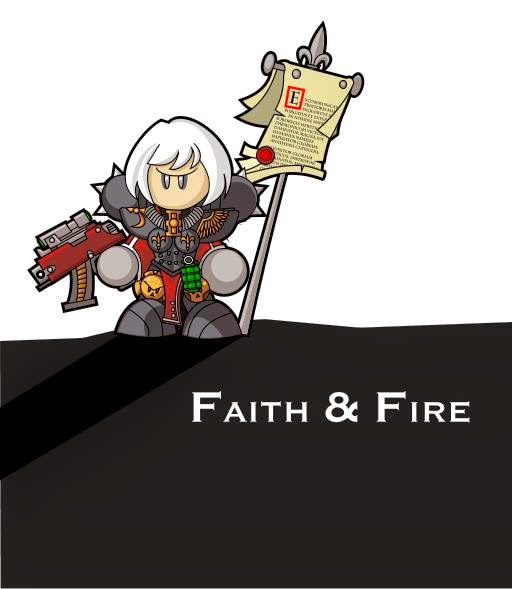
Faith & Fire

Faith & Fire by James Swallow. A Sisters of Battle novel by James Swallow, originally published March, 2006. Approx. 395 pages.

Ah yes, the Adepta Sororitas, also known as the Sisters of Battle. Those stoic daughters of the Emperor that so seamlessly combine lethal, power-armored soldiery with the "sexy nun" fetish most men harbor. The Sisters have long been fan-favorites in the WH40K universe, and yet, there are a painfully minuscule number of books devoted to them. Sure, they pop up here and there in other works. But so far, the only real chances they've had to shine on their own are in the two novels and one audio book penned by James Swallow. Oh, and the Sisters of Silence audio book penned by Edward Knight. Can't forget that one.

If you peruse online reviews of Faith & Fire, they are pretty mixed. The reviews on the lower end site problems with it such as pacing, characterization, and just being pretty boring overall. I wonder if those folks actually read the novel all the way through. F&F is by no means perfect, and it does get off to a slow start, but it ends up being a pretty decent read all in all. Let's take a look.

Faith & Fire revolves around a Celestian Squad of the Order of the Martyred Lady. This squad is led by a Sister Superior named Miriya.

No, not this Miriya. Although I confess to picturing the protagonist looking like this....


Miriya and her squad are tasked with delivering a particularly dangerous psyker named Torris Vaun from a Black Ship to the planet Neva (which the Sisters orbit in their cruiser Mercutio) and into the hands of the Ecclesiarchy leader there, one Deacon Viktor LaHayn. Things take an inevitable turn for the worse, and the psyker uses his considerable powers to engineer his escape. Turns out the Vaun was quite the successful villain and corsair down on Neva, and he is more than ready to re-engage in his nefarious former activities.

Miriya takes it as her solemn duty to track Vaun down and bring the Emperor's justice to him. Not only for her unjured pride though. Vaun's escape act led to one of her squad dying, and another feeling shamed enough to commit to the Sisters Repentia squad. And so, the chase is on.

Of course, things are not only what they seem. It turns out the Vaun's actions are geared more towards revenge, not base criminality. His actions also bring the attention of the Sororitas to bear on LaHayn himself. Could such a seemingly righteous, pious beacon of the Emperor's light be involved in the heretical happenings on Neva? And, if so, how high are the stakes that Vaun and LaHayn are playing for?

Let's take a look at where Faith & Fire hits the mark, and where it misses...

Characters:
Kind of a miss here, and that's what ultimately consigns this book to the mid-level of 40K novels.

Yeah, I've been champing at the bit to pepper this review with kawaii Sororitas "Heresy" pics. And you can bet your sweet ass that there are more to come.

The main problem with our main protagonists, the Battle Sisters, is that they are, by engineering, quite possibly even more narrow-minded than the mighty Space Marines. They are groomed for piety, and zealotry, not independent thought or creative interpretation of dogmatic doctrine. Ergo, Miriya becomes quite a rigid lead. Her dogged straight-forwardness is admirable, and her unwavering attitude gives her a strength, but there is little personality. She is given a moral tether of sorts in Verity, a Sister Hospitaller who was blood sister to Miriya's squad Sister that died in Vaun's escape. Verity is a bit more of a sympathetic figure; she possesses a broader spectrum of emotions by far. The problem with her is that everything about her, from her actions to her reactions and line delivery is fairly predictable and rote. Unfortunately, she is relegated to the role of pretty cardboard cutout.

Even as a cardboard cutout, Verity makes out better than the rest of Miriya's squadmates. They are simply extras with names. The other Celestians do little more than show up when the bolts fly, and after a certain point I gave up trying to match the brief physical descriptions with the names (at one point, I was just trying to remember which was the "wounded one"). Canoness Galatea, being the top ranking Battle Sister, is handled decently, striking a fair balance between sternness and care for those under her.

The villains fare slightly better than the heroes. Torris Vaun is fleshed out as a bad guy with every right to be bad (he's been used as a tool and a creature by those in charge since he was little), and that kind of bad guy always gets some sympathy right off the bat. I just pictured him as Rutger Hauer's Roy Batty character from Blade Runner, and it worked well. A little more pathos would have made him a great character, but he gets by on copious amounts of sarcasm and acidic one-liners just fine.

As for Deacon LaHayn, he should have had a handlebar moustache to twirl diabolically from the get-go. Not to raise the spoiler alarm, but most of the duplicitous characters in this book come festooned with red flags, so there are few surprises. LaHayn shapes up to be a decent villain in that there is a valid logic, an actual method to his madness. Although he spends most of the time chewing the scenery with glee, he does present the argument the the end might justify the means, no matter the cost of the means.

Guilty as charged.....

Story:
Faith & Fire starts off as a fugitive mystery and evolves into a conspiracy story with a grand finale. No surprises, very standard story template with fairly predictable obligatory obstacles. Nothing bad, but nothing new.

World Building (and adherence to canon terminology):
Here is where Swallow hits it out of the park. I'm guessing he decided to devote the bulk of his creativity into building a truly vibrant slice of Imperium life (too bad it ends up stocked with static characters). Swallow richly blends elements of parochial grandeur and steampunk technology. We also get excellent depictions of the specific technology of the 40K universe (the rankings, etc. of the Sororitas, various weaponry, how they work, what havoc they wreak, etc.). He knows the lore well, and does not make the telling encyclopedic or dry. You get a good idea of the physiology and capabilities of the Sisters, an accurate idea of their appearance and tactics.
Pictured: Miriya in her battle dress. Oh wait, nevermind.....(needs more fleur-de-lis).

Action:
Going back to existing reviews, some will lament how boring this book is, and some say it is non-stop action. Faith & Fire is neither, further proving how little trust you should put in online reviews. There is a significant lapse in action towards the beginning, after Vaun's escape. This is where Swallow goes into the many details of life on Neva. There is plenty of action throughout, and well-done too. There are a few nicely staged major set pieces.

Swallow writes some brutal sequences as well. he enjoys describing the effect that 40th Millenium technology has on squishy human parts. He likes to use the word "paste" often in describing remains. Anyone is susceptible to a gruesome death; it was pretty jarring when one high-ranking sister died in a mess of burning, exposed ribs. Also, he does a good job writing for the destructive powers of the psykers. There are scenes where you have witchfire against cleansing fire, and it is pretty glorious. We also get the big ending sequence featuring a literal (not literary) Deus Ex Machina.

And so, there you have it. Faith & Fire ends up being a good title, when it could have been a great title. Yet, I am sufficiently intrigued to slog through the second Sisters of Battle book, Hammer & Anvil, just to see some more Sororitas kicking rear end.

Happily.

Here's what it is:
James Swallow's first Battle Sisters offering delivers a glorious panorama of an Imperial world, populated with enjoyable, cinematic villains, and tougher than dollar steak protagonists. It's enough to make you root for the nuns and love the psyker.

Yup, sweetcheeks. Delicious, moist, heresy.

Please leave comments if you agree the Black Library needs more Sororitas novels now! Or if you have anymore Kawaii-Sisters memes, leave them too.


Final Score:

67/100


Cover Score:

Honestly, I am really not too crazy about this cover.

No. Now you are just being a pain in the ass.

The black and white color scheme is nice, but the figure of (Miriya, I guess) is too rigid. The posing should have been done a little differently to allow more visibility of the arms. Personally, I am not a fan of that style of rendering faces. But to each their own. Good detail on the uniform though.

If you ask me, they should reissue these books in omnibus form and slap a pic of master cosplayer Jna (whose Sororitas getup gives me some mightily heretical thoughts) on the cover.

Cover Final Score:

58/100

Friday, December 20, 2013

Angels Of Death Collection

Angels of Death: The Digital Collection by various authors. Originally published by The Black Library, September 2013. All stories approx. 1000 words each.

Readers can be decidedly opinionated regarding short stories (often they love them or hate them), but, you have to admit, for a universe as vast and rich as the Warhammer 40K one, short stories have an invaluable benefit. They serve as a testing ground for new authors, and, as evidenced here, can provide exposure for some of the lesser known Chapters. Now, the micro-short (roughly 1000 word per tale) format is very challenging; authors are compelled to tell a story in its entirety, while also capturing a Chapter's unique characteristics, in 3 pages. How did they fare? Of course it's a mixed-bag. There is a great assortment of writers involved here (but before you start drooling, Abnett and Dembski-Bowden sat this one out). Each has their own fans, of course, so maybe for some of them, their style just didn't gel for me, or, gelled a lot. Some of these writers represent the Black Library "Old Guard"; McNeill, Thorpe, Swallow. Some are the "New Guns" that have upped the literary value of the Library's offerings in recent years; Sanders, Wraight, Haley, Fehervari.

Be warned, many of these stories are "bolter-free"; they focus on ceremonies, character studies, etc. These make for interesting topics, and are, in my opinion, a good way to budget a tight word count. However, I can also understand that some people expect loud bangs and bloody gobbets when reading about super-human space warriors. Fair enough.

For these micro-shorts, I will be assigning a score of 1 to 10. I will list the story, the author, the Chapter involved, and then my 2 cents. You can buy the collection in its entirety or a la carte at the Black Library website.

Codex by Graham McNeill (Ultramarines):
By naming this Codex, I assume the metaphor is "by the book" (or, as the Black Librarians say, "buy the book". Sorry, no more bad puns. I promise). McNeill kicks off the collection with his go-to character, Uriel Ventris of the Ultramarines. I'll be honest, I've never read any of the Ultramarines books. I like McNeill's work to a degree; while he is a master choreographer of action, his dialogue often comes off as stilted. Such is the case here. A by the book setup, the boys in blue have to assault an ork stronghold to rescue a person of importance. It starts with some bad dialogue, and, in McNeill fashion, some affront is taken, there is a tense moment with a terse warning, and then the action starts. There is no character advancement, and none needed. There is an intentionally annoying Adept, who takes it to a new level by referring to himself in the third-person. But goddamn it, when the bolts start flying, it is beautiful. I would love to see how McNeill storyboards his action sequences. You get some bang for your buck here.
Score: 5 out of 10

Death Speakers by Andy Smillie (Executioners):
The Death Speakers, a trio of morbid Chaplains, are making the account of a fallen Executioners sergeant, culminating in his last deeds. We then flashback to that sequence. Smillie really impressed me with his brutal, visceral action scenes in the otherwise lackluster Flesh of Cretacia. This holds true here. A sufficient mood is not evoked for the ceremonial part of the tale, but the action is great, especially in Smillie's rendering of a wretched, Nurgle-infected Death Guard warrior. His descriptions of the vile, disgusting afflictions that permeate through Lebbeous Scara are perfectly stomach-turning. Not bad at all.
Score: 6 out of 10

Skin Deep by Sarah Cawkwell (Silver Skulls):
Lord Commander Argentius of the Silver Skulls comes home from fighting to get a tattoo. And his tattoo artist is dying, which makes him sad. That's it. I haven't read anything by Cawkwell before (and probably won't in the future), but I am assuming the Argentius was featured in her Space Marine Battles title "The Gildar Rift". So, I am further assuming that prior knowledge of this character going into the story might arm the reader with some emotional attachment. I had none, and this story did nothing to create it. I know nothing of Argentius, other than that he is muscular and handsome. And tattooed, obviously. But what really gets me in this story is the dialogue. It's not just bad, it's forced emotional writing. It tries so hard to be endearing, meaningful, and just ends up cloying and false, like a spoonful of Equal.
Score: 1 out of 10

Final Journey by Guy Haley (Novamarines):
There is not much to describe here. This tale is about the ceremony of tendering fallen Sergeant Voldo to his final resting place. So the word count is devoted to setting the scene, which Haley does very well. Haley is very descriptive, and uses fiercely intelligent prose to convey his ideas. This story is one that you can completely immerse yourself into for 3 pages; and feel the somber tone. Well done.
Score: 7 out of 10

Judgement by Mark Latham (Doom Legion): 
The Doom Legion is a Chapter I would like to hear more about. They are one of those Chapters which are under the microscope of the Inquisition, their ultimate affiliation and loyalty to the Emperor being under question and investigation. So, in this tale, which sees an Inquisitor being sent on his way before more important business was attended to, there was a lot of potential for tension and drama. Unfortunately, instead of craftily veiled threats and accusations, what we get is basic sarcasm. And, the three main characters doing the talking all use that same level of sarcasm in their dialogue, despite their vastly different affiliations. Point being, Latham did not alter his dialogue for different speakers. Pretty bush-league fumble, in what should have been a good story. I will admit, I would really like to know what happens after the final line.
Score: 3 out of 10

Bastions by Rob Sanders (Excoriators):
I have been jonesing for some more Excoriators action since the excellent Legion of the Damned. I was pretty psyched when I saw that Sanders put this tale out. When a Chaplain and his contingent board the watch-fortress Semper Vigilare to read charges of dereliction against the Castellan, they find the cause of the infractions, and it is a greater horror than they could have imagined. There is some great, blistering action going on here, bolstered by Sanders' trademark rich descriptions and cinematic style. Proper service has been given to the Excoriators, from mention of their maintaining and reverence of battle-damage, to their style of attrition fighting, maximizing enemy losses while minimizing ally loss. Even better, this story is more than double the length of most of the other stories in the collection. Please, let Sanders put out a full-length Excoriators novel!
Score: 10 out of 10

Iron Priest by Chris Wraight (Sky Warriors):
Wraight brings us a tale of a boy, and the man he will be. Young Olvar is making his way on his journey to become an Iron Priest of the Sky Warriors of Fenris. But something is watching him. Also, the grown Iron Priest, now known by a different name, does battle with a champion of Chaos. Wraight is one of the strongest writers in the Black Library stable, and the bifurcated approach he used here paid off well. This is a nice, solid tale of the bonds we forge in our journeys, and how they affect us. Well done.
Score: 9 out of 10

Iron Soul by Phil Kelly (Iron Hands):
While billed as an Iron Hands story, most of the plot focuses on a Space Wolves Wolf Priest. Wolf Priest Leatherhand is making his rounds in the aftermath of a tyranid/Iron Hands battle. While going about his business harvesting progenoid glands, he engages in some discourse with a dying Dreadnought. It's nice to watch the priest at work, and there is a bit of a twist at the end with a knee-jerk finale. This one was well-written through and through.
Score: 8 out of 10

Mission:Annihilate by Gav Thorpe (Deathwatch):
I don't know why it is so hard for me to get into Thorpe's books. I can see that he strings words and ideas with precision, and yet, nothing he writes ever pops off of the paper and grabs me. I've tried starting a lot of his books and stories, and yet the only one that I finished was his enjoyable, if not very memorable, dwarf book Grudgebearer. Mission:Annihilate is another case of this. There was absolutely nothing engaging about this tale. None of the immediacy or urgency that should drive a Deathwatch tale, especially one with stakes this high. The baddies here are the necrons, who get no real screen time. I couldn't even be bothered to commit to memory the names of the Deathwatch team members, or even care what Chapters they had been cobbled together from. If you want good Deathwatch action, pick up something from Steve Parker.
Score: 2 out of 10

The Judges, in Their Hunger by David Annandale (Carcharadons):
Lord Nathaniel Bellasun of Sendennis is in crisis mode. The Flawless Host has taken the planet, and he must now find the best way to supplicate and ingratiate himself to his new lords so as to insure his continued survival. And then, a miracle. Salvation! Annandale has crafted a juicy little tale here, with a very clever, fitting title. It is easy to see that sharks have stunning smiles which become terrifying when they turn to you. Finishing this story, you find yourself wanting to hang around for another page or two to see the true judge dispense real justice. It would be nice to see some more shorts featuring the Carcharadons.
Score: 8 out of 10

Duty's End by Robin Cruddace (Howling Griffons):
Cruddace's freshman short story finds a lone Space Marine holding the line against a rampaging horde of orks. Already reeling from his injuries, the Griffon still deals out death in a manner as natural as breathing. Cruddace does well in capturing the motions of an Astartes in action, the violence being relayed well. However, some small thing is missing. There is nothing to distinguish this lone Marine as a Howling Griffon. He could have been a member of any Chapter, saying it is the Griffons just prompts you to imagine him in a certain color scheme. But then again, in a story like this, isn't that enough? You'll have to decide that one yourself, as the reader. Well done overall.
Score: 7 out of 10

Cadre by Josh Reynolds (Mentors):
Now Cadre, on the other hand, makes the Chapter's characteristics the driving point of the plot. The Mentors Chapter act as sort of Astartes consultants, working with resistance fighters to make them more self-sufficient. In Cadre, Tutor Manse helps a pocket of fighters strike back against some cultists. Another thing that makes this story stand out is that Reynolds injects a little more levity into his prose than the other authors. It feels....odd. But, oddly, it kind of works. Kind of. In the end, a good short story. Not great, totally different. Which is admirable. Honestly though, I don't need anymore Mentors stories in my life. This one was more than sufficient.
Score: 6 out of 10

Setting the Stage by C.L. Werner (Emperor's Warbringers):
Warhammer Fantasy cornerstone author Werner has done some work in the 40K universe (his Siege of Castellax is floating on the "To Read" horizon), and this tale is his second featuring the Emperor's Warbringers (his first appeared in the Victories of the Space Marines anthology). What makes the Warbringers special is their truly practical approach to warfare. This story focuses on Feralis IV, a planet that has fallen to the ranks of traitor guardsmen. The Warbringers' plan is to cause chaos and foster confusion among the traitors before they make planetfall. Tasked with this special ops endeavor is a contingent of Warbringers scouts. Setting the Stage recounts their maneuvers as the scout squad fishes for a big catch with a very special piece of bait. This is another of the few stories in this collection that fully integrates the spirit of a chosen Chapter with a complete story. Werner's descriptive prose is top-notch as always, gory, harsh, brutal, perfect for the medium.
Score: 9 out of 10

Honour of the Third by Gav Thorpe (Dark Angels):
Thorpe's second offering in this collection focuses on the Dark Angels, a Chapter he has done considerable work with in the past. Legendary Sergeant Belial helps lead an explosive egress from a Temple, and the forces of arch-fiend Furion. Some explosive action culminates in a nifty duel. It's exciting, fast-paced, but not as visceral as some of the more recent authors. But in all honesty I enjoyed this tale immensely more than Mission:Annihilate. The Dark Angels are a compelling Chapter, the duels have a brutal balletic grace to them.I don't know if the Belial/Furion dynamic branches into any other works, but their encounter here is well done.
Score: 7 out of 10

The Fury by James Swallow (Blood Angels):
Here we have another classic Black Library author weaving a tale with their iconic, go-to Chapter. What The Fury focuses on is one aspect of the Blood Angels' persona: the Black Rage. The blood fury of mental instability that warriors of the Chapter can fall to. And in this short tale, we watch a brother succumb. The Fury is paced brilliantly, and its first person POV allows the reader to truly step into the ceramite armor and watch the goings-on. And there is blood; oh so much blood. This is how you put 1,000 words into brutal, blood-soaked use.
Score: 9 out of 10

No Worse Sin by Joe Parrino (Brazen Claws):
I was thoroughly impressed by Parrino's Witness a while back, and hoped that future works would maintain the same level of quality. Well, the strengths that he exhibited in Witness; setting mood and tone, are definitely evident here. No Worse Sin is one of the stories in the collection that does not see a single bolt fired; although there is a nice, nasty twist at the end. At the tail end of a failing twenty year crusade to avenge their fallen home world, Chapter Master Engentre summons his legion. Those who answer, severely decimated and depleted, finally confront him on the folly of the venture. It is a tense story, and Parrino does well in capturing that emotion which is so strong, so prevalent in the Emperor's Angels: pride. Injured pride, acceptance of wrong and loss. Very well done. Please tell me Parrino is going to get a full-length 40K novel out soon.
Score: 9 out of 10

Visage of Zeal by C.Z.Dunn (Black Templars):
Christian (C.Z.) Dunn has been editing at the Black Library for pretty much forever. However, in the past year or so he has started churning out some shorts and novellas. To be honest, I really didn't think much of Easy Prey, his entry in the 15th Birthday Collection. Even though I did not expect much going into this tale, I ended up enjoying it well enough. Fun, but forgettable. A Black Templars Chaplain peruses a field, looking for a certain trophy from a fallen brother. Flashbacks serve to relay the last moments of said brother Chaplain. Nothing reaches up from the pages and grips you, but the battle scenes are rendered well enough.
Score: 6 out of 10

The Third War by Ray Harrison (Mortifactors):
A Chaplain of the Mortifactors Chapter engages in the near-death meditation and sees events to come on Armageddon. Such a basic premise, but it fully focuses on a unique aspect of this Chapter. And Harrison's descriptions of the surroundings, and the orks in particular, are masterful. Not much else to say, but it is a rousing three pages.
Score: 8 out of 10

Final Duty by David Guymer (Hospitallers):
***RECORDS EXPUNGED***

The Ghost Halls by L.J. Goulding (Grey Knights):
In this tale, a group of Grey Knights wait patiently in an eldar dome to speak with a revered seer. Okay, I'm sure this all ties into some larger storyline. But even though I have no idea which one, that isn't the reason why I didn't care for this story. The writing just didn't work for me. At all. The writing seemed patently false (yes, I understand it is hypocritical to claim falseness regarding dialogue between genetically engineered super-humans and ancient alien races), and is completely bland. Pass.
Score: 1 out of 10

The Tithe by Ben Counter (Imperial Fists):
Long time readers seem to have a love or hate relationship with Counter, so, with the only offering of his that I have read being Galaxy in Flames, I came into this expecting some nice, easy, mindless fun. The Tithe follows an Imperial Fists brother, and his relationship to an Iron Warrior that he slew in combat. Counter's style focuses less on poetic descriptions, and more on which pattern bolter an Astartes uses, or which version armor they don. He also tries to go for a surprise at the end, which aspires to be shocking, but comes off as corny.
Score: 3 out of 10

Rite of Pain by Nick Kyme (Salamanders):
I'll put it bluntly, it is a chore for me to get through anything by Kyme, and this tale is no different. Someone is being tortured throughout the story, and then a Chaplain fights him. Maybe if I read Kyme's Salamander books, I would know who some of these folks are, but I don't, and I don't care to know. Here's the challenge to the author: if you are writing a story that requires some previous knowledge to understand, make your writing interesting enough that established readers are satisfied, and also engaging enough to pique the curiosity of potential readers. It's not easy to do, I understand. I couldn't get into this; for Salamanders fans only.
Score: 2 out of 10

Trophies by Cavan Scott (Death Spectres):
I did not much care for Scott's Doom Flight, so hope were not high going into Trophies. The same problems which plagued Doom Flight are evident here as well; I just don't think Scott "gets" the Astartes mentality. However, once again, the action scenes are well done, and the tale never lapses into being boring. In Trophies, we have a Death Spectre engaging in a hunting expedition, under the guise of purging xenos in the name of the Emperor. The protagonist is a real jerk (well hey, no one ever said Space Marines were nice). Again, good action, bad everything else. Side note: this is one of the longer stories. About five pages where most of the others are around three.
Score: 4 out of 10

The Thrill of the Hunt by Anthony Reynolds (White Scars):
Whereas some of the tales in the collection focus on ceremony, Thrill of the Hunt centers entirely on action. Action, and how the Scars relish harrying their prey from their mighty bikes. In this story, the prey is eldar. There is nothing earth-shattering or game-changing in this story, you are just watching a chase in motion. Fun, forgettable reading.
Score: 6 out of 10

The Crown of Thorns by Peter Fehervari (Angels Penitent):
Peter Fehervari's Fire Caste blew me away earlier this year, and so I had some high hopes for this story, especially since this would be my first exposure to his handling of Space Marines. Crown of Thorns is another absolute home run for him. The Angels Penitent are an intriguing Chapter, being formerly named the Angels Resplendent. However, the entire Chapter falls under the sway of an eerie, spectral martyr figure, and they now operate under a brutal, dogmatic regime. With the ascendancy of this new ruling order, books and art are now forbidden (doesn't sound like too much of a stretch from most militant religious orders, now does it?), and the Crown of Thorns, a panel of Chaplains acting as judges, metes out cruel punishments for perceived infractions. In the story, a sergeant prepares to bring a neophyte before this kangaroo court, knowing full well the extents of how much wrong is going on around him. Now, Crown of Thorns is another five-pager, but the amount of Chapter backstory (along with the main narrative) that Fehervari packs into it is nothing short of amazing. Bravo!
Score: 10 out of 10

By Artifice, Alone by George Mann (Raven Guard):
George Mann has been putting out a bunch of Raven Guard shorts recently, that I unfortunately missed out on. I was glad for this story so that I could get a sampling of his work. What we have here is Raven Guard Captain Koryn having his mental mettle tested by Chaplain Cordae prior to a major engagement. As Koryn prepares his armor, he resolves himself to his probable fate and engages in the wordplay. This story is written well enough, although it strays somewhat towards melodrama. It would be great to read a novella of the engagement itself, Raven Guard paired with Brazen Minotaurs. One can only hope, right?
Score: 6 out of 10 

Bitter Salvage by Nick Kyme (Marines Malevolent):
Kyme strikes back in this collection. This time, he has Marines Malevolent (a very interesting Chapter to write about) squaring off with some Black Templars over the spoils of a tussle with some orks. After some insults are traded, a duel ensues. However, unlike most duels, honor is not the only motive here. Salvage stands head and shoulders above Rite of Pain in terms of quality, but it still is not a "good" work. Points for an original story concept, and decent duel choreography. If only Kyme could craft some more clever wording, and not focus on telling the audience what he is implying so as to ensure that they "get it".
Score: 5 out of 10

Vigil by James Swallow (Doom Eagles):
Yes! Now this is a great story! Brother-Sergeant Tarikus of the Doom Eagles is waiting. For other a Terran standard month, he waits. And as he waits, he reflects on his philosophy, his cause, his purpose. This is how you summarize the psychology of the Doom Eagles, that death is inevitable, it is the point of service to the Emperor, and that the only thing of importance is to make sure that you inflict as much death on the enemy as possible before succumbing to your own. And it all culminates in a rousing finale as well. Swallow really steps it up here, and the payoff is huge. Like I said, he has perfectly depicted a Chapter philosophy in the span of three pages. Great work!
Score: 10 out of 10

Blood Calm by Guy Haley (Blood Drinkers):
With their Chapter Master dead, Captains Castor and Sorael, of the First and Fifth Companies (respectively), will duel for the right to don the mantle of stewardship. Squared off, swords drawn, it seems a perfectly typical duel, except, the victor will be the one that displays "Blood Calm", a mental state of mind in which the blood thirst so integral to the Chapter's internal programming is harnessed as the task at hand is completed. Under the blistering sun of their homeworld, and denied the sanguineous nectar they so crave, who shall emerge victorious?
Haley is in great form here. He deftly uses the motif of the oppressive heat to accentuate the thirst that must be suppressed. Even if the outcome is never really in doubt, the tension builds, with a payoff as satisfying as a burst vein rupturing forth for these frightening warriors.
Score: 9.5 out of 10

Reclamation by L.J. Goulding (Scythes of the Emperor):
Boy oh boy oh boy. What can I say here? I have never hidden my admiration for the short story "Orphans of the Kraken" (it being, actually, the first story I ever read focusing on the Space Marines). I can't say that the Scythes are my favorite Chapter, but their decimated situation provides the potential for great storytelling. In the hands of a good storyteller. Which Goulding, unfortunately, is not. More's the pity, there's a chance that he may pen the full-length Scythes SMB novel, if it ever sees the light of day (please, Black Library, just let Richard Williams do it).
Anyway, enough complaining. What's going on in this story? Not much, to be honest. Some neophytes show their Forge Master some salvage (as the Scythes are reduced to being scavengers), and he gives some trivia regarding it. Then there is a nice piece presented. The problem is that Goulding does nothing to evoke emotion here. Either a paragraph at the beginning to really draw a picture of the surroundings, or some work with the dialogue to capitalize on the range of emotions circling this rebuilding Chapter, would have worked wonders here. Goulding knows the lore, but the soul eludes.
Score: 1 out of 10

Obsidian by Graham McNeill (Sable Swords):
The Sable Swords are an interesting Chapter, formed to replace the decimated Astral Knights. Obsidian deals with the transfer of ownership of the Astral Knights' fortress monastery to the Swords, who will assume stewardship and garrison it.
McNeill is another writer that isn't your best bet for character-driven work. He maps out masterful battles, and he can paint vivid backgrounds. But his dialogue has a generic movie-script feel to it, and you can bet sooner or later someone will either reach for a sword (or other weapon), or seriously contemplate doing so. Spoiler Alert: it happens in Obsidian.
Obsidian isn't a bad story, but there was so much potential here. You have the dynamic of the older inhabitants that bridle at being put out to pasture, and the resentment they naturally feel for their replacements. Replacements that bear them no ill, and who have their own tests to face in the future. But it is definitely readable, and good subject matter.
Score:5.5 out of 10

Here's what it is (Final Thoughts):
Well there's not much to add here. It is what it is; so if you are one of those that do not care for the micro-shorts in general, just pass. The good is that one of you favorite Black Library authors probably has an offering here, and some really interesting Chapters are getting to see the light of day. I will say this, while I appreciate the directions that some of the authors took here, I would have loved to see a little more; say an epic short poem, or an account in the form of a distress transmission. You know, something a little different. Oh well, maybe next year.

Cover Score:

The cover of each story in this collection is essentially the same; the basic color scheme characters you usually see on the Warhammer wiki, adjusted for the unique heraldry of the showcased Chapter. For a slew of $1.99 shorts, I guess no one could expect unique covers for each short. The collection cover is just an array of such pics with the text in the middle. Nothing special.

Cover Final Score: 25/100