Showing posts with label Anthologies. Show all posts

Tuesday, January 9, 2018

Kaiju Rising: Age Of Monsters II Kickstarter

Today is a truly momentous day! Why, you may ask? Because today marks the launch of a brand new, exciting Kickstarter: “Kaiju Rising: Age of Monsters II”!


Long-time followers of the blog will remember how thrilled I was when the Kickstarter for the first edition ran. And, as we can see by general consensus around the web, the end result was stellar. For all those who haven’t read my review yet, I have a page dedicated to my reviews of all the stories here.

As an added bonus, we are joined today by my good friend Nick Sharps, who not only serves as one of the editors for this edition, but was one of the editors of the first edition as well.

Nick, it’s really great to have you here. To kick things off, can you tell us a bit about the Kaiju Rising: Age of Monsters II Kickstarter?

N.S.: Kaiju Rising: Age of Monsters II is (unsurprisingly) a sequel to Kaiju Rising: Age of Monsters, a project that is very near and dear to my heart. This time around we’re offering stories from 15 stories from such names as Marie Brennan (A Natural History of Dragons), Jeremy Robinson (Project Nemesis), Dan Wells (I Am Not a Serial Killer), Lee Murray (Into the Mist), and more.

The first Kaiju Rising anthology was a work of genius. It was filled with top-notch entries; some which played by generally accepted “kaiju rules”, and some that were completely original concepts. Yet, they were all high quality. As someone who was directly involved in putting together this tome, what was the experience like for you (then and now), and what has been some of the feedback/response that you’ve seen first-hand?

N.S.: I’m extremely proud of the first anthology and humbled by the support it garnered from the fans. To say I was impressed by the quality and diversity of the stories on display would be a Godzilla-sized understatement. The authors delivered stories that explored the kaiju genre in a number of unexpected ways and I had as much fun reading the anthology as anyone who backed the Kickstarter or bought the book after commercial release. I’m a fanboy first and an editor second (thankfully we have true professionals such as Tim Marquitz on the first book and Alana Joli Abbott to cover for me). The feedback has been largely positive, enough so that it was a no brainer to assemble a sequel.

I’m sure, like with the first Kaiju Rising, there’ll be some kick-ass add-ons and unlockable goals associated with the second edition. Can you enlighten us as to some?

N.S.: This time around we’ve decided to keep things mean and streamlined. We’re aware that the previous publisher had issues fulfilling some of its promises. We plan on dodging that bullet by taking a simpler route and just offering the sequel (in multiple formats) as well as the original. There are also Tuckerization/Red Shirt options from almost all of the authors available for fans who want to be written into giant monster stories by their favorite word weavers. It’s all about the most important thing this time around – the book.

First impressions are really important, and this cover is killer. It combines shades of Toho goodness and Harryhausen’s Kraken and brings it to a nightmarish level. Who do we have to thank for this?

N.S.: Tan Ho Sim (AlienTan) really knocked it out of the park with the Kaiju Rising: Age of Monsters II cover. I think the illustration conveys what we’re aiming for with the anthology – big, beautiful, badass monsters absolutely wrecking face. We recruited Tan for this project based on his work with the Tiny Frontiers: Mecha and Monsters RPG from Gallant Knight Games. If you’re into giant monsters and role playing games you should really check it out. Hell, even if you’re not into RPGs you should check it out for the awesome art alone (disclaimer: I have a micro setting in the game book).


How about your own kaiju passion? I’ve been a kaiju fan since seeing the original King Kong in a theater re-release when I was about 5; as well as WPIX Channel 11 Godzilla marathons. You were able to deliver an anthology that satisfied a devoted fandom. What are your own favorite kaiju movies/books/etc.

N.S.: This is going to be controversial but my absolute favorite is Cloverfield. I love Cloverfield. It blew me away in theaters and my admiration of it has only grown. I’ll say 10 Cloverfield Lane deflated that passion a little but I can’t really blame the original for that as it’s only a pseudo sequel. Godzilla and all the Japanese kaiju are classics but I’m an American and I appreciate the concept of having our own giant monsters. Another controversial film choice is the 2005 remake of King Kong. Apart from the over-long bit in New York at the end I really enjoy that flick. And as far as books go I cannot recommend Jeremy Robinson’s Project Nemesis series enough. Anyone who enjoys these anthologies and hasn’t already read Robinson needs to go add Project Nemesis to their Amazon cart right now.

If you could see one grand kaiju battle, who would you choose?

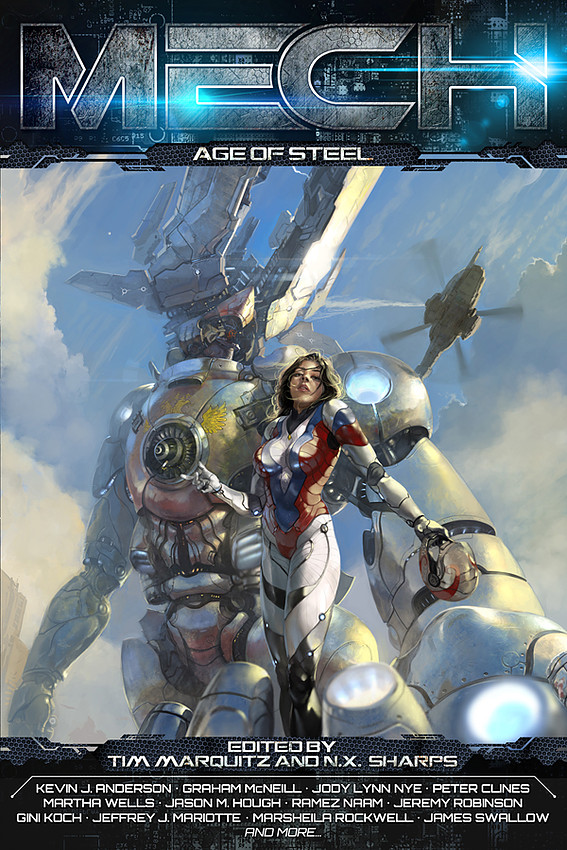
N.S.: I’d actually really love to see some of the kaiju from the first anthology square off. Kane Gilmour’s Kashikoi from the story “The Lighthouse Keeper of Kurohaka Island” is a fan favorite and has an entire island made of kaiju bones to add to its kill tally. Dzoavits from Edward M. Erdelac’s “Devil’s Cap Brawl” was an interesting specimen that could hold its own in a brawl. And then C.L. Werner’s Mishipeshu from “Animikii vs. Mishipeshu” and the MECH: Age of Steel anthology story “Theseus IV vs. Mecha-Mishipeshu” is another pit fighter. I say throw the three of them in an arena and LET THEM FIGHT!


Anything else you want to add today?

N.S.: I’d like to thank you for reviewing Kaiju Rising: Age of Monsters before we were even friends and for giving me the blog space to promote the sequel now. I’d also like to thank everyone who has supported these anthologies. I mentioned earlier what a humbling experience it can be. It’s no less of a humbling experience the second or third time around as it was the first. If anything it’s even more so. The amount of money the fans were able to raise for these projects, these labors of love, is staggering. I am so thankful for your continued support and I genuinely hope that you will love Kaiju Rising: Age of Monsters II as much as I do.

Alright, well there you have it! So now that you have the info, head on over to Kickstarter and back this amazing anthology! Starting today, the Kaiju rise again!

Monday, August 28, 2017

Angler In Darkness

Angler in Darkness by Edward M. Erdelac. A short story anthology, originally published August, 2017. Approx. 329 pages.


Here we have a collection of tales, most collected from previous publications; with some that were previously unpublished. You have a fairly diverse group here; starting off with a slew of weird Westerns, and then giving us a mix of kaiju stories, Irish mob tales with a supernatural twist, tales inspired by Japanese folklore, and unique takes on classic stories.

This is one of the rare anthologies where, quite frankly, every story is a winner. There are no middling or marginal entries here. If you haven't read any of Erdelac's work before, consider this a perfect primer, or sampling platter. I really enjoy the interests from which he sources his material, and he always seeks tirelessly to put fresh/unique twists on all of them. Many stories have elements of the weird and horrific, and he makes sure to grant these takes legitimacy via logical execution. Also, he writes some of the best, bloodiest action scenes out there.

I will say that the arrangement of the stories threw me a bit. The collection is front-loaded with the Western tales, and then the remaining stories are somewhat randomly ordered. Also, there were a few typos throughout - averaging about one or two per entry. No dealbreaker for me; but they are out there.

But, again, great stories, and a sweet cover to boot! Here are my takes on the individual entries. Enjoy!

The Mound of the Night Panther: The first story in the collection tells the tale of Auguste Oudin; a trapper of French and Indian heritage who sets off on hunt for gold, and instead unearths a terrible history lesson.

After bringing some priests down to the States from Canada, Oudin barters with a local Indian boy for a gold-flecked gaming piece. To him, this is a veritable treasure map, leading to a claim, and prosperity. However, what he finds instead are a collection of huge monumental mounds; too massive to be barrows, and permeating with a palpable aura of foreboding.

Setting up camp, Oudin finds himself approached by an Indian elder; who begins to share with him the history of the sacred land...

Ok, you can tell from the premise that all will probably not go well here. However, what makes this story pop is Erdelac's respect for the source material, attention to detail, and talent for portraying vivid, brutal acts of violence. Native American lore is ripe with great material; and in this tale we hear of the Mishipijiw, the terrifying "water panther". We also find ourselves awash in the blood-soaked pages of this culture's history.

On a personal level, there is another reason why this story resonated with me. I remember when I was a little kid, we went on a school trip to the Museum of Natural History. Well, actually, it was a fairly popular school trip destination, but I remember one time most of all. Maybe I was the right age for being impressionable to the material, maybe it was a great tour guide. But in this visit, I first learned the story of Romulus and Remus, as well as the Indian tribes that played games in great arenas, with their very lives on the line. And now, Erdelac has incorporated elements from both legends; tales from separate continents, into one powerful short story.

All in all, a direct premise yields anything but a simple story. Erdelac pulls you back in time, drags you through a hallucinogenic nightmare, and leaves you in a place where the tenuous membrane between reality and legend isn't just blurred, it is torn to shreds. Great story to kick off an anthology.

Killer of the Dead: Here we have another 'weird Western'; but in this case, it's a fast, violent piece with all the surprise and power of a sudden gut-punch. The premise here is simple and direct: a young Indian boy, staying up late to greet the men of the village when they return from a hunt, bears witness to a quartet of pale riders as they massacre they village. There is a twist, of course; these riders are not just typical white men: they are not only in for wanton slaughter; they also suck the very life out of their victims.

Killer of the Dead gives us a setup, a conflict, and a resolution; but the execution ensures that it yields much more than that. Erdelac focuses on the right details to make each character identifiable and memorable (especially the villains). This is a difficult task when working within a very tight word count. The violence is also well done; brutal and pulpy. But, perhaps my highest praise can be awarded to the "vampire elements": for example, the imagery of their cheeks drawing in as they take deep drinks from their prey is something that sticks with you.

This is a great little story. As said, it's very short, and very violent. There is no expository backstory involved; but the details given tell you all you need to know. Actually, allow me to correct myself - there is a bit of backstory, if you take the minute to read the author's intro. Here, Erdelac lists some of the inspirations that went into this tale; including the criminally underrated vampire film Near Dark.

Bigfoot Walsh: The third story in the anthology is also a Western tale. Here we have the first person POV of  Keidel, a liberal-minded Dutch doctor who helps both settlers as well as local Indians. He joins up with a group of Texas Rangers to investigate a brutal raid (read: murder spree) that the Rangers are eager to pin upon the Comanche Indians (with whom the locals have a tenuous treaty in place). With the dual hope of preserving this treaty, as well as assisting any survivors, he sets off with them.

Along the way, they meet up with the titular Walsh, a quite literal Sasquatch type who is an excellent tracker/pathfinder for the Rangers. He has some leads of his own in his mind as to who the culprits are, and the group sets out with new purpose. No one, in the end, is quite prepared for what they are about to face.

Bigfoot Walsh is yet another excellent entry. Violence is the very lifeblood here; and of the first three stories, this is the one that yields the most primal ferocity and pent-up rage; as the story escalates from a routine search into something akin to Eaters of the Dead.

On top of all the other great elements here, it is the character of Walsh that seals the deal. Erdelac makes him into such an interesting entity that he outright steals every scene that he is in.

If there is one thing that I could cite as a detraction to the tale, it's the character of Keidel. I know he is integral in that he will 'bear witness' to what transpires, but I think he could've done more to show his overall mettle in the climactic action piece. Other than that, solid all around.

Devil's Cap Brawl: This is the story that first introduced me to Erdelac's work; and I originally read it in the Kaiju Rising anthology. So, I'll just copy paste that review here:

This was a fun one. Devil's Cap Brawl is set in the Dead West universe (also published by Ragnarok, I've read a bit of the first book - Those Poor, Poor, Bastards by Tim Marquitz - and really enjoyed it).

In this story, workers for a railroad baron literally unearth a long-buried miscreant monster as they go about blasting through the titular mountain. Luckily for them, they find that they have a rather unconventional ally on their side. I really don't want to get too much into it, for the sake of avoiding spoilers.

The writing here, as in the other Dead West books, is balls to the wall and full throttle. A lot of the stories in this anthology have curses, but this takes it to a new level, peppered throughout with some quite politically incorrect language. The fact that the protagonists nickname was bestowed upon him for the sheer volume of blasphemous language he uses is one clue. The fact that he is also a brash, back street brawling Irishman in the 1800's in charge of Indians and Chinamen should give you another hint of what kind of language is in store.

Erdelac does a great job in painting the scenery, fleshing out his monster, and choreographing the action. I had a bit of trouble at first with the "good guy", but he made it work. This story is the badass bastard offspring of the frantic coupling of classic Western pulp tales and good old fashioned giant monster stories.

Spearfinger: In Spearfinger, a Cherokee half-breed sheriff named Ben Burnham is on the trail of a town ne'er do well who has committed a pretty heinous crime. As his quarry flees up a mountain, attempting an egress to Arkansas, Burnham, the victim's loved ones, and all else involved find themselves within the domain of a horrifying creature known as Spearfinger.

Although this is another Western story, Erdelac flexes some serious horror chops in this outing. He imbues his characters with enough depth and personal baggage to make them all empathetic, an his depiction of the titular creature is pretty bone-rattling. But his best work is in the descriptions and detailing, shown in such colorful metaphors as comparing the click-clacking of branches in the wind to "the applause of skeletal hands". That's good stuff right there.

See also some influences from other books and movies peppered throughout. The crime committed by the slow-minded Waterback carries shades of Cormac McCarthy's "Child of God". There are also scenes evocative of the body-snatcher horrors of "The Thing".

This is a great story that I will avoid going into too much detail on, so as to avoid spoilers. But it is Erdelac at his violent, terrifying top form.

In Thunder's Shadow: I really enjoyed the premise of this story. Set during the Bone Wars, we follow academic Calvin Pabodie and his grizzled guide Neb Bukes as he sets out to research the area where a fossil was discovered.

In this story, Erdelac gleefully fleshes out a full-blown dinosaur adventure based upon the old, staged Huachuca/Thunderbird photos. Coupling his already mentioned versatile and colorful prose with truly memorable characters yields a yarn the spoke directly to my younger, dinosaur-obsessed self.

Pabodie is a classic, textbook academic character on a quest for a new discovery. Bukes, on the other hand, absolutely steals the show. He is a cantankerous combination of Rooster Cogburn and Matthew McConaughey's character in Reign of Fire.

I cannot laud enough Erdelac's job in making the pteranodons seem 'real' here. Instead of just trying to impress the reader with size or danger, he makes them living flesh; as if they are terrifying entities that you can reach out and touch - or ones that could reach out and snatch you.

Also, this story has some of the most vivid and imaginative violence in the whole book. I mean, in how many stories does the protagonist get knocked out cold by a donkey leg blown off in an explosion? You tell me.

The Blood Bay: I am reviewing these stories as I read them; but I'm predicting that this might just be the best tale in the anthology. The Blood Bay, as Erdelac explains in the introduction, plays off of the narrative of Steinbeck's 'The Red Pony' (one of my least favorite books of all time), and then ups the ante by incorporating such legendary equines as the Man-Eating Horses of Diomedes and Alexander the Great's own steed, Bucephalus.

In The Blood Bay, we meet Jonas, a sullen young boy whose father has absconded for greener pastures; leaving him in the care of his alcoholic mother and bitter grandmother. After a gruesome turn of events, his father comes to collect him, and try to integrate him into the better life that he has made for himself. This is no easy transition for a boy already molded by bitterness; although a glimmer of hope soon arrives in the form of the titular steed.

Gifted to Jonas by his appeasing father, there is a wildness and fierceness about this new horse; as well as something unsettling to all those around. As misfortune begins to falls upon Jonas' new 'family', we quickly realize that this is not just a wild-spirited horse; it is no less than a creature transplanted from the aforementioned mythologies. And, while we see the thin veneer of the 'perfect life' of Jonas' father, Famous Fallon, erode over the course of the tale, we cannot help but stare in awe at the perfect bond between the boy and his horse.

It is, indeed, the depth of the characters that make this story the minor masterpiece that it is. It is the strength of these characters that bolster the premise, which is so ludicrous that it is bold. I was blown away by the character of Jonas - here we have a true representation of a boy hardened way too early in life, due primarily to the actions of those who should have looking out for him instead of themselves. The harsh life lessons he learns early on are the drivers for his tightly coiled anger and reticence. And, it frightens me to a degree; since I have seen boys my son's age, around where we live, who come from tough or broken homes, who carry themselves and speak much in the same way as Jonas. I find myself seeing their faces as I read the words coming out of his mouth.

The action and violence in this story is much like as in the other tales; it is dark, brutal, bloody, oftentimes sudden and shocking, but never over the top or superfluous to the narrative. It must be a difficult balance to strike; but it is done successfully here.

The Blood Bay is a frightening story that will likely haunt you for days after reading it.

The Exclusive: According to the author intro for this tale, this one ties into the Merkabah Rider series, which has definitely been on the TBR horizon for a while. This tale might be responsible for moving it up a few rungs in reading expediency.

In The Exclusive, we meet Barry Twiggs, a reporter at a New Mexico newspaper who most decidedly opts to step on precisely the wrong toes (continuously) when he commits to printing all the dirt he can dig up on local magnate Tom Cotter. This leads to harassment, assaults, and, finally his untimely death. However, in this surprisingly clever and deep story, death is just the beginning. For, in this story, death brings Death, and Twiggs offers the proposal to hear His side of the story.

I don't know how much the Angel of Death appears in the Merkabah Rider series; but, if he is handled this well in them, he might just be the kind of scene-stealer that Death in the Discworld series always was.

The best part of this yarn come in when Erdelac uses Death (or, properly, Samael) as a mouthpiece to recount happenings from the very beginning of time. We get hints about Satan's fall from grace, and of Adam and Lilith's earliest transgressions and petulance. These are very engrossing and interesting portions.

Erdelac also makes Samael a sympathetic soul: a being who is, in turns, stoic, withdrawn, rageful, dutiful, and mournful. But, what allows us to find commonality with him is that he has, like all of us, suffered at one point from that most tragic, and deeply felt hurt of all: the loss of love.

The portrayal of Twiggs is well done, also. Personally, his banter with Samael gets a bit too cute at times, but I can understand the Erdelac is trying to keep some levity flowing through some otherwise sombre material. Plus, as we can see over the full course of the story, Twiggs is not just a one-note narrator. Like Death, he has a story to tell as well. And, it is a truly heartbreaking one.

Tell Tom Tildrum: Ah, yes, there was some really good stuff in this story. Although, I will say, to truly enjoy this tale at its fullest, you might want to do a bit of homework first. Definitely read the author's intro, as well as Erdelac's blog post about what went into making this tale. Then, if you aren't familiar with them, read up on some of the notorious exploits of "white hunters" as well as the Happy Valley Set.

So, this story first appeared in an anthology called 'Tales from the Bell Chair', the premise of which posited an exclusive club which members could only join by regaling the current members with a shocking personal tale, and having it be riveting enough to garner their approval. Nice. Very cool.

In Tell Tom Tildrum, the prospective new member is one Captain Howe, who will choose to tell a certain story from among his drink and drug-addled days of running with the Happy Valley folks. The tale he tells recounts a lion hunt that goes horribly, horribly wrong. And that's all I'll say on that, so as to avoid spoilers.

Erdelac's 'method writing', making the setting so palpable that it allows for complete reader immersion, is what truly elevates the story here. It is not just making the horizon feel alive; there is something great in how he captures the mindset of these people; for whom their personal hedonism allowed them to blithely eschew anything that even remotely resembled a moral compass.

For me, the end sequence came off as a bit over the top - well, to be honest, I never wanted the story to leave Kenya - but, it does make sense in the tying up the narrative, so I can't complain. It also incorporates the angle of citing the classic fable "The King o' the Cats". Plus, the closing lines are, in equal amounts, beautiful and jarring.

Mighty Nanuq: As previously mentioned, my first exposure to Erdelac came from his Kaiju Rising contribution. Little did I know just how many 'giant monster' tales he has under his belt. Here we have another stellar kaiju outing from him, with a tale that originally appeared in Mechanoid Press' anthology "Monster Earth". I guess the premise in that collection is that each country has a "national kaiju" of sorts; akin to the country specific jaegers in Pacific Rim. Not sure if all of these stories tie in to WWII, however.

So, in Mighty Nanuq, Erdelac chooses to focus on the titular creature, the local representative for - Canada. Well, not exactly the first country to pop into one's mind when veering towards discourse on the Great War, but Erdelac has stated that he wanted to do a story focusing on the Inuit, and this was a grand opportunity.

Nanuq focuses on Hal Anawak, who is retiring from his post in Canadian Intelligence; and his relationship with his estranged, angry young activist nephew Matthew. Actually, I should clarify on the importance of the activist angle real quick - in the backdrop of this story is the occupation of Alcatraz Island by Native Americans in the late 60's. I had never in fact heard of this story; and I appreciate an author who can send you running to the history books without shoving an agenda down your throat.

Matthew is more of a rally attending, fist pumping activist; and he harbors a bit of resentment for his uncle, whom he believes to have sold his heritage to become the white man's stooge. Over the course of the story, he is going to get a real education.

Erdelac manages to pack a lot into this story. I don't know if it is a part of this anthology, or just this story, that these monster stories showcase a relationship between the monster and a "master" of sorts (one who as either direct control or influence; with Nanuq it is the latter). As Hal helps Matthew come to grips with his shaman lineage, we get a flashback to WWII, and how Hal began his work with the Canadian government. This is where we get to the meat of the kaiju action, as Nanuq does battle with an abominable, stitched together Nazi horror.

Kudos on a well-choreographed battle, too. Erdelac hit all the right notes on a giant monster scrap - size, scope, and brutality. On paper, Nanuq might seem a bit bland - just a huge polar bear wit bright blue eyes. But, in the finished product, he is a sight to behold.

Erdelac shows strong finesse in other detailing aspects as well. In describing a Nazi U-Boat and its crew, he perfectly portrays the shape of it and the different uniforms of the crew in basically the space of a paragraph. He does this by stressing the important details and letting the reader's imagination fill in the blanks.

Finally, the story caps off with a return to the 'present' of 1969. And, in tying things up, he integrates elements of duty, heritage, and racial politics, all without teetering into the exploitative or hamfisted. No mean feat, there.

A Haunt of Jackals: Every good anthology deserves a follow-up, it stands to reason. So, there Mechanoid followed up Monster Island with 'Betrayal on Monster Island', which again features a contribution by Erdelac.

In Haunt of Jackals, Erdelac gets to play around more with his created Nazi "Monstrum" program. Here, we meet a group of Mossad Nazi hunters as they go deep into Paraguay to retrieve the Monstrum equivalent of Dr. Mengele.

Of course, the doctor has not been idle in all of these years since the war. And, as our protagonist, Boaz, attempts to close the deal on the pick-up, he is treated to a taste of the doctor's efforts.

Remember, in the Monster Island world, each country gets its own monster. Dr. Austerlitz' calling is in making monsters. It piqued the interest of the Nazis and their deep coffers during the war; and now, it has attracted new suitors - the Mukhbarat, Iraq's Intelligence Agency. This, of course, does not bode well at all for Boaz's new home state of Israel.

What we have in 'Haunt of Jackals' is 99% of a great kaiju story. Why only 99%? Well, let's heap the praise before we pick the nits.

We definitely get a solid lead in Boaz. Erdelac has made this aging, hardened Nazi-hunter into a real person. Boaz has survived the camps; whereas his family did not. He carries the wide palette of emotions that I am sure many Jews did as they made Israel their new home, and tried to find some closure with what had happened: anger, sadness, frustration, fear, and hope. Boaz knows that his shelf life is expiring, and he wants to go out with a big catch.

We also get some fantastic kaiju, yet again. Once again, there are creatures that seem little more than giant animals (in this case, the pair of striped hyenas), but what Erdelac has done to make them memorable (especially their breath weapons) is extremely commendable. On the Israeli side, there is a defender as well. Not surprisingly, it is a type of golem; but the execution brings to mind a type of Krav Maga Daimajin.

Another important aspect of kaiju stories is location. I'm sure one of the best parts of planning a giant monster tale is determining just where they are going to destroy. Are they going to take down famous landmarks? The author's hometown that he or she always hated?

The important thing in bringing these areas to life, of course, is making sure to capture what actually gave that area its importance. You don't just talk about smashing apart New York City and describe the buildings falling; you need to make it feel like NYC for authenticity.

The point I am trying to make here is that Erdelac does this in an astounding manner during the story's climax in Jerusalem. Through Boaz's eyes, we can truly process the importance of the religious landmarks being destroyed. Giving us a sense of the true value of these monuments increases the urgency driving all efforts to stop the rogue creatures. This touch adds a real sense of reader investment.

So, I guess that brings us to the one thing I had an issue with - the ending. And that is; it all ends way too abruptly. I'm not talking about an ambiguous ending. I literally mean you may go back and forth on that page, expecting a new chapter to start because that is really how suddenly it all ends. I thought perhaps there was some kind of error, but this story is bookended on both sides with well-chosen Bible passages, so I knew that it was over.

Perhaps it was setting the stage for more stories with Boaz? If that's the case, I'm on board. Apart from the abrupt end, this is a fantastic kaiju tale, with a unique choice for setting that was executed in a fantastic manner.

The Better To See You: According to the author intro, the idea for this entry arose from some story swapping between Erdelac and his seven-year old daughter. What it is is a new, modern take on the classic Little Red Riding Hood story.

The Better To See You is the shortest tale in the book so far. But, within that economic page count, it delivers a lot of evocative, image heavy prose, as well as palpable tension and danger.

I really can't say much more about it. We all know the origin story. Going from that, it's best to just sit back and watch what daughter and father did with a modern, alternate take.

Conviction: What a raw, powerful story here. In Conviction, we meet Abassi, a young boy growing up in a truly hellish landscape - the former Cabrini-Green housing projects in Chicago. Abassi is a bright boy with real artistic talent - all skills that are usually suffocated beneath the broken families, oppressive poverty, and oppressive gang presence/control that ghettos are often so rife with.

But, there's more to this story. Actually, it is something that has been done before. This is one of those stories where the theme is "if you believe hard enough, it will become real". This sounds routine until you run it through the lens of the absolutely hellish landscape which Abassi must walk everyday.

Continuously harassed by the local gangs, plagued by the memories of what they did to his sister, and even talked down to by his own grandmother, Abassi finds a glimmer of hope in Ms. Orozco (a guidance counselor or social worker, or someone in that capacity); only to have that one glimmering ray of benevolence yanked away from him; consumed by the ever-hungry furnace of ghetto misery.

Once that happens, Abassi will use the power of belief, as well as his artistic talent, to paint new pictures.

So, if The Blood Bay is going down as my favorite story in the anthology, then this is a close second. As I mentioned, the premise of "belief becoming real" has been done before, but I've never seen it done like this. Not many authors can effectively capture a prose snapshot of the projects, but Erdelac does it here. I seriously cannot lavish enough praise on the legitimacy that his attention to authenticity has imbued this story with. From the desolate panorama, to the spot on 'hood dialect, even down to the gang-specific writing on the walls, he has truly brought the projects to life.

Then, there are the "pictures" themselves. What I truly love about this story is that, at the turning point where Abassi begins to make his pictures real, you cannot tell for sure if this is literally happening; or if it is the coping mechanism of an unreliable narrator. The pictures themselves are terrifying in proposal, without going into exploitative, full detail. Erdelac is a shrewd enough author to give the reader enough notes so that they can fill in the details in their own minds; and then be horrified by the results. There is some amazing stuff here; and we have to come to terms with how satisfying it is to the vengeful spirits within us.

And through this all, Abassi remains a strong protagonist. He is never held up as a cheap prop to curry sympathy for those whose dreams and talents are crushed on a daily basis by the ghetto meat grinder. As outlandish as the story proceedings become; he never turns into a cartoonish villain. Abassi is, from beginning to end; a smart boy with a good heart that has become hardened way before his time by the environment which he lives in. And, in the end, all he wanted to do was draw a beautiful picture.

Crocodile: When I was reading the descriptions of the stories in this anthology, this is one of the ones that sealed the day. What a deliciously ludicrous premise: a Pizza Hut cashier at a seedy Interstate truck stop falls in love with a modern day (read:sparkly type) vampire. That's great stuff. As if to up the ante, Erdelac even finds time to use elements of the classic Peter Pan story as the underpinning for the narrative.

It's fairly apparent that Erdelac is having a fun time with this story. What we have is a stinging indictment on the current state of vampire fandom. The observations run the gamut of shrewd quips right up to blatant mockery. The girls of my youth that touched themselves to Lestat have grown up and spawned a legion of teenyboppers that gush and fawn over sparkling pansies like Edward Cullen. And Gwendolyn, our protagonist here, is a prime example of this demographic. There's a good deal of fun poked at her narrow-mindedness and naivete; even though there is a real kind of sadness to her narrow little world; a world of dirty, lusty truck drivers that only the attention of a pale, fanged, waifish pretty boy can offer liberation from.

Taking all of this outlandish, and seemingly incongruous inputs, and making an engaging, cohesive story out of them was no mean feat, but Erdelac has done it. I won't teeter into spoiler territory by going into too much detail; but even at the point where you can see that things are not going well, there are some fresh surprises. Also, the attention to detail; as well as an authentic sense of place, really bring the location to life. This story blends the levity and tension of the scenario in a seemingly effortless manner. Cannot recommend enough.

Philopatry: In this story, an old South Boston priest seeks out a former altar boy turned hitman to solicit his 'services'. It turns out that there has been a recent string of gruesome murders; and the priest, Father O'Malley, has come in possession of the identity of the killer via the confession booth. It's a tough call for our erstwhile killer, Terry Dunne. But, given the heinous nature of the killings, he opts to help put an end to them.

Again, I really don't want to go into too many details here, for there are some surprises. Then again, Erdelac gives the biggest of these away in the author's intro, so there's that. There's also something really interesting in those notes: it turns out Erdelac had written an initial version of this book in High School; we have no idea how rough or raw that version was, but if the framework was the same, it's very commendable.

So again, without letting loose with spoilers; I can still comment on all the things done right here. Again, we have characters that are superbly fleshed out; as the reader you feel as though you are in their heads; grappling with their inner demons. I haven't spent much time in Boston myself, but there was a real sense of placement.

And then there is the violence. Most of the stories in this anthology have had some fairly brutal scenes in them, but the action scenes in Philopatry are some of the best, bar none.

The whole story reads with a seamless, cinematic quality; culminating in a rousing sequence, and capping off with a scene that begs for a serialized continuation.

Also, kudos for the history lesson on St. Mercurius.

Sea Of Trees: The interest in Aokigahara, Japan's 'suicide forest', has been a true cultural phenomenon, spread like wildfire courtesy of the internet. Erdelac offers a fresh story here, using the forest as his basis. As he notes in his introduction; instead of doing a ghost story, he focuses on how the occurrences of suicides within the forest spike in correlation with the close of the fiscal year. He uses this as a springboard for the plain and simple tragedy that is the inarguable fact that we are ruled to such a large extent by money. Our security in our quality of life is tied to designed paper; or, in modern times, dancing numbers on a computer.

This brings us to our protagonist, Manabu. It is easy to sympathize with, and, for many of us, outright identify with Manabu (especially those of us that weathered the Great Recession). Working insane hours in an accounting job; Manabu should have been able to carve out some semblance of an enjoyable life. But, in modern day Japan, still unable to right itself after the burst of the economic bubble of the 80's, life is a never-ending hamster wheel of exorbitant rents, bills, and loans due. So, even with a decent position; Manabu is still living paycheck to paycheck, over 15 hours a day, and only barely keeping his nose above water.

Correct that. He was. Now, after the close of the fiscal year, his company decided that "he was a redundant expenditure", and so, he has no options, and no safety net.

Then again, he has no family, and no children. By that metric, an easy egress via a stroll into the suicide forest seems a logical solution.

I never expected this kind of take on the Aokigahara legend. I also never expected the execution to be this good, either. The opening scenes were kind of a crushing blow; bringing to mind a lot of painful memories of when financial burdens were a lot more oppressive. Also, the scenes with Manabu's mother never failed to bring a tear to my eye. It really shows us how tragic it is that that pure, honest maternal love has to be replaced by indentured servitude to currency.

The tone switches gears a bit towards the middle, as Manabu meets a 'grave robber' of sorts, allowing for a bit of honest discourse and introspection.

The 'third act', if that's what we should call it, adds a bit of dark humor to the dark material. I really did not see the story panning out like this, but it does tie the story up nicely.

Read this story; get you priorities in life straight, and don't take anything for granted.

Thy Just Punishments: From the Aokigahara suicide forest, we find ourselves transported back to South Boston. Once again we have the church seen in Philopatry, and a tenuous reference to that story (a mention of Terry Dunne heading to jail dates this tale as a bit before that one). In Punishments, we meet Father Tim O'Herlihey, a real dirtbag of the cloth who drones through the monotonous rituals of his calling, as he dips his fingers into the collection boxes to support his habit of betting (and losing) at the track. He also has a side gig as well - as a "occult hitman" to the Irish mob. I won't go into the detail of what qualifies as an occult hitman; it is a really cool concept, executed with precision by Erdelac.

The Just Punishments is another of the shorter entries in the anthology; and, according to the author notes, one of Erdelac's first outings with putting a humorous touch in his tales. I'm guessing that makes it an earlier story for him; since he really seems to have found his stride in imbuing deft (and sometimes overt) touches of humor through his tales.

The best thing about this story is the fact that O'Herlihey's main foil is a shriveled little Irish biddy; transplanted from a neighboring church undergoing renovations. She sees through his B.S. with a clarity beyond the capacity of her rheumy old eyes, and harries him at every turn with a doggedness that type usually only reserves for clipping coupons and bingo night.

If there is anything I could recommend for this story; it'd be a little more info on the amount of money O'Herlihey has pilfered, and the true extent of his gambling habit. Also, an idea of just how many 'hits' he has performed; all of these could solidify his scumbag status a bit more and allow us to truly enjoy him getting his "just punishments".

On a personal note, I really enjoyed the author's intro here. Being raised Catholic as well, there were some similar stories here. Erdelac tells of the incident that turned him off of church, as well as a story about a little old lady. For me, the incident that turned me off of church involved a little old lady and an asshole priest. Just putting that out there; for it seems that as we get further into the book, Erdelac opens more and more in his notes; making them just as interesting as the stories.

The Wrath Of Benjo: With this story, Erdelac truly saves the weirdest for last. The concept for Wrath of Benjo takes root in the idea of tsukomogami, a Japanese legend that postulates that tools, or items, can acquire a spirit after a century. In this unique tale, we meet a toilet, long idle, that comes self-aware after existing for a hundred years.

Crossing paths with this long-forgotten, yet eternally proud commode is Araki, a news photographer who finds himself bouncing along the back roads of the boonie village in the midst of a tumultuous storm. However, the storm is not the only source of turbulence; there is also a roiling, raging unrest in his bowels. Seeking any port in the storm; he comes across the forgotten Benjo.

Then, in his naivete, he makes the error of doubting Benjo's studious attention to his duties.

Not a good idea when your ass is literally on the line.

What follows is a true gross-out climax; and I'll just leave it to you to read since it is probably the shortest, yet wildest, tale in the book.

The only things that didn't really work here was that it decidedly felt like a modern day story; yet Erdelac had to mention advanced technology in other areas of Japan to suggest that the events transpire in the future. Since Benjo is a Western style toilet, his hundred year sentience wouldn't occur until later this century. Still, a lot of gross fun here; even if I was wincing almost the entire time.

You can get your copy of Angler in Darkness here. At $3.99 for 18 great stories, it's a steal.

Wednesday, June 15, 2016

Kickstarter: Evil Is A Matter Of Perspective

There's a new, very interesting looking grimdark anthology over at Kickstarter. This one is titled Evil is a Matter of Perspective, and it is created by Adrian Collins from over at grimdarkmagazine.com. The working theme here is stories told from the antagonist's point of view. Also, this anthology boasts a remarkable lineup of authors, many of whom are tying their stories to their established writing universes. Anyway, I'll just paste the info here; it explains it better than I can. Then, head on over and back this bad boy.

First, the cover art:
And now, the other stuff:

The team at GRIMDARK MAGAZINE want to get fantasy authors into the shoes of their established antagonists and present you with 15+ dark fantasy stories in a beautiful print tome. We've engaged a range of fantasy authors with established worlds including R. Scott Bakker's The Second Apocalypse, Courtney Schafer's Shattered Sigil, Adrian Tchaikovsky's Shadows of the Apt, Teresa Frohock's Los Nefilim, Jeff Salyards' Bloodsounder's Arc, and many more.

Wrapped in Tommy Arnold's beautiful cover art, designed by crowd favourite Shawn King, and with a stretch goal to fill it with Jason Deem's interior art, Evil is a Matter of Perspective will be an eye-catching addition to your shelf once you're done seeing the world through evil's eyes.

The author lineup:

  • R. Scott Bakker (The Second Apocalypse)
  • Adrian Tchaikovsky (Shadows of the Apt, The Tiger and the Wolf)
  • Michael R. Fletcher (Manifest Delusions)
  • Shawn Speakman (The Annwn Cycles)
  • Teresa Frohock (Los Nefilim)
  • Kaaron Warren (The Gate Theory, Mistification)
  • Courtney Schafer (The Shattered Sigil)
  • Marc Turner (Chronicles of the Exile)
  • Jeff Salyards (Bloodsounder's Arc)
  • Mazarkis Williams (The Tower & Knife)
  • Deborah A. Wolf (The Dragon's Legacy)
  • Brian Staveley (Chronicle of the Unhewn Throne)
  • Alex Marshall (Crimson Empire)
  • Bradley P. Beaulieu (The Song of the Shattered Sands, The Lays of Anuskaya)
  • Matthew Ward (Shadow of the Raven, Coldharbour)
Plus, lots of stretch goals and add-ons to be unlocked and obtained. Again, check it out, and back it up.

https://www.kickstarter.com/projects/155719766/evil-is-a-matter-of-perspective-an-anthology-of-an?ref=user_menu

[UPDATE]

The Kickstarter is almost funded, and stretch goal #1 is already unlocked (350 backers). That is a Year One bundle from Grimdark Magazine. Check it out!

What are you waiting for? Get backing!

Tuesday, June 14, 2016

Kaiju Rising - Part 5

Kaiju Rising by various authors. Edited by Tim Marquitz & Nick Sharps. Originally published by Ragnarok Publications, Febraury 2014. Approx. 552 pages.

And now we come to the end. The last five stories in this amazing anthology....

Stormrise by Erin Hoffman (26 pgs):
Although this is technically both a mech and a kaiju story, the real focus of Stormrise is self-aware digital intelligence. Erin Hoffman creates a fierce and fun short story in which a digital intelligence becomes aware, names itself Keto, and decides to demonstrate to the organic, human intelligence that she is more qualified to be their steward. A digital, benevolent overlord if you will.

Caught up in this are Keto's programmer/creator Sandra, who is working the damage control angle for the corporation that helped create Keto, and Airi, a renegade flyer person (actually, her job title isn't really specified), who becomes Keto's ward/captive.

Set in 2154, this story nicely highlights a kind of saturation point of human dependence on technology, to the point where we essentially have a HUD of sorts implanted in us. Hoffman effectively postulates how easily this could be used against us should the machines rise; how simple it would be to read our moves and deploy countermeasures before we take a single step. Hoffman does it so well that you don't even care that there isn't a giant monster or robot stomping about.

The concept is great, the characters are great, the execution is great. Hoffman crams a lot of elements, and realizes them fully, without leaving the story feeling overstuffed. In a perfect world, this story could've been stretched to a 50-60 page novella. Also, the ending leaves you begging for the sequel. I checked the Mech anthology lineup to see if one was listed, but alas, there isn't. Here's hoping we see more of these characters one day.
Score:9/10

Big Dog by Timothy W. Long (27 pgs):
Really nice military mech vs. kaiju actionfest here. This story takes place right after the end of World War II as we know it. Here, the Japanese have allied themselves with alien intelligence, the kaijus, and it is up to a united American/European front (included a beaten Germany) to save the day. The action here takes place in Saipan, as the titular mech, a new weapon in the war against monsters, is getting the acid test, and being tasked with retrieving a kaiju biological sample.

Our protagonist here is Commander Katie Cord, a tough and capable Air Force pilot turned mech commander. Long does a nice job in fleshing her out; giving her a deep rooted animosity towards her former Nazi assistant, Glaus (due in a large part to his being a former tank commander, while Cord's fiance was killed in a tank).

Long's depiction of the kaijus, their appearance, characteristics, and weaponry, is effective, imaginative, and bizarre.

The real winner here is his description of working within the Big Dog. This is a clunky, awkward monstrosity, and its primitive technology coupled with the chaos of battle make piloting it a living hell. Long really conveys that feeling of trying to successfully maneuver an ungodly mechanical construct against unearthly monsters.

So what we have is a pretty standard narrative framework, with a fairly predictable outcome, bolstered by great execution, vivid conceptualization, and blistering action. And I always say that even the most trope-y storyline is still fun when done right. Big Dog proves that.
Score: 8.5/10

The Great Sea Beast by Larry Correia (23 pgs):
Now we move on to a pretty dark redemption story from 12th Century Japan. As a boy, Nasu Munetaka survived an encounter with the titular monster, and that was only the beginning of his misery. The injuries he sustains in the incident cause him to grow up small and weak, causing him to be considered useless in a court that refuses to acknowledge what occurred. Instead, the blame is placed on his father, who is labeled in death as a drunken incompetent. Alone and dishonored, Nasu feels despondent. That is, until he discovers one talent he possesses: a deadly acumen with the bow.

Years later, Nasu has a new sense of worth, as a veteran archer of many feudal conflicts with an impressive kill tally. Working from some newly uncovered intelligence, he leverages his clout into an expedition to discover and kill the creature which ruined his life so many years ago.

Correia tells a great tale here. He's done his historical research into the period, and he paints it with a vivid brush. Our 'hero', Nasu, is a driven man. He is not one for kindness, or consideration. He has been galvanized by a life of hardship to a sort of pinnacle of single-mindedness. This might make him hard to like, but I found his utter realness refreshing.

On top of that, you get a fairly terrifying kaiju, and some great, bloody action. I really liked this story.
Score: 9/10

Animikii vs. Mishipeshu by C.L. Werner (29 pgs):
This is a story I was really looking forward too. Not only is Werner a solid and prolific Black Library scribe, he is also a known kaijuphile (check out his Godzilla vs. Cthulhu fanfic). What he presents here is without a doubt the purest example of a kaiju vs. kaiju brawl in this entire anthology.

Following a nifty little intro that sets the scene, and dispatches with the only real human presence in the story (a sleazy corporate type), Werner unleashes two massive beasts from Ojibwe myth: Animikii, the Thunderbird, and Mishipeshu, the Water-Panther. What ensues is some stomping action followed by an all-out monster battle.

With the kaiju being the focus here, Werner meticulously details the appearance of each. With Mishipeshu, he deflty combines the lizard-like and feline traits to craft a lethal hunter-killer. And with Animikii, the physical traits render him something not unlike veteran kaiju Rodan (although with an electricity based beam weapon instead of the fire Rodan employed in Godzilla vs. MechaGodzilla II). I've always loved Rodan, but there was always something about him that didn't translate well in the movies. You knew he could create devastating wind attacks with his enormous wings, but it always just looked silly to see him standing there flapping them. In the story, Werner portrays the enormity of an attack like that excellently.

The descriptions are vivid, and the special weapons are done well. The action itself plays out with a blow-by-blow analysis. All in all, Animikii vs. Mishipeshu is the epitome of what this anthology is all about.
Score: 9.5/10

The Turn of the Card by James Swallow (37 pgs):
The last story in the anthology is also penned by the last of the Black Library scribes. James Swallow's involvement in Kaiju Rising was one of the stretch goals, and it is based in the Colossal Kaiju Combat universe.

This turns out to be another one of those stories that is paper thin on premise, but solid in execution. In Turn of the Card, we follow a London Police helicopter crew as they try to make sense of the sudden appearance of multiple kaiju in the Queen's stomping grounds. The lead character, a tough girl with a troubled part named Hannah Brook, decides to impulsively take the chopper into the city (which has been earmarked to be leveled in an attempt to stop the monsters) to rescue the uncle who raised her. Said uncle is holed up in the British Museum, and may hold a key to understanding what has allowed these creatures to run amok. Also, there is the persistent, underlying feeling that Hannah has some sort of tether to the goings-on.

All of this is just a set-up to letting these monsters unleash hell. Swallow packs a lot of the CKC kaiju into this story. He does a bang-up job describing them realistically as well; especially seeing as though a lot of them look pretty cartoony in the game. That's what he excels at, though. Swallow also has a true director's eye when it comes to staging the action. He gives us a multitude of perspectives; from shaky phone cam footage, to aerial shots, to on the ground views reminding us just how small man is in the face of these terrors.

The human characters are likable and easy to relate to. The kaijus chosen (I believe there was open voting to pick which ones would appear) are interesting, and Swallow does them service fleshing them out. Here's hoping he one day does a full length CKC tie-in novel.
Score: 8.5/10

And that's it! It's been a pleasure finally finishing this anthology!

Thursday, June 9, 2016

Kaiju Rising - Part 4

Kaiju Rising by various authors. Edited by Tim Marquitz & Nick Sharps. Originally published by Ragnarok Publications, Febraury 2014. Approx. 552 pages.

Moving along at a nice, speedy clip now. Stories 16-20 today.

Operation Starfish by Peter Rawlik (16 pgs):
With Operation Starfish, Peter Rawlik presents a kaiju story steeped in Lovecraftian influence. Told in the form of a letter penned by a man losing his grip on his sanity, it recounts a government experiment conducted in the 60's to strike back against "invading" monsters (as is commonly done, Rawlik wisely ties kaiju events to real life historical occurrences).

The Lovecraft touch is strong in this tale. Rawlik focuses on the tragic hubris on man's actions; and his monsters, while terrifying, garner that quality not from frightening depictions, but by their inherent "wrongness" and incongruity with our perceived reality. This is all bolstered by a strong writing style that truly puts the reader in the action. One of the few tales that actually frightened me a bit.

If I were to list one complaint with the story, it is that Rawlik does not maintain the level of the narrator's lunacy from start to finish. Instead, the displays of madness is remanded to the bookends of the very beginning and very ending. I'm assuming this was to allow more accessible expository description in the bulk of the narrative. How great would it have been if the entire story had been one manic rant, forcing the reader to parse the actual information from the ramblings. Either way, a very solid, scary tale.
Score: 8.5/10

With Bright Shining Faces by J.C. Koch (18 pgs):
I'll say right off the bat, this one might get my nod for most original story in the anthology. Also, there isn't much that I can elaborate on in the review without getting spoiler-y.

In a small town near the Gulf of Mexico, a schoolteacher watches as a peculiar student (peculiar, yet popular) holds her peers enraptured by a succession of monster doodles. And yet, even the teacher, Mrs. George, has to admit that there is something odd about the pictures when viewed in the periphery. Almost as if they are alive....

Even with a setup like this, I had no idea where this story would actually be going. All I can say is that it is outlandish, audacious, and fun.

With Bright Shining Faces is also bolstered by a great writing style. Koch has a real knack for detailing scenery and rendering real characters. Mrs.George is a full-fledged person, made very real over the course of a few pages; a capable teacher and good-hearted person stuck in a failing marriage.

All in all, weird and wonderful.
Score: 9/10

The Banner of the Bent Cross by Peter Clines (24 pgs):
During World War II, an esteemed group of historians are called in to solve the riddle of a mysterious Nazi ship that had appeared and began cutting swaths through Allied vessels. Once they determine that the ship is an artifact straight out of Greek mythology, they propose an equally fantastic, yet considerably more dangerous, potential solution.

Banner of the Bent Cross has an exciting concept. It's execution has a definite cinematic flair to it. This story reads like a throwback to those high-adventure, richly color-saturated Technicolor movies of the 60's.

While most of the kaiju action occurs off-page, the descriptions of the creatures is fantastic and terrifying.

Where the story suffers, however, is in the characters. None of the characters really escalate above a comfortable trope level (with the exception of the treasure hunter character Carter, aka The Roman). I understand that the players here are truly focused on the mission at hand; but there is nothing here to make them sympathetic.

Lastly, one thing that really would have snagged the reader from the get-go would have been a scene showing the Argo itself in action, letting us see this mythical ship in action against a modern day warship. An ancient craft tearing a mechanical colossus to ribbons. But that's just my opinion.
Score: 7/10

Fall of Babylon by James Maxey (28 pgs):
Even though David Annandale's entry had some biblical overtones to it, it was inevitable that somewhere in this anthology there would be an entry that drew on Revelations. Fall of Babylon is that story. In Fall of Babylon, a young man finds himself embroiled in no less than the Apocalypse as the literal Lamb of God does battle with his sister, a internet star turned pop idol turned manifestation of Babylon.

I have to say; the interpretation and incorporation of Biblical elements from the Book of Revelations that we witness here is amazing. Maxey paints the apocalyptic landscape (a realm shift of the spirit world over Earth, with the action taking place in the Big Apple) is vivid colors and torrential blood rains. And his representation of the Lamb of God as a kaiju is awe-inspiring.

As for characters, this really isn't my cup of tea. Dan, who provides the first person perspective, is set to perennial snark. And it's not just him; this whole story is steeped in snark and sarcasm. When it becomes the general tone, as it does here, there is no chance for immersion, or to generate a bond with the characters. It's kind of like watching a Tarantino movie; everybody talks the same, and soon you realize, it's not different characters at all; it's the author speaking through different mouths. And that detracts from the overall effect.

But, for visuals, an overall superb conceptual framework, and a truly imaginative take on the Biblical elements, you can't beat it.
Score: 8/10

Dead Men's Bones by Josh Reynolds (22 pgs):
The second of entries submitted by Black Library veterans, Dead Men's Bones takes place during one of my favorite periods to read about: World War I. In it, a trio of specialists (Britain's Royal Occultist, his assistant, and an American mystic man/soldier), investigate strange goings-on in an abandoned medieval castle in France. What they find is a horror beyond imagining, made undeniably real.

I've read a few of Reynolds' stories, and I usually find them to be great on visuals and action, with the characterizations relying more on witty dialogue than actual substance. This is the case here, as well. The occultist trio rely far too much on quips, and not all of them hit home (throw the spaghetti at the wall and see what sticks). However, I enjoyed them enough that I would gladly read further adventures featuring them.

As for the monster, this might be my favorite in the book. What we have here is a colossus cobbled together from the dead in a vast German laboratory. The depiction of this beast, who emerges prematurely, with his skin perpetually sloughing off, and emanating a noxious cloud of mustard gas, is no less than terrifying. Reynolds took the old adage "War is Hell" and made its message frighteningly corporeal.

The action here is localized; one can only imagine a story where groups of these creatures roam the trenches of the Western Front, unleashing unholy horror.
Score: 9/10

There you have it. Next entry will wrap up the anthology!

Thursday, June 2, 2016

Kaiju Rising - Part 3

Kaiju Rising by various authors. Edited by Tim Marquitz & Nick Sharps. Originally published by Ragnarok Publications, Febraury 2014. Approx. 552 pages.

Moving along in this anthology at a brisker clip, today we look at stories 11-15...

Heartland by Shane Berryhill (23 pgs):
There is something rotten going on in the town of Heartland, located in America's heartland. This much is known from the get-go, as we meet desperate mother Carol Blevins, gun in hand, and husband handcuffed to the fridge. A complete and total egress from Heartland with her kids in tow is on the agenda, but what is the motivating cause?

And, how much credence can be given to a woman with such an extensive history of mental illness and reliance on anti-psychotic medication?

Heartland is a well conceived and executed story, which in the end is delivered in a fairly predictable manner. It's a shame; especially since the idea is that even though there is the promise of a kaiju, the real monster lies within us.

My main problem is that the story is told in way to straightforward a manner. Berryhill could have optimized Carol as the ultimate unreliable narrator: is she a woman with a legitimate concern who has finally "woken up", or is she a drugged-out menace to herself and her children? Some real, completely palpable tension could've been whipped up from that scenario, leaving readers on the edges of their seats. So why not? Is it to avoid portraying the mentally ill in a poor light? Maybe.

Either way; everything is rendered well, the characters are a bit cookie cutter, but a very satisfying payoff.

Side note: I am not an expert on these meds, but from what I know Zoloft is an anti-depressant that doesn't necessarily leave you "jonesing" for a dose. Missing a few days of it will not have a dramatic effect. If Carol was feeling that level of desperation for something to calm herself, she'd probably be looking for anti-anxiety medicine like Xanax.
Score: 7/10

Devil's Cap Brawl by Edward M. Erdelac (26 pgs):
This was a fun one. Devil's Cap Brawl is set in the Dead West universe (also published by Ragnarok, I've read a bit of the first book - Those Poor, Poor, Bastards - and really enjoyed it).

In this story, workers for a railroad baron literally unearth a long-buried miscreant monster as they go about blasting through the titular mountain. Luckily for them, they find that they have a rather unconventional ally on their side. I really don't want to get too much into it, for the sake of avoiding spoilers.

The writing here, as in the other Dead West books, is balls to the wall and full throttle. A lot of the stories in this anthology have curses, but this takes it to a new level, peppered throughout with some quite politically incorrect language. The fact that the protagonists nickname was bestowed upon him for the sheer volume of blasphemous language he uses is one clue. The fact that he is also a brash, back street brawling Irishman in the 1800's in charge of Indians and Chinamen should give you another hint of what kind of language is in store.

Erdelac does a great job in painting the scenery, fleshing out his monster, and choreographing the action. I had a bit of trouble at first with the "good guy", but he made it work. This story is the badass bastard offspring of the frantic coupling of classic Western pulp tales and good old fashioned giant monster stories.
Score: 9.5/10

Shaktarra by Sean Sherman (18 pgs):
Here we have the second story submitted by a Kickstarter backer. At first, I really did not care much for this story at all; but it kind of lingers with you, and you can see the pure heartfelt fun that serves as the underpinnings for the goings-on. That doesn't mean that the short story isn't pretty raw.

There are some truly weird things happening in Vegas. Even by Vegas standards. An EMP has shut down everything, and an ominous green haze hovers across the horizon. Two friends, Craig and Leslie, decide to head into this alien "forest". At the same time, a giant creature heads out of it, and begins to rampage through Vegas.

Ok, I really hate to be critical, but there are a few things that didn't sit right with me, as a reader. The dynamic between the two leads is never clarified or solidified; a notion of what constituted their bond would have helped immensely; be it work, long-term friendship, or relationship/flirtation. Second, there is a little too much narrative convenience going on here. Craig and Leslie are seemingly the only ones heading for this green alien light? And they just so happen to enter the forest at such a close proximity to the home of the elder of the alien race?

Also, the mechanics of the EMP attack are a little fuzzy. Did it render everything within it's range useless permanently? Was there a lingering EMP effect remaining? If so, how could the military move in?

I really don't want to keep nitpicking on small issues, however. Point is, when I finished the story, I really didn't like it. It just wasn't the type of story that appealed to me; and I didn't care for the tie dye and psychedelic monsters. The way the aliens were presented didn't do much for me either.

Then you get to the good stuff. This is another fan piece that is quite clearly made with love. Sherman tries to inject some levity into to proceedings as well. As a kaiju, Shaktarra is done nicely; and that is what really matters. Also, Sherman makes a clever choice in allowing his monster to rampage through Vegas -  it allows the creature a chance to destroy a slew of landmarks without leaving the area.

In the end, Shaktarra does not work as a short story. It works as a proposal for some sort of a visual piece; this might have made a nifty comic, cartoon or TV show. However, as a narrative work, its shortcomings are too glaring and it ultimately dooms it.
Score: 4.5/10

Of the Earth, of the Sky, of the Sea by Patrick M. Tracy and Paul Genesse (32 pgs):
For this little slice of alternate historical fiction, we move to Japan near the end of the Tokugawa Era. We meet a priestess named Shinobu as she confers with General Tokugawa Ichiro on how to repel hordes of gaijin invaders from Britain and the Netherlands. Ichiro knows that Shinobu heads up a triumvirate of priestesses that hold the key to unleashing Japan's most lethal tools of self-defense: ancient dragons, tied the the very elements of the land itself. With these creatures presenting the only tangible defense against the steampunk-inspired onslaught of metal ships, dirigible bombers, and men in mech-suits, Shinobu and Ichiro must decide if these uncontrollable forces of nature are worth unleashing.

So, this story has a lot of good things going for it. It is amazing, conceptually. It also manages to pack a large amount of kaiju into a small story. The action is pretty great, especially as the kaiju clash against the West's steampunk monstrosities.

However, for all of these good points, there is a lack of soul here. The characters and characterization is paper thin. It is as if Tracy and Genesse wrote their Japanese characters as Far East mystical Yodas with a perennial BGM of bamboo flutes.


There is no realness to Shinobu's account. I would think that someone who helped orchestrate the residual carnage would relay their account with a little more hardness, hurt, and shame; not flowery, fortune-cookie prose.

Either way, however, the good far outshines the bad here. I just wish we'd have seen a little more of the invaders up close and personal. There were so many interesting elements introduced for them.
Score: 7/10

The Flight of the Red Monsters by Bonnie Jo Stufflebeam (9 pgs):
This is another of those very short tales that manages to pack a mean punch. The titular Red Monsters are simple in presentation; little more than giant lobsters from the ocean depths. However, they excel in execution. Stufflebeam turns their tale into a migration/revenge tale; and then creates direct parallels to the story of a young woman affected by the swarm of lobster kaiju. We have excellent first-person POVs for both Maria (the young girl), and one of the Reds. This gives us an opportunity to see how dramatic events sent them both on pilgrimages, and then missions of revenge.

Then, in the end, after a huge mutual realization, we come to a deviously ambiguous ending. Really don't want to give away more in what makes for a wonderful ten minute reading.
Score: 9/10

Monday, May 23, 2016

Kaiju Rising - Part 2

Kaiju Rising by various authors. Edited by Tim Marquitz & Nick Sharps. Originally published by Ragnarok Publications, Febraury 2014. Approx. 552 pages.

Last September I started reviewing some of the shorts in this monstrous anthology which was published back in 2014. I have been pretty remiss in returning to it to read the next batch; but wanted to catch up, especially with Ragnarok's Mech anthology being successfully backed. So, without further ado, here are the next five short stories from the Kaiju Rising collection:

One Last Round by Nathan Black (36pgs):
One of the nice backing options this Kickstarter offered was a chance to submit your own story. There were, I believe, three available slots, and this is the first one.

What Nathan Black offers here is a homage to all the great Ultraman type tokusatsu shows of old. In this story, one can guess that kaiju attacks occur with some frequency. Also, things are at a point where not only are kaiju movies, featuring authentic kaiju response type robots, a thing, but they are also waning in popularity. In this short, a team of robot pilots, taken out of commission by the government bureaucracies that be, reassemble to try and stop a rampant crocodilian kaiju from leveling New Orleans.

Ok, first of all, congratulations to Nathan Black for getting his work published. There is no better reward for a backer than finding their own work in the finished product. Now, as for the story itself, it's pretty rough. The characters are pretty simple, but I took that as intentional, since this reads like a tokusatsu episode. Just like in those shows, most of the team members fall into standard templates. There is a mouthy rebel type, quick with his fists, a tough, beautiful female member, and an overweight one with a heart of gold.

The winning angles are the kaiju, Grimmgarl, and KRASER, the robot that heads off to do battle with her. Black's descriptions of both are very solid, and he has conceived his kaiju very well.

Also in this tale is Colonel Ausum, who satisfies the Ultraman element as the hero who can transform to kaiju size. What we get mostly of him is a vivid portrayal of his uniform, and well-described descriptions of his special attacks. Two things, however, would have made Ausum more, well, awesome. First would have been even a paragraph or two of backstory on him, letting us know who he is as a hero. Second, one of the things that makes Ultraman exciting is that they use professional martial artists in the suits. There is mention of one of his attacks being an ax kick, but other than that, tying his attack combos to an actual martial arts style would've helped a lot.

Now, the aspect of this story that I personally feel needed the most help is in regards to location. I'm just throwing this out there as a reader's observation. In the beginning of the story, there is some commentary on the toughness of New Orleans and its residents. Ok, fine. Great jumping point. However, after this, there is absolutely no sense that this story takes place there. There are plenty of iconic neighborhoods and architecture in New Orleans, an author should have had a field day letting a monster destroy it. The point is; if the resiliency of a certain area is at the heart of your story, then you should show us how the facade can be destroyed, but the spirit never broken.

Even in kaiju and tokusatsu films, specific cities and areas are recognizable in the model work.

Now, this might seem like a lot of criticism, but the story was still fun, and I'd read another story with this group in a heartbeat. Plus, the kaiju was excellent. HachiSnax Note: Just realized that Grimmgarl is, in fact, a creature from the Colossal Kaiju Combat universe.
Score: 5/10

The Serpent's Heart by Howard Andrew Jones (27pgs):
Jones writes pulp-style stories featuring Cossack/Middle Eastern protagonists in the vein of Harold Lamb. The Serpent's Heart is a good example of this. In this tale, we follow the surviving members of a ship sent by the caliph to kill a sea serpent which has been attacking merchant vessels. Told in the first person by the bodyguard of the scholar (Asim and Dabir of Jones' Desert of Souls series) sent to head up this expedition, the story follows the group as they are rescued by a fearsome Chinese alchemist who has plans of her own regarding the creature.

A little bit SPOILER-Y: What I really like about this story is how Jones turns this "olden times" story into a kaiju vs. mech tale. The characters and dialogue are engaging and enjoyable; the scenes with the diabolical Lady Xin and her dread ship are a blast. In fact, the only thing anti-climactic was the sea serpent itself.

All in all a fun little pulp throwback that evokes the adventures of Sinbad.
Score: 8/10

Monstruo by Mike MacLean (17 pgs):
Short but sweet is the best way to describe this tale by screenwriter MacLean. In MacLean's world, the invading kaiju are weapons of mass destruction utilized by aliens. However, they require a form of intellectual remote control, via a human host. Thus, we have creepy little hatchlings a la Alien which infect the unlucky target.

The story is seen, for the most part, through the eyes of Lieutenant Grimes, a tough Marine who specializes in eliminating these hosts, thereby severing the control. The problem is; the monster that arrives in Mexico where he is vacationing has been tethered to a host who happens to be a nine year old boy.

So, for the duration of the story, we alternate between Grimes and Carlito, the young boy. Grimes faces a pretty harsh dilemma; kill the kid or let millions die. This kind of scenario forces itself on your emotional heartstrings with all the subtlety of a sledgehammer, but you tend to not mind when it is written well. And Monstruo is written well. The characters aren't deep, but they are recognizable and well-written. The action pops off the page. Best of all, the details of the kaiju are excellent and terrifying; from the great description of its terrible shriek, to the stomach-churning description of the smell it emits. Good stuff.
Score: 8.5/10

The Behemoth by Jonathan Wood (31 pgs):
Next up, we have another story that has a tandem theme to it. This time, it is on the side of the mech operators. In The Behemoth, which takes place in Chicago some hundred-odd years in the future, mechs are a defense mechanism against the Leviathans, kaijus released from the melted ice caps.

Piloting a mech in this world is extremely taxing on the body; so, to absorb the brunt of this physical and emotional toll, proxies are used. There is no sugar-coating it; proxies are effectively punishment sponges. There is no skill involved in the job; and, since no one in their right mind would volunteer for the job, a lottery is held.

In the midst of this world is our protagonist, Tyler. This is his story, and it is told in the style of fractured flashbacks. It chronicles his rise to being a pilot, and his struggles with substance abuse. Unfortunately, Tyler is the ultimate functioning drug addict; and the drugs make him a better pilot than he ever could have been on his own.

Tyler also has Lila, his emotional core and support. In love since first meeting in High School, she has always been his rock. This all falls to pieces when she receives her "winning" lottery ticket....

This is another story that packs the emotional schmaltz on with the world's largest shovel, but it is written so damn well. The narration is great; angry, bitter, emotional. The violence is solid, and the mech and kaiju properly awe-inspiring. And, the love that tries to hold on despite all the hardships; if that doesn't evoke a strong feeling, then you probably don't have a heart.

Great stuff, knockout ending.
Score: 9.5/10

The Greatest Hunger by Jaym Gates (13 pgs):
Another short entry in the game here, Gates pens a dark tale of a world in which kaiju started appearing after World War II and quickly became a commodity for greedy capitalists. Now, kaiju fight in battle pits, working alongside a handler. However, the protagonist here, a handler herself, has a dark secret all her own. She possesses frightening powers that extend far beyond the kaiju empathy that those around her can see.

The Greatest Hunger has a lofty, legitimate premise and some poetic, lurid writing. However, it didn't quite seal the deal. The imagery of the time period isn't fully optimized, and it features multiple occurrences of one of my pet peeves - expository parenthetical statements (especially given that this is a first-person POV).

The main character's kaiju, Derecho, is well realized, and there is some real imagination behind some of the other creatures. Plus, some wickedly sensual situations bolster what we have. But, again, take that final reveal; and, in a story as compact as this, that message should have been driven in like a nail into the temple.
Score: 6.5/10


Tuesday, May 3, 2016

Mech: Age of Steel Kickstarter

It's actually been up for a while now, but just wanted to let you all know that there are only 10 more days left in Ragnarok's Mech: Age of Steel anthology.


Look at that beautiful cover. So, check out the Kickstarter here.

Here is the tentative author/story list. Bear in mind that this anthology is a spiritual sequel to the Kaiju Rising anthology, and some of these stories are carryovers.


  • “Travailiant” by Kevin J. Anderson & David Boop
  • “Easy as Pie” by Jody Lynn Nye
  • Untitled by Peter Clines (Kaiju Rising: Age of Monsters tie-in)
  • “Ordo Talos” by Graham McNeill
  • “Rogue 57” by Jeremy Robinson
  • “Toy Soldier” by James Swallow
  • “Birthright” by Martha Wells
  • “A Single Feather” by Jeffrey J. Mariotte & Marsheila Rockwell
  • “Jäegermeister” by Gini Koch (as J.C. Koch)
  • “All for One” by Mark Teppo
  • “I Am the Pilot” by Ramez Naam & Jason M. Hough
  • “All Together Now” by Ramez Naam & Jason M. Hough
  • “The Bonus Situation” by Jeff Somers
  • “Fadem” by Anton Strout
  • “The Tempered Steel of Antiquity Grey” by Shawn Speakman
  • “Mecha Mishipeshu vs Theseus IV” by C.L. Werner (Kaiju Rising: Age of Monsters tie-in)
  • "After the Victory" by M.L. Brennan
  • “The Cold and the Dark” by James R. Tuck
  • “Vulture Patrol” by Jennifer Brozek
  • “Here We Go! Fight!” by Kane Gilmour
  • “The Stars Shine Home” by Mallory Reaves
  • "Battlefield Recovery" by Andrew Liptak
  • “Integration” by Steve Diamond
Again, check out the Kickstarter, or look for more info on Ragnarok's site. Lots of great add-ons and stretch goals to be gotten. 


Thursday, September 24, 2015

Kaiju Rising - Part 1

Kaiju Rising by various authors. Edited by Tim Marquirz & Nick Sharps. Originally published by Ragnarok Publications, February 2014. Approx. 552 pages.

Two years ago, I was honored to be one of the Kickstarter backers for Ragnarok Publication's ambitious kaiju-themed anthologies. Rooted in a theme near and dear to my heart (giant monsters), and brought to life on paper by an prospective array of talented authors (including a quartet of Black Library veterans), this was a no-brainer.
However, my own problems, namely the infamous glacial reading pace, exacerbated by the even more glacial writing pace, and a severely limited amount of reading time, has consigned way too many anthologies to dusty to-be-read heaps.
I finally said "no more". I was dedicated to getting a comprehensive review of Kaiju Rising up. Especially since the second Ragnarok anthology, Blackguards, which I also backed, is accumulating a noticeable layer of dust as well. Plus, later this year, the Mech anthology goes up for backing too.
Anyway. Fact is, though, these anthologies are real doorstoppers. It's going to take forever to get even this one done, and, to be honest, I want to start chipping away at some other anthologies too. So, the only fair thing to do is to break the review up into parts. Roughly 25 stories here, so, five at a go.
Without further ado, here are the first five stories from Kaiju Rising....
(And don't forget; at the end of each story is a picture of the kaiju from the tale. There are some real winning pics here.)

Big Ben and the End of the Pier Show by James Lovegrove (20pgs):
The opening story in the anthology, Big Ben and the End of the Pier Show gives off a real "Pacific Rim" type vibe. There is a rampaging kaiju, and a country-specific robot to defend against it (here called "KRV"s - Kaiju Response Vehicles). The storytelling is fun, and the action is solid. Lovegrove wisely puts the right amount of humor, never going overboard.
What the story lacks, however, is a sympathetic human linchpin. Not to say that all kaiju tales need a human character to evoke emotion. Not at all. But, in this story, while we are introduced to a human lead, not much is done with him. His involvement bookends the story. Ergo, we have no real concern for the Pier Show, or what happens to it.
Again, the main stars here - Big Ben (the KRV) and Red Devil (the kaiju) shine in their own right. Their climactic battle is very satisfying.
The end, however, is another story. I outright hated the ending. It is very tacked-on, and saccharine beyond compare. Not to mention that it isn't grounded in any conceivable logic. There are a few jabs by Lovegrove throughout the story at soulless corporations that bully others due to excess capital, and yet, at the end we are supposed to buy that the government is capable of grand benevolence and generosity? Ok. Giant monsters are more believable than that any day of the week.
In the end, big Ben and the End of the Pier Show is like a monster movie DVD that works best when you fast forward over the talky bits and just watch the action.
Score: 6.5/10

The Conversion by David Annandale (20pgs):
Let me just lay it out there before I get into the review itself: this story blew me away. Veteran Warhammer 40K scribe Annandale flexes some serious horror chops in a splendid kaiju tale about a creature, very aptly named the Eschaton, unleashing biblical Hell upon England.
Written in a very dark tone, and interspersed throughout with stanzas from William Blake's powerful poem "Jerusalem", The Conversion is a seriously character-driven story that goes beyond the monster and destruction and focuses on a more powerful force: faith.
Anchoring the human portion of The Conversion (quite well too) is Joyce Caldwell, a Brigadier General in the British Army. Caldwell is a well-rounded character; she is strong, shrewd, caring, and soul-crushingly weary. She has seen firsthand the evils of both man and monster in the seven years since the Eschaton first arrived. And now, she finds herself tasked with maintaining a last line of defense in Manchester, knowing full well the ultimate futility of it. For, you see, England is one of the last stops on the Eschaton's world tour. It is known that no weapon known to man has yet had any impact on the creature. Plus, there is nowhere left for the residents to evacuate to.
Adding to Caldwell's stress is the constant harrying of her religious fanatic brother, Sam Bickford, a strong leader of masses who have found that faith is the only thing they have left to cling to. Bickford has a plan that he is sure will work. And a lot of it hinges on Caldwell giving him something that she does not believe is at her disposal...
On the monster side, I absolutely love the Eschaton. Annandale wisely portrays this walking doomsday as an exercise in contradictory appearance, with ultimate lethality being the only constant. I really don't throw this term around casually, but the first appearance of the creature was literally frightening.
Another aspect that was done extremely well was portraying size and geography. Instead of just talking about stomping and smashing, Annandale gives you a real sense of the mass of the Eschaton; the length of its strides and a feeling of being an insignificant human gazing up at more than thirty stories of ambulatory doom. Also, he really brings the landscape to life, making you feel the loss of destroyed landmarks, instead of just name dropping famous targets. And finally, Annandale also pens the best description of "death breath" that I have read yet (I know, there are many more stories to come).
All of these things add up to a great story, but just as important is the underlying message; and that is a message about faith. Whether you are religious or fall into the secular side of society, faith is an integral aspect; faith in humanity, faith in what is truly right and wrong, and faith in the truth of some sort of higher power. It may be easy to turn from a name recorded in a book, but not so much the physical embodiment of the End of Times. What a great story.
Score: 10/10

Day of the Demigods by Peter Stenson (14pgs):
And now for some unquestionably lighter fare. Peter Stenson's Day of the Demigods tells the story of Sweetgrass, a self-loathing son of a whore kaiju turned 'roider who decides to make his mark in Hollywood.
Stenson plays up the obvious comic ramifications of that absurd premise, but there is more here. He also hits the mark on many aspects of the self-loathing stigma that affects personalities lacking in self-esteem and confidence. It's just that the snarky tone makes it hilarious too.
There's not much else to say here; it's a pretty short tale. Sweetgrass' big stomping moment is done very well; and the first person narrative really shines here. You get a real idea of his frustration as what he thought was a given (that the people would be happy to see him) doesn't go as well as planned, like pretty much everything else in his life. After the dark mood of The Conversion, Demigods supplied some much needed levity.
Warning: a lot of cursing and sexual references. Be prepared if that isn't your thing.
Score: 8/10

The Lighthouse Keeper of Kurohaka Island by Kane Gilmour (28pgs):
On an uncharted island off the coast of Japan, a father indoctrinates his son into the family business; keepers of a lighthouse on this peculiar landmass. As he shows him around, they open up to each other about another family secret, a special talent gifted upon first-born sons: the ability to see monsters.
What follows is a family flashback that serves as an alternate history account of what really happened at Hiroshima and Nagasaki. For, even though only the gifted can see the kaiju of this world, they can apparently leave tangible damage.
There are some things that really work in Lighthouse Keeper. Gilmour does a serviceable job with the writing, and he excels when depicting the creatures. He tries to add some valid detail of what Japan looked like in the 40's as well, which is admirable. In fact, as far as details are concerned, the destruction scene plays out something like this video:

Minus anyone going Super Saiyan, of course.

That's all well and good. Characters here are nothing spectacular. The skill of sight is a fine novelty and all. 
But there are some annoyances too. One is repetition. Gilmour restates the specifics of the firstborn son gift time and again, plus another instance of repeating blatantly telegraphs any surprise that might have been contained in the last few lines. Also, some descriptive terms aren't integrated as seamlessly as they could've been. For example, we learn that there is a wide diaspora of kaiju sizes, which makes sense. Fine. Then, later on, as the giant monsters are fighting, there is a line referring to them as "omega-class" kaiju. Wait...so these creatures that most normal people cannot even see now have official designations? Doesn't make sense. 
Also, another pet peeve of mine is when an author discovers a word they like about halfway through the narrative and then uses it a little too liberally. One of the combatants here is a giant, two-headed snake creature. A good deal into the battle, Gilmour describes it as ouroboros-like. From then on, he keeps referring to it as an "ouroboros". Not for nothing, but for most readers, the term ouroboros does not denote "serpentine", it more implies "self-devouring". If the creature in the story wrapped itself around, it would be French kissing itself, not eating.
All things aside though, the monster action is good here. The kaiju concepts are solid, and the "good" kaiju has many shades of under-appreciated daikaiju icon Gamera. Actually, I was wondering how deep the Gamera comparisons went, especially since one of the death scenes involved a rather useless, portly youth...
"If you can't save them all, let the annoying ones go first." ~what Darwin should have said.

Not bad, but not reinventing the wheel either.
Score: 6.5/10

Occupied by Natania Barron (18 pgs):
Five stories in, and Occupied by Natania Barron is the most fiercely original kaiju piece yet. The creature featured in this tale is not a product of nature, but a writhing amalgamation of fallen angels (drawing inspiration from the Book of Enoch) awoken from a million year slumber.
The concept of angels as a destructive force is a brilliant stroke, somewhat reminiscent of the Angels of Neon Genesis Evangelion.
Barron writes with wonderful style that will haunt you for a good while after reading. The first pages focus on a two-sided dynamic between creator and creation, although it seems more "awaker" and "awakened". Barron does not waste time with lengthy expository background setting; she cleverly weaves the notions of how the society operates through well-places cues.
All of this builds up to a pretty stirring climax; one that is well imagined and greatly realized.
Barron does her creations a great service by fully realizing them; these fallen angels have such a wide range of emotions; fear, sadness, anger, passion. This investment in creating the characters allows the reader greater investment in sympathizing with them. Tell me after reading this that you cannot personally feel Penemue's excitement upon release, fears for the damage his brothers may cause, and his urgency in his attempts to stop them.
Dark, poetic, evocative, and moody, are some of the words that first come to mind when describing this tale. But also beautiful. For all the dark, frightening images, there is true beauty here. Beauty terrible to behold. Very, very good story.
Score: 9/10