Showing posts with label Horror. Show all posts

Sunday, January 29, 2017

The Thing

The Thing by Alan Dean Foster. Originally published by Bantam Books, June 1982. Approx. 250 pages.


What is it that captivates us about movie novelizations? Is it the potential of "finding out what happens" before all the other rubes waiting for the release of a movie? Is it the promise of some additional character background detail; expository nuggets that perhaps were not truly fleshed out in the film? Growing up in the late 70's and early 80's, before Wikipedia and Director's Cuts, these were legitimate draws. Heck, a movie novelization was often the only way to "re-watch" a movie if your family didn't have a VCR yet.

It's fairly safe to say that the heyday of the movie novelization has passed. They still exist, but their cultural significance is somewhat diminished. Video game novelizations, on the other hand, seem to be enjoying a robust market/audience.

The myriad novelizations of my youth run the gamut in quality. There are gems, and there are ones that pretty much put the draft of the script into paragraph form.

One thing is for sure, however. No discussion of movie novelizations will go long without mention of Alan Dean Foster; the man regarded as the best and most prolific in the genre.

I have no idea how much information is given to an author in advance; how many specifics or details on characters, places, etc. I will say this, though: ADF always turns in consistently detailed, vibrant settings in his works.

With the movie novelization diatribe done (I think I am going to try and revisit some classic ones this year), let's look at ADF's novelization of The Thing.

Well, before I get started, I need to clarify...does anyone need a plot synopsis for this? I mean, is there anyone left who hasn't seen this science-fiction classic? If not, go do so now, then come back and we'll discuss how this novel stands as both an independent work and as a companion piece.


Plot similarities and differences:
The core structure of both the movie and the novel are the same for the most part (bearing in mind that this is the novelization of a movie that is a remake of a movie that was a novella adaptation). If I remember correctly, the novelization is drawn from the second draft of the movie script; so while there are structural similarities, the spiritual essence is different (seeing the evolution of script drafts to final film gives you a good perspective of just how talented a filmmaker Carpenter is).

Some scenes from the film are not present in the book: I am assuming that they spawned from the collaborative process between Carpenter and Bottin.

Also, there are scenes present in the book which did not make it to the final film: most notably the "dog chase" scene (no, not the opening scene with the helicopter pursuing the "dog-thing"), and the suicide of one of the team members (giving the novel a distinctly 80's "splatter scene"). The dog chase scene is a good one, to be sure, however it has the distinct feel of a traditional Hollywood action scene. I can see where this might have been omitted for either being too costly a scene, not necessary to the overall plot, or both.

Other than that, the ending is fairly different. The location of the finale takes place in a different part of the compound, and the final moments themselves, well, I think they end on a most "positive" (not necessarily upbeat) note. It is slightly open-ended, but with a kind of salvation in sight; unlike the nihilistic, bleakly ambiguous ending of the movie.

Characters:
So, what information does a movie novelist usually get beforehand? I've seen some movie scripts, and I remember they might have a short paragraph description of each character as they are introduced. Is that all the novelists get? Do they get additional notes?

Well, to be honest, it's kind of difficult to reconcile the characters in the book to those in the movie. I mean, they weren't cast yet, so that's that. And it is a testimonial to what was some of the best ensemble acting that we've seen in cinematic history.

The problem is that these characters are hard to identify overall. And, again, I'm guessing that ADF didn't have a surplus of detail heading into this task.

I was going to gripe a bit about how lead character R.J. MacReady gets the thinnest characterization of all. He's fairly withdrawn, as in the movie. The best scenes in the book show hints at some mental trauma carried over from a stint in Vietnam. I was going to say how a little exposition would have enriched the depiction, but then I remembered - in the 80's, we all knew someone who had been messed up by the events in 'Nam. Usually, it was enough of an explanation just to say that someone had "seen some shit over there", and that was sufficient. Taking that into consideration, it remedies any complaints about the characterization.

My remaining complaint is that Childs is not the formidable figure that he is in the movie. Well, a lot of that has to do with the irrefutable coolness of Keith David, but a major part of the climax of the story is the "chess match" between MacReady and Childs. If they can't be seen as equals, it's all for naught.

Other than that, there are slight differences, but you can attach the faces from the movie, and it'll help a bit. Palmer is presented in the book as a more youthful grease monkey than the burned out stoner in the film, and the Clark we get makes you really appreciate all that Richard Masur put into his role.

Interestingly, the character of Windows is called "Sanders" here. This is funny, because it was originally supposed to be "Sanchez", and the character still speaks Spanish at points in the book.

Setting:
The one aspect where the book trumps the movie. Rule One in ADF's novelization playbook: make the setting come alive. Go back and read any of his novelizations. They usually start with an in-depth description of the scenery. Bringing the area to life will help draw the reader in.

I wonder how much research, how many phone calls and interviews back in the pre-internet age he had to undergo to compile what comes off as a very accurate description of living and working at an Antarctic outpost. The tools and machinery, the day to day protocols involving everything; even seemingly mundane but actually critical details like dressing properly to step outside.

Remember, in the movie, the team members are stepping outside in shirts, hatless, etc. I get it; we need to see the actors to recognize them. However, they are dressing lighter than we do for Upstate New York winters, and it doesn't add up.

In the book, the full ramifications of the environment are recognized - the unforgiving, killing cold, the months of impending darkness as winter sets in, the feeling of total and utter isolation as no help can be reached. The movie plays well on the distrust of the team members; the book utilizes the isolation and claustrophobia to a better extent.

The creature:
Well, there's no way the book was winning this one. The effects that Rob Bottin brought to the table in the film version are incomparable. He is a genius in his field, and The Thing is his magnum opus (with his effects for Legend coming in second). Again, what tools ADF had to work with, we'll never know. He does indeed create a quite formidable creature for the book; playing off the terrifying screeches and bizarre transformation effects. Also, ADF demonstrates the formidable physical power of the Thing, further making the dog chase scene a helpful addition to the book.

As a comparison to the movie monster effects, it's a no-brainer. But, if you evaluate this as a creature that features in a book randomly picked off of a shelf, it's not too shabby.

Final thoughts:

I always knew this was going to be a tough one to give an unbiased review for. When you consider the movie, there are so many elements that elevate it to the masterpiece level - and you really can't rank them. You are nowhere without Carpenter's direction, Bottin's vision, the ensemble acting, Morricone's score (again with Carpenter), and Lancaster's script. That Foster could churn out a novelization of this caliber from what we assume are a script draft, some notes, and maybe some sketches is pretty amazing.

The Thing: the movie novelization works as a companion piece to the movie. Not exactly "separate but equal"; it is both similar and different in equal amounts. It excels as a novelization. It works as a standalone sci-fi/horror title, albeit one with fairly thin characterizations. It even surpasses Peter Watts' annoyingly pretentious short story "The Things".

If you are a huge fan of the movie, or a movie novelization fetishist, this title is a must have. Be aware, the costs in the secondary market run fairly high.

Final Score:

8/10

Cover Score:

Plenty of covers abound for the novelization. This one is what it is. It's creepy, it's desolate, it works.

Cover Final Score:

5/10


Tuesday, October 11, 2016

Tomes Of The Dead: Tide Of Souls

Tomes of the Dead: Tide of Souls by Simon Bestwick. Originally published by Abaddon books, January 2011. Approx. 320 pages.

Over the past few years, I've really been enjoying these Tomes of the Dead titles that were released in 2010-2011 by Abaddon Books. And, with each new one I read, I can appreciate more how they tried to present innovative takes on the zombie genre - they struck when the iron was hot, and didn't cause more gridlock with the same old, same old. These books posit new origin types for outbreaks of the undead, or utilize different historical periods as settings. In short, they were a breath of fresh air.

Tide of Souls kind of got shuffled to the back of the Tomes reading pile for some immature reasons; first, the cover isn't as catchy as some of the other excellent ones (very unfair of me), and two, I have no problem trying new authors, but sometimes I hesitate when reading first novels (again, unfair and uninformed). However, once I did pick this story up, I tore through it with all the enthusiasm of, well, of a zombie at a brain buffet (forgive me that bad joke, please). Tide of Souls is an excellent story, and not just an excellent zombie yarn, for two primary reasons: one, it has the richest characters of any of the Tomes stories that I have read so far, and two, the zombie depictions are great (although the green eyes can be kind of off-putting).

The set-up of Tide of Souls is simple, but horrifying. Succinctly put, the icecaps melt and the world floods. And from these new depths emerge the "nightmares"; innumerable armies of the walking dead. Shambling, persistent creatures in various stages of decomposition with one constant: the glowing, green eyes. That, and a shared malevolence.

The events, as we bear witness to them, unfold in England. We see them through the eyes of a trio of first-person narrators, three central participants whose fates will intertwine and interweave as the truths are uncovered. Be forewarned; even though I try to keep these reviews as spoiler-free as possible, just going over the outline of how the book is put together will unleash some reveals. Feel free to scroll down a bit is that's an issue.

Bestwick does a superb job in structuring these memoirs. The first is that of Katja, a young Polish woman who fell victim to the human trafficking epidemic in Britain. Katja is a strong, intelligent woman, and very capable; as the daughter of a special ops soldier, she possesses critical survival skills. These are the only things that kept her sane and alive during her time as a prostitute; an experience so harrowing that "rising of the dead was....a godsend."

It is important that we see the first events through Katja's eyes. Like her, at this point, we are confused, and helpless. She has to piece together what is going on, and how she is going to survive, especially since she finds herself looking out for a young, fellow prostitute named Marta. The duo has to beat a hasty egress from flooded Manchester, all the while avoiding the undead horrors. Along the way, they fall in with a widowed survivalist named Derek, who reinforces the idea that kindness and goodness are two separate entities.

Katja's tales culminates with them reaching an island (well, a former hilly town), which is currently occupied by a detachment of soldiers.

Here begins the story of Robert McTarn. McTarn is a former standout soldier who gets called up for a special mission in the midst of this most unnatural disaster. As with most situations of this magnitude, the high-ranking government officials have enacted their contingency plans, while the populace, well, drowns. McTarn is charged with coordinating the extraction of a high-value asset along with the RAF. This particular asset is a mentally damaged scientist named Stiles, who just might have some sort of inkling as to what caused this mess; and, hopefully, can concoct an idea of how to stop it.

McTarn's account takes over from where Katja's leaves off; where everything was new and frightening before, it all becomes about survival now. As the original mission becomes impossible to complete, McTarn must rally his few soliders and the local townsfolk to stave off the undead hordes while they try to get a solution out of Stiles.

Stiles. To a degree, he might be the most important man on the planet at this point. And also a complete mess. Physically and emotionally broken, perpetually drunk and strung out on painkillers. What few utterances he makes are incoherent babblings. Somehow, though, Katja is able to strike up a semblance of a rapport with him. Will this yield enough information before the survivors are overrun?

After the action reaches a dynamic climax, with a possibility of some kind of resolution in sight, the third and final (and shortest) account begins. This is Stiles' own account. It is here that we finally learn the beginning, and the end.

Every zombie outbreak needs a reason, or a cause. What online criticisms I have seen of Tide of Souls consider this to be the weak link in the story. I totally disagree, but again, no spoilers here. Bestwick puts forward a solid, original idea here.

Stiles' account might just be the most intriguing of all. Where Katja's juggled notions of fear, strength, and even hope, and McTarn's flew by with the practical, clipped statements of military jargon, Stiles' tale is almost poetic in its own way. Where we had only seen a disheveled shell of a man for the past 150 pages, we now get to see the man that was. Young Ben Stiles was a passionate diver, accomplished marine biologist, and consummate ladies man. This was all until a diving accident left him crippled, and unable to submerge again: a diver who fell from grace from the sea. Soul crushed, and soaking in alcohol and opiates, the visions soon began. Who would have known that those visions were actually portents of the horrors to come?

Let's look at the components of Tide of Souls bit by bit:

Characters: As mentioned, true winners here. If you look at the three narrators on paper, they almost look like stock characters; the beautiful young lady who can kill you with her bare hands, the efficient soldier with a past, and the mentally unhinged scientist. But I can't stress enough how well-rounded these characters are. Katja knows well that the time may come when her womanhood is the only currency that will get her by, no matter how tough or resourceful she is. McTarn realizes that no matter what he tries or believes, there is more of his abusive father in him than he can handle. In fact, inheriting his mother's kindness only benefits him in allowing him to appreciate and hate his darker side. And Stiles, for all his realized passions and achievements, is flawed, insecure, and afraid.

The secondary characters are fleshed out enough for them to be memorable. Some of the soldiers on McTarn's team stay as just names; he only really gives consideration to the ones that stand out in a meritous way.

Pacing/Overall Writing: Tide of Souls flows by at a nice pace. It never lags, and there is nothing superfluous. Bestwick does the first-person POV's well, letting them stand as three very distinct identities. There is a nice 28 Days/Weeks Later vibe going on here, and, even being a native of the States, I could envision the British setting well.

Action: Tons of it. And this isn't a case of all action, no story either. There are no arbitrary action scenes inserted simply to pass time. Also, Bestwick has done his homework (the extent of which is shown in part in the acknowledgements) regarding gunfights; untrained firearms wielders like Katja do not simply become overnight headshot machines.

Zombies: Even though it took me a bit to get used to the green eyes, I absolutely love Bestwick's take on zombies. He describes their various states of decomposition in ways that are truly horrifying. On top of this is the fact that these zombies are operating under the influence of some kind of leadership structure. Some of their attack patterns seem....calculated. And later, it's almost as if they adapt and learn from past mistakes. Normally they shamble, but occasionally they can launch into bursts of speed. And also, how is it that these creatures can stave off decomposition when they are constantly marinating in salt water? At first glance, this seems like their portrayal is somewhat inconsistent; however, when we learn more of the cause of their awakening, it all becomes clear.

Fear Factor: Pretty high, to be honest. It's that combination of the genuinely scary depictions of the zombies, coupled with the fact that you honestly do care about the characters. The initial attacks, at the beginning of Katja's account, are examples of some of the finest zombie fiction I have read. There are no "safe" victims either; we see children being attacked, and we see them shambling with the rest of the green-eyed monstrosities.

There you have it. Tide of Souls is an excellent zombie title, guaranteed to give you some Halloween chills. Kudos to Bestwich for this being his first published novel (he already had a number of short stories under his belt). Grab a used copy of the out of print paperback or buy an ebook from the Abaddon website.

Here's what it is:
One of the accolades on Tide of Souls credits Bestwick's "emotional integrity". I'd like to add "emotional intensity". Strong characters, scary zombies. Win-win.

Final Score:

9.5/10


Cover Score:

Not bad, but not up to snuff with some of the other Tomes covers. The green eye effect is well done. The color palette fits the tone of the story as well. However, occupying the center area with something reflecting the rising water/sea motif of the book would have been a better choice than a huge building. Especially since most of the action happens on rooftops, boats, and hilly villages.

Cover Final Score:

6/10

Tuesday, January 12, 2016

The Sea Between The Stars


In a recent post in the Grimdark Fiction Readers & Writers group on Facebook, author Alexander Wallis offered to e-mail to anyone interested in reading a PDF copy of his short story "The Sea Between the Stars". He described it as a prequel story to his book "The Way Knight: A Tale of Revenge and Revolution", saying:

"I wrote the story as a prelude to The Way Knight, exploring the heroine's childhood loneliness and despair. Happy to email a copy to anyone who wants to read something dark and depressing!"

Dark, depressing, and tackling a pretty heavy emotional topic? Sounded interesting. First of all, here's the blurb on The Way Knight, from Goodreads:


"THE WAY KNIGHT is the terrifying tale of a girl’s journey from child, to woman, to goddess. It is a provocative story that will challenge everything you believe.

Daimonia is a wild and impulsive girl, who fears she is unlovable. When corrupt politicians execute her brother, she travels to find her mother — the famous hero who abandoned her years before.

To survive the treacherous journey, she hires the Way Knight — a travelling warrior sworn to protect anyone who pays his fee, no matter how dangerous the journey, or hopeless their cause.

Together they will chance the battle-torn coast, pursued by the champion of the Secret God."

While all of that sounds interesting enough, I was not expecting how powerful this two-page prequel story turned out to be. Dark and depressing turned out to be just the tip of the iceberg. Under the veneer of gothic horror (reinforced with stark, gloomy imagery) pulsates an emotional undercurrent of anger, sadness, rage, and despair. 

These are just a few of the feelings to be found on the emotional palette of a troubled young woman. Wallis writes with honest authenticity, neither patronizing nor glorifying his tragic protagonist.

His writing frame of reference stems from personal experience - as he told me:

"Professionally I help young people who are troubled. Some have learning difficulties or disabilities, whereas others come from families that are very disruptive to normal development. I created the character of Daimonia to explore the experiences of young women with narcissistic mothers."

Not surprisingly, The Sea Between the Stars was a winner in the "Write Across Sussex" short story competition. Below is a small sample; just the opening paragraph.

"The girl haunted the old tower after her mother’s departure. Neither the girl nor her mother was dead but, like a ghost, the child mourned their separation. Each night she drifted from shadow to shadow, pale feet on stone, hair black as the sea between the stars. When the skies were benign, she was the storm that racked the steeple, torrential in her cries. When all the villagers were asleep, she was their nightmare unravelling in the dark."

Due to competition guidelines, I cannot post the story in its entirety here. However, Mr. Wallis has offered to e-mail a copy to anyone interested. You can contact him at thewayknight AT outlook.com or look for him on Facebook, Alexander Wallis.

The Way Knight is available on Amazon.

Wednesday, January 6, 2016

The Hunting Season

The Hunting Season by John Coyne. Originally published by Macmillan Books, January 1987. Approx. 245 pages.

Originally released in 1987, The Hunting Season is a horror novel by blog favorite John Coyne which focuses on what I believe to be one of the more fertile horror sub-genres - inbred backwoods maniacs (see Deliverance, The Hills Have Eyes, Jack Ketchum's Offseason, its sequels, and more). It centers on a young woman named April Benard; widowed at the opening of the novel, now remarried and looking to turn a house in the Catskills into a base of operations for a career-defining anthropological study.

After losing her husband in a horrific car accident, and with a newborn son depending on her, April needs to find a way to take charge of her life. Four years later, it looks like all of her ducks are finally in a row: she is newly married to a powerful lawyer, her career as an anthropology teacher is thriving, and best of all, she has her sights set on a career-advancing opportunity.

In her anthropological studies, April has learned of an insular society located in Upstate New York's Catskills Mountains; a community of inbreds that have been, for lack of a better term, "recycling" their genetic stock via consanguineous breeding for a term dating back to the late 1700's, when Dutch settlers first began mixing with the indigenous Indians of the area. Little to no extensive research has been done on this group, colloquially referred to as "Pumpkinheads" due to their bizarre appearances; deformities spurred by debilitating cacogenic reproductive practices. Her desire is to research, interview, and study these people; and eventually get her findings published.

As luck would have it, near this pocket of freakish folk is a region popular with NYC residents for buying summer homes, antiquing, and enjoying the country life outside of the concrete jungle. When an attractive property appears on the market, April persuades her husband Marshall to buy it, and she prepares a summer of intensive research.

Of course, soon after they move in, things do not go as smoothly as possible. Part of the plan included family bonding time, but Marshall finds himself pulled away and tied up in court cases, leaving April alone in an unfamiliar area, and contending not only with her own son, but with Marshall's teen daughter, who has thus far been resistant to accepting her new stepmother.

Then there is also the issue of the on-premises caretaker, Luke Grange. A by-product of the local incestuous stock who has evaded the myriad deformities of his peers, he possesses model looks, an insightful mind, and a moral obligation to his "people". His intentions seem good, but straightforward, honest answers are not always forthcoming from him. He is also filling April's son Timmy's head with frightening legends and local lore, making him believe that he is seeing monsters scampering around on the property at night.

Or, are those actually really there?

Worst of all, Luke's presence is cultivating some considerable sexual tension; not only with April, but pointedly with Marshall's daughter Greta. 14 is old enough to get married among Luke's people. What are his actual intentions in regards to her? Luke already enjoys infamy among the NYC vacationers, who casually indulge in some hedonism while in their summer retreats.

And, there are the pumpkin-heads. They turn out to be more horrifying in appearance than even April had imagined, and there is a palpable sense of danger regarding some of them.

As the summer progresses, the relationship between Marshall and April becomes increasingly strained, exacerbated by his frequent absences. Unable to connect fully with her fellow City vacationers, and growing more and more frightened of the pumpkin-heads, April begins to feel trapped in what was supposed to be her dream home.

But, just when you think that things can't get any worse, they do. Just as it seems April cannot feel more unsafe in her new home, a spate of brutal killings begins. Will April even be able to escape with her children?

I will mention now that there may be some SPOILERS coming. Nothing more than is mentioned on the blurbs and praises on the edition I read, but I just want to be forthcoming. That being said, let's talk about what works in The Hunting Season.

In an era when many a spinner rack was filled to bursting with horror paperbacks, Coyne earned his acclaim due to being, simply put, a good author. This is one reason why he has been so adept at writing across many different genres. And, he brings these skills to bear in The Hunting Season. While part of the climax seems somewhat incongruous to the rest of the narrative (more on that later), the rest of the novel works due to the strengths of people, place, and themes.

People: John Coyne's characters are memorable and enjoyable not for being strong, or "good", but for being well-rounded, actual human beings. His lead, April, is a good person, but like all real people, she is flawed. She makes mistakes, she is presumptuous at times, she compromises her morality, she is petulant and spiteful at times, in addition to being a strong, loving, career-minded woman/wife/mother.

The entire supporting cast is populated with an solid mix of well-rounded characters as well.

Place: All the times that I read Hobgoblin growing up, it always struck me how rich the Upstate locales seemed. It wasn't until I actually moved to Upstate New York that I realized how authentic the descriptions were. This is in play here, as well. The scenes in NYC ring with such an authenticity it is like I was seeing the City of my youth over the span of a few pages. It is not just about name-dropping a few street and store names. It is about capturing the legitimate, tentative trepidation that a young woman in the City in the 80's would feel before going on the subway. It is not just about knowing to stop at Zabar's on the weekend, but that to get the best bike, you needed to head up to the East Side.

The scenes in the Catskills are richly and beautifully rendered as well, with strong attention paid to the local flora and fauna. Coyne writes with an observer's eye put to fluid prose.

Themes: There are some interesting themes abound in The Hunting Season, and Coyne does his fans a great service by not ramming them down our throats. But they are always lurking uncomfortably, just out of sight. One central theme that runs throughout is the difference in class structure. There is a certain, mutually parasitic arrangement between vacationers and the locals in vacation areas. This is normal, and universal. But it is a little more glaring in this New York community. As Coyne mentions in the book, these areas were already declining, with the industries that defined them leaving them. I live in one of these areas now, and it is not a pretty sight. So, perhaps it is a bit egotistical for out-of-area benefactors to come in and expect to be regarded as "better" simply because they have the advantage of disposable income. To be fair, however, the locals can be equally haughty in believing that they have should be respected simply for having the birthright in the area. This comes to the fore in one scene that takes place at an estate auction; while the city folk look down their noses at the "local yokels", the area people turn up their noses at flighty city folk treating their local treasures as novelties. The smartest man in the whole place finally observes that he can use their (the city vacationers) money to get a new pickup truck, and better his life. Again, the themes aren't hammered home; they play out at their own speed, because they are necessary, and because they occur. The moral of the story is that just because two kinds of people can find themselves in the same vicinity, exchanging goods and moneys, it doesn't mean that they like each other.

Finally, we need to mention the fear factor aspect of this horror novel. I'll admit, it is hard to cobble together a visual representation of the pumpkin-heads from the cues that Coyne gives us; they truly are a frightening amalgamation of stunted odds and ends. To be honest, I took some inspiration from the locals around me; I swear that there is some hint of the same kind of inbreeding going on in these parts. A common local trait is a big, round head (like a pumpkin), with very close-set, circular eyes, and a pointy, beak nose. I just reverse engineered this, made them darker (for the Indian admixture), wrinklier, and more stunted in the limbs department, and, voila! Good old fashioned nightmare fuel.

And it is the best, and most frightening, scenes in the story that see these people skulking around. That's the allure of this niche genre, right? Monsters among us.

I can see some people having an issue with the climax of the book, however. Coyne kicks the happenings into overdrive with the initiation of the killing spree (again, not really a spoiler, it's mentioned on the jacket). Perhaps it's because "slasher" isn't really my thing. Don't get me wrong; the violence, as always, is beautifully written. Coyne does not simply paint the walls red arbitrarily. He stages horrific acts of violence with a poetic grace. And when those horrid pumpkin-heads are involved in the killing, the book really feels like a horror tome again.

So there you have it. The Hunting Season is a solid horror title, filled with fully fleshed-out characters, realistic scenery, tense, scary moments, and some jarring violence. The finale might have fit better in a story that was a dedicated stalker/slasher title from start to finish, but it still makes for a blood-soaked climax.

Final Score:

8.5/10

Cover Score:

Pretty standard fare. A glimpse of the Benard farmhouse as seen from the woods. There is an odd, ghostly head floating above the residence, and two pudgy looking figures ambling towards it. It doesn't really convey terror. A glimpse of a sinister pumpkin-head skulking in the trees would have helped immensely. And I can't really figure out the point of the stylizing on the "S" in Season. It's more distracting than enriching.

Cover Final Score:

2/10

Friday, December 18, 2015

A Review Of John Coyne's Hobgoblin Re-release

From the Peace Corps Writers page....

"Boo! Trick or Treat?

No, this isn’t a Halloween novel with Ghosts, Vampires, and Witches. This is a murder mystery, with bodies everywhere. From Connecticut, where young Scott attended Spencertown Academy to Flat Rock, a rural high school in Crossroads, New York. Scott and his beautiful Mom Barbara have moved south after his father Warren dies of a heart attack. The mystery just gets started as Barbara takes on the position of Historian for a medieval castle known as Ballycastle. Built by wealthy Irishman Fergus O’Cuileannain, who is a rather weird individual, cared for by another Irish Serf named Conor Fitzpatrick. Conor resembles a fast walking Hobbit always carrying on in his Irish Gaelic.

What a setting. Ballycastle is three hours from New York City and built in the 1930’s. Young 16 year old Scott is a master player as his classmates would shout, and his Hobgoblin game piece Brian Borù unstoppable. Brian Borù, a twenty-five level paladin, who had played dozens of adventures in the ancient land of Erin of long ago. The adventure of Hobgoblin is Scott’s life.

Yet when he and his Mom move to Ballycastle, he continues to live out the spirit of the Celtic knight and plans for more battles that Brian Borù could face and win . . . he is Brian Borù himself. Scott’s new and only friend at Flat Rock High is leggy Valerie. She is strong and stands up for her point of view, at times challenging Scott. And sometimes he takes on the Football Neanderthals like, Nick and Hank, who seem to be threatened by anyone with an IQ over 90.

The plot thickens and yes, Halloween is around the corner. Barbara begins to uncover strange events in Ballycastle’s past, where several very young women die within a year upon arriving at Ballycastle. There is even a small cemetery where the young Irish women, some as young as 16, were buried. And the “deathly departed” Fergus O’Cuileannain appears as the Black Annis out of the Celtic past.

I found that I could not put this book down, and later found myself having strange dreams of the little folks that make up Irish tales . . . one great and very special move into a murder mystery from a Celtic game board to a medieval castle in New York. Can’t say more or I give the ending away . . . check the body bags as events begin to roll."

Very nice synopsis there.

I recently got my copy of the new edition as well. All I have to say about it can be summed up in the picture below:


It's beautiful, and it looks very handsome on a shelf. My only complaint is that Dover isn't offering a hardback in the same size as well.

So anyway, if you are looking for a great last minute Christmas gift for the book lover in your life; especially someone that loves horror, 80's tales, RPG stories, or even fantasy lovers, get a copy of this new edition. And get one for yourself too.

Buy it on Amazon here.

What's it all about? Read my review of Hobgoblin here.


Friday, October 30, 2015

Tomes Of The Dead: Empire Of Salt

Tomes of the Dead: Empire of Salt by Weston Ochse. Originally published by Abaddon Books, April 2010. Approx. 301 pages.

I really enjoyed the two Tomes of the Dead that I read last year, Stronghold and Viking Dead, so it was a given that I would review at least one this Halloween season. The first one I tried (not mentioning the name now, I'll give it another go another time and maybe a review next year) was pretty difficult to get into, so I shifted Empire of Salt to the top of the pile. Weston Ochse has spent way too long on my "to read" list, especially since I've heard nothing but rave reviews of his work in both the military fiction and horror genres.

So, what was Ochse's take on the shambler trope? And how did it fare? Empire of Salt is, quite simply put, an excellent zombie yarn. It combines a fresh take on the often stale undead formula, mixes in a good amount of shoot-em-up action, and incorporates a solid young adult underpinning that is enjoyable, not annoying or cloying. This is no mean feat.

The titular Empire of Salt is, in actuality, none other than the actual Salton Sea, the man-made sea resort in California, which is now derelict, and almost vacant, its penned-in waters an acrid, rotten, beer colored body of water, yielding daily bounties of dead and decaying fish.

Into this faded resort rolls a broken family; teen siblings Natasha and Derrick, their alcoholic father Patrick, and their live-in nanny, Auntie Lin. They've been drawn West by an economy in shambles, and the inheritance of a restaurant on the Salton Sea (due to Patrick's father dying in a sudden, rather gruesome manner). They leave behind the relative domesticity of Lancaster County, PA, in search of a new start. This is all quite hard on the teens, especially since they recently lost their mother as well. So, they have to place all their eggs in one basket and hope for the best. At least there is the promise of life near the sea.

Of course, as mentioned before, the current state of the Salton Sea is, well, less than ideal. Living among the decrepit trailers is an oddball mix of resident leftovers and castaways. Those who were too stubborn to sell or leave when things literally turned sour, and those who simply had no place else to go.

But there is more. Always, there is more. In addition to the inherent weirdness of the area, there is a sense of danger and foreboding. Rumors. Cryptic warnings to "beware the green", whatever that means. Mysterious traffic in and out of the local desalination plant. And then, just when Natasha and Derrick's family opts to stay and try to keep the restaurant going, people start disappearing.

Then things get much, much worse. Well, you can guess that there are zombies involved, naturally.

So let's take a gander at the story elements and see how they gelled into a solid tale.

Setting the scene: Ochse brings the Salton Sea to life for the reader. Given its current state of affairs, I cannot testify if that is a good thing or not. Seriously, though, he has a masterful grasp on descriptive writing. And it's not just in the background painting. Actions have a genuine fluidity as well. But as for the environment, Ochse throws us headfirst into a warped postcard with a panorama of piss-colored water and rusty trailers, hollow shells of dreams that once were.

Characters: Very good. The dramatis personae are all fun. The characters are given a lot of respect in honest portrayals. Every one is flawed; and most very much so. But all characters have something noteworthy, or catchy. They work well as comic book standouts, or memorable folks from a great B-horror movie (honestly, I would love to film Empire of Salt as an 80's style VHS horror flick). The core group, however, especially the teens, are outstanding. Don't get me wrong; I have nothing against teen leads, or YA fiction. It's just that it seems that much harder to do well, and maintain any semblance of authenticity. Oches does it here. In the acknowledgements, he mentions using his own kids as source material. He must have really been paying attention to what they said and how they acted, because he nails the teen portrayals.

Pacing: Pacing is good. We get a satisfying kill early on, that a good chunk of introduction before things take off. Some of the character interplay does not work as well as it should here. These folks are fleshed out well enough to carry the scenes, but it seems more written in a way to endear them, with all their individual quirks, to us.

There is no lagging in the middle of the narrative. The climax redefines breakneck. And brutal. Plus, even though the book ends in a somewhat open manner, it is a satisfying conclusion.

Action: Plenty. And it is some of the best described action you'll read in this type of book. The military sequences ooze authenticity. The zombie scenes play on all the potentials for horror these creatures bring to bear. There are some real tense moments, some scenes that made me jump a bit. That doesn't happen all too often, and it happened a few times at the end here.

Zombies: So what does Ochse do to make zombies, which some may think are stale and oversaturated, something unique and fresh? First of all, he crafts his scenario to explain why the zombie outbreak here is a localized, contained threat, and not an epidemic. He also creates a unique backstory for the existence of the zombies, and this gives him room to play with appearance. These guys are pretty frightening; green, mottled skin, glaring yellow eyes, and physical capabilities on par with there condition at the time of infection. Plus, they are pretty hard to put down. Ochse does not do them the disservice of having them drop like ragdolls with any old glancing blow to the noggin. No, it takes a dead-on shot right through the brain (and Ochse also knows that that particular money shot is not always obtained on either the first, second, or even third shot). In short, these zombies are winners.

Fear Factor: Yeah, there are some scares here. You really expect some levity based upon the fun back and forth early on. It doesn't last. Then you realize that Ochse doesn't wear kid gloves when he writes for his characters. Absolutely no one is safe here. And that gets scary after you spent fifty or sixty pages getting to really like people too.

All in all, this particular Tome of the Dead comes highly recommended. Only in general release in ebook format right now, you can still get a paperback copy in the secondary market (although the price tag is sometimes a little higher due to Ochse's name value). I got my copy pretty cheap on eBay, and I think that it most have been an early edition that didn't go to market, because there are a bunch of typos throughout. Some pretty glaring ones too. Or maybe that's in all editions. If anyone has a copy and sees them, please let me know.

Anyway, grab Empire of Salt. Definitely great zombie reading.

Final Score:

9/10

Cover Score:

That's a great cover. Look at the color scheme and rot effects on that zombie. Plus, this is one of the few times where you do get the cover scene in the book. Most of these Tomes of the Dead books have solid covers, and this is one of the top ones.

Cover Final Score:

9/10

Sunday, October 25, 2015

The Valley Of The Lost

The Valley of the Lost by Robert E. Howard. As appearing in The Black Stranger and Other American Tales anthology. Approx. 19 pages.

Although I was raised on Robert E. Howard's sword & sorcery epics, the older I get, the more and more I can appreciate his Western tales. Especially his weird Westerns. The Valley of the Lost is a horror Western, taking cues in its basic framework from another Howard masterpiece, the Bran Mak Morn epic "Worms of the Earth". But don't get me wrong; this story is much, much more than a literary palette swap. The Valley of the Lost is one of Howard's strongest yarns, in terms of tone, terror, and ferocity.

In Worms of the Earth, we had the tension stemming from the Roman occupation of Pictish lands. In Valley, what we get is a good, old-fashioned early Texas family blood feud. This one involves two clans; the Reynolds and the McCrills (plus a slew of cousins, friends, and hired guns). As the story opens, John Reynolds, one of the last of the fighting Reynolds, is on the run from a mob on the McCrill team following an intense shootout in town. His egress leads him into hiding in an area that the Natives term "The Valley of the Lost", which the white man had truncated to "The Lost Valley" (it's amazing how a small alteration changes the meaning entirely). As he waits for the McCrill clan to regroup and resume their pursuit of him, Reynolds ventures into a mysterious cave where his enemies have left one of their fallen members, in an attempt to retrieve the dead man's ammunition. What he discovers in the cave is a horror beyond his imagination.

This point is where the similarities between and differences in execution arise between Worms of the Earth and Valley of the Lost. In Worms, there were subterranean creatures which Morn sought to contract to enact his revenge. These were abominable creatures, who had degenerated badly from their once human stock.

In Valley of the Lost, there is no employment being pursued. Reynolds stumbles upon the lair of the remaining threads of a serpentine race, whose once thriving civilization had fallen victim to tide after tide of marauding hordes. This last vestige of that once proud, magical race has also suffered genetic blows due to the many years in exile below ground. In essence, they are shorter, beady-eyed versions of Sleestaks...

One of the many things that terrified 5 year old me.

They also still retain some of their magical prowess, including a terrifying ability to control the dead, giving us a taste of remote control zombies (there are two scenes with these; one an action sequence, and one a flashback, which are done very well). 

Also, in one vivid scene with a nice Lovecraftian touch, Reynolds is treated to visions of these creatures' history across the panoramic eons of time; their rise, their fall, and their degradation. Of course, the instant accumulation of such base knowledge is beyond maddening, and for the second time in this story, Reynolds has to mount a ferocious escape. Will he succeed?

I will say that The Valley of the Lost has some of Howard's strongest writing. Note: I don't know when this story was first published, but the editor's note in this anthology states that the text was taken from REH's typescript. Reynolds is a fierce character; here is a man driven solely on rage and anger. Howard's Western tales always have this strong vibe to them - it might be argued that his Western yarns are of an actual stronger quality than his sword & sorcery ones (quite a statement given the immense impact of his fantasy work). Perhaps it is also the benefit of writing what is near and dear to you. Whatever the reason, native Texan Howard makes this Wild West Texas come alive. 

The creature effects are fairly well done here. The darkness, permeated with an eerie green glow sets an effective mood. The action scenes are fast and furious. Best of all, these culminate with a very strong ending. 

With a few genuinely chilling moments thrown in to boot, The Valley of the Lost is a superb Weird Western that is perfect for Halloween Season reading!

Score: 9/10

P.S.: You can enjoy an audio reading of this story here. Personally, I'm not too crazy on the voice acting, but it still makes for a good hour of background noise.


Tuesday, October 20, 2015

Nightmare At 20,000 Feet

Nightmare at 20,000 Feet by Richard Matheson. Originally published by Ballantine, 1962. Approx. 21 pages.

Ah, now here we have a true classic. It is unlikely that you have not seen at least one of the screen adaptations of this, one of horror Grandmaster Richard Matheson's most popular stories. Whether you prefer the Shatner version or the Lithgow one, they are both terrifying in their own rights.


But how many of us have actually read the story that serves as the basis for this tale? And what exactly makes this yarn so enduring?

The fact is that Nightmare at 20,000 is more than a story of what may or may not be an actual monster tampering with the works of an airplane. It is about fears, phobias, and frustrations.

Our protagonist, Wilson, is traveling coast to coast on a business trip. we get the sense that he is pretty harried; no big fan of flight, irritable stomach issues, a general dissatisfaction with his life in general, Even his job comes with the fear of attack from looming youth gangs; hence, Wilson has taken to carrying a gun with him for safety.

But are these boogeymen real or in his head? The true test comes when, during the storm-tossed plane's flight, Wilson is sure he sees something, something very much like a man, tampering with one of the plane's engines. Not only that, this hunched, hairy creature is taunting him; taking advantage of the apparent fact that only Wilson is aware of him.

Wilson's calls for help make him seem, of course, all the more irrational. But, the creature's tampering is upping the stakes more with each minute. Who will ultimately win this battle of wits?

Matheson starts this story off extremely well. He uses a situation most of us can sympathize with: wariness of air travel, as the basis for understanding the danger. Along with this fear is the crippling claustrophobia of being in a plane, and the utter impotence of not being able to help in any way should anything start to go wrong.

The plane roils, so does Mr. Wilson's stomach. Even his mental state is tossed and turned. This really sets the overall tone.

The climax, however, is a tad bit rushed. It could be argued that the endings to either the TV episode or the movie version tied things up in a more satisfactory manner. Each of those end with a "kicker"; there is some evidence that shows something odd did, in fact, happen to the engine. The close here is a bit ambiguous; which is fine as well. We are left more to ponder whether Wilson lost his sanity, or made a desperate grab at something meaningful in what he already felt was an meaningless existence. Or, was there actually a creature on the wing? An actual gremlin, like the ones the men returning from the War talked about.

Track this story down and give it a whirl, it makes for a nice half hour of reading in the days before Halloween. Or revisit one of the film versions. The original Twilight Zone series is on Netflix, and this is Season 5, Episode 3. The movie version isn't too hard to find, just skip to this story (the last one, because the other ones kind of suck).

Final Score: 8/10 


Sunday, October 18, 2015

The Girl Next Door

The Girl Next Door by Jack Ketchum. Originally published by Warner Books, 1989. Approx. 320 pages.

Did you ever consider that the monsters, boogeymen, and other fantastical, grotesque creatures we envision are actually security devices? Identifiable, somewhat other-than-human manifestations of all the attributes we can easily point at and say "See that? That there is the face of evil." Why is it that we do that? We do it for so long, we do it so naturally, that we embrace the fallacy, the vain hope, that these values come from these monsters, as if our world would be utterly devoid of them.

We should only wish.

The truth is that the roots of these evil tendencies lay nowhere else but in our own black hearts, our own twisted minds. It is so convenient to paint an ugly face and say that it is the evil one. But no, evil is in us. It festers behind our flimsily constructed moral barriers; it oozes out in casual displays when there is general consent and allowance. And sometimes, true evil is right next door.

The Girl Next Door is a terrifying story. It is a true horror tale. It is not horror in that there is a demon, or devil, or slithering creature. It is horror because it tells what man can do to fellow man; or, as is the case here, woman to woman. And the horror aspect is amplified by its true crime underpinnings; yes, The Girl Next Door is based loosely upon (but fairly close to), the real life tragedy of Sylvia Likens.

The Girl Next Door is told from the first-person perspective of a boy named David, a seemingly normal All-American kid in the 50's, living in an idyllic little down in New Jersey. His house is on a row near the woods, and everybody knows everybody, all the kids play together, you know the deal.

Well, you also know going in that something bad is going to transpire. The opening chapters center on an adult David, and the whole account is being recorded as his testimonial. Or perhaps it is a confession.

Whereas David's house puts forward a semblance of normalcy (or at least a facade of one, since divorce for his parents is always seemingly on the horizon); his next door neighbors, the Chandlers are another story. There are three boys there; twins roughly David's age, and a younger urchin nicknamed Woofer, whose experiments with insects shows the hallmarks of a budding psychopath. Without a doubt, though, the most dynamic character at the Chandler's is the matriarch; single mother Ruth.

Ruth Chandler is a fantastically realized character. She is an aging beauty, who feels somehow that it is life that didn't meet her halfway. To her, her life has been a tragedy of circumstantial failures; she came from comfortable means and should have become elevated higher, she managed an office building when the men were fighting in World War II, only to find herself unemployed when they returned. Plus, her husband never made good on all his grand plans; he promised her the world and then handed her a desk globe. She condemns him as a lout, but a helluva man's man as well. The fact is, of course, that none of these portions of her past were as grand as her hindsight storytelling. All her confidence derives from regaling the ever-present clutch of pubescent boys with these tales of hers, as she drinks and chain-smokes her days away. The boys are infatuated with her manner and her looks; she's pretty hot as far as moms go, and the way she acts - she's one of the guys. She'll sneak you a beer or a cigarette, and you can always come and stay over. And so, she runs her home like a faded queen in her castle.

And then Meg and her little sister Susan arrive. Second cousins, they become orphans when their parents die in a horrific car crash. The girls did not emerge unscathed either; Meg (who is roughly two years older than David), carries a jagged scar down the length of one arm, and frail Susan is left in braces; most of the bones in her lower body shattered. Being a last family option, Ruth agrees to take them in. There is no way this could have been easy, though; her resources were already stretched thin with her own brood of boys (although, like most examples of American Trash, there is no shortage of beer and cigarettes in the house).

For David, meeting Meg is like a bolt of lightning hitting him straight in the heart. I do believe that this is what they refer to as a "sexual awakening". Ketchum writes these scenes fantastically; truly capturing emotions I haven't felt in almost thirty years, making you feel them like it was only yesterday. The awkward nervousness, the hesitations, the fear, the awe at the pure beauty and goodness of a young lady who seemingly stepped down from Heaven and into your life.

But, for some reason, things just don' t seem to click between the girls and their new mother figure, especially between Meg and Ruth.What starts out as tension and dislike for the beautiful teen descends into a cycle of hair-trigger punishments handed out for minor infractions.

Of course, things only get worse from there on. On beneath the anger is a seething undercurrent of sexual tension. Tension from Ruth's boys directed at Meg, and Ruth's inability to deal with her star fading as Meg's continues to rise.

As the severity of the punishments and mental abuse escalate, Meg tries to seek help from a local police officer. This, of course, being a small town in a different time, offers no help whatsoever to Meg, and only leads to Ruth finding out about her plea for assistance. Here is where everything takes the dramatic turn for the worse.

In the basement of the Chandler house is a concrete bomb shelter, built by Ruth's husband during the Red Scare. Meg is moved down here so that more brutal and intricate punishments can be unleashed on her. And the frightening thing is, because we are the creatures we are, the punishments do indeed get worse and worse, and attract a wider swathe of participants: local neighborhood kids.

At this point even David is a silent participant. Guilty of doing nothing, he watches and witnesses. In a brutal show of honesty, we are told the full palette of emotions that these scenes evoke in him; from horror and fear to excitement, arousal, and, perhaps most frightening of all, a sort of indifference. For as the sheer volume of pain inflicted rises, it seems possible to desensitize yourself to the shock of it all.

Isn't that always the case, though? As soon as the venue changes to somewhere private, out of public view, these true, abominable aspects of ourselves can shine through? That's why the bomb shelter is such an apt metaphor for the dark caverns of our own hearts.

Jack Ketchum can write great slasher fiction, we all know this. I think there is a part of us that wishes we could write off this book as spinner rack horror novel exploitation, going for shock value by upping the ante and putting a child in danger. But it isn't. Too often, way too often we read or hear about extreme cases of cruelty. Where people can make a concerted effort to systematically torture someone. Even as I write this, not two hours away from me here in Upstate New York, six members of a church are being held for beating a young man to death over the course of a 14 hour "counseling session".

It all goes back to what I was saying before about morality. We are simply not moral creatures; we just all consign ourselves to silent, mutual agreements to not to certain things to each other in the hopes that we get extended the same courtesy. But take someone off that map, and all bets are off. Plus, couple this with the fact that assent spreads through crowds like a plague.

Back to the book, Ketchum has written it very well. The characters are all brought to real life; even the background ones. The setting and scenery are real to the touch as well. He shows a mastery of tone as well. Since he introduces the lingering knowledge that something bad will transpire right from the opening chapters, all mundane and normal things come with a sense of dread. He chooses situations that will reflect that "up and down" feeling; from David's first meeting of Meg to the utter terror of trying to go next door and talk to her, to the elation of going up in a Ferris Wheel together, only to experience the gut-churning descent.

Ketchum also sets a perfect tone in depicting the violence. In the beginning, it is a shock, even a sort of grand event, that matches the heady excitement of the assailants and audience. But as it continues, it is just numbing depictions, mind-numbing, soul-crushing, life-destroying. As it reaches a climax, you don't even wish for just a miracle or a rescue, just an end. Any kind of end. Any kind of respite for this poor girl.

David makes an identifiable and sympathetic protagonist. On paper, it is easy to hate him. Hate him for "doing nothing", for bearing witness, even for his understandable arousal. But remember what it was like to be his age; under the full authority of adults, and small town protocols. These were oppressive guidelines to abide by, and in the end, he really does try his best.

In fact, the only problem I have comes towards the end. This is where there is a sense of justice is exacted. Sorry, but that is too clean of a resolution. The fact that the real life perpetrator of these crimes, Gertrude Baniszewski, was allowed a life, and ultimate parole, perfectly shows us how truly warped this world's priorities are. Other than that, it is a great book. Not a book to enjoy, and not a book to hide from. Truly a heart-wrenching experience.

If you are so inclined, you can watch the movie based on the book here:


You can also watch the movie An American Crime, based upon the actual Likens case, here:


And here are some interesting photos and such from the Likens case:


Final Score: 9/10


Friday, October 16, 2015

Hobgoblin Is Getting Republished!

It is very rare these days that a snippet of news gets me truly excited. You know, those announcements that stoke a new excitement, or tap a nostalgic vein and yank you forcefully down memory lane. On a recent saunter through some familiar sites, I spotted one such example.

I think I made it abundantly clear in my review of it how much I love John Coyne's 1981 fantasy role-playing inspired horror yarn Hobgoblin. If you haven't read my review yet, please give it a look here.

Well, on a visit to John Coyne's website (where my review is generously linked), I saw the news: Dover Publications is repubshing Hobgoblin, to be released on November 18th! Check out the great new cover:


Isn't that neat? I mean, I love the cover on my old copy, but this really taps into the influences of Celtic Mythology that is utilized in the book.

You can pre-order the new edition of Hobgoblin on Amazon here.

Wednesday, October 14, 2015

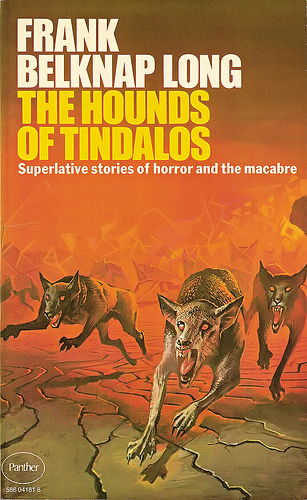
The Hounds Of Tindalos

 The Hounds of Tindalos by Frank Belknap Long. Originally published in 1929. Approx. 14 pages.


Today we take a look at one a classic Lovecraftian tale that has had a massive pop culture impact, Frank Belknap Long's The Hounds of Tindalos.

Hounds tells the tale of a tragic author named Halpin Chalmers, who decides to undertake a foolhardy experiment. By obtaining a mysterious East Asian narcotic, be plans to achieve a mental state in which he can perceive what is referred to as the Tao - which apparently is not a philosophy, but a way of seeing the true spectrum of time. To Chalmers, the concept of true time transcends so far beyond Einstein's concepts of curved space. Chalmers believes our present time is just the limited view available to the average person, a tiny slit of a glance into the real truth. Chalmers believes that with the help of the drug, he will see and experience all of the pasts, and futures, along with the present, running concurrently. And so, with his friend (and our narrator) Frank attending to him, he embarks on his narcotics-induced voyage.

Chalmers gets to see all the he dreamed, and more.

Chalmers also discovers nightmares he never expected, and worse. And, as is the true threat of these scenarios, sometimes when you look into the eye of evil, evil looks back.

The Hounds of Tindalos is a perfect primer for Lovecraftian myth. In fact, it had such a lasting impact that the Hounds themselves were incorporated into Cthulhu Canon. These creatures, born from a dark deed that transgressed in the infancy of time, move, as do other dark denizens, along angular time (not the curved time that we pass through). Once they have caught your scent, they are tireless in their pursuit, and they can reach their quarry through angles. Just think about that; look around whatever room you are in, and count all the right angles, and think of how you might best avoid the dread demonic dogs.

Frank Belknap Long writes this story extremely effectively; it moves along at such a brisk clip. The concepts posited here are both astounding and terrifying. Like some of the best horror readers, he leaves the actual conceptualizing up to the end user, and just crafts the accommodating mood. The reader is left in doubt of exactly what is there; the only constant is terror.

There is wonder here as well. Perhaps the most thrilling scene in the story is where Chalmers recounts his journey through time, bearing witness to so many major historical events. For those raised on classics and not Twitter feeds, how grand that concept must have been.

As mentioned, the hounds pop up in many other stories, and have influenced other pop culture genres as well. Take a look at some of them on the wiki page here.

The Hounds of Tindalos reside in the public domain, which is full of angular space. So watch the corners of your computer screen. Read the full story here.

Or, need some nice Halloween listening? Why not enjoy an audio reading of the story?


Need more tunes? How about the classic song by Beowulf?


Or the Metallica song influenced by The Hounds of Tindalos?


Or maybe the group that took their name from them?


Enjoy! And remember, "They are lean and athirst!"

Tuesday, October 13, 2015

In The Pines

In the Pines by Karl Edwards Wagner. Appearing in the Where the Summer Ends (Volume One) anthology, published by Centipede Press, May 2012. Approx. 30 pages.

I first discovered In the Pines a few years back. It hooked me instantly then, and I've made sure to read it at least once a year since then. Up to recently, I was hesitant to post single stories from anthologies, but now that I am definitely past that obstacle, I figured it was time to give this classic horror tale a proper write-up.

The thing that makes In the Pines hit so deeply is not necessarily its horror elements, but more of how it portrays the emotional condition. Bear in mind that Wagner was classically trained as a psychiatrist, and the mental deterioration of the protagonist lends authenticity and credibility to the horror of what transpires.

Gerry and Janet Randall are a young couple that had everything going for them. Gerry's career was going well, they were happy, and they were starting a family. One day it all changes when Janet gets into a car accident (it's not mentioned how it happened, just that it is her fault). This accident claims the life of their young child, leaves Janet nearly handicapped, and totally destroys their finances. As Janet leans more on self-pity, Gerry teeters off into alcoholism, and the emotional deconstruction begins.

We first meet Gerry and Janet as they are heading to a mountain lodge in Tennessee (they are from Columbus, OH) in the hopes that the time away will help with their mental convalescence. The lodge itself is in a scenic locale, but is somewhat rundown. With not much to do, Gerry explores that cabin and comes across a painting. Nothing so odd about it at a first glance; just a painting of a young lady in the dress of the 20's, set against a landscape of pines, much like those that carpet the Tennessee landscape. But to Gerry, there is a connection with the beautiful woman in the painting that he cannot deny, or refuse.

Ok, at this point you don't need a crystal ball to tell that there will be some kind of spectral bond between Gerry and the girl in the painting. That's not a spoiler; he finds the picture early on, and that's what sets the action in motion. As his research into the girl in the painting goes from curious to obsessive, he falls deeper and deeper into his alcoholism, becoming more and more distant and disgusted with Janet. And that's not all; the further he falls into his stupor, the more the girl in the painting seems real. Almost real enough to touch...

I mentioned before that it is a realistic portrayal of the emotional condition that makes this story hit home, and that is true. Wagner does not go the easy route, and have Gerry become "possessed" or turn into a gibbering madman. No. What happens in this story is built upon an existing foundation; there was already guilt, and resentment on the hands of both parties. Perhaps having all the security, safety, and happiness in your world cruelly yanked out from under you like a carpet is too much for even the strongest of us to bear. This is something that Wagner masterfully observes in a one page introduction to In the Pines; a truly gloomy, somber, heartbreaking page that sums up the feeling of absolute emptiness that plagues so many of us (these emotions aren't necessarily predicated upon the loss of a child). And so, all the anger, bitterness, etc., is cultivated from seeds already long taken root.

And that's what makes this terrifying. Imagine being trapped in a prison of your own heart. You cannot fault either Gerry of Janet for the deep fathoms of despair that they felt. As Wagner himself puts it in the last paragraph on the first page: "These places are best left to the loneliness of their grief..." It makes to whole notion of a retreat as bad a joke as their life had become. Of course, dark thoughts are always happy to fill the deep tears and recesses in our hearts.

The horror aspects of In the Pines are very effective, if somewhat predictable. You can see or guess what is coming, but the characters and placement are so real (I believe Wagner was a native of Tennessee, and you get a real sense of him writing what he knows) that you can't help but get jolted by them. Actually, the very ending was handled much differently than I had expected and it gives me a bit of a jump every time.

Perhaps the only thing I don't care for in In the Pines is a short segment where Gerry comes across the diary of a former cabin resident (the artist who created the infamous painting). These kinds of scenes, to me, always come off as shoehorned in for forced exposition, so it takes away from an otherwise seamless narrative. Other than that, In the Pines is pretty much flawless.

We all have our individual tastes, of course, but I usually refer to In the Pines as one of my top horror stories. If you can track down a copy of it (Wagner's stuff is always kind of tough to get), give it a whirl.

Score: 9/10


Oh, and if you have a few minutes, give this song (which serves as the basis for the title, and is referenced a few times in the story) a listen. Can't beat classics like this:


Thursday, October 8, 2015

Götterdämmerung

Götterdämmerung by Jonathan Green. A Sniper Elite: Nazi Zombie Army short story, originally published by Abaddon Books, February 2013. Approx. 31 pages.

Just a quick mention before I get into the actual review - as of the time of this writing, this story is available for download absolutely FREE over at the Abaddon Books/Rebellion Publishing site. There's really no reason not to grab a copy. Link is here. Now, on to the review.

Ok, say what you will about the inherent evil of the Nazis. But, you cannot deny, they were the best dressed folks at the big party. I cannot help but wonder if a little bit of that, combined with the sheer heights of their evil, have kept them so relevant in pop culture even seven decades after World War II. 

It seems these days that there is a thriving sub-culture catering to the Nazi Zombie genre (actually, there have been books and movies for decades as well). You would think people would be tired of it by now. I guess some things never die. Exactly the case in point here.  

In Götterdämmerung, we meet a crack British sniper team tasked with a most urgent mission; infiltrate the city of Totenstadt, and eliminate a high value asset named von Teufel, a high-ranking member of the Nazi Party's occult division. 

The story opens with a bang, dropping us into the midst of a thrilling action sequence. This segues into a meeting with a deranged Nazi scientist, who leads our merry covert band down a true pathway to Hell. This all culminates with a scene which delivers on the promise of the title, set against the backdrop of a nightmarish Nazi occult machine. I haven't seen such a nightmarish summoning device since Urotsukidoji introduced us to the infamous Nazi Death Rape Machine...

Please, please, PLEASE forgive me using the horrid edited dub. It's all I could find on Youtube.

So, what works here and what doesn't? Götterdämmerung is a solid little Nazi zombie yarn. The opening scene is great; Green really captures the feel of the battle. For a moment, I didn't want it to stop being a traditional WWII story. As far as the supernatural elements go, kudos to Green as well. The climactic set-piece is, again, well constructed and well imagined. 

I will say that the best action takes place in those first few pages. The action in the latter portion has some real highlights, but it gets confusing at times too. 

Characters? Well, we don't get to know too much about the characters. Which is fine, since they are supposed to be going in deep cover. We get their names, and enough characteristics to make them likable (especially the two primaries; one is resourceful, and one is a tad jocular. Basically all you need for a short tale anyhow). As far as their prowess as snipers, and resourcefulness as commandos, that is done well too. However, again, in the later scenes, when all literally goes to Hell, so do their techniques. There is, though, one moment which I had a problem with: I don't care if you agree to follow a demented Nazi scientist to the target location, but I doubt any covert operative is going to willingly offer his full name, and nickname, plus the names of his fellow operatives to said nutcase. Then again, we can also assume that they were all operating under aliases, so there's that.

But what about the important stuff? Mainly, the zombies? They are done nicely, when they finally show up. Green puts his own touches on them to differentiate them from standard zombie fare. They are creepy, too. I just wish we could've gotten at least one or two more paragraphs with them (see, I'm not greedy). Just enough time to see some various stages of decomposition; time to see a broader range of their possible attributes so that we could quantify the true danger that the Nazis now had at their disposal.

Again, the zombies are done well, but to be honest, the setting of that final scene, and Green's description of the sheer horror of what was going on, were more scary than the monsters themselves. I hope that doesn't come off as backhanded praise; I honestly think the scenery trumped the actors. All of them. 

Solid Nazi zombie action here. A great read for an October night. Head on over to Rebellion Publishing and get your copy now.

One last thing that I feel I need to mention: there are, unfortunately, a fair amount of typos in this short story (I counted 3-4 pretty glaring ones). This kind of thing, you don't blame the author (or take points off), since we all make typos in our texts. It's just, the editor should've caught them. These things aren't the end of the world, but they do detract from a seamless reading experience.

Final Score:

7.5/10

Cover Score:

Do I need to say anything? Just look at it.

Cover Final Score:

10/10


Wednesday, October 7, 2015

Into The Wood

Into the Wood by Robert Aickman. As appearing in The Wine-Dark Sea collection, Approx. 40 pages.

Approaching the Halloween season, I began harassing friends (as usual), whose opinions I hold in high regard, for horror recommendations. Not what would promise or guarantee the most fright, or shock, or blood and gore. Just what they thought was the apex of the genre. One friend's recommendation was to try Robert Aickman, whose stories fall much more firmly into the category of "strange" than horror. He also recommended that I begin with the short story "Into the Wood" which appears in The Wine-Dark Sea" collection. So, how did it fare? Well, again, it is not what you might think of as "horror". But I can say this...even though I finished reading it a day or two ago, it still hasn't left me, and I don't think it will any time soon.

Margaret Sawyer is a middle-aged Englishwoman, whose husband owns a construction firm. She is seemingly happy, and seemingly relegated to the mundane lifestyle of the housewife of decent means. This all changes when her husband takes a road-building contract in a remote area of Sweden.

On an outdoor excursion with some business associates and their wives, Margaret takes notice of a peculiar lodge in the woods. She is informed that in older times, it was a Kurhus, a sanatorium. Now, however, it seems to be inhabited by rather normal folk. With her husband heading off to Stockholm for more business dealing, Margaret opts to spend some time there, and finds that in fact nothing in there is normal, and, quite possibly, she might not leave there as what she might have termed her normal self.

For, you see, the Kurhus is a care center for insomniacs; true insomniacs, those who, from a certain point on, have never slept. At all. The tendencies and personality traits of these people make them pariahs in normal society. Most peculiar of all, the spend their evenings traversing a labyrinth of paths that surrounds the Kurhus. For what purpose, it is not clear.

A tale of insomniacs. That doesn't sound too chilling, right? So what makes Into the Wood stick with you? Aickman's English mastery, and his ability to weave a layered, intricate, moody tale. From the beginning, we don't find ourselves comfortable in Margaret's English home, and as soon as the narrative shifts to Sweden, the atmosphere becomes gloomy, and barren, just as the panorama is described. It is that same uncomfortable chill that clutches at your chest and doesn't let go. Events that transpire in and around the Kurhus feel insulated by the dense woods around them; isolated, and cut off from normal society. Completely intentional and meaningful.

My personal favorite aspect of Aickman's writing here is his intelligent wit. The best example is seen on the first page. Talking about Margaret's husband's business card (remember he is in construction), it lists his title as "Earth Mover"; even though, "he seemed to have neither the back muscles of Atlas nor the mental leverage of Archimedes". I mean, really, how can you top that.

Aickman uses clever tricks as well to make Margaret a much richer character than her outer appearance would imply. Pay careful attention to any physical cues when he is describing her movements. One good example is when her frustration over how she is supposed to dress leads to an offhand remark about the lack of eroticism in her marriage. You can see that repressed under the English housewife template is a simmering spirit. It makes you wonder; who are the ones that are actually asleep here? And, once one becomes truly awakened, will sleep, in the conventional sense, ever be had again?

The concept of insomnia itself is handled brilliantly. The average person would most likely find nothing wrong with the concept of perpetual wakefulness, but, strip away all these preconceived notions, and consider a lifetime without the respite of rest. It is no big surprise that Aickman can hint that perhaps this truly chronic insomnia may be at the root of legends of vampirism.

There are even some moments that are chilling in the classic sense. Any of the times we find ourselves on the twisting paths around the Kurhus, it taps into rooted fears of the dark, of the unknown, and of being lost.

If you like your horror with a catchy cover, a definable boogeyman, and an ending with a ribbon on it (even a bloody one), well, there's nothing wrong with that. But probably Aickman's work won't be for you. However, I definitely recommend everyone give one or two of his stories a whirl.

And so, I leave you with this line from the story, which seems to sum it up so well:

"Losing one's way was largely an act of intention."

Side Note: Just an odd mention, and I don't know if this appears like this in the British printings. For some reason, after the first few pages, the name of Margaret's husband changes from Harry to Henry. Is this an editorial oversight or a dimensional shift? We may never know.

Score: 9.5/10