Showing posts with label Light Novels. Show all posts

Thursday, April 16, 2020

5 Centimeters Per Second: One More Side

5 Centimeters Per Second: One More Side by Makoto Shinkai; adapted by Arata Kanoh. Translated by Kristi Fernandez. Originally published in the United States by Vertical, February 2019. Approx. 240 pages.

Back in 2007, anime wunderkind Makoto Shinkai (Your Name, Weathering With You) released 5 Centimeters Per Second, a short movie (just over an hour long) comprised of 3 segments, which told the story of Akari and Takaki, a pair of outsiders joined by their developing love, and torn apart by distance (their parents keep moving because of their jobs). Coinciding with the theatrical release, a novel was dropped, as well as a manga adaptation. A few years later, a 'side story' novel was released, penned by Japanese novelist Arata Kanoh. These types of side stories are increasing in popularity and frequency, and they basically retell the same story through the eyes of one of the other characters.

Last year, Vertical dropped this fantastic translation (along with a beautiful cover by the incomparable VOFAN). This side story expands a great, great deal on the material in the movie, yielding a much more heartfelt, poignant experience. Let's take a peak at the summary, and then take it bit by bit:

"A contemporary classic, 5 Centimeters per Second won animator Makoto Shinkai international renown as a rare talent. Indeed, he just might be one of the most powerful bards of romantic longing and thwarted love working today in any medium. This official novelization narrates from the other side—for instance, from the point-of-view of the girl rather than the boy in the legendary first segment, “Cherry Blossoms”—to tell a story that is both deeply engaging for first-timers and astonishingly fresh for fans of the film.

The author of fantasy novels based on the Shining videogame series, Arata Kanoh is best known for his imaginative prose adaptations of the masterpieces of Japan’s hottest animator. Most recently, his take on Your Name was the #1 Kindle bestseller at Amazon Japan."

I want to put something out before I compare the three segments in the movie to those in the novel. I know that I am in a distinct minority here, but honestly, I'm not a big fan of Shinkai, based off of the few titles I've seen by him. They boast stunning visuals, smooth directing tricks, and beautiful character design; yet, they seem manufactured...telegraphed. Painfully heavy metaphors. A sense of self-love rather than genuine affection for the medium/story. It's like biting into a Godiva Easter bunny - decadent chocolate, intricate design...yet hollow inside. Now, don't get me wrong. I love sappy romance - missed opportunities, unrequited love; man, I eat that stuff up. However, Shinkai's technique just isn't for me. Again, just my opinion.

Also, it bears noting that I have not read the original novel which, one assumes, follows the POV's shown in the movie. Here's hoping that original novel finds a home in the States as well, one day.

The first segment of 5 CM is "Cherry Blossoms", and this is the story of Akari and Takaki as kids. The movie maps the period between meeting at a Tokyo elementary school, their bonding and burgeoning love for each other, up to their final meeting on that snowy night in Tochigi.

As mentioned, both of them were nomadic children due to their parents transferring often because of their jobs. They are both somewhat quiet, shy, and guarded - a marriage of natural personality and trained response to their ever-changing environments. They share a love of books - especially fantasy titles. They spend every moment together, cultivating a bond that goes deeper than words can describe.

There's something I want to say here which can be applied through every segment of the book - as much as I was not a huge fan of the movie, I absolutely loved this book. Finally, we get an in-depth look into the minds, hearts, and souls of Takaki and Akari - and what a bittersweet trip it is.

The side story aspect of this book allows for this first segment to be told from Akari's point of view - a recollection of sorts, prompted by her rediscovery of the undelivered letter she had written for Takaki, declaring her love for him. We get to see how the quiet, introverted girl is bounced around in her younger days; until a kind heart finally offered her comforting reassurance.

This first segment is hauntingly beautiful; effectively nailing the varied emotions of those tumultuous formative years.

The second segment is "Cosmonaut"; which, in the movie, chronicled the story of Kanae Sumida, an
earnest girl who carried a torch for Takaki from the moment she laid eyes on him after his move to Tanegashima. Therefore, in this novel adaptation, the segment recounts those times from Takaki's POV. This segment was a mixed-bag in the movie; a bit meandering; although the audience comes to sympathize with Kanae's pure emotions.

The novel bolsters this segment immensely as well. While in the movie, we just see Takaki as, well, not aloof, but definitely distant, a trip inside his head is very welcome. The cosmic scenes shown in the movie are explained as a persistent dream; a reminder of a portion of him which has been lost, which he is truly less than whole without. Meticulous care is also given to bringing the picturesque vistas of Tanegashima to vibrant life. Excellently done.

Finally, we come to the climactic segment of the story, "5 Centimeters per Second". This segment was criminally short in the movie adaptation; which makes the novel handling all the more appreciated. Here, we see snippets of Akari's time in college, her ascension working with a franchise bookseller, and, finally, her meeting the man whom she will eventually marry.

On the other hand, Takaki is still spinning his wheels, mired in a life of feeling incomplete. He's a successful programmer, but feels fettered and dissatisfied. He's been in a long-term relationship, but cannot give all of himself, as he still feels incomplete. There is a confluence of emotions as Akari realizes that she has something to return to Takaki; and Takaki, seeing the progress of a shuttle which launched during his time on Tanegashima, has an epiphany. This all leads to that moment.


In the novel, Takaki's emotion tailspin is heartbreaking; as you see how he is not only damaging himself, but also his long-suffering girlfriend. In the movie, you just see a few scenes before it cuts to the poorly-chosen song which frames the end montage.

And, to cap it all off, in the novel, you actually get to read the two infamous letters - the one Takaki wrote which was blown away in the wind at the station, and Akari's, which she discovered in an old sewing kit in her adulthood. You can choose for yourself whether that aspect was better found out, or left unsaid.

So, in summary, 5 Centimeters per Second: One More Side offers a richer, deeper, and, of course, more heart-wrenching of this story than the pretentious movie could ever have aspired to. Even if you have never seen the movie, I recommend this volume purely on its merits as an intriguing, genuine, love story.

Cover:

Renowned Taiwanese artist VOFAN (the Monogatari series light novels) brings his signature style to capture that moment; that precious lost moment in time. That perfect moment in time.

Excellent cover.


Thursday, April 9, 2020

Konosuba: An Explosion On This Wonderful World! Volume 1

Konosuba: An Explosion On This Wonderful World! Volume 1 by Natsume Akatsuki (translation by Kevin Steinbach). Originally published by YenOn, December 2019. Approx. 224 pages.

In my opinion, the best medium for the immensely popular Konosuba's brand of comedy is the animated form. This is not a knock on the light novels or the manga; it's just that the show (at least the first season, that is) juggled that perfect, endearing balance of frenetic lunacy.

However, for a property as significant as Konosuba, side stories are a foregone conclusion. And what better place to start than with the most popular character and top waifu, the Arch Wizard Megumin? This brings us to Megumin's Turn!, Volume 1 of the Explosion on this Wonderful World side story light novel series. Wow, don't they love those long titles?

Let's take a look at the summary, and then talk about how they handled the story itself:

"My name is...
One year before a certain useless goddess and NEET extraordinaire hit the scene, Megumin, the "Greatest Genius of the Crimson Magic Clan," is hard at work. Ever since a life-changing encounter in her youth, the young wizard has dedicated her every waking moment to the pursuit of the ultimate offensive magic, Explosion! (Well...every moment not spent hustling food from her self-proclaimed rival.) And while the big sister's away, the little one will play. On a routine trip into the woods, Megumin's little sister, Komekko, finds a strange black kitten. Little does she know that this cat plays a key role in unsealing a Dark God's tomb..." 

Well, that's pretty much the book in a nutshell. I mean, we knew about that much on Megumin's pre-party life, so this novel just runs with that. It is all harmless fun; chronicling day to day life in the Crimson Magic Village. Day in and day out we're treated to Megumin's one-sided 'rivalry' with Yunyun; as well as mishaps in the magic school. Highlights include witnessing the actual event which sparked Megumin's mission to acquire Explosion magic, as well as seeing her adorable, precocious younger sister (Komekko) follow, in a way, in her footsteps.

All in all, this is no work of art or literature, but it's definitely a lot of fun, bolstered by the fan-favorite lead. Some of the scenarios are generic or mundane; and would be hard pressed to elicit a laugh if it weren't for the beloved players involved.

Characters:

Assuming you're reading this, you know well who Megumin is. If, by some reason you don't, Megumin is a egomaniacal teenaged arch wizard who has dedicated her studies to learning a sole spell - Explosion magic. Explosion is extremely damaging; destroying everything in its path - including the intended target and anything around it. It consumes massive amounts of magic points; usually in excess of the caster's amount, leaving them incapacitated after casting. Megumin is cocky, overdramatic, a consummate chunibyo. Her daily life consists of trying to con her friend/rival Yunyun out of food because her and her little sister live a life of unsupervised, abject poverty courtesy of her ne'er do well parents. Yes, a core aspect of our protagonist is her comedic attempts to stave off childhood starvation.

Yunyun, Megumin's long-standing 'rival', who is actually more of a forced entity in the anime series, actually rises to the occasion in going from background character to lead. She brings her big-busted,
ditzy, heart of gold personality to the fore; making a nice contrast to her scheming, conniving friend.

As you can see in the pic above, we get to meet some of the other students in the magic school. Sadly, for the most part (save for one small arc later on), they are relegated to being little more than window dressing.

As mentioned, the scenes with Megumin's sister, Komekko, are well done. It is easy for kids in these stories to teeter into the realm of absolutely annoying; but, being somewhat of a miniature Megumin, Komekko steals the scenes that she is in.


Within the Komekko interludes, there is also a demon named Host, who adds a good deal of levity to the proceedings.

Other characters are simple on deck for plot advancement. But it's ok, since it's Megumin's story anyway.

Writing:
The writing is actually pretty good here. It's not easy to write for situations where the onus is on quick physical responses; shocked faces, exaggerated gestures, etc. However, Akatsuki does a good enough job conveying those scenes as pen on ink.

Again, this is just the long version of historical events we already know about Megumin, combined with some basic situational comedy. It works because it involves Megumin, and becasue of Akatsuki's skilled writing.

Recommended if you're a fan of everyone's favorite Archwizard, and who isn't?


Cover:
Artwork here is provided by Kurone Mishima. The interior is peppered with a fair amount of black and white illustrations, and there are some nice fold-out color pieces at the beginning. What can I say except that the artwork is exceptional? And that cover - simply beautiful. The composition, detail, and color work - all perfect.

See you all next time - in the interim, why not enjoy some explosions?


Thursday, April 2, 2020

Magical Girl Raising Project Volume 1

Magical Girl Raising Project Volume 1 by Asari Endou (translated by Alexander Keller-Nelson. Originally published by YenOn, June 2017. Approx 190 pages.

I'll just admit it outright: I unabashedly love Magical Girl animes. About 20 years ago, my main VCD/DVD-R supplier started offering some of the classic Pierrot Magical Girl shows - a bunch of episodes of Creamy Mami, Magical Emi, Pastel Yumi, and Magical Fairy Persia. I just couldn't get enough of them. I've seen a bunch of the shows over the years, and I'd say my top favorites are still Creamy Mami (luckily now streaming on Amazon), Minky Momo, Majokko Megu-chan, and Fancy Lala.

Over the past five decades, magical girl shows have been present. Naturally, every now and then, some titles appear which attempt to subvert the standard tropes. That's fine; the formula is good, and experimentation is good. Especially when it yields admirable results. A few years back, we were treated to the magnificent Madoka Magica (a spin-off is currently airing; haven't had a chance to check it out). Madoka Magica was an amazing show - it retained the purity and hope of classic magical girl shows, yet upped the ante on real danger, drama, and heart-breaking trauma.


However, cruising under the radar was another hard-edged spin on the classical magical girl formula. This one was more of a magical girl plus Battle Royale hybrid. A darker than expected - especially given the character designs - title, this one is known as Magical Girl Raising Project. I loved the 13 episode series - and so I decided to check out the light novels. Turns out, the first one is pretty damn good.

MGRP revolves around a titular mobile phone game - billed as absolutely free- which allows gamers to play as magical girls. Soon, a select few players find themselves receiving an irresistible offer - to become actual magical girls. As magical girls, they'll be expected to do good deeds, and earn the in-game version of currency, candies.

Of course, there's a bump in the road...at a certain point, it turns out the Magic Kingdom has spent too much mana recruiting these magical girls, and so a bit of pruning must be done. An elimination game is set in motion to weed out the least productive magical girls - of course, an in-game elimination results in a real-life one. And so, the game becomes a very real game of survival.

Like every game of survival worth its salt; tenuous alliances are formed, backs are stabbed, etc. And this is where MGRP excels. The character backstories are well done enough; but seem more curated to elicit an optimal emotional response when a magical girl is eliminated. The fight scenes and eliminations, in both the novel and the anime, are excellently done - bloody and brutal.

The characters are brought to vivid life via the ambitious designs of Marui-no. The artist has gone the extra step of creating kawaii 'avatar' style designs, as well as normal ones, used for the interior illustrations.The designs are evocative of the magical girls; effectively capturing the looks and special skills which are granted based upon the player's personality.

Speaking of characters, MGRP also features a devious in-game
mascot akin to that scumbag Kyubei from Madoka Magica (sorry, no better term for that piece of...work). This one's name is Fav; and while he's not as odious as Kyubei, he's still a devious, duplicitous villain.

Comparing the first volume to the anime; I'd have to give the edge to the anime. Unlike other shows, where each novel might correlate to 2-3 episodes, the entirety of the show's run covers the events of the first novel. This allows for a considerably larger margin of character growth; especially for our protagonist, Snow White. It also allows for more dedicated backstory for the other girls, granting a more poignant, visceral gut-punch when they are 'eliminated'.

But don't get me wrong, the writing here is very good. It's a bit simple at times, but the background world is painted effectively enough, and the fight scenes are where the author excels.

And, best of all, even though there was only one season of the anime, there are at least seven more light novels (so far). Keep an eye out for future write-ups on them.

Cover:
Not a bad cover, but not great. It's a beautiful pic of Snow White, and the black background is understandable for the dark tone of the work. However, the color palette used for Snow White is too muted, and ends up getting swallowed by the darkness she finds herself surrounded by. Oh wait, maybe this cover is actually genius....


Tuesday, March 31, 2020

Re:Zero Volume 1

Re:Zero Starting Life in Another World Volume 1 by Tappei Nagatsuki (translated by ZephyrRz). Originally published by YenOn, July 2016. Approx. 228 pages.

As much as I love my anime and light novels, I have to admit how far behind the curve I am on newer titles...and by newer, I mean pretty much anything after 2000, when I had to curtail my anime viewing to work extra jobs and raise kids. But, I've been trying to catch up; and luckily, I have a good work friend who comes by every week or so to watch 6 or 8 episodes at a go, of one or two titles at a time. We've knocked out some good titles, and have a bunch in the queue. Sadly, with the current Coronavirus panic, our viewing sessions are on a temporary moratorium. Ergo, I'm taking the time to try and catch up on the every increasing TBR of light novels on my shelf (and in Rubbermaid buckets).

Whew, that was long-winded. Point being, Re:Zero is, I know, a title that is already a few years old (according to Wiki, it was Crunchyroll's most viewed title of 2016). My friend and I have it in the queue, but it's taking forever to get to, so I decided to cheat a little and grab the first volume of the light novel off the shelf.

I'm pretty sure most of you who might be reading my light novel reviews are already familiar with Re:Zero from either the anime or the manga; but still, I will be trying to avoid spoilers as much as possible. Therefore, it might be a bit of a short review, but, I really liked it so I figured I'd put in my two cents.

So, before my quickie review, here's the blurb from the back, which gets as spoiler-y as I'm gonna go with this review:

Subaru Natsuki was just trying to get to the convenience store but wound up summoned to another world. He encounters the usual things--life-threatening situations, silver haired beauties, cat fairies--you know, normal stuff. All that would be bad enough, but he's also gained the most inconvenient magical ability of all--time travel, but he's got to die to use it. How do you repay someone who saved your life when all you can do is die?

Well, that was a bit simplistic, but I suppose you could argue that the story (so far) is pretty simplistic. Re:Zero, at least Volume 1, is another drop in the ocean of isekai stories. However, what distinguishes it is a higher caliber of writing. The prose is engaging and brisk; therefore a lot of credit has to go to the translator. There is a distinct comedic touch to Re:Zero, though it is not the primary focus, a la Konosuba. Also, there is a real grandeur to the action scenes; especially the climactic ones.

As mentioned in the blurb, the basic idea is that a young man, one Subaru Natsuki, magically transports into a prototypical fantasy setting while headinf home form the convenience store. After an unfortunate encounter upon 'landing', he becomes embroiled in the theft of a precious item from a beautiful, mysterious silver-haired girl. Luck is not upon his side as he seeks to return this item; and he finds out that his only superpower is.....tenacity? Resilience?

Subaru is a fun enough protagonist; especially falling under the umbrella of 'snarky, not quite-hikkimori, yet not quite-delinquent, snarky yet not-obnoxious, tracksuit-wearing teen' (hi, Kazuma!). He has enough experience with these types of worlds via video games, manga, and anime; and therefore can grasp the basic gist of what's going on, however, being broke is a severe impediment.

The 'mystery girl' is an interesting enigma - cold and standoffish, brutally honest, yet with some undefinable charm.

The supporting characters are instantly identifiable from similar titles, but still fun enough, due to the better-than-average writing.

Back to the writing, Nagatsuki puts a lot of focus on descriptions; from ever aspect of Subaru's thought process to every facet of his overly-dramatic physical responses.

I'm guessing that a huge reason this review is going to be short is because the entirety of the novel revolves around a) Subaru wrapping his head around what is going on, and b) trying to get the girl's item back. That's really it. Like I said, I haven't watched the anime, so I'm wagering that this entire novel likely fit into one, two episodes tops.

So there you have it. I'll definitely be going back for Volume 2; however, Amazon is not delivering anything until late April, so we'll have to wait and see.


Cover:
Shinichirou Otsuka's cover and interior illustrations are beautiful, evocative, cute, and well-constructed, effectively bringing Nagatsuki's vision to life.

Monday, February 24, 2020

SCP Foundation: Iris Through The Looking Glass

SCP Foundation: Iris Through the Looking Glass by Akira. Originally published in English by Seven Seas Entertainment, January 2020. Approx. 330 pages.

When I had first seen this title pop up for pre-order a few months ago, I was filled with a slight glimmer of hope. As we all know, I am a huge fan of light novels. Also, I find the whole SCP genre fascinating. I won't claim even the slightest pedigree of knowledge on the subject; however, my kids were pretty heavy into it, and I watched a few videos with them. I think it's great; very imaginative and more in-depth than the hackneyed ghost stories and urban legends I grew up on. Given that, I couldn't pass up on a title that combined these two genres.

My hopes were up.

Reminds me of my favorite Warhammer quote: "Hope is the first step on the road to disappointment."

Novel 1 in the SCP Foundation light novel series is a mess; actually, it is an amalgamation of messes. It's going to take a bit to pinpoint everything that went wrong with the novel. We'll start with the blurb, and then break it down in the review itself:

"An ordinary boy encounters the paranormal when a photo of the same girl starts inexplicably showing up in every book he opens. One day, the girl reaches out and pulls him into the photo to her location: a cell in a top-secret facility belonging to the SCP Foundation, an organization dedicated to the research and containment of people, objects and phenomena that defy reality! Even worse: they’ve deemed him a threat to be contained, and he’s going to have to work with them if he ever wants to see the outside world again!"


Okay, let me preface this takedown with a reminder that I am in no way an authority on SCP lore. Therefore, I cannot attest to the amount of liberties taken with any SCP objects present in the narrative.

This novel is told in the first person perspective of the nameless (actually, name redacted) protagonist (designation SCP-105-C), who, as the summary tells us, is pulled through a photo into an SCP Foundation location. Prior to this, he'd seen an identical picture in every book he opened: that of a beautiful young blonde girl cradling a vintage Polaroid camera. This turns out to be Iris Thompson (SCP-105) and her camera (SCP-105-B). The boy has no idea what his connection to this mysterious girl is; and his life is turned upside-down as he attempts to unravel this mystery; all while contending with running across other SCP objects at the facility, and being subjected to 'research' conducted on him by the enigmatic Dr. Bright (don't know what the existing lore on him/her/they was, but I wonder if it involved him being a hard-core otaku with a fidget spinner).

With a basic premise like that, there is hypothetically a lot of wiggle room to make a fun story. You can try and balance drama, horror, and levity, which would likely be the best recipe for the subject matter.

It's way too bad that the final result is more of a patchwork mess.

What went wrong?

I'm not sure how this novel was conceived, but I'm fairly certain I am correct in guessing that it was written in installments on a message board. While some very successful light novel series have started in this fashion (especially in the isekai genre), such is not the case here. SCP Foundation comes off as lightly warmed-over fan-fiction. I have no issue with the fact that the structure is essentially an anthology of interconnected vignettes; however, each section has multiple breaks, giving off a feel of serialized installments. There is no fluidity.

Next, let's talk about writing style. Sadly, there isn't much of one. There is no attempt made to cultivate or evoke mood or emotion. Every situation in the book is composed of one small percentage statement and exposition, and the rest is padding and repetition. For, say, every SCP object the protagonist meets, the same formula is used:

1. State what is going on ("The thing before me was half a cat")
2. Repeat the fact in disbelief ("I could not believe that a being that was half a cat was in front of me. But it was there, so it had to be real.")
3. Attribute it to current life status ("I guess such things as half-cats are a way of life in this bizarre facility, where these amazing objects and their myriad powers exist.")

Rinse. Repeat. Recycle.

Next, we move on to characters. Sadly, the characters here are fairly bland cardboard cutouts. Our protagonist is another nondescript, unassuming Japanese high school boy. His kind are legion. He has budding emotions for Iris, which of course aren't developed upon. Iris is a fun, flirty gaijin girl; and of course it is impossible to get a bead on her romantic interest. Dr. Bright is the epitome of the obnoxious comedy relief. There aren't many other cast members. Dr. Selkie and Dr. Goldman appear briefly to redefine cringe. The dramatis personae of SCP objects present get treatment akin to lip
service. Everybody deserved better.

All these things aside; perhaps the biggest complaint with the book is its lack of a core theme. One could safely assume that one of two storylines would be the focus here: either exploring the interconnected relationship between the SCP-105 entities, or using the protagonist's odd circumstance to experience other SCP objects first hand (kind of a play on Alice Through the Looking Glass, which is referenced in the title). Heck, I would even have accepted an honest attempt to do both. However, we get neither; simply more repetition and padding.

Whatever the reasons for their connection, whatever possible utilization of implementation of their joint skill might have occurred, it isn't explored or revealed. The majority of the book chronicles their lives as roommates, without ever really delving into any of the circumstances that brought them together. Was this trip really necessary?

Towards the end, you can also tell that the author (or perhaps authors, who can tell) had no idea how to wrap this tale up. There is an instance; when the protagonist is wondering as to whether he is missed or not back home, which is answered in such a nonsensical way that it is insulting. Then, as if to backpedal over it, the book culminates with an uber-convenient ending; again, straining credibility and plausibility to levels they shouldn't be stretched to.

Was there anything good about this book?

Hmmmm....honestly, not too much. It is still readable; and the translation isn't the worst I've read. There are some noticeable typos, which are always an eyesore (proofread, people). I mean, you keep turning pages, hoping it'll gain traction, hoping that the characters will be given something, some angle, to endear themselves to you. It doesn't really pan out, though. Recommended only if the novelty of having an SCP-themed light novel on your shelf is your cup of tea.

Cover:

The cover, by Sidu, isn't bad. It's fun to revisit it after appearances by Josie and Builder Bear. The interior illustrations aren't too shabby, but have a basic, manga feel to them.


Sunday, January 26, 2020

Goblin Slayer Side Story: Year One


Goblin Slayer Side Story: Year One, by Kumo Kagyu. Originally published in the U.S. by Yen Press, October 2018. Approx. pages.

HachiSnax Note: I first started reading the Goblin Slayer light novel series back in 2018, right before the anime was announced. It has been a lingering regret that I have not reviewed the novels themselves in a timely order. RightStuf took forever to get my copy of Vol. 8 to me, around when Vol. 9 was about to drop, so in the interim, I dug up my copy of this, the first volume of the prequel story.

Ideally, I had wanted to do concurrent reviews of the original light novels as I read them, as well as the anime and the manga (although I'm only up to Vol. 4 of the manga, as I'm borrowing them from the library). Each of the various Goblin Slayer incarnations have their own strong points; the light novels have a real nostalgic, homage feel for the pen and paper RPG's of yore. The original mangas, with art by Kousuke Kurose, were amazingly illustrated, and gave a real hard, dark edge to the series. And the anime, directed by Takaharu Ozaki (of Girl's Last Tour), provided the joy of seeing the characters brought to life and given perfect-fit vocal talent. It also re-ordered some of the events of the first two light novels; giving it a better feel. Of course, each medium had its own weakness - the light novels can get very repetitive (like goblin slaying! I guess that's the point), and the writing (or translation) isn't always that great. The anime gets hobbled by some bad CGI scenes (not Berserk
bad, but still bad), and the manga, in its focus on the 'hardness', loses some of the...umm, 'softness', I guess? Not going to lie, the manga was pretty damn strong.

Ok, on to the review... Til next time! ~Hach

What could one expect out of a prequel story centering on everyone's favorite, methodically myopic, goblin-killing adventurer? Goblin Slayer's modus operandi is a formula that has worked for nine novels already. Kumo Kagyu has made some inroads in developing the evolving story around his single-minded warrior - that the uptick in goblin population ties in to re-evolving demonic forces in the world, that actions are being taken to port over the little critters as shock troops of sorts to disrupt local populaces, etc. It's slow going at times, but it's always fun to see the new and inventive ways the pragmatic G.S. comes up with to dispatch these hated vermin. Also, while there is not a lot of evolution regarding the backup cast - the party of adventurers re-uses the same jokes over and over, Cow Girl and Guild Girl are just perennial members of his ever-growing harem, etc. - it stays fun, if not fresh, because we've come to care about the characters.

So, again, what to expect from a backstory? I mean, of course it is fun to see developed, bad-ass characters way back when they were getting started, but what else? Would we see more of the traumatic event (the devastation of the village Goblin Slayer grew up in; the rape and murder of his sister before his eyes) that formed him into the reticent killing machine he is now? Would we see more of the training with the abusive old rhea (the series' version of a halfling) who took him in and trained him?

Actually, while those events are referenced briefly, Goblin Slayer Year One plays out like most of the other novels....same formula, just hit the Rewind button. It's Kumo Kagyu playing it safe, but it's still good stuff.

Year One traces from G.S.'s first registering at the Guild, and follows him on his first few quests. That is, that is the core focus of his aspect of the book. The rest of the book serves as a year one for
our beloved secondary cast as well. It's fun to see those initial awkward reactions to this young, oddball adventures; and, of course, the best parts are watching him learn via trial and error during the quests themselves. Here he learns about the importance of sword lengths, weapons durability, importance of mobility over straight protection in armor, etc. We see his iconic helmet in its original form; with two awkward horns that made it more trouble than it was worth (although it had a cool, Dragon Quest aesthetic).

Another change in this new series is a new artist for cover/interior illustrations. Where the original series was handled masterfully by Noboru Kannatuki, the Year One light novel series enlists the deft hand of Shingo Adachi. Adachi does a fine job, employs a masterful color palette, and offers us poignant younger portrayals of the characters.
 It's really hard to find things to knock in a series that utilizes a formula solidified via a successful track record. If anything, I could say I wanted something more, something daring.

Also, while we expect to see the snippets of the other background characters in their younger forms, a large chunk of this novel is dedicated to what I'll call the 'Rock Eater' segment. While done well; featuring the emotional powerhouse moment of the novel, let's be honest; it was superfluous to the origin of Goblin Slayer himself. Still, it was a strong vignette in its own right.

And there you have it. The writing is engaging as always, if not powerful. Kamo Kagyu has a distinctive style; and if you've liked one of his novels, you can enjoy them all.

You can argue that the Year One series isn't completely necessary, but it's fun nonetheless. Let's see how Volume 2 pans out.


Cover:

Not bad at all; but no offense to the cute-as-a-button Cow Girl, young Goblin Slayer should be at the fore of this volume.

Now, as much as I like this cover, when I pre-ordered it, they were showing this as the potential cover. And, wow, holy cow why didn't they use this cover???

Image result for goblin slayer side story light novel cover japan

And this was being shown as the cover for Volume 2:


Yeah, that's young Sword Maiden and the party she rolled with when they defeated the Demon Lord (part of this tale appears in the novel as well). Now that's a great cover.

Friday, May 10, 2019

86

86 (Volume 1) by Asato Asato. English translation by Roman Lempert. Originally published in the United States by Yen Press, March 2019. Approx. 256 pages.


86 is another of those titles that were on my radar for a while, based on an awesome cover and a decent blurb. What I was hoping for was an entertaining military fiction piece, enhanced by mech action. What I got was a light novel with a lofty premise, the deeper ramifications of which are never truly realized, that in the end remains an entertaining military fiction piece, with solid mech action.

First the blurb, then we dissect:

"A War Without Casualties
The Republic of San Magnolia has long been under attack from the neighboring Giadian Empire's army of unmanned drones known as the Legion. After years of painstaking research, the Republic finally developed autonomous drones of their own, turning the one-sided struggle into a war without casualties-or at least, that's what the government claims.
In truth, there is no such thing as a bloodless war. Beyond the fortified walls protecting the eighty-five Republic territories lies the "nonexistent" Eighty-Sixth Sector. The young men and women of this forsaken land are branded the Eighty-Six and, stripped of their humanity, pilot the "unmanned" weapons into battle..."

Solid premise. In fact, it barely glosses over what Asato Asato posits in the work. In a move which he admits draws from historical actions/positions in WWII, the people of the 86th Sector are interred, robbed of their agency and positions, and relegated to "less-than-human" status. These people represent the ethnic minorities of the Republic of San Magnolia.

However, why exactly this happens is not explored to a satisfactory extent. The story picks up after the invasion of the Giadian Empire, so we are observing the militarily inefficient Republic on the defensive. What we do not have any exposition into is 'why' the Empire invaded, what was their motivation, etc. This becomes problematic in that the internment of the ethnic minorities (Colorata) is predicated upon a flagrantly false accusation of sympathy to same Empire. However, it would've been nice to have a clue as to what these supposed horrid values were. 

It's fairly obvious that the digs are made at America during WWII (the author claims in the afterword that he based the Republic and the Empire on an Axis and an Ally power). The order which inters the Colorata is a none-too-subtle dig at Executive Order 9066 (which is an odious blemish on our history). This is fine and all. In my opinion, though, it does bear mentioning that a lot of the atrocities committed by the Republic are crimes perpetrated by all contributors in the War. But, let's not nit-pick. This is speculative fiction, after all. The real question is; was it entertaining? Gripping? Fun?

For the most part, yes. This is not the deepest book, by far. It doesn't need to be. It's a light novel. How do the various parts stack up?

Characters: 
This should've been a home run. Asato has created a compelling dramatis personae. It isn't too sprawling, since it primarily focuses on a singular group of 86, and their "Handler" on the San Magnolia side, Lena. (quick mention: the Handler and the soldiers share a connection via Sensory Resonance, which allows for communication, etc. However, since it links the subconscious of all participants, it also leaves the window open for some compelling emotional side effects)

We are first introduced to the cast via fold-out illustrations in the beginning of the book. They are an interesting group, beautifully realized by the fantastic illustrator Shirabii. 

Yet, in the book itself, they are terribly underutilized. A few of them get shining moments, but most are relegated to a singular mood, or viewpoint, and are, as such, consigned to it. Excellent conception, mediocre execution.

The main focus throughout remains on our core protagonists; Shin, aka Undertaker, the leader of Spearhead Squadron, and Lena, the earnest, open-minded Handler assigned to them. Lena possesses a dramatically different moral compass than most of the Alba (the pale, silver-haired "master race" of the Republic), and wants to be the best commander she can for her charges. In this position, she finds herself hopelessly sandwiched between an uncaring military and the derision of those under her.

Shin and Lena are both handled well, as is the evolution of their relationship with each other. Although Shin learns to open up a bit over the course of the narrative, he is for the most part, relegated to the role of 'taciturn survivor'. His character arc involves, but isn't really advanced by, a subplot involving his estranged brother. This whole sequence reads more as an add-on to introduce the whole "vestiges" notion (not going to spoil it here), and while it is interesting, it isn't particularly compelling.

Lena, on the other hand, is given the most fulfilling character arc and advancement, as she has to adapt, overcome, and survive, all while swimming upstream.

Worldbuilding:
Herein lies the greatest flaw of 86. I've already mentioned some of the aspects that did not make sense. Again, the hatred of the Colorata makes no sense, as we are shown nothing upon which it is predicated. At one point, everybody lived together happily, and then suddenly, all of the Alba viewed them as sub-human. There are no logical parallels. The ethnic internment in the States, as well as the slaughter of Jews in Germany, were not done arbitrarily. There were intensive propaganda campaigns to paint them as villains and cultivate the distrust, and then hatred, of them. Simply saying a mysterious Empire attacked, and then we said the Colorata was in with them, and so they gotta go, is lazy writing.

Therefore, it makes no sense to sell to your public that the drones are unmanned, even though the 86ers are piloting them. Would the average Alba really care if someone they considered less-than-human was being the bullet sponge that saved their own rear ends? Likely not.

Well, actually, what did the average Alba on the street think about the Colorata and the way they were treated? As the story progresses , we learn about some heroic Alba who tried to protect the perpetrated, but a few snapshots of what average people thought would have been a real boon. Instead of repeating, for the umpteenth millionth time, what was done to the Colorata, why not show how people really felt, and then the reader can truly gauge how messed up things are?

Action:
Action saves the day here. It isn't easy to detail mech action in a book, but Asato does it here. This aspect is boosted a great deal by the excellent contributions of mech illustrator I-IV. The Legion unmanned drones of the Empire are given 'life' via rich, organic designs; sleek and terrifying. The Republic get a cool-looking standard drone; woefully under-armored, and under-powered, yet utterly lethal in the hands of a competent pilot.

Here's what it is:
86, in the end, is very good. Not great, very good. It has compelling characters that should've been paid attention to more, great action, and some lofty aspirations for cultural commentary that fall short of hitting any discernible mark.

After chugging along for the first half or so, it really takes off, heading for a satisfying finish. The ending works perfectly to make this a self-contained story. Of course, they left the door open a bit, and so we have at least two more volumes coming in the near future.

However much it seems I was nit-picking, I still recommend this light novel. Check it out.

Get it:


Cover:

As mentioned, the cover is a huge part of what sold me on pre-ordering this way back; it goes without saying that I like it. I really dig Shirabii's style. The interior illustrations are a mixed bag; the fold-out color pic in the beginning is amazing, as are I-IV's mech designs. Then, there are a few character pics by Shirabii throughout. These are nicely done, but there's something light, and, I don't know, unfinished (?) about them. Still good though.


Thursday, March 7, 2019

The Empty Box And Zeroth Maria Vol. 1


The Empty Box And Zeroth Maria Vol. 1 by Eiji Mikage (translation by Luke Baker). Originally published in the U.S. by Yen On (Yen Press), 2017. Approx. 200 pages.


The Empty Box and Zeroth Maria (referenced for the remainder of the review as "Zeroth") is one of those novels which grabbed my interest from the first sighting. Boasting an intriguing title, as well as hauntingly beautiful artwork (by 415), it challenges you to look away. A seven volume light novel series which ran in Japan from 2009 to 2015, Western audiences are now being treated to this engaging, mind-bending series in the...well, is "Groundhog Day" an official genre title yet?

First, here's the blurb:

From Goodreads:

"Kazuki Hoshino leads the easy-going life of a typical high school student--until the appearance of a new girl in his class turns his world upside down! Introducing herself with a promise to "break" Kazuki is abnormal enough to make an impression, sure, but why does she seem so familiar...?"

From Yen Press' site:

"Kazuki Hoshino treasures nothing more than his ordinary life, and March 2 should have been an ordinary day. The arrival of a transfer student, the mysterious Aya Otonashi, shouldn't have shattered the world he knows. He's never seen this girl before in his life, but she says she's met him thousands of times--and declares war on him for a crime he can't even remember... As the truth begins to unravel, nothing is as it seems, and at the heart of it all is a wish powerful enough to change everything..."

There's nothing like a unsolicited declaration of war by a beautiful transfer student to throw an average high schooler's life into complete and utter turmoil.

Otonashi's personal crusade is predicated upon her search for a mysterious Box which has transformed their ordinary classroom into a 'Rejecting Classroom'; doomed to repeat the same day (March 2nd) for eternity. Said Box is in the possession of one of the classroom's students, bequeathed to them, with the promise of the ability to grant any one wish whatsoever, by a mysterious, shadowy, ethereal 'benefactor'. Otonashi, by a process of elimination narrowed down over the course of more than 13,000 jumps, has determined that Kazuki is in possession of the Box, and she will break him, take possession of it, and end the soul-crushing infinite loop.

Given a premise like that; the reader might feel as though the story is near its climax right off the bat. However, with a premise like this, there is obviously so much more than meets the eye. Eiji Mikage presents us with a story full of twists, turns, and slowly unfolding answers. His pacing over the course of the 200 pages is impeccable; keeping the reader fully engaged and invested, even when no direct answers are forthcoming.

Let’s look at the book piece by piece:

Story:
Absolutely fantastic. The concept of a vessel by which a wish (wishes) can be granted is as old as time. Also tied into the narrative is the ever-underlying moral of ‘be careful what you wish for’.

The concept of ‘re-doing’ the same day/time period over and over is not new, either (hence the earlier Groundhog Day reference). However, what Mikage has done is taken these tried and true elements and reshaped them into something entirely unique, and entirely his own.

The end result is a warped take on a 'genie in a lamp' theory; instead giving us a mysterious gamemaster, one whose motivations may not be entirely benevolent.

There are, of course, the hallmarks of many light novels present here; slice of life elements, romance, even shades of horror. Yet, what makes Zeroth superb as a story is the sense of utter urgency and reality which Mikage infuses it with. We’ve all seen stories where characters are caught in a loop. But I’ve personally never seen the psychological trauma of such a quandary depicted as well as it is with the mentally weary cast of Zeroth. It makes for a truly haunting and harrowing experience.

Throughout the story, there are feints and headfakes galore; as Otonashi and Kazuki attempt to untangle the myriad mysteries of the Rejecting Classroom. To Mikage’s credit, none of these twists are arbitrary or forced. The only concern I had came towards the end, when I feared that the proceedings would devolve into an Another-esque bloodbath - luckily, that incident wove itself into the overall narrative, moving us closer to a satisfying resolution.

In the end, the door is left open for subsequent novels; and yet, Volume 1 works wonderfully as a standalone work as well.

Characters:
The dramatis personae for Zeroth initially reads off as familiar, with nearly every “-dere” type being represented. There is an outgoing, extrovert, somewhat goofball best friend to Kazuki, a cool-as-a-cucumber rebel ace student, a female friend who is at a glance materialistic, but in actuality is sensitive and kind, and finally, you have the quiet, mysterious love interest of Kazuki. You can tell, however, that Mikage has and intimate, and very personal, level of caring invested in his crafting of these characters, and it shows in their development.

For our protagonists, especially Otonashi and Kazuki, we get to bear witness to their development from not only the point at which the narrative begins; but also their evolution from the point at which the Rejecting Classroom began its endless cycle. As mentioned earlier, we see their despondency, their emerging hopes, their dashed hopes, their dreams, and their nightmares. It is all relatable; it is nearly palpable. We witness the ebbs and flows of the emotions of these young people, feelings of love grow and wane, anger swells and dissipates, fear motivates and deters, and the knowledge of a perennially present daily disaster looms ever overhead.

Every day, the students must fight towards a return to normalcy, even if normalcy will only bring pain. Even though they might never be able to feel 'normal' after reliving the same day over twenty-seven thousand times. There are no guarantees in a return to normalcy; the only guarantee is madness and despair within the endless loop of the Rejecting Classroom.

All in all, The Empty Box and Zeroth Maria is a compelling, character-driven psychological drama, totally engrossing, and absolutely unique. Highly recommended to all light novel fans, as well as to those who might want to test the light novel waters, and want something original to sample. Grab a copy today (Amazon).

Cover/Art:

The art for Zeroth is done by 415, and the artist’s work truly captures the mood and essence of the story. These pictures are complex, beautiful, and haunting; everything the book is as well. There are gorgeous color pieces at the beginning; but sadly, only two or three interior black and white illustrations. All are fantastic, though.

Tuesday, December 4, 2018

JK Haru Is A Sex Worker In Another World

JK Haru is a Sex Worker in Another World by Ko Hiratori. Translation by Emily Balistrieri. Originally published by J-Novel Club, September 2018. Approx. 334 pages.

The Japanese light novel genre is booming Stateside now. This is a great boon for fans of certain titles. Often, we will see recent anime being developed from light novel sources, where in the past, manga was usually the primary source. Depending on the popularity of said title, a manga adaptation might follow. This gives fans 3 venues through which they can enjoy/revisit beloved titles (light novel/manga/anime). Good times indeed.

One of the most popular sub-genres in the industry, if not the most popular, is "isekai" (another world). These are your stories, which, if you think about it, are most in touch with the true escapist element that fantasy is honestly predicated upon. Put your mundane, oppressive, boring world behind, and step off somewhere amazing, where there are no limits to who you can be or what you can do. Along the anime/manga/novel landscape, we see various methods to 'port over' to the new worlds in question...sometimes, as in SAO, it is via becoming stranded through a VR game. Often, well, it requires reincarnation.

It seems within the sub-genre of isekai, there is yet another sub-genre, that of "being reincarnated in some ludicrous manner or another". Yes, you read that right. We have people being reincarnated as slimes, spiders, and, because why not, vending machines. I mean, they do sound ridiculous, but it isn't like the premise itself is a new one...

Image result for connecticut yankee in king arthur's court
On the downside, there's zero waifu material in this title....


Another interesting note about these titles is that a good number of them arise not from commissioned publications, but as serialized stories licensed from Japanese message boards. Such is the case with today's book, JK Haru is a Sex Worker in Another World. Yes, this is assuredly an isekai title. Yes, the title is pretty outrageous and most assuredly in your face. However, the book itself is not a fluff piece. It is a fairly well-balanced work, that, despite some rough edges, offsets its levity with some dark corners and strong characters.

The title, as you most likely could figure, is not just a thesis, but an entire synopsis. Our young protagonist, Haru Koyama, wakes up in a fantasy world, after expiring in our world via the tried and true method of getting hit by a truck. She is joined by classmate Chiba, an introverted otaku who died as well attempting to push her out of the way. Like all standard fantasy alternate worlds, this one is under constant, perennial danger from an evil Demon Lord. 

However, our young heroine has bigger fish to fry. Haru learns quickly that, in this world, the cards aren't exactly stacked in favor of the fairer sex. Her former loser classmate, Chiba, courtesy of some banter with the god who guided them over, finds himself blessed with a broken skill set - one that allows him to 'level up' at 16x the normal speed. Also, the society itself is completely male-dominated. The ubiquitous Adventurers' Guild only issues permits to men. In fact, the only open paths for women seem to be as housewife, priestess/healer (the only way women can be attached to an adventurer), or, sex work. With no skills from her old life to parlay here, Haru opts for the third choice; and then does her damnedest to be the best.

So, how does it all stack up?

Story/Writing: You can tell that this was a serialized piece, which was completed in installments. It all falls under a general thematic arc, but you can still feel that with each chapter, each vignette, the progress and character evolution was more specific to that portion than the overall book. This is not a bad thing, but as each vignette has a somewhat different mood, it plays merry hell on the overall feel of continuity.

The silver lining to this is that the book is, all in all, well-written. Hiratori has put a lot of love into her protagonist, and it allows the readers ease in sympathizing with her. Haru isn't perfect; in Japan, she was one of those materialistic, face in the crowd types (the equivalent of what we call "basic bitches" here). Also, escort and sex work was not entirely new to her when she touched down in the new world. The "JK" in the title stands for "Joshi Kousei", which literally means "High School Girl". However, in recent times, the term has evolved to refer to the compensated dating scene which is prevalent in Japan; and it is basically escort work with the option for sex, and a lot of teen girls engage in it. Haru had done that sort of work to make ends meet in middle school, and she needed to reinvent herself in the wake of it. As the story progresses, Hiratori gives us peeks into Haru's heart, bit by bit, so that you can see, under the veneer, there's a sweet, sensitive, hard-working soul there. And so, by the end of the book, you end up falling in love with Haru as well.

I must also note that, for this book to be so immensely readable to me, a Western reader, a good amount of credit must go to the translator. In this case, that honor goes to Emily Balistrieri. Good job!

World Building: Two ways to look at this one. The world building itself is a bit scanty. We have those aforementioned terms, the ones used in most isekai works, tossed around like window dressing. As for serious discourse regarding industry, economics, climate, etc., it's not there. So is that bad? Not really. Remember, Haru's view is limited to her dedication to working to survive. What we do get is detailed description of life at her workplace. Ergo, we learn about the world in the same manner she does; via her customers. To be honest, that is the best fit for this type of work.

Action: Well, there's action, and there's, ummm, "action". For the former, the clang-clang sword type, there's some, including one magnificent setpiece. As for the sex, well, to be honest, I don't read a lot of that type of fiction, so I can't really appraise it. It is, erm, interesting, to say the least. I did enjoy it, so I'll just say it's well-done.

Overall: Again, all in all it's a fun, heartfelt book. Don't be dissuaded by any perceived implications behind the title. I mean, yes, there is a lot of sex in this book, and there are some precarious situations. But life, as well as this book, is about overcoming those obstacles. While the serialized structure makes it a tad less powerful than a singular piece, and the fact that there are some superfluous elements (the entire Kickin' the Can segment), JK Haru is a Sex Worker in Another World is a solid book that begs for a sequel.

Get your copy of JK Haru here.

Cover:

The artwork is pretty, to be sure, and the color palette enhances the overall effect. However, in my opinion, something along the lines of a bifurcated image - one showing elements of Haru in both worlds, would have worked immensely better.

My other complaint - unlike most other light novels, there's no interior art. Remember, most light novels have a few color plates right after the front cover, as well as an average of 5 interior B&W pics. I'm not even asking for NSFW/hentai pics, just some pics of more of the dramatis personae would have been very welcome. 

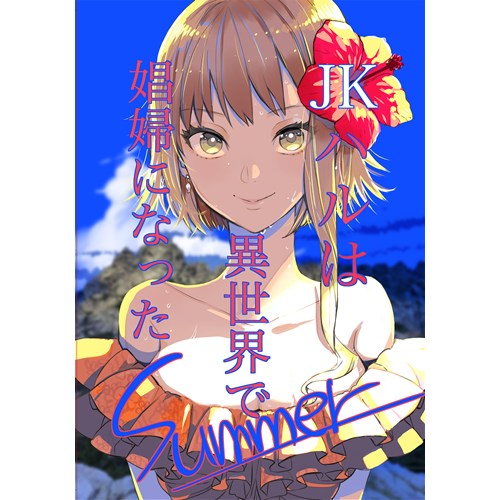
On a bright note, though, it looks like a limited comic - JK Haru "Summer", or something to that effect, has been released. Very interested in that; look at that gorgeous cover!


More info here.

Here's hoping for more from Haru - more novels, more manga, and how about an anime?

Friday, November 2, 2018

Slum Online

Slum Online by Hiroshi Sakurazaka. Originally released in America by Viz Media/Haika Soru, 2010. Approx. 203 pages.

After watching this book languish on my shelf for countless years; I finally decided to pick it up and give it a shot. An interesting bit of history behind it; as, in a way, it is something of an artifact by today's standards...somewhat obsolete.

These days, you can peruse large volumes of light novels on Amazon and at your local bookstore. There was a time this was not the case. Before the explosion of popularity in the novels predicated upon SAO's performance, the niche market for Japanese fiction was rather small. Agreed upon classics, or new releases from top bestsellers were present, but that was about it. Many of us jumped on the original release of Battle Royale in novel form, only to be stymied by horrendously stiff translation.

Later, Sakurazaka's 'All You Need Is Kill" started making some waves (before being adapted into the film Edge of Tomorrow). Picking that up, I found myself drawn in by the cover on this book. Can't exactly say what it is, but I love the aesthetic of it.

So, what exactly is "Slum Online"? I'll post the synopsis in a moment, but in a nutshell, it's about a disenfranchised young Tokyo man who spends the bulk of his time fighting to be the top dog in a popular MMO fighting game. However, the difference is that, unlike in modern light novels, it isn't an isekai work, in which the protagonist is transported or reincarnated into the game world. Also, the protagonist isn't a full-blown, anti-social NEET type. No, Slum Online has elements of a gaming novel, and a love story, all told with a nice cinematic flair by an accomplished author (bolstered by a strong translation by Joseph Reeder).

Here's the synopsis:

"Etsuro Sakagami is a college freshman who feels uncomfortable in reality, but when he logs onto the combat MMO Versus Town, he assumes the personality of "Tetsuo," a karate champ on his way towards becoming the most powerful martial artist around. While his relationship with new classmate Fumiko goes nowhere, he spends his days and nights online in search of the invincible fighter Ganker Jack. Floating in between real and virtual, at last, Etsuro finds himself face to face with his most powerful opponent..."

The writing style in Slum Online is strong and engaging. Sakurazaka draws the reader in with vivid depictions of areas dotting the Tokyo panorama; we feel transported into the quirky areas of Shinjuku, etc.. Our moods are swayed by weather patterns swaying from oppressive heat to melancholic rainfall. We feel ourselves languishing along with Etsuro in tedious university classes which he cannot bring himself to become personally invested in.

The characters here are strong as well. Etsuro is a hard sell, but Sakurazaka does it. The young man, as mentioned, is not anti-social, but he is also not proficient at social interactions. He possesses the acute logic to dissect and succeed at the games which are his passion, and he applies the same pragmatic skills of deduction to everyday life.

Etsuro finds himself a bit stymied by his developing relationship with responsible classmate Fumiko. Their budding love is the best part of this gaming novel. Where he might not have the capacity for the 'right' way to verbally communicate; we can see the endearing manner in which he regards her (case in point, the 'hamburger shop smile').

In fact, one might argue that the weakest aspects of the novel are those which revolve around Versus Town, the game with which Etsuro is obsessed. The online fighter is conceptually sound; and conceivably immersive.

However, the fight scenes (and there are quite a few), aren't always engaging. Kudos goes to Sakurazaka for doing blow by blow descriptions of the matches. The thing is; it boils down to a lot of "buffered this, dashed in, canceled out, did the lightest punch, etc.". Throughout the novel; Fumiko compares Etsuro to Newman's character in The Hustler. Imagine reading a book about a critical pool match; and it read in such a manner: "then he adjusted the stick 45 degrees, striking the cue ball on the upper left hemispherical region, etc." It just isn't that catchy. The thing is; it is understandable because that is how Etsuro's mind works (the story is told in a first-person manner). He isn't focused on the lithe animations of the snake boxers, or the stumbling-yet-lethal meanderings of the drunken boxers. His mind focusing on the mechanics of the game; and matching attacks and counters to the motions of his prey.

There is also some slight jarring in regards to the first-person narration. During the fight scenes, we are told what Tetsuo (Etsuro's character's name) is doing in the third-person. Yet, during these moments, it also switches out to first-person, if telling how Etsuro is manipulating the controls. It's not bad; just awkward at times.

Other than that; there is one minor, specific complaint that I have. This is in regards to one instance in the translation (again, the translation itself in general is extremely strong). When Etsuro meets Fumiko, he has trouble reading the kanji of her last name, Nagihara. This implies that the spelling of it (hence, the kanji used in constructing it) is uncommon. Which also implies that there might be a specific meaning behind the kanji which is used. The thing is, we are never shown her name the way her name is written. I had wanted to take it and ask my wife (who is also named Fumiko) to translate it for me. So, if anyone out there has the Japanese version of the novel, or can find a pic of it online, please throw it in the comments. Greatly appreciated.

And there you have it. A short review of an enjoyable, short read. Like previously mentioned, it is conceptually a dinosaur in the age of isekai and LITRPG works, but it is still endearing. Also, enjoy the 20 page short story, "BONUS ROUND", also included in the book (Slum Online was originally published in Japan in 2005, and BONUS ROUND 5 years later).

Check it out.

Cover:

As mentioned earlier, this cover snagged me from the get-go. Better yet, it beautifully captures one of the more endearing scenes from the novel. While not as intricate, or bright, as many other light novel/manga covers, this cover oozes emotion, and works as a great companion for the book itself. Makes you wish that the artist, toi8, had done some interior pieces as well.