Showing posts with label Glen Cook. Show all posts

Friday, January 17, 2020

A Fortress In Shadow (Dread Empire)

A Fortress in Shadow (Dread Empire Omnibus 2) by Glen Cook. Omnibus edition published by Night Shade, August 2008. Approx. 368 pages.

Before The Black Company, there was the Dread Empire.

So the blurbs often go; however, there are precious few parallels between Glen Cook's early dark fantasy series and his iconic mercenary series.

Reviewing the Dread Empire series is a bit of a tough job; I actually read the first three installments (bundled together in the A Cruel Wind omni) a few years back, but was never able to pen a proper review. I liked them; quite a bit in fact, but yeah, they're kind of odd. As early works, there're issues with pacing, direction, and cohesion of narrative.

However, before getting into the two installments included here (which, by the way, are actually prequel books to the original three), we should touch base a little with the series so far.

Apologizing in advance; I've forgotten a lot of what's transpired already. A lot. Ugh, sorry. Bear with me.

With the Dread Empire series, Cook did something he really seems to enjoy doing; basing stories off of areas from different historical points, and adding influences such as magic, and/or deities into the mix. From this template, he extrudes a compelling narrative. The titular Dread Empire serves as a stand-in for Eastern Asian expansion, while the Western kingdoms are our Europe proxy. Smack dab in the middle (or thereabouts, remember Cook eschews the inclusion of maps) lays the series' version of the Middle East, Hammad al Nakir (or is that just one of the regions? I can never remember, the name onslaught never ends...).

The first trilogy details geopolitical tumult and power moves in the Western Regions as the Dread Empire amasses power and prepares for conquering moves in the East. At the center of this is a trio of friends; Bragi (a Trolledyngjan, the series' Norse equivalent), Mocker, a scheming thief/trickster, and Haroun bin Yousif, the King Without a Throne, the vagabond king of al Nakir, and victor of the El Murid Wars. This trio are former friends and adventurers, and their paths continually cross, overlap, and intertwine as events unfold.

While that sounds pretty straightforward; as I mentioned, the first book of the series, A Shadow of All Night Falling, seems to have trouble figuring out where it wants to go. A large portion of the narrative focuses on the history and current plight of the wizard Varthlokkur, and that's great. But then, along the way, Bragi gets introduced; and in a fairly minor capacity. This is odd as he is, overall, the central character in the series. Hell, in this book, Mocker gets much more page time than him; and that doesn't really work, as Mocker is an extremely annoying character (at first, he gets better as Cook's writing got better). Haroun features barely at all.

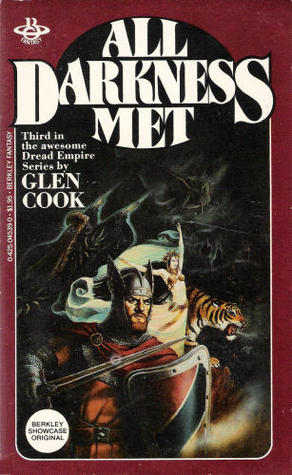
The second book, October's Baby, was mostly battle reports (excellently done). And the third book, All Darkness Met, sees the series really hitting its stride;
with the battles and intrigue intensifying, the stakes continually getting raised, and the espionage/spy angles really being played up.

Short take: once the series really gets rolling, it's amazing. Lovers of The Black Company will of course miss the laconic, sardonic wit of a narrator like Croaker. However, they'll also be amazed by Cook's ability to turn extremely bare bones, sparse descriptions and dialogue into compelling scenes and characters. Huge battles are resolved in mere sentences. Major characters die off-screen. There is very little time spent in their heads, and yet, you still get to
know these characters well. But that's why he's such a great author.

Now, back to these prequel books. These were released around the time the first Black Company book came out. Safe to say, this is when Cook was at the top of his game, and it really shows. The writing here is top-notch Cook, and he has a clear vision for how he wants these books to play out.

The two books contained in this omni are The Fire in His Hands (1985) and With Mercy Toward None (1985), keeping up his tradition of absolutely amazing book titles. As was fairly typical of the mid-80's, these books are fairly short; coming in at about 180 pages each, making this omnibus about the size of a normal, modern book at about 370 pages.

The core thesis of the duology is as a chronicle of the El Murid Wars mentioned earlier in the series; and which forged our core trio of characters into the men they are. The primary focus is on El Murid
himself; born Micah, the son of a salt merchant (whose caravan was slaughtered by bandits), who is charged by the Star Rider (that shadowy, omnipresent interloper seen in the first books) with becoming a true Disciple of the Lord. He gifts Micah with the name El Murid, as well as a magic wrist amulet which can literally call down the power of the Heavens.

El Murid soon finds, however, that entrenched power structures are quite adverse to usurpation. El Murid must secure and grow his base of followers; then raise armies and take lands. The "Lord" has charged him with taking the religion to the lands of the non-believers, but he finds it hard going just unifying the lands of his own people. The majority of the first book deals with these actions/battles.

Also interspersed throughout the first book are the introductory backstories for Bragi (and his brother Haaken), and Haroun (which gives us an invaluable insight into the Royalists, who support the establishment over the upstart El Murid).

The second book focuses on the actual taking of the Word to the lands of the infidels. By this point, El Murid has amassed a massive army, with the Royalists reduced to a few scattered bands. By rules of lineage, Haroun is technically king, but he is stranded, on the run.

On the Western front, we see the moves, maneuvers, and power grabs/consolidations which transpire in the wake of the invading forces. There are countless battles, and positions of power shift at the drop of a hat.

Book 2 also introduces Mocker into the mix; showing him as an invaluable asset as a spy an covert ops specialist.

There isn't much else to say on this prequel duology. As already stated, even within the sparse prose; the myriad landscapes are richly envisioned and detailed. The battles effectively convey their horror, magnitude, and significance. And the characters are rich and real. El Murid, the eye of the storm in corporeal form; is an immensely deep, and tragically flawed character. He is no zealot of iron resolve. He has desires; personal desires, sexual desires, desires for power, for revenge, and even desires to grow his Empire into a verdant utopia, rather than subjugate infidels by the sword.

But life does not bend to accommodate our desires. Few authors hammer that sobering message home better than Cook.

So, are there any problems? With the story we get, not really. It's solid. Cook obviously had a vision, and he served it up. There are some questions, though. The main question is....why? Why do we have/need a prequel duology focusing on the El Murid Wars? The Dread Empire, you know that massive evil institution that serves as the primary antagonist for the series, as well as giving it its name? Yeah, them. They don't figure in these two books....at all. El Murid's jihad does not take his forces to their lands.We don't get snippets of what is transpiring in these lands when the forces of the Disciple hit the Western kingdoms (and, we know well from the first books, they're always watching).

Also, although you may have liked Haroun in the first books, and may have grown to like (tolerate) Mocker, perhaps we didn't need to see so much focus on them, especially Haroun. Compelling as his tale is; if you're reading these books, you likely remember that Haroun's tale came to a close in the third book. Mocker's too.

As you can see, the "why?"'s are no deterrent, and these books are great. You also get the added bonus of a heartfelt introduction by Steven Erikson, telling his history with Glen Cook's books. Jeff Vandermeer penned an intimate intro for the first, Cruel Wind omnibus.

So there you have it. Grab these first two omnibus volumes and enjoy some early Cook. See what a brilliant mind this natural strategist has. I'll be moving on to the final book in the series soon, hopefully.

Cover:

Night Shade has always gotten Raymond Swanland to do some of his best work ever for the Cook releases. This one is no exception. What an eye-catching cover, look at that dynamic posing.

Sunday, October 7, 2018

Port Of Shadows

Port of Shadows by Glen Cook. A Chronicle of The Black Company, originally published by Tor, September 2018. Approx. 385 pages.

At long last. What more can I say?

Nearly two decades after the series came to an amazing close; nearly one decade after the first 'new' short story surfaced, we finally have a new, physical Black Company book in our hands.

Rejoice.

Now, this review might be a little different than normal; for a few reasons. First, this is the first review I've done in, what, a year? I'm way out of practice. Second, this is a book about obfuscation and disinformation. It's hard to pin down a true synopsis. It's harder to review; especially the way Cook has written it, without spiraling into major spoilers (which I am loathe to do). So, please, forgive me if I meander a bit with personal opinion of Cook's choices rather than objective appraisal. I'll do my best.

First, the synopsis proper:

"The father of Grimdark returns…

The soldiers of the Black Company don’t ask questions, they get paid. But being “The Lady’s favored” is attracting the wrong kind of attention and has put a target on their backs, and the Company’s historian, Croaker, has the biggest target of all.

The one person who was taken into The Lady’s Tower and returned unchanged has earned the special interest of the court of sorcerers known as The Ten Who Were Taken. Now, he and the company are being asked to seek the aid of their newest member, Mischievous Rain, to break a rebel army. However, Croaker doesn’t trust any of the Taken, especially not ones that look so much like The Lady and her sister…"

Ok, that's not too far from what we have here in the book. The bulk of Port of Shadows takes place in the period between books 1 and 2; and these portions are narrator by our dear friend Croaker. There are also chapters dedicated to historical events circa the Domination. These stories are told in a more classic third person POV (Cook did something similar to this in Shadows Linger, although that was all present time).

Port of Shadows finds our favorite mercenary group on fairly quiet garrison duty (post-Charm battle) in a small city named Aloe. Daily duties include winning hearts and minds, civil engineering and agricultural duties; arguing, drinking, and cheating at tonk at the local bar, and keeping Rebel insurgents at bay (all this action is off-screen, much to the chagrin of many reviewers).

Things take a turn for the active when the Company is tasked with retrieving one Tides Elba, a young lady of the Senjak family tree; who also bears a link to the titular Port of Shadows, a purported gateway through which the Dominator might be able to return to the world.

Things teeter into the bizarre from that point. Elba later returns as Mischievous Rain; a newly appointed member of the Ten Who Were Taken, as well as the bearer of some deeply personal news for Croaker.

Also, further compounding matters, girls bearing striking similarities to Ms. Elba begin popping up with perturbing frequency, increasing the chances of a Port of Shadows opening to allow the old Evil in.

Perhaps that's the best place to stop the core overview. What follows is a lot, and I cannot stress a lot enough, of murky, convoluted happenings. Croaker begins to refer to himself as a 'mushroom man' (kept in the dark and fed a steady diet of shit), and rightfully so; he is left out of the logistical loop. And, since we count on his records to see what is transpiring, we too are left out of the loop.

Imagine this: reading a book that details the rise, fall, and growth of a Fortune 500 company. Except, you only see through the eyes of some shlump in the mailroom, never peeking into the executive offices. You just notice subtle policy changes here and there. That's basically how this story unfolds.

Understandably, this approach is flummoxing a lot of readers. Also, understandably, it makes sense for how the narrative needs to transpire. But I digress.

Along with this core narrative, there are the aforementioned historical interludes. These detail the story a necromancer and his adventures with a dead Senjak sister, as well another sister who sets out to find her.

Ok, let's break Port of Shadows down and evaluate its components:

Writing: Well, here we go again. You will likely either love or hate it. I have seen some nasty reviews out there; citing 'senility' and a host of other ills, all declaring that this is 'not the real Black Company'. Yes, there's some credence to that claim. More on that later, in the opinions section.

As for writing, I think Cook is still on point here. Take into consideration that the first 3 chapters here that feature the Company; Tides Elba, Smelling Danger, and Bone Candy, were previously released in short story anthologies (there's a disclaimer at the beginning that they've been edited slightly, but I'm not going to do word for word comparisons). In those stories, Cook is definitely in old form. Remember, he usually does not do linear or redundant well. He changed Annalists, aged them, and kept it consistent. But he always seemed loathe to keep doing the same thing. This Croaker does speak like the Croaker of old, for the most part. Later on, he chides himself for his obvious tonal shifts. But it is all part of the planned narrative. It isn't the compromised memory of the author; it's - well, it's something else.

So, yeah, the first person ain't what it used to be. Personally, I believe that, unlike in previous Croaker outings; some of it is what appears in the Annals, and some is his own mental meanderings. There's no way to know for sure. Cook is notoriously reticent and deliberately obtuse.

In short, I won't say it's bad, but this could've been shortened to 200 pages, like older volumes, and still packed the same punch.

As for the older interludes, the writing in those is sharp, poignant, and emotional.

Action: Cook was never one to detail protracted fight scenes, but there is almost no action in this book. Skirmishes, etc., all happen off-camera.

There are some nice displays of magic, well actually, not some. One.

Yes, this book is very light on action. If that's a deal-breaker, you've been warned.

Characters: As mentioned, I personally believe Cook is still on point with Croaker. Some have claimed he isn't the same as old; and for a large chunk of the book, he technically isn't; again, with reason.

The supporting characters appear in their former glory; although I would've loved to see more of them. Elmo, Otto, Hagop, etc., make little more than glorified cameo roles. We clap when we see them, then wish they'd stay longer. There are some rare slips like making the Captain too verbose.

As for the new characters, they're a bit hit or miss. Mischievous Rain is a stellar, well-fleshed out character; although some might see her as Cook trying to insert another Lady/Soulcatcher caliber character.

Newly introduced wizards Two Dead and Buzzard Neck work best in the opening chapters, then kind of fade. Two Dead is first posited as kind of a Limper Lite, then he becomes damn near friendly. Oddly.

However, Cook also does the near-impossible in introducing children into the story, and not making them 100% obnoxious. That is no mean feat.

Opinions: I guess, like this book, my review is to be filled with more personal meanderings than concrete evidence...

Mind you, some of these points are ones which I've raised in varying degrees in past reviews.

We've known for a good while that Cook was working on two new Black Company novels, Port of Shadows and A Pitiless Rain. After the release of Tides Elba back in 2010, we could guess that Port was going to be an older Company tale. Still no word on what the storyline of A Pitiless Rain will be; but we can speculate as to whether or not the titular Rain refers to Mischievous Rain. This would indicate another story set in the olden times. Also, bear in mind that since Soldiers Live, Cook has released 5 short stories set in the old days; only 3 of which were included in Port. Shaggy Dog Bridge and Bone Eaters remain unincorporated.

For me; while I'm always ecstatic at the prospect of new material, I was still holding out hope that Cook would be able to (would desire to) do an entire Black Company centered around the Company that left Khatovar. I know, I understand, it was devoid of the familiar faces, but I believe he could've made something spectacular out of it.

Back to Port. What about the obvious issues surrounding writing a book 1.5 after the series was completed? Two glaring problems come to mind:

1) You need to come up with a concept that is compelling enough to frame an entire novel around.

2) You have to justify how and why said events never appeared, or were never referenced, in the successive volumes. Remember, the entire series is predicated upon record-keeping.

Basically, how do you resolve these mutually exclusive issues, and still deliver what the fans want?

Honestly, there's only one way to swing it. And that's what Cook did. As to whether it was 100% successful or not, is up to us. As I said, solid as I found it, it still could've been cut at least 25% and made leaner and meaner. Cook always used to be about trimming the fat. Now it seems padding crept into the works a bit.

Well, response is fairly skewed. Some say it's pure genius, or a complete return to old form, a sentiment with which I cannot 100% agree (close, but not 100%). Some say "even bad Cook is better than most other stuff"; which is true in theory, but this book is not bad. Many lament that these characters are not the characters of old, they're different...well, to this I must say: (SPOILER IN CASE YOU HAVEN'T ALREADY FIGURED OUT) the members of the Company are under some pretty heavy sorcery for the duration of the novel; muddling their minds and keeping them unfocused on what's going on. You can see this especially with One Eye and Goblin, who are their normal bickering selves at the onset, and then keep getting sent out for most of the remainder of the book.

Finally, I've seen quite a few lamentations on the representation of women in the book. Ummm; I'm not going to implode my entire blog by wading into gender politics. I will say that there have always been some constants in regards to Black Company books; first, Croaker has always been pretty pervy. He has his types and he has little time for those who aren't his type. Second, part of the realism that has driven the popularity of these books is the unflinching lens through which we view some of the nastier aspects of wartime and brutal regimes: rape (of women of all ages), incest/inbreeding, etc. Remember, when the Company members are ogling nubile, teen girls, that a) these are not nice people. Many of them are criminals escaping dark pasts, and b) in many countries, across many periods of history, and, we can assume in alternate worlds as well, the statute of limitations does not reflect our current state's. Just because I don't condone or engage in something doesn't mean I will pretend it doesn't exist.

But, as always, you take from it what you will. I can't tell people how to receive a book. Though I'd love to discuss this in the comments.

In the end, we finally got the new Black Company book, and it's pretty darn good. Here's hoping A Pitiless Rain sees the light of day in the future; although, if it takes place in the same timeline as Port of Shadows, I'm guessing a lot of the issues people are having now will manifest themselves again.

Cover:

Glad to say, Raymond Swanland has returned to grace yet another Black Company book with his talents. For me, this is his best Company work to date. Whereas facial structures/features were harsh and angular on previous covers; these are simply beautiful. And the attention to detail is commendable (well, except for making Croaker look like a grimdark badass).

An outstanding piece of artwork, indeed.


Wednesday, September 26, 2018

'The Heirs Of Babylon' Is Getting Re-Released!

Oh happy day! Not only do I have a new Black Company book to enjoy these days, it seems the wonderful folk over at Night Shade Books (you know, the ones that released a large swathe of Glen Cook's back catalog in recent years) have gotten a hold of Cook's first published novel (no, not the softcore porn 'The Swap Academy' written under the pseudonym Greg Stevens), The Heirs of Babylon.

You can read the press release here.

What's more; the uber-talented Raymond Swanland was contracted to design the new cover! Check this beauty out:

Glen Cook - Heirs of Babylon

Amazing, right? Compare that with the original cover:

(Note: that's my actual copy of the original book)

What's more, at the Night Shade website, you can see all of the conceptual pieces which Swanland proposed. They are definitely worth taking a look at. 

Also, if you're interested in reading more about The Heirs of Babylon, look no further than my own review of it here. In short, it was solid for a first book.

Monday, February 26, 2018

Port Of Shadows Cover Revealed!


From Tor:
https://www.tor.com/2018/02/26/cover-reveals-glen-cook-port-of-shadows-the-black-company/

Well, here it is! We finally have a cover for Port of Shadows, the new Black Company book from grandmaster Glen Cook, arriving in September of 2018!

Once again, Raymond Swanland has delivered a fantastic cover.

From Tor's page:

"We’re excited to share the cover for Glen Cook’s Port of Shadows, a new novel of the Black Company, coming this September!

The soldiers of the Black Company don’t ask questions, they get paid. But being “The Lady’s favored” is attracting the wrong kind of attention and has put a target on their backs, and the Company’s historian, Croaker, has the biggest target of all.

The one person who was taken into The Lady’s Tower and returned unchanged has earned the special interest of the court of sorcerers known as The Ten Who Were Taken. Now, he and the company are being asked to seek the aid of their newest member, Mischievous Rain, to break a rebel army. However, Croaker doesn’t trust any of the Taken, especially not ones that look so much like The Lady and her sister…

Port of Shadows publishes this September with Tor Books. Check out the full cover below, along with a brief excerpt from the novel that inspired its design!"

Also, a brief excerpt!....

"The chimes turned orchestral as she stepped down from the carpet. A gust tossed her hair in streamers as black as her clothing, but shining. Her hair included several intensely scarlet streaks. A silver and lapis lazuli butterfly clip sat at the root of the boldest red stripe. She was as slim as a maiden but her face suggested past strains beyond those of any maiden’s years.

So, truth absolute. She was Taken. She had gone to the Tower. She had come out of the Tower a bespoke servant of shadow.

Nobody moved to greet her. Nobody doubted what she was, either, though no Taken had visited us in months. The Limper had been the last.

She turned my way, frowned slightly, then smiled just as the sun sneaked out from behind a cloud. Its light kissed her. Her face suddenly seemed coated with white makeup on which thin blue lines had been sketched. The light faded before I got a good look. Then I got distracted by the cat that ambled out of her shadow.

It was a three-eyed cat. You do not see many of those. It was as black as her hair. The rationally placed eyes were yellow, except when they looked straight at you. Then they became a pale lilac rose, and glowed. The third eye, above and between, was a slit visible only from straight ahead. It shone crimson for a moment, then purple."

So, yeah, exciting news...Hopefully, they will package in the 4 short stories that have already been released as chapters...We shall see.

You can read my reviews of Cook's works (including the 4 stories that came after Soldiers Live) here:

http://hachisnaxreads.blogspot.com/search/label/Glen%20Cook

Saturday, April 9, 2016

The Heirs Of Babylon

The Heirs of Babylon by Glen Cook. Originally published by Signet Science Fiction, 1972. Approx. 183 pages.

Last year, for my birthday, I decided to get myself a little treat, and so I tracked down The Heirs of Babylon, Glen Cook's first published full-length book (he already had his porn novel, The Swap Academy, released under the pen name Greg Stevens, and some short stories and Clarion contributions published by the time). Of course, with the TBR pile as high as it was, I haven't really had a chance to read it. Actually, no...that's not 100% true. Like many other books by Cook, I tried a few times to read it, getting a few pages in, before I could actually sit through it. It's a strange thing; I'd put him as my favorite author; and yet, it's like the stars need a certain alignment for me to be able to commit to the long haul of finishing one of his books.

Well, I decided I would get it done by this birthday. 100%. And, of course, that passed over two weeks ago... But hey, this is as close to being on schedule as I can get these days, so I'll take it.

The Heirs of Babylon is an interesting little novel. It is set in a post-apocalyptic world, two hundred years after nuclear and chemical warfare has annihilated almost the entirety of the global population. And yet, for some reason, maybe the inherent madness of man, the war continues. Every few years, there is a Gathering; where the remaining territories must cobble together a Tribute: man and naval power, and trudge off the the "Meeting", and do battle with the phantom enemy. Few, if any, ever return.

Our protagonist, Kurt Ranke, is a young man that lives in the Littoral, the ragged remnants of Germany. Impulsive action and obstinate pride have committed him to participation in what High Command (the ruling force for the West) has deemed the "Final Meeting". We meet him as he is bidding farewell to Karen, his new wife. Before leaving, she hits him with two curveballs; one, that she is possibly pregnant, and two, she is contemplating absconding to Telemark, Norway, to join a pacifist faction up there. She begs him to join, but he commits to duty. And so, he boards his ship, the Jager, and sets off on his appointment with destiny.

For the most part, the book details life aboard the ragtag destroyer. This is what Cook has always excelled at; taking something seemingly normal, and adding fantastic elements to it. Due to the loss of the technology of two centuries past, those attending the Gathering can still put mighty ships in the water, but they are often patchwork craft, often running on steam power.

This part of the story works because of the authenticity of the naval portrayal. As Cook even mentioned recently in an interview, a lot of what was written here was drawn upon from his Naval service a few years prior. So, if the day to day actions of a Quartermaster don't appeal to you, a good chunk of this novel won't work.

Now, as these things are wont to happen in a militaristic system of government, High Command has a sort of "propaganda police bureau" known as the Political Office, to make sure that everyone keeps marching in step. These feared agents are clad in black, and inspire fear and command respect wherever they go. Think SS officers or Warhammer 40K Commissars.

In such a totalitarian society, it comes as no surprise that the undercurrents of dissent are evident on a broader spectrum than those fleeing to Telemark. On the Jager, and, we find later, most other ships participating in the Gathering, there is an underground movement. The seeds of mutiny that they sow create an intense amount of tension on the ship.

Our protagonist, Kurt Ranke, finds himself smack dab in the middle of this ideological maelstrom. Cook has, in Kurt, presented us with a very real, human lead. He is a young man who is not non-violent, but simply not violent. He is not anti-war; he just cannot quantify hating an "enemy" that he has never seen. He is not pro-High Command, but he understands that life is much easier when one follows a set path (even though in the back of his mind he realizes that this path is probably a one-way trip). He also recognizes the goals of the resistance; he even finds excitement in them, and a desire to help bring about change. Of course, he ends up committing again to the path laid out for him, and hating himself for his laziness. Kurt is very much like us in this way; we can rage over political and social issues in the news and on social media, then finish our coffee and head off to our work pods.

Even though Babylon borrows from other anti-war and anti-totalitarian works, it is not a propaganda piece. It is, like so many of Cook's other works, a story seen from the everyday soldier's point of view.

Towards the middle, Cook borrows a page from 1984 and has Kurt visit a small shop, where upon him is bestowed a book which illuminates some of the mechanics of the current societal structure. He picks up some rudimentary English skills, and sets about translating the tome.

As the rickety armada trudges off to its final rendezvous, the clamps from High Command are tightened, and the seeds of mutiny truly begin to blossom. At this point, it all becomes a matter of time....

There's really two main ways to look at a book like The Heirs of Babylon. If you are reading it today, it's most likely because you are a Glen Cook fan, and perhaps a completist of sorts, and are interested in seeing what his earliest works were like. Perhaps you want to see if you can see parallels between older and contemporary books by him, and see if you can chart the evolution of his writing prowess.

Or, you can look at it as a standalone. Imagine you plucked this off the spinner rack at a bygone drugstore, or found it in a used-books box at a flea market. In that case, you can appraise it on its own merits as a standalone book.

On its own, The Heirs of Babylon is an enjoyable enough book. It is post-apocalyptic, but not in an insane, "Mad Max" manner. Given this, it might come off as a tad boring for some. In fact, this may be the first instance of Cook "self-critiquing" himself in-book (remember when Croaker savaged Murgen for how he recorded his Annals?). As Kurt is translating the forbidden book, he notes how it is much more boring than he expected, and after a certain point he was just continuing to turn pages in the hope that something exciting would happen. Babylon isn't boring, but it isn't chock full of explosions either. The action scenes, when they come, are fast, furious, and intentionally confusing. Terrifying, too. You know, just how they'd be in real life.

I'm not going to give away too much in regards to the climax. Suffice to say, Cook surprises us by not giving us what we expect, and yet delivering something entirely believable. If you are hoping for either a lofty, heroic ending; or an overly dramatic, sad one, you will be disappointed. Cook knows that in the end, soldiers do what they need to do to survive (remember, soldiers live and wonder why). Ergo, this story ends the moment that the war ends for Kurt. This yields a finale which is both immensely frustrating and completely satisfying at the same time.

In the end, I'll just say that The Heirs of Babylon was much better than I expected. Cook exhibited smooth polish even as a young writer, although I wonder if he would've written from the first-person perspective if he had written it later in his career. If you are a fan, and have $5-10 kicking around, it's totally worth hunting down a copy.

Final Score:

8/10

Cover Score:

Not bad at all. The ships are beyond basic, and the faces in the mushroom cloud remind me of the onionheads in the original Don't Be Afraid of the Dark movie, but it's still fairly evocative.

Cover Final Score:

6.5/10

Wednesday, August 26, 2015

Bone Eaters (Black Company)

Bone Eaters by Glen Cook. A Black Company short story, originally appearing in the Operation Arcana anthology, published March 2015 by BAEN. Approx. 25 pages.

As Tom Petty said, the waiting is the hardest part.

Ever since Operation Arcana came out this past March, with the blissful promise of a new Black Company story, I've been biding my time until a used copy hit the Amazon $.01 section. As soon as one did, yours truly grabbed it, and promptly devoured the story in one afternoon. Side note: I already started reading some of the other stories in the anthology; they are pretty damn good, so hopefully I can slap together a larger review of all the tales in this tome (then again, this is like the third anthology I've said this for, and I never seem to get around to do it. But seriously, there are some powerhouses contributing in this book).

As for Bone Eaters....

Regardless of what my concerns may have been with Glen Cook adding new stories into old Annals, all of these recent shorts have been superb. Bone Eaters is no different. This is Cook channeling Croaker's younger self seamlessly (no mean feat; since there is probably much of Cook in Croaker, and as the author aged and evolved philosophically, so did the Annalist), allowing the reader to tap back into the vein of the story line that originally hooked them.

Bone Eaters is slightly different from some the previous shorts in that the timeline takes place during around the Shadows Linger arc, with the Company fleeing their former pact with the Lady (whereas most of the other shorts took place while the Company was stationed at Aloe, still in the Lady's employ). If I remember correctly, Shaggy Dog Bridge would directly precede this.

There are two major points of interest in this short. First involves the Company picking up some would-be brigands/would-be Company members. Of note in this mob is a young girl named Chasing Midnight, who shows portents of being a budding witch. The interactions between Croaker and her are reminiscent of his dealings with sisters Shukrat and Arkana in Soldiers Live. Part parental, and part predatory. There is no other way to put it; Cook is a master at capturing the way that (some) older guys lustfully leer at nubile young girls like the Big Bad Wolf of fable, no matter how much of a nurturing facade they offer as an excuse. Heck, the older I get, the more I see the truth in it. That's why you love to read Cook's works; there is no B.S. allowed; he's got your number and he's holding up his as well. But there is a lot to Midnight; the undercurrents of fear, anger, and manipulation. At one high point Croaker makes an observation about the beginnings of the evil mages in dark towers. It stands as some decent food for thought.

The second point of action is the obligatory conflict that needs to be resolved. In Bone Eaters, Cook introduces the idea of "Hungry Ghosts"; spirits that inhabit an entire town. They emit a perpetual siren call to lure hapless passersby into becoming vessels for them to occupy. The general consensus is that Lady is steering them towards a demise here so that her hunting dog Taken (namely Whisper), can recover a bit from what has been an exhausting pursuit of them. 

The ghost town idea is done very well. The high point is not in the monsters themselves, but in how the Company approaches resolving the problem. To be 100% frank, this whole portion of the story is somewhat superfluous; in fact this would have been a winning story just focusing on the inter-Company exchanges in light of the new faces among them. But the "hungry ghosts" are nicely realized; Cook, in typical fashion, makes sure to guarantee that there is a cause and effect, and limit to their powers, in order to give them legitimacy. The scenes where some Company members enter the haunted town is pretty tense, and it shows how the characters act under actual pressure. 

As always, it is great to see old friends again. There aren't any real complaints I can list regarding this short. The only thing that caught me a little off guard was the insinuation that the feelings between Silent and Darling may have been somewhat mutual, instead of one-sided (of course, I might either be remembering wrong, plus all the Annalists have been notoriously unreliable narrators). Cook also does a lot with his new characters as well. As already mentioned, Midnight and her gang are done well. Malicious bully Rusty, introduced in Shaggy Dog Bridge, is given some strong moments as well.

All in all, this story alone is worth picking up a reasonably priced copy of this book. 

Here's what it is:
On the run from the Lady, Croaker and Company pick up some urchins and get steered towards a literal ghost town. A strong conflict is upstaged by stronger characterizations.

Final Score:

9.5/10

Thursday, February 19, 2015

Shaggy Dog Bridge

Shaggy Dog Bridge by Glen Cook. A Black Company short story, originally appearing in the Fearsome Journeys anthology, published . Approx. 31 pages.

Just when I thought I had presented a complete synopsis of the legendary Black Company series in 2014, I find out that I let one short story slip through the cracks. Shaggy Dog Bridge, first appearing in the Fearsome Journeys anthology (edited by Jonathan Strahan of Swords & Dark Magic renown), is the third of the (so-far) quartet of short tales that will segue readers into the long awaited, much anticipated Port of Shadows.

In Shaggy Dog Bridge, we find our favorite Annalist, Croaker, attached to a recon patrol scouting ahead while the angry Taken, Whisper, pursues with a clutch of angry Imperials. Along the way, they find a massive glamour (illusion), one of a perfectly mundane chunk of forest. The thing about illusions of normalcy is that they are usually there to mask things markedly out of the normal. Being a recon group, it falls on them to see what exactly that is. What they find are parts of the puzzle which Cook has in store for us in Port of Shadows.

Out of the four Black Company shorts released over the past few years, Shaggy Dog Bridge is definitely my favorite. There are a few reasons for this. Firstly, once again, Cook shows us (again) that not only can he still write for "earlier books" Croaker, but he can still capture specific moods and attitudes. In this story, Croaker is pissed off, ornery, and in a generally foul mood, due to being attached to this tedious task (which he himself had volunteered for). The writing is cranky, full of expletives and vitriol.

Another high point of the story is the addition of a few more "grunts". Other stories in this arc have introduced wizards and concepts for "bad guys", but here we can meet a few more personalities of the rank and file. These additions, namely Rusty, Robin, and Whittle, have a lot of potential.

Finally, and most importantly, we get a real whiff of the type of evil that will be faced in the upcoming book. For example, the most intriguing bit of geography mentioned is not the titular Bridge, but a scar on the earth known as the "Rip", a cleft in the landscape possibly caused during a battle between formidable nasties. We also find out about the "Master", who will serve as the Dominator type in Port of Shadows. And, lastly, we get to meet Blind Emon, a "Taken" of sorts in thrall to the Master (the fact that she is a concentrated ball of agony is a great touch).

As in most other Black Company titles, the joy is not in the violence, but in the characters, the dialogue, and the authenticity of the battlefield tactics and situations. There is no clanging of swords, but more of what makes the Company who they are; planning, resourcefulness, sabotage, and a lot of luck.

So, as I've said before, I shall say once more; I am overjoyed that Cook is getting closer towards a new Black Company book, and, while I am happy that he can still write for the crew circa Books 1-3 as well as before, I'd rather see other Company stories. Perhaps A Pitiless Rain, if it ever sees the light of day, will focus on Suvrin, Tobo, and those that survived Soldiers Live. But how about some coverage of the original Company? Those of renown that first marched from Khatovar and put so much fear into the Taglians? Ah well, it's still a business, and I am sure the majority want to see more Croaker. And, as the quality of these four shorts testifies, it'll be a great read.

Here's hoping I'll get a chance this year to review the other titles in this anthology. It looks like a solid one.

Final Score:

96/100

Friday, November 21, 2014

Bone Candy

Bone Candy by Glen Cook. A Black Company short story, originally appearing in the Shattered Shields anthology, published October 2014 by Baen. Approx. 25 pages.

While I am loathe to review individual short stories from anthologies, today we have a special case. Shattered Shirlds, a military fantasy compilation published by Baen last month, features a brand new Black Company short by Glen Cook. So, while I will most likely finish this anthology at a later date, it is imperative that I review this short story.

Now what do we have here? To start, Bone Candy, like the previous two shorts (Tides Elba and Smelling Danger), takes place in the city of Aloe, at some point on the timeline between the first book and Shadows Linger.

Before I get into what is good in this story and what I have issues with, let's look at the premise:

Things are rather uneventful for the Company in Aloe. However, they have an officer from Charm attached to them to contend with: Two Dead, a wizard dispatched by the recently minted Taken Whisper. Two Dead is no friend of the Company. Whisper does not hold them in a very high regard either.

One day, nuisance turns to legitimate problem. Two Dead grabs Croaker and Silent to help investigate some odd furry creatures that have turned up. These furry mysteries are packing a nasty secret inside, which lays Two Dead up. Meanwhile, Two Dead's hulking bodyguard, Buzz (who is actually well-liked by the Company), is contending with sudden health issues of his own.

It falls on Croaker to keep these two in the realm of the living, since their passing would cause some waves with people you don't want to cause waves with.

Ok, let's start with the good. Cook shows us that he is still in perfect form with this story. He is able to tap into the vibe of the Company from around that time seamlessly.

There is also an added bonus here: Bone Candy actually makes reference to the Port of Shadows. Black Company fans will of course recognize this as one of the potential new Black Company books announced years ago. So does this mean that a new novel is actually in development? This is quite exciting indeed. But, also, a tad anti-climactic. Why? Read on, as I present my issues with the story.

Look, I am as grateful as the next Company fan for anything to nibble on from Cook. But, let's be honest. Croaker's tale is done. He got one of the best endings in a fantasy series. I understand that he is the fan favorite (with good reason), but, as Cook said in one of his rare interviews: "The Company itself is the character." So, how come we can't get a book with Suvrin as Captain? Or one from pre-Croaker times? Part of the suspense in reading Black Company books is that anybody's number can be up, any moment. You can't do that, going back to circa book 1.5. If you've finished the series, you already know what's happened to all these guys. We've met some new faces in these shorts, but that means they are the only ones at risk. And the fact that the Port of Shadows is no more than another Dominator Resurrectionist tool is deflating too. Obviously he doesn't come back before Shadows Linger.

One other issue I have is with the usage of modern terms. "Wait a sec..." you might say, reminding me that way back I defending the usage of modern slang and colloquialisms in what is a "fantasy" setting. I still support that type of dialogue. What I have an issue with is technology. One of the later books, I don't remember which, had a scene in which rock melted "like plastic". That jarred me out of the moment. I have no problem with fantasy characters saying "Go f*** yourself, a$$hole." instead of a faux-British "Bugger off, you arse." (Note: this assessment does not pertain to actual British writers; it is directed at those who try to emulate what the speech of a time period might have sounded like rather than focus on how the conversation would proceed in modern discourse). But plastic is not part of their universe. In Bone Candy, someone uses the term "live ammunition". It doesn't read right.

Ok, gripe's over. Bone Candy is the most solid of these Black Company shorts (so far), and hopefully this is the segue into the next novel. If you have a chance, get a hold of this and check it out. I hope that soon I can finish the whole anthology and let you know how the other entries fare.

Final Score:

93/100

Wednesday, July 9, 2014

Happy Birthday Glen Cook!


Today I would like to wish a very happy 70th birthday to one of sci-fi & fantasy's most influential authors, Glen Cook!

Of course everyone is familiar with his signature series, The Black Company. But Cook is also the person behind a slew of great series in these genres, including the Dread Empire, Garrett, P.I., Starfishers, Darkwar, and Instrumentalities of the Night series. Add to this mix a handful of beloved standalone novels, and you have around fifty quality tomes produced.

It's been an honor and a joy to finally finish reading and reviewing The Black Company series. The review for the finale, Soldiers Live, went up at the end of June, which left just one more short story to track down, named Smelling Danger, and appearing in the Subterranean: Tales of Dark Fantasy 2 anthology. Luckily, there was a copy in the local library system. So how did it fare?

Smelling Danger by Glen Cook (30 pages):
Smelling Danger is the second short story featuring the Black Company the Cook has published in recent years. The first was Tides Elba, which appeared in the Swords & Dark Magic anthology (reviewed here). That story followed the Company for a period during which they were stationed in a land called Aloe, taking place chronologically between the first book and Shadows Linger. In Tides Elba, the Company used their trademark trickery and subterfuge to outscrew the Limper, who was trying, as always, to screw them over. As it turns out, Smelling Danger is a continuation of sorts to Tides Elba, and it references the events that occurred in it (so basically give it a read first). Other than that, the story is nearly identical. The Limper, greatly ticked off by having been one-upped in the last story, looks to get over on the Company again. He employs dirty tricks, the Company reciprocates. There are a few nagging things going on; a purple fungus plaguing the troops, terrible weather, festering sores on our favorite wizards, nasty nests of hornets, weird little whirlpools, and a lurking Rebel rabble-rouser looking to start some trouble.

The good thing is that Cook in on top of his game here. You get the good old authentic military lifestyle vibe from Danger that you have come to expect from him. He also doesn't slip in writing again for the "Croaker of then", which makes you fully understand how talented an author he is that he can age his characters appropriately. People change, they evolve, and Cook has always made sure that that reflects in his Annalists as well.

There is no tension in Smelling Danger, since their is no real danger, or risk. We know already what happens to everyone involved through the book series. So, the best thing to do is to enjoy this tale in the nostalgic sense. I'll admit I got choked up when I first saw Elmo again.

Smelling Danger is a must if you are a completist. On it's own, it is still a strong story, just make sure to read Tides Elba first.

Score: 9 out of 10

Again, happy birthday Mr. Cook! Thank you for all the great stories!

If you haven't read The Black Company series yet, you owe it to yourself to give it a look-see. At least read the first book; I can honestly say that the first chapter is one of the best pieces of fantasy fiction I have ever read.

Heck, if you have some time to spare, you can listen to the first book in audiobook format for free at Youtube!

Give it a listen, and send out a "Happy 70th" to Glen!

Sunday, June 29, 2014

Soldiers Live (Black Company Book 9)

 Soldiers Live by Glen Cook. The final book in the Black Company saga, originally published by Tor Fantasy July, 2000. Approx. 419 pages (Tor omnibus edition).

Where we left off:
Water Sleeps was a book comprised of two very separate parts: the sneaky, guerrilla war waged by the Company within Taglios, and their journey south and onto the Plain of Glittering Stone.
The Taglios campaign culminated with key Taglian figures being captured and/or taken out of the picture (including the Radisha herself), along with that perennial Company foil Narayan Singh (along with the Daughter of the Night). When a deal was brokered with Singh to retrieve the Nyueng Bao Shadowgate Key (remember the Lance of Passion still lays with Murgen in stasis), Sleepy knows that they can finally make their move.
As the story shifted its focus southward, it was time for some long-overdue exposition. The Captured were finally freed, as there resting place was revealed to be in the cavernous expanses under the throne room of the protector-golem-god Shivetya. Those labyrinthine chambers also yielded vast treasures, as well as the original three Books of the Dead (which Sleepy and Swan later burned). Far below, however, a true terror awaited. Tobo, heeding some inner call, ventured nearly a mile down into the bowels of the Plain, and discovered the sleeping Kina, who made an attempt at awakening. This was only halted by a brave charge by veteran mage Goblin, who sacrificed his life by burying the Lance of Passion into the awakening death goddess, temporarily halting her rise.
Topside, the throne room of Shivetya was revealed to be a diagram of the Plain itslef (actually a diagram inside a diagram). It turns out the the Plain is a major transportation hub, and along with keeping Kina at bay, Shivetya also acts as the eternal air traffic controller. There were many other Shadowgates, and all lead to other worlds (or variations of or different eras of the same world), and groups like the Black Company and the Nyueng Bao have been traveling them for ages, seeking the best way to raise Kina to bring on a universal Year of the Skulls (or something to that nature, this all gets a bit mind-boggling). Currently, the Gate to Khatovar is out of commission, but Sleepy strikes up a relationship with Shivetya, in which the god-golem imparts information at his leisure to key members of the Company (and give us more much-needed exposition).
At the end of Water Sleeps, the Company crosses the only other open Gate, and enters the Land of Unknown Shadows, where they are greeted by a welcoming party comprised of folks that resemble the Nyueng Bao in appearance, as well as dialect. Which brings us to....

Where we are now:
I cannot believe we are already here at the end of our journey with the Company. Or, maybe, I did not realize how emotionally invested I had become with this group. We all know that journeys end. People go. Soldiers Live. And wonder why. That is the mantra here. And, if you have become as close to this crew as I have, this book may stay in a special corner of your soul forever. It is immortality of a sort.

After crossing through the last working Shadowgate at the end of Water Sleeps, the Company finds themselves in a world that is a sort of clone of their own, inhabited by a race resembling ancestral Nyueng Bao. This land is known as Hsien.

It's been four years in this new land. Four years of peace, a complete anomaly to the veterans of the Company. The only recorded deaths in this time are veterans Otto and Hagop, passing on naturally with no fights to fight, and one risk taking recruit that took the wrong risk. Speaking of recording, for this last trip with the Company, Croaker has taken up the quill again. This is only fitting. And, as it should be, what makes Soldiers Live what it is is less the events that transpire, but more how this world looks to this aging veteran, now feeling every bit the antique in the only family he has ever known.

Just a few notes before getting into the actual story: yes, Croaker is again the Annalist. But, there are also a slew of third-person chapters focusing on the events involving adversaries and different locations. Speaking of chapters, not only is this the thickest book so far, it also boasts the most chapters at a whopping 148 (can you believe the first book only had seven chapters?). What's good about the format here is that, like in Shadows Linger, the chapters tell you where the events are transpiring, and are also named (quite cleverly too, I might add).

As mentioned, Soldiers Live opens during the peaceful times in Hsien. We get some needed background on the people and places, the system of government, etc. A lot of focus is on Tobo, and how much he has grown. He has bonded with the indigenous spectral creatures of Hsien known as the Unknown Shadows, patchwork critters reminiscent of the denizens of the Plain of Fear.

There are local feuds and such; everyone in Hsien is wary of the Company as they take no partisan stance. All the Company wants is for the information needed to repair the gate to Khatovar so they can complete the mission Croaker began. Well, not just that. Sleepy (still Captain) is killing some time so that she can keep retrieving all the treasures contained in the caverns under Shivetya's throne. But Sleepy is a conniving, duplicitous little number. Which is what makes her a good Captain.

When there is sufficient cash and a decent army arrayed, the Company begins to move back into the old world to start settling scores. Meanwhile, Croaker has a score of his own to settle. That would be with one Lisa Bowalk, the shapeshifter stuck in forvalaka mode who has finally exacted her revenge upon One Eye (no spoiler there; at the end of Water Sleeps, Sleepy notes that One Eye dies four years after that entry ends). Again, Sleepy has ulterior motives for Croaker's mission as well.

Keep in mind that Bowalk makes her retreat in what lies past the gate to Khatover. I won't divulge too much of what Croaker and his crew find there, but it involves a new race (the Voroshk, a very pale people with a loose family hierarchy system, interesting technology, and limited talents in sorcery). Some of these Voroshk end up traveling back with them once accounts with Bowalk are settled.

Back in the regular world, well, things fall into a regular routine. Some readers might get frustrated or exasperated at this point, since 90% of the proceedings still focus on the logistics of harassing Soulcatcher and Mogaba, and hunting down the Daughter of the Night and her guardian. Seriously. Even with the whole Kina/Year of Skulls angle still unresolved with fewer and fewer pages left, it is still focusing on Tobo and tactics. But there is a reason. There is always a reason when you look at it.

Cook has always been a patient and deliberate author. He is one of the very few that I can truly say rarely puts a word in his stories that does not have meaning. Cook is also known to plant the seeds of ideas that don't sprout until a few hundred pages later, leaving you madly flipping back through pages once understanding hits you.

And so, it is quite possible that some readers will be pretty disappointed with what they are reading as they are reading it. Soldiers Live marks Croaker's narrative return, but, after One Eye's death, his perspective becomes understandably more melancholy. So even though the book starts off with those trademark cynical, clipped sentences, it all lapses into exposition and disenfranchised battle reports. But can you blame him? How many decades has Croaker been soldiering for? At this point, the battles are just sad wastes of life. And for what? The whole Taglios aspect has ballooned, and, we all know that the religious angles are of no importance to him. As he points out, he was just passing through.

Croaker still does his work dutifully, though. He applies due diligence to reporting the tactics used, and makes note of fallen sworn brothers. That is his job as Annalist. This way the Company of the future can reference the victories and losses of the past. But there is no flamboyance in the battle scenes. I doubt that war is very flamboyant for broken senior citizens.

So, the battle scenes may seem anti-climactic. Some say the same for the reporting of the multitudes of deaths. There is no secret, almost everyone dies in Soldiers Live. Name a remaining Company member or affiliate, there is a 90% chance they die here. You almost never see the death scenes. It is mentioned, and recorded. As is Croaker's job. You might feel at first that this is a bit of a disservice to characters that have been evolved over several books, but consider Croaker. At his age, deaths of friends become more common. The occurence can be stated as fact no matter how it tears you apart inside. Plus, many of those that go are simply attached to the Company. He is actually doing them a favor by recording them. It is an immortality of sorts. If you think about it, it is perfectly significant when he gives a lackluster eulogy to a Nyueng Bao that passes. Remember, Croaker never trusted that group, and always considered them an additional burden foisted upon his considerable logistical workload.

And finally, what might be taken as the final disappointment is how so many important loose ends are hurriedly tied up. The Year of Skulls, especially. Don't get me wrong, the final showdown with Kina is impressive, but the Year of Skulls is kind of treated as, "Oh, so that's what it was? Ok, moving on...". This is not lazy writing, to repeat, Croaker is not big on religion. He cannot deny a god when he sees one, but he doesn't need to subscribe to the philosophy. Plus, the Kina stuff was never in his contract.

Personally, I was expecting the Year of Skulls to be the Company themselves. Their little jaunt in the South ended up causing tens of thousands of deaths anyway.

Reading this, you might think, "Well, if you keep saying the exciting bits are kind of boring, and the other stuff is rushed, this final book must suck, right?". It doesn't. Without giving away the very ending, let me put it like this: remember when you were a young student and wanted to go somewhere really badly, and had to finish a report for school before you could leave? That task, although necessary, or even being something you would usually be passionate about, suddenly becomes a mundane obstacle. And that's what happens at the end. There is a huge transition about to take place, and the assumption is that the Annals have to be brought up to date first.

There are parts in Soldiers Live that are written with some real emotion. These are the scenes involving Booboo (the Company nickname for the Daughter of the Night), Croaker's deep love for his aging wife (Lady no longer has the power to maintain her beauty glamours), and the parts regarding Tobo's evolution. This is an interesting aspect; most of Water Sleeps and the earlier portions of Soldiers Live seemingly fawn on Tobo as a sort of all-powerful, all-good wunderkind, but Croaker shows us how easily a wizard can go down dark, scary paths without proper grounding and a moral compass. These scenes are handled very well. A very good reminder that there is a very thin line between being a force for good and becoming the next Dominator. Croaker even manages to find a place in his heart for his enemies, Soulcatcher and Mogaba (remember, he was always more sympathetic to him than the other Annalists). And lastly, the most emotional aspect focuses on friendship. Not just camaraderie, but the true bonds of a unit that is family. There is a touching scene where Croaker reflects on the extents of One-Eye's friendship for Goblin, and wishes someone had cared that much for him. Then he realizes that someone had in fact done it for him as well.

Croaker's melancholy at his own aging sets quite an emotional tone for Soldiers Live as well. Maybe I am just a little more sympathetic to this plight as I am feeling a bit of an antique as well, but you can sense the frustrations of physical limitations. Of being humored rather than listened to. Especially when your observations and gut feelings might be helpful to a Captain who is very capable, but who also forgets the small details sometimes.

And yet, sadness and futility aren't the only messages of this final entry in the Black Company saga. Faces change, but the Company survives. Soldiers Live. And wonder why. There will be new Captains, new lands. New pairs of feuding wizards (I personally loved the Voroshk girls).

Best of all (bit of a spoiler here), Cook manages to come up with the happiest ending conceivable. Not to give it away, but he creates a true heaven for a non-religious man. What better reward is there?

Soldiers Live is by far one of the best "final entries" I have ever read, and I will place The Black Company high on the list of Best Fantasy Series read. Even though some things remain unanswered (like why so many extraordinary things happened to an ordinary man like Croaker), the story is completed and the door is left open for future tales. I know, Port of Shadows and A Pitiless Rain were announced long ago, but I hear varying reports as to whether they will be prequels or further stories.

For now, goodbye Croaker & Company.

Here's what it is:
Glen Cook ends his signature series with a grand finale that rates a hair short of the first book. So many have come and gone, but memories remain. Memory is immortality of a sort.


Final Score:

97/100


Cover Score:

This piece by Jainschigg is easily my favorite of the old covers. The arrangement is nice, and the color palette is truly evocative of the tone. Love the idea of a faceless conglomerate of soldiers fulfilling their natural destiny. If anyone would be so kind as to give a gift to your favorite reviewer, there is an original painting of the cover here. I'll just hold my breath waiting....


Cover Final Score (Swanland):

91/100

Tuesday, June 10, 2014

Water Sleeps (Black Company Book 8)

 Water Sleeps by Glen Cook. Originally published by Tor Fantasy, March 1999. Approx. 348 pages (Tor omnibus edition).


Where we left off:
After a few books where little progress was made on the road to Khatovar, She is the Darkness saw some major pushes by the Company on the way to the Plain of Glittering Stone. First was a win in the battle of Charandaprash Pass, which was highlighted by the revelation that the enmity between Croaker and Blade was simply a ruse, leading to a large number of Longshadow's forces being taken out of the game before it was even played. 
Past the Pass, the Company began its siege of Overlook. For a good while this went on, and it was revealed the Croaker was working along with Soulcatcher to expedite Longshadow's downfall. Meanwhile, the Howler and Narayan Singh worked to protect their own posteriors. 
On and on it went, with more double-crosses and almost had 'ems. 
The end result:
Longshadow was taken down and brought to Company custody, as was the Howler and Singh.
Soulcatcher screwed everyone over and started helping the Radisha Shah renege on her obligations to the Company. The Prabrindrah tried to double-cross the Company as well, and was taken into their "care".
Soulcatchaer, under the guise of Sleepy (who is revealed to be, in actuality, very much a young woman), infiltrates the Company camp and assassinates Smoke, taking away one of the Company's methods of near omniscient spying. 
In other big reveals, something that was hinted at in Bleak Seasons turned out to be true: Murgen's Nyueng Bao wife, Ky Sahra (Sarie) is still alove, tucked away as a widow in a temple, and pregnant with their child.
She is the Darkness ends with a contingent of the Company, mostly old crew members and prisoners (including Soulcatcher), finally crossing the Shadowgate and entering the Plain of Glittering Stone. A few days into their journey, they happen upon a fortress in disrepair. Within, secured to a wooden throne by a series of silver daggers, is a colossal golem, who the Company figures is Shivetya, a guardian charged with preventing Kina's resurrection.
As the Company tries to make heads or tails of what is going on, it is revealed that even though she has been bound up pretty tightly, Soulcatcher has been able to place everyone in a sort of trance. She traps the Company in a sort of stasis (the caverns of frozen spiderwebs and old men that Murgen often saw in his dreams) in the lower chambers of the fortress and makes off with the traitor Willow Swan, seemingly victorious. Which brings us to now....

Where we are now:
Fifteen years. It has been fifteen years since the group that entered the Plain became trapped in their stasis. The Captured, they are called now. 
After they disappeared, the remaining Company was routed by both traitors within and Mogaba from without. 

Now, the Radisha rules in Taglios, along with an insane dictator known to the people as the Protector. The Protector is known to the reader as Soulcatcher.

But what of the remnants of the Company? 

What remains of the Company, some two hundred-odd members, are scattered throughout Taglios. Leading them is none other than former Company mascot, and Annalist in training Sleepy. Sleepy, like Murgen during the siege of Dejagore, is acting as Captain, as well as maintaining the Annals. She is joined by the last two remaining old crew members not trapped under the Plain, the ancient sorcerers Goblin and One-Eye (although fifteen years later, even One-Eye is too ancient to continue his usual antic feuds with Goblin). Another addition to the Company (though not an actual brother) is none other than Ky Sahra (it is never explained how and when she joined up with them). Sahra and Murgen's son, Tobo, is now a petulant teenager, although one with a proficient inclination towards the magic arts. It is generally agreed upon that he is the "future" of the Company, especially with the resident magicians on obviously limited time.

This reduced shell of the Company has two primary missions; first being to topple the traitorous Taglian establishment, and the second, of course, to free their Captured comrades. And so, the two halves of Water Sleeps are dedicated to the execution of those directives.

The "shadow war" against the ruling class is some of the best stuff Cook has put to paper; he has always had the knack for writing these sneaky battles. Sleepy makes an adept leader for orchestrating moves that sow dissent and fear in the populace and the government. Pyrotechnic charges strategically planted throughout the city flash in crowds, displaying the Company sigil and those prophetic words "Water Sleeps". 

In the meantime, Sleepy and Sahra (serving as a spiritual pillar for all), do their fair share of hands-on spy work. Donning various disguises, they infiltrate the Palace, gathering intel, and recovering pages from the lost Annals which were left in the wizard Smoke's old room. All this is done right under the noses of the Radisha and the Protector, which lead to some truly tense moments.

In the latter part of the novel, we have the journey southward which culminates with our intrepid band treading the same path as their lost predecessors. 

I really can't give away too many of the secrets revealed in this final arc of Water Sleeps; suffice to say they come at you fast and furiously. Many of the answers that have eluded and confused Black Company readers since the Books of the South started are clarified here; and of course, many more are posited. But as to where the Company originated, where is Khatovar (and is it still accessible), what in fact the Glittering Plain is (hint: it's a huge transit hub of sorts), and who are the spectral walkers who tread the Plain at night, we get some closure. There is even a pretty scary face to face encounter with a god, which is handled excellently.

The real question is, as always, how is the narration in Water Sleeps? Here we have yet another Annalist. Personally, I really like Sleepy. She might be Cook's most fleshed-out Annalist (since I am assuming that there is a whole lot of Cook in Croaker). Sleepy is a strong, tough, sharp, and shrewd. You also have to remember that when she was younger, she suffered terrible, prolonged sexual abuse at the hands of family members. You can sense the mental scars even though she mentions nothing directly. She has a high amount of respect (culturally) for her elders, and reveres them accordingly. This leads to some of the most heartfelt moments in this entire series. Another interesting quirk of Sleepy is that she is the most outwardly religious Annalist that we have had. Throughout the novel, she says quick prayers as a mental reassurance, and these become more frequent towards the climax of the book.

The pacing of Water Sleeps is fair enough. Sleepy spends a lot of time chronicling her and Sahra's infiltrations, always recording their names as the false faces they don. It is very easy for Sleepy to become absorbed in the characters she creates, undoubtedly this is a coping mechanism that helped her through her terrible past. For the bulk of the novel Cook retains the first person point of view, with the scenes featuring Soulcatcher and Mogaba being accounts as seen by Murgen's still-detached spirit (he was out of body when Soulcatcher trapped the Company in stasis and his spirit still continues spying). But towards the end of the novel, we get a few random third person chapters showing what is going on in Taglios, not courtesy of Murgen. Also, Sleepy's narration in these last chapters deteriorates into overly expository theological info dumps. Her account up to this point had a very "spoken" versus "written" quality, and so this felt a little off to me. Perhaps the implication is that they were written at a later time incorporating information granted her by Shivetya. 

Bear in mind that this novel is very much the "in between" novel for She is the Darkness and Soldiers Live. For any meandering you may have thought the past few books do, these last three are keeping things moving at a brisk clip. There are no grand battles in Water Sleeps, but also no endless verbal tangents. There is confusion and closure; for as this is one of the most original series going, there is really no way to predict how things will turn out.

Water Sleeps is a solid Black Company novel, but not a distinct one. Just remember it is here to move the action closer to a conclusion. Too bad we couldn't have had another book with Sleepy narrating.

Here's what it is:
We are almost at the end of the journey. A new Captain and Annalist tries to hold the last threads of the Company together as they stay focused on their ultimate destiny.


Final Score:

85/100

Cover Score:
I have mixed emotions on this Swanland cover. To put it plainly, I love the foreground and hate the background. I am assuming that is Murgen holding the Lance of Passion in the front, with an awakening Kina in the back. Now, I had no solid picture of how Murgen looked, and this character looks more as how I imagined former Company member Elmo, but it is still well done. As for the Kina rendition, that looks like an alien. This cover would have worked better for the last omnibus, to be honest.

As for the original cover done by Nicholas Jainschigg, all I can say is that I am not crazy about his covers that feature people/figures. An odd take on the Shivetya character is crucified upside down. good placement, if not accurate, and a nice color scheme though.

Cover Final Score (Swanland):

91/100

Thursday, May 29, 2014

She Is The Darkness (Black Company Book 7)

She is the Darkness by Glen Cook. Originally published September 1997. Approx. 399 pages (Tor omnibus edition). 

HachiSnax Note: Just wanted to warn all readers; this review will be a tad more spoiler-y than previous installments. I have tried to keep all the secrets secret, but we are getting to the end of the road in this series (quite literally), and as is Cook's style, the secrets and double-crosses keep popping like Jiffy-Pop. A spoiler-free review of this book would read something like: "the Company tied up matters here and here and then headed there".  I will try to succinctly cover the story as well as I can without any major reveals. Other mention will be given to the further narration of Standardbearer/Annalist Murgen, whose style has always served as a source of contention amongst fans. Enjoy the review! Cheers, Hach.

Where we left off:
As mentioned before, there was very little new trail blazed in Bleak Seasons. However, it served as more than a mere digest of previous events. Cook used Seasons to introduce several elements integral to this last arc of the Black Company storyline: namely the Nyueng Bao (including their "duty" to the Company), and Murgen's "time travel" capabilities. At the very end of the story, the gang was all back together and ready for their big final push to Overlook, the Shadowgate, and beyond. But first, former comrade turned arch-for Mogaba awaits them at the Charandaprash Pass.

Where we are now:
As mentioned in the note above, stripping away all the twists, turns, and espionage, She is the Darkness breaks down to three major events (and the lulls in action in between): the battle at Charandaprash, the final standoff with Longshadow at Overlook, and the Company's first voyage to the plain of Glittering Stone. This is a bit of a departure from the previous novels in this arc which needed to devote more and more time to the cultures and geography of the Southern areas. As a result, we have a much more structured, linear tale here. Which ultimately works out for the better. There is no over exaggerating in saying that She is the Darkness is the best Company novel since the first installment as far as scope is concerned. As for most enjoyable? Well, let's just say that Murgen's verbal meanderings take a bit of the shine off of an otherwise well-polished novel.

Serving in the military is not a prerequisite for writing good military fiction, but it certainly helps. We can all agree that the authenticity of the interplay of the members of the Black Company comes from Cook's Navy experience, but he infuses so many other aspects that allow his works to transcend the norm. First and foremost of these skills is his understanding of strategy and battlefield psychology. Like it's predecessors, Darkness remains a fairly blood-free gritty fantasy title. The focus has never been on stroke by stroke descriptions of swordfights. Cook's focus is on what really wins wars: intelligence and counter-intelligence. With each page turned, another devious plan is revealed, another betrayal perpetrated.

She is the Darkness is once again told from the point of view (first-person, as usual) of Murgen, still serving as Standardbearer and Annalist. As in the first novel, Darkness is told entirely from the point of view of the Annalist. There are no third party interludes checking on how other players in the game are faring. These checkups are done via Murgen's spectral jaunts with Smoke.

I had no problems with Murgen's narration in Bleak Seasons. We knew already that he was mopey and introverted, but he still had a healthy dose of pessimistic humor which helped with the descriptions of the horrors of Dejagore. Now, well, he just talks to damn much. How much? So much so that near the end of the book, Croaker flat out tells him that he doesn't like his Annals since they are so verbose (and self-absorbed, which Murgen is in spades).

Let's just put it out there: Murgen is kind of a dick. He is the epitome of middle-management; he thinks that he is too good to haul the weight with his underlings, and he thinks that he is smarter than his bosses (another character flaw which Croaker calls him out on later in the book). You can't really blame Croaker either; Murgen is way too casual and flip in how he addresses his superiors.

His narration gets way too repetitive after a bit. The beginning of Darkness was showing signs of being weighted down by this fact; for every few steps, we have to wait while Murgen remembers his dead wife Sahra, and comment on how taciturn his perennial Nyueng Bao shadow Thai Dei is.
Wash. Rinse. Repeat. You can glaringly notice how self-centered he is once he has cause to question the motives of the Nyueng Bao. Murgen questions them because he feels personally slighted; whereas Croaker has had to grow an extra eye to watch them since he already detected possible duplicitous behavior and had to worry how it might affect his grand army.

Which brings us to Croaker. Croaker has changed. My, how he has changed. He has learned, hardened, and adapted. Croaker employs some truly mind-blowing schemes over the course of this book. I won't get into spoilers with them, but suffice to say, he has learned to manage his resources in the most pragmatic fashion possible. Factors with the lowest overall value are the currency most easily spent, and he also has ways of whittling down those that would come to bite his ass another day.

Working together with Lady (still in the role of Lieutenant), the Company has also developed some new technologies. Most prominent of these are a sort of "bamboo rifle", rods of bamboo with a mechanism to discharge colorful projectiles which work as shadow-killers (Longshadow not only uses a Shadowlander army, but he also releases forces of shadows from behind the Shadowgate as well).

On the subject of Lady, there is not much development with her. It is fairly obvious that Murgen is not very fond of her (and she has precious little patience for him), so their conversations are few and far between. The most important thing to realize about Lady is that she has regained a lot of her former potency, and we finally discover how this once-named sorceress has managed that feat.

On the opposing team, we still have Longshadow in charge. Longshadow seems to be at his wits' end; falling victim to frequent spastic attacks and behavioral fits. He is still formidable as ever, and a plot device has been added in which guarantees him a little more personal security. The former Taken member Howler is still in his service, although he is investing more effort in CYA maneuvers than anything else. Narayan Singh, the living saint of the Deceivers, is still loitering around with his group. He also remains the guardian of the Child of Darkness, the Daughter of Kina, Lady and Croaker's kidnapped four year old daughter. And finally, we still have the traitor Mogaba, who is still pursuing his personal vendetta against Croaker.

I just wanted to take a second to talk about Mogaba. I've always liked his character, despite being a brutal, cannibalistic traitor. He has always been, and still remains, a consummate soldier and leader. What bothers me is that he seems overly eloquent speechwise for someone who cannot read, and also, when Croaker was reunited with him in Dejagore, it was hinted at that he was suffering from a mental affliction driving him insane (which is why he begged Croaker to kill him then). Now, it seems like that plot point got swept under the rug. To be fair, we only see Mogaba through Murgen's spectral eyes (and Murgen can't see inside his head), so maybe this will come up in the future.

As always, affiliating herself with no side but Her Own, we have everybody's favorite Agent of Chaos, Soulcatcher. The looniest Senjak sister is in supreme form in Darkness, playing side against side against side. As the strongest free agent on the market, it is understandable that people would want to retain her services, but why anyone could think they could trust or manage her is beyond me. It doesn't matter; anyone that does pays a hefty price. I really can't get into detail about how much damage this psychotic vixen does over the course of the book, but it is a joy to watch. You can't help but understand Murgen's fetish about wanting to give her a good spanking.

Those are the main players in the game (oh, and don't forget the Radisha, still back in Taglios planning to shortchange the Company). And over the course of the book, nearly everyone manages to one-up everyone else. It is safe to assume throughout Darkness that everybody is in bed with someone from this side, someone from that side, as well as pushing their individual agendas. Cook has always been a master at layering these plotlines, and unwrapping them well.

The pacing is well done throughout, with only a lull in action between the siege at Overlook and the journey past Shadowgate (which is to be expected since a real life army would also need this time to secure sufficient resources). The final segment, while woefully short, delivers a surprise payoff and sets the stage for what big things must come.

It may be easy to complain about the over saturation of Murgen in this book; but you need to remind yourself that he serves as a linchpin for several of the threads. Likewise, not only does he use Smoke as a vessel for his spy missions, he is also used as one by both Soulcatcher and Kina herself (which helps to explain the omnipresent white raven that visits Murgen). Top that off with the fact that even in his dreams, Murgen is walking out of body, and it becomes understandable why the Standardbearer is so often irritable. It does not absolve him of his insufferable expositions and self-pity. Too bad One-Eye and Goblin are still separated, their antics would have brought a lot of much needed levity to the proceedings.

Either way, the Murgen era is over. It was not nearly as bad as many reviewers have made it out to be. I am just especially happy that this whole story arc made bold moves forward towards what may be the inevitable Year of the Skulls. Next up is Water Sleeps, featuring the very intriguing Sleepy as Annalist. And remember:

Water sleeps, but Enemy never rests.

Here's what it is:
The Black Company steamrolls towards their ultimate fate in this superb outing featuring double-crosses, triple-crosses, almost got thems, and spiritual journeying. A great setup for a knockout ending.


Final Score:

92/100


Cover Score:

As stated last time, this is my least favorite of the Swanland covers. I guess it has to be Lady or Soulcatcher on the the cover; but they are supposed to be pale with black hair, not dark with white hair. But I digress. The older cover, again by Nicholas Jainschigg, is pretty good. The background is nice; and there was an effort to make Croaker actually look as he was described in the book (although this Croaker is a few books younger). As for the treatment done to Lady's face: no comment.

Cover Final Score (Swanland):

90/100