Showing posts with label Fantasy Legends. Show all posts

Friday, January 17, 2020

A Fortress In Shadow (Dread Empire)

A Fortress in Shadow (Dread Empire Omnibus 2) by Glen Cook. Omnibus edition published by Night Shade, August 2008. Approx. 368 pages.

Before The Black Company, there was the Dread Empire.

So the blurbs often go; however, there are precious few parallels between Glen Cook's early dark fantasy series and his iconic mercenary series.

Reviewing the Dread Empire series is a bit of a tough job; I actually read the first three installments (bundled together in the A Cruel Wind omni) a few years back, but was never able to pen a proper review. I liked them; quite a bit in fact, but yeah, they're kind of odd. As early works, there're issues with pacing, direction, and cohesion of narrative.

However, before getting into the two installments included here (which, by the way, are actually prequel books to the original three), we should touch base a little with the series so far.

Apologizing in advance; I've forgotten a lot of what's transpired already. A lot. Ugh, sorry. Bear with me.

With the Dread Empire series, Cook did something he really seems to enjoy doing; basing stories off of areas from different historical points, and adding influences such as magic, and/or deities into the mix. From this template, he extrudes a compelling narrative. The titular Dread Empire serves as a stand-in for Eastern Asian expansion, while the Western kingdoms are our Europe proxy. Smack dab in the middle (or thereabouts, remember Cook eschews the inclusion of maps) lays the series' version of the Middle East, Hammad al Nakir (or is that just one of the regions? I can never remember, the name onslaught never ends...).

The first trilogy details geopolitical tumult and power moves in the Western Regions as the Dread Empire amasses power and prepares for conquering moves in the East. At the center of this is a trio of friends; Bragi (a Trolledyngjan, the series' Norse equivalent), Mocker, a scheming thief/trickster, and Haroun bin Yousif, the King Without a Throne, the vagabond king of al Nakir, and victor of the El Murid Wars. This trio are former friends and adventurers, and their paths continually cross, overlap, and intertwine as events unfold.

While that sounds pretty straightforward; as I mentioned, the first book of the series, A Shadow of All Night Falling, seems to have trouble figuring out where it wants to go. A large portion of the narrative focuses on the history and current plight of the wizard Varthlokkur, and that's great. But then, along the way, Bragi gets introduced; and in a fairly minor capacity. This is odd as he is, overall, the central character in the series. Hell, in this book, Mocker gets much more page time than him; and that doesn't really work, as Mocker is an extremely annoying character (at first, he gets better as Cook's writing got better). Haroun features barely at all.

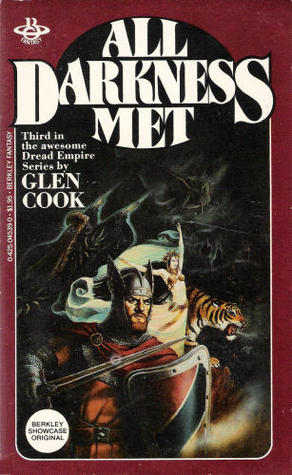
The second book, October's Baby, was mostly battle reports (excellently done). And the third book, All Darkness Met, sees the series really hitting its stride;
with the battles and intrigue intensifying, the stakes continually getting raised, and the espionage/spy angles really being played up.

Short take: once the series really gets rolling, it's amazing. Lovers of The Black Company will of course miss the laconic, sardonic wit of a narrator like Croaker. However, they'll also be amazed by Cook's ability to turn extremely bare bones, sparse descriptions and dialogue into compelling scenes and characters. Huge battles are resolved in mere sentences. Major characters die off-screen. There is very little time spent in their heads, and yet, you still get to
know these characters well. But that's why he's such a great author.

Now, back to these prequel books. These were released around the time the first Black Company book came out. Safe to say, this is when Cook was at the top of his game, and it really shows. The writing here is top-notch Cook, and he has a clear vision for how he wants these books to play out.

The two books contained in this omni are The Fire in His Hands (1985) and With Mercy Toward None (1985), keeping up his tradition of absolutely amazing book titles. As was fairly typical of the mid-80's, these books are fairly short; coming in at about 180 pages each, making this omnibus about the size of a normal, modern book at about 370 pages.

The core thesis of the duology is as a chronicle of the El Murid Wars mentioned earlier in the series; and which forged our core trio of characters into the men they are. The primary focus is on El Murid
himself; born Micah, the son of a salt merchant (whose caravan was slaughtered by bandits), who is charged by the Star Rider (that shadowy, omnipresent interloper seen in the first books) with becoming a true Disciple of the Lord. He gifts Micah with the name El Murid, as well as a magic wrist amulet which can literally call down the power of the Heavens.

El Murid soon finds, however, that entrenched power structures are quite adverse to usurpation. El Murid must secure and grow his base of followers; then raise armies and take lands. The "Lord" has charged him with taking the religion to the lands of the non-believers, but he finds it hard going just unifying the lands of his own people. The majority of the first book deals with these actions/battles.

Also interspersed throughout the first book are the introductory backstories for Bragi (and his brother Haaken), and Haroun (which gives us an invaluable insight into the Royalists, who support the establishment over the upstart El Murid).

The second book focuses on the actual taking of the Word to the lands of the infidels. By this point, El Murid has amassed a massive army, with the Royalists reduced to a few scattered bands. By rules of lineage, Haroun is technically king, but he is stranded, on the run.

On the Western front, we see the moves, maneuvers, and power grabs/consolidations which transpire in the wake of the invading forces. There are countless battles, and positions of power shift at the drop of a hat.

Book 2 also introduces Mocker into the mix; showing him as an invaluable asset as a spy an covert ops specialist.

There isn't much else to say on this prequel duology. As already stated, even within the sparse prose; the myriad landscapes are richly envisioned and detailed. The battles effectively convey their horror, magnitude, and significance. And the characters are rich and real. El Murid, the eye of the storm in corporeal form; is an immensely deep, and tragically flawed character. He is no zealot of iron resolve. He has desires; personal desires, sexual desires, desires for power, for revenge, and even desires to grow his Empire into a verdant utopia, rather than subjugate infidels by the sword.

But life does not bend to accommodate our desires. Few authors hammer that sobering message home better than Cook.

So, are there any problems? With the story we get, not really. It's solid. Cook obviously had a vision, and he served it up. There are some questions, though. The main question is....why? Why do we have/need a prequel duology focusing on the El Murid Wars? The Dread Empire, you know that massive evil institution that serves as the primary antagonist for the series, as well as giving it its name? Yeah, them. They don't figure in these two books....at all. El Murid's jihad does not take his forces to their lands.We don't get snippets of what is transpiring in these lands when the forces of the Disciple hit the Western kingdoms (and, we know well from the first books, they're always watching).

Also, although you may have liked Haroun in the first books, and may have grown to like (tolerate) Mocker, perhaps we didn't need to see so much focus on them, especially Haroun. Compelling as his tale is; if you're reading these books, you likely remember that Haroun's tale came to a close in the third book. Mocker's too.

As you can see, the "why?"'s are no deterrent, and these books are great. You also get the added bonus of a heartfelt introduction by Steven Erikson, telling his history with Glen Cook's books. Jeff Vandermeer penned an intimate intro for the first, Cruel Wind omnibus.

So there you have it. Grab these first two omnibus volumes and enjoy some early Cook. See what a brilliant mind this natural strategist has. I'll be moving on to the final book in the series soon, hopefully.

Cover:

Night Shade has always gotten Raymond Swanland to do some of his best work ever for the Cook releases. This one is no exception. What an eye-catching cover, look at that dynamic posing.

Wednesday, August 26, 2015

Bone Eaters (Black Company)

Bone Eaters by Glen Cook. A Black Company short story, originally appearing in the Operation Arcana anthology, published March 2015 by BAEN. Approx. 25 pages.

As Tom Petty said, the waiting is the hardest part.

Ever since Operation Arcana came out this past March, with the blissful promise of a new Black Company story, I've been biding my time until a used copy hit the Amazon $.01 section. As soon as one did, yours truly grabbed it, and promptly devoured the story in one afternoon. Side note: I already started reading some of the other stories in the anthology; they are pretty damn good, so hopefully I can slap together a larger review of all the tales in this tome (then again, this is like the third anthology I've said this for, and I never seem to get around to do it. But seriously, there are some powerhouses contributing in this book).

As for Bone Eaters....

Regardless of what my concerns may have been with Glen Cook adding new stories into old Annals, all of these recent shorts have been superb. Bone Eaters is no different. This is Cook channeling Croaker's younger self seamlessly (no mean feat; since there is probably much of Cook in Croaker, and as the author aged and evolved philosophically, so did the Annalist), allowing the reader to tap back into the vein of the story line that originally hooked them.

Bone Eaters is slightly different from some the previous shorts in that the timeline takes place during around the Shadows Linger arc, with the Company fleeing their former pact with the Lady (whereas most of the other shorts took place while the Company was stationed at Aloe, still in the Lady's employ). If I remember correctly, Shaggy Dog Bridge would directly precede this.

There are two major points of interest in this short. First involves the Company picking up some would-be brigands/would-be Company members. Of note in this mob is a young girl named Chasing Midnight, who shows portents of being a budding witch. The interactions between Croaker and her are reminiscent of his dealings with sisters Shukrat and Arkana in Soldiers Live. Part parental, and part predatory. There is no other way to put it; Cook is a master at capturing the way that (some) older guys lustfully leer at nubile young girls like the Big Bad Wolf of fable, no matter how much of a nurturing facade they offer as an excuse. Heck, the older I get, the more I see the truth in it. That's why you love to read Cook's works; there is no B.S. allowed; he's got your number and he's holding up his as well. But there is a lot to Midnight; the undercurrents of fear, anger, and manipulation. At one high point Croaker makes an observation about the beginnings of the evil mages in dark towers. It stands as some decent food for thought.

The second point of action is the obligatory conflict that needs to be resolved. In Bone Eaters, Cook introduces the idea of "Hungry Ghosts"; spirits that inhabit an entire town. They emit a perpetual siren call to lure hapless passersby into becoming vessels for them to occupy. The general consensus is that Lady is steering them towards a demise here so that her hunting dog Taken (namely Whisper), can recover a bit from what has been an exhausting pursuit of them. 

The ghost town idea is done very well. The high point is not in the monsters themselves, but in how the Company approaches resolving the problem. To be 100% frank, this whole portion of the story is somewhat superfluous; in fact this would have been a winning story just focusing on the inter-Company exchanges in light of the new faces among them. But the "hungry ghosts" are nicely realized; Cook, in typical fashion, makes sure to guarantee that there is a cause and effect, and limit to their powers, in order to give them legitimacy. The scenes where some Company members enter the haunted town is pretty tense, and it shows how the characters act under actual pressure. 

As always, it is great to see old friends again. There aren't any real complaints I can list regarding this short. The only thing that caught me a little off guard was the insinuation that the feelings between Silent and Darling may have been somewhat mutual, instead of one-sided (of course, I might either be remembering wrong, plus all the Annalists have been notoriously unreliable narrators). Cook also does a lot with his new characters as well. As already mentioned, Midnight and her gang are done well. Malicious bully Rusty, introduced in Shaggy Dog Bridge, is given some strong moments as well.

All in all, this story alone is worth picking up a reasonably priced copy of this book. 

Here's what it is:
On the run from the Lady, Croaker and Company pick up some urchins and get steered towards a literal ghost town. A strong conflict is upstaged by stronger characterizations.

Final Score:

9.5/10

Thursday, February 19, 2015

Shaggy Dog Bridge

Shaggy Dog Bridge by Glen Cook. A Black Company short story, originally appearing in the Fearsome Journeys anthology, published . Approx. 31 pages.

Just when I thought I had presented a complete synopsis of the legendary Black Company series in 2014, I find out that I let one short story slip through the cracks. Shaggy Dog Bridge, first appearing in the Fearsome Journeys anthology (edited by Jonathan Strahan of Swords & Dark Magic renown), is the third of the (so-far) quartet of short tales that will segue readers into the long awaited, much anticipated Port of Shadows.

In Shaggy Dog Bridge, we find our favorite Annalist, Croaker, attached to a recon patrol scouting ahead while the angry Taken, Whisper, pursues with a clutch of angry Imperials. Along the way, they find a massive glamour (illusion), one of a perfectly mundane chunk of forest. The thing about illusions of normalcy is that they are usually there to mask things markedly out of the normal. Being a recon group, it falls on them to see what exactly that is. What they find are parts of the puzzle which Cook has in store for us in Port of Shadows.

Out of the four Black Company shorts released over the past few years, Shaggy Dog Bridge is definitely my favorite. There are a few reasons for this. Firstly, once again, Cook shows us (again) that not only can he still write for "earlier books" Croaker, but he can still capture specific moods and attitudes. In this story, Croaker is pissed off, ornery, and in a generally foul mood, due to being attached to this tedious task (which he himself had volunteered for). The writing is cranky, full of expletives and vitriol.

Another high point of the story is the addition of a few more "grunts". Other stories in this arc have introduced wizards and concepts for "bad guys", but here we can meet a few more personalities of the rank and file. These additions, namely Rusty, Robin, and Whittle, have a lot of potential.

Finally, and most importantly, we get a real whiff of the type of evil that will be faced in the upcoming book. For example, the most intriguing bit of geography mentioned is not the titular Bridge, but a scar on the earth known as the "Rip", a cleft in the landscape possibly caused during a battle between formidable nasties. We also find out about the "Master", who will serve as the Dominator type in Port of Shadows. And, lastly, we get to meet Blind Emon, a "Taken" of sorts in thrall to the Master (the fact that she is a concentrated ball of agony is a great touch).

As in most other Black Company titles, the joy is not in the violence, but in the characters, the dialogue, and the authenticity of the battlefield tactics and situations. There is no clanging of swords, but more of what makes the Company who they are; planning, resourcefulness, sabotage, and a lot of luck.

So, as I've said before, I shall say once more; I am overjoyed that Cook is getting closer towards a new Black Company book, and, while I am happy that he can still write for the crew circa Books 1-3 as well as before, I'd rather see other Company stories. Perhaps A Pitiless Rain, if it ever sees the light of day, will focus on Suvrin, Tobo, and those that survived Soldiers Live. But how about some coverage of the original Company? Those of renown that first marched from Khatovar and put so much fear into the Taglians? Ah well, it's still a business, and I am sure the majority want to see more Croaker. And, as the quality of these four shorts testifies, it'll be a great read.

Here's hoping I'll get a chance this year to review the other titles in this anthology. It looks like a solid one.

Final Score:

96/100

Friday, November 21, 2014

Bone Candy

Bone Candy by Glen Cook. A Black Company short story, originally appearing in the Shattered Shields anthology, published October 2014 by Baen. Approx. 25 pages.

While I am loathe to review individual short stories from anthologies, today we have a special case. Shattered Shirlds, a military fantasy compilation published by Baen last month, features a brand new Black Company short by Glen Cook. So, while I will most likely finish this anthology at a later date, it is imperative that I review this short story.

Now what do we have here? To start, Bone Candy, like the previous two shorts (Tides Elba and Smelling Danger), takes place in the city of Aloe, at some point on the timeline between the first book and Shadows Linger.

Before I get into what is good in this story and what I have issues with, let's look at the premise:

Things are rather uneventful for the Company in Aloe. However, they have an officer from Charm attached to them to contend with: Two Dead, a wizard dispatched by the recently minted Taken Whisper. Two Dead is no friend of the Company. Whisper does not hold them in a very high regard either.

One day, nuisance turns to legitimate problem. Two Dead grabs Croaker and Silent to help investigate some odd furry creatures that have turned up. These furry mysteries are packing a nasty secret inside, which lays Two Dead up. Meanwhile, Two Dead's hulking bodyguard, Buzz (who is actually well-liked by the Company), is contending with sudden health issues of his own.

It falls on Croaker to keep these two in the realm of the living, since their passing would cause some waves with people you don't want to cause waves with.

Ok, let's start with the good. Cook shows us that he is still in perfect form with this story. He is able to tap into the vibe of the Company from around that time seamlessly.

There is also an added bonus here: Bone Candy actually makes reference to the Port of Shadows. Black Company fans will of course recognize this as one of the potential new Black Company books announced years ago. So does this mean that a new novel is actually in development? This is quite exciting indeed. But, also, a tad anti-climactic. Why? Read on, as I present my issues with the story.

Look, I am as grateful as the next Company fan for anything to nibble on from Cook. But, let's be honest. Croaker's tale is done. He got one of the best endings in a fantasy series. I understand that he is the fan favorite (with good reason), but, as Cook said in one of his rare interviews: "The Company itself is the character." So, how come we can't get a book with Suvrin as Captain? Or one from pre-Croaker times? Part of the suspense in reading Black Company books is that anybody's number can be up, any moment. You can't do that, going back to circa book 1.5. If you've finished the series, you already know what's happened to all these guys. We've met some new faces in these shorts, but that means they are the only ones at risk. And the fact that the Port of Shadows is no more than another Dominator Resurrectionist tool is deflating too. Obviously he doesn't come back before Shadows Linger.

One other issue I have is with the usage of modern terms. "Wait a sec..." you might say, reminding me that way back I defending the usage of modern slang and colloquialisms in what is a "fantasy" setting. I still support that type of dialogue. What I have an issue with is technology. One of the later books, I don't remember which, had a scene in which rock melted "like plastic". That jarred me out of the moment. I have no problem with fantasy characters saying "Go f*** yourself, a$$hole." instead of a faux-British "Bugger off, you arse." (Note: this assessment does not pertain to actual British writers; it is directed at those who try to emulate what the speech of a time period might have sounded like rather than focus on how the conversation would proceed in modern discourse). But plastic is not part of their universe. In Bone Candy, someone uses the term "live ammunition". It doesn't read right.

Ok, gripe's over. Bone Candy is the most solid of these Black Company shorts (so far), and hopefully this is the segue into the next novel. If you have a chance, get a hold of this and check it out. I hope that soon I can finish the whole anthology and let you know how the other entries fare.

Final Score:

93/100

Sunday, June 29, 2014

Soldiers Live (Black Company Book 9)

 Soldiers Live by Glen Cook. The final book in the Black Company saga, originally published by Tor Fantasy July, 2000. Approx. 419 pages (Tor omnibus edition).

Where we left off:
Water Sleeps was a book comprised of two very separate parts: the sneaky, guerrilla war waged by the Company within Taglios, and their journey south and onto the Plain of Glittering Stone.
The Taglios campaign culminated with key Taglian figures being captured and/or taken out of the picture (including the Radisha herself), along with that perennial Company foil Narayan Singh (along with the Daughter of the Night). When a deal was brokered with Singh to retrieve the Nyueng Bao Shadowgate Key (remember the Lance of Passion still lays with Murgen in stasis), Sleepy knows that they can finally make their move.
As the story shifted its focus southward, it was time for some long-overdue exposition. The Captured were finally freed, as there resting place was revealed to be in the cavernous expanses under the throne room of the protector-golem-god Shivetya. Those labyrinthine chambers also yielded vast treasures, as well as the original three Books of the Dead (which Sleepy and Swan later burned). Far below, however, a true terror awaited. Tobo, heeding some inner call, ventured nearly a mile down into the bowels of the Plain, and discovered the sleeping Kina, who made an attempt at awakening. This was only halted by a brave charge by veteran mage Goblin, who sacrificed his life by burying the Lance of Passion into the awakening death goddess, temporarily halting her rise.
Topside, the throne room of Shivetya was revealed to be a diagram of the Plain itslef (actually a diagram inside a diagram). It turns out the the Plain is a major transportation hub, and along with keeping Kina at bay, Shivetya also acts as the eternal air traffic controller. There were many other Shadowgates, and all lead to other worlds (or variations of or different eras of the same world), and groups like the Black Company and the Nyueng Bao have been traveling them for ages, seeking the best way to raise Kina to bring on a universal Year of the Skulls (or something to that nature, this all gets a bit mind-boggling). Currently, the Gate to Khatovar is out of commission, but Sleepy strikes up a relationship with Shivetya, in which the god-golem imparts information at his leisure to key members of the Company (and give us more much-needed exposition).
At the end of Water Sleeps, the Company crosses the only other open Gate, and enters the Land of Unknown Shadows, where they are greeted by a welcoming party comprised of folks that resemble the Nyueng Bao in appearance, as well as dialect. Which brings us to....

Where we are now:
I cannot believe we are already here at the end of our journey with the Company. Or, maybe, I did not realize how emotionally invested I had become with this group. We all know that journeys end. People go. Soldiers Live. And wonder why. That is the mantra here. And, if you have become as close to this crew as I have, this book may stay in a special corner of your soul forever. It is immortality of a sort.

After crossing through the last working Shadowgate at the end of Water Sleeps, the Company finds themselves in a world that is a sort of clone of their own, inhabited by a race resembling ancestral Nyueng Bao. This land is known as Hsien.

It's been four years in this new land. Four years of peace, a complete anomaly to the veterans of the Company. The only recorded deaths in this time are veterans Otto and Hagop, passing on naturally with no fights to fight, and one risk taking recruit that took the wrong risk. Speaking of recording, for this last trip with the Company, Croaker has taken up the quill again. This is only fitting. And, as it should be, what makes Soldiers Live what it is is less the events that transpire, but more how this world looks to this aging veteran, now feeling every bit the antique in the only family he has ever known.

Just a few notes before getting into the actual story: yes, Croaker is again the Annalist. But, there are also a slew of third-person chapters focusing on the events involving adversaries and different locations. Speaking of chapters, not only is this the thickest book so far, it also boasts the most chapters at a whopping 148 (can you believe the first book only had seven chapters?). What's good about the format here is that, like in Shadows Linger, the chapters tell you where the events are transpiring, and are also named (quite cleverly too, I might add).

As mentioned, Soldiers Live opens during the peaceful times in Hsien. We get some needed background on the people and places, the system of government, etc. A lot of focus is on Tobo, and how much he has grown. He has bonded with the indigenous spectral creatures of Hsien known as the Unknown Shadows, patchwork critters reminiscent of the denizens of the Plain of Fear.

There are local feuds and such; everyone in Hsien is wary of the Company as they take no partisan stance. All the Company wants is for the information needed to repair the gate to Khatovar so they can complete the mission Croaker began. Well, not just that. Sleepy (still Captain) is killing some time so that she can keep retrieving all the treasures contained in the caverns under Shivetya's throne. But Sleepy is a conniving, duplicitous little number. Which is what makes her a good Captain.

When there is sufficient cash and a decent army arrayed, the Company begins to move back into the old world to start settling scores. Meanwhile, Croaker has a score of his own to settle. That would be with one Lisa Bowalk, the shapeshifter stuck in forvalaka mode who has finally exacted her revenge upon One Eye (no spoiler there; at the end of Water Sleeps, Sleepy notes that One Eye dies four years after that entry ends). Again, Sleepy has ulterior motives for Croaker's mission as well.

Keep in mind that Bowalk makes her retreat in what lies past the gate to Khatover. I won't divulge too much of what Croaker and his crew find there, but it involves a new race (the Voroshk, a very pale people with a loose family hierarchy system, interesting technology, and limited talents in sorcery). Some of these Voroshk end up traveling back with them once accounts with Bowalk are settled.

Back in the regular world, well, things fall into a regular routine. Some readers might get frustrated or exasperated at this point, since 90% of the proceedings still focus on the logistics of harassing Soulcatcher and Mogaba, and hunting down the Daughter of the Night and her guardian. Seriously. Even with the whole Kina/Year of Skulls angle still unresolved with fewer and fewer pages left, it is still focusing on Tobo and tactics. But there is a reason. There is always a reason when you look at it.

Cook has always been a patient and deliberate author. He is one of the very few that I can truly say rarely puts a word in his stories that does not have meaning. Cook is also known to plant the seeds of ideas that don't sprout until a few hundred pages later, leaving you madly flipping back through pages once understanding hits you.

And so, it is quite possible that some readers will be pretty disappointed with what they are reading as they are reading it. Soldiers Live marks Croaker's narrative return, but, after One Eye's death, his perspective becomes understandably more melancholy. So even though the book starts off with those trademark cynical, clipped sentences, it all lapses into exposition and disenfranchised battle reports. But can you blame him? How many decades has Croaker been soldiering for? At this point, the battles are just sad wastes of life. And for what? The whole Taglios aspect has ballooned, and, we all know that the religious angles are of no importance to him. As he points out, he was just passing through.

Croaker still does his work dutifully, though. He applies due diligence to reporting the tactics used, and makes note of fallen sworn brothers. That is his job as Annalist. This way the Company of the future can reference the victories and losses of the past. But there is no flamboyance in the battle scenes. I doubt that war is very flamboyant for broken senior citizens.

So, the battle scenes may seem anti-climactic. Some say the same for the reporting of the multitudes of deaths. There is no secret, almost everyone dies in Soldiers Live. Name a remaining Company member or affiliate, there is a 90% chance they die here. You almost never see the death scenes. It is mentioned, and recorded. As is Croaker's job. You might feel at first that this is a bit of a disservice to characters that have been evolved over several books, but consider Croaker. At his age, deaths of friends become more common. The occurence can be stated as fact no matter how it tears you apart inside. Plus, many of those that go are simply attached to the Company. He is actually doing them a favor by recording them. It is an immortality of sorts. If you think about it, it is perfectly significant when he gives a lackluster eulogy to a Nyueng Bao that passes. Remember, Croaker never trusted that group, and always considered them an additional burden foisted upon his considerable logistical workload.

And finally, what might be taken as the final disappointment is how so many important loose ends are hurriedly tied up. The Year of Skulls, especially. Don't get me wrong, the final showdown with Kina is impressive, but the Year of Skulls is kind of treated as, "Oh, so that's what it was? Ok, moving on...". This is not lazy writing, to repeat, Croaker is not big on religion. He cannot deny a god when he sees one, but he doesn't need to subscribe to the philosophy. Plus, the Kina stuff was never in his contract.

Personally, I was expecting the Year of Skulls to be the Company themselves. Their little jaunt in the South ended up causing tens of thousands of deaths anyway.

Reading this, you might think, "Well, if you keep saying the exciting bits are kind of boring, and the other stuff is rushed, this final book must suck, right?". It doesn't. Without giving away the very ending, let me put it like this: remember when you were a young student and wanted to go somewhere really badly, and had to finish a report for school before you could leave? That task, although necessary, or even being something you would usually be passionate about, suddenly becomes a mundane obstacle. And that's what happens at the end. There is a huge transition about to take place, and the assumption is that the Annals have to be brought up to date first.

There are parts in Soldiers Live that are written with some real emotion. These are the scenes involving Booboo (the Company nickname for the Daughter of the Night), Croaker's deep love for his aging wife (Lady no longer has the power to maintain her beauty glamours), and the parts regarding Tobo's evolution. This is an interesting aspect; most of Water Sleeps and the earlier portions of Soldiers Live seemingly fawn on Tobo as a sort of all-powerful, all-good wunderkind, but Croaker shows us how easily a wizard can go down dark, scary paths without proper grounding and a moral compass. These scenes are handled very well. A very good reminder that there is a very thin line between being a force for good and becoming the next Dominator. Croaker even manages to find a place in his heart for his enemies, Soulcatcher and Mogaba (remember, he was always more sympathetic to him than the other Annalists). And lastly, the most emotional aspect focuses on friendship. Not just camaraderie, but the true bonds of a unit that is family. There is a touching scene where Croaker reflects on the extents of One-Eye's friendship for Goblin, and wishes someone had cared that much for him. Then he realizes that someone had in fact done it for him as well.

Croaker's melancholy at his own aging sets quite an emotional tone for Soldiers Live as well. Maybe I am just a little more sympathetic to this plight as I am feeling a bit of an antique as well, but you can sense the frustrations of physical limitations. Of being humored rather than listened to. Especially when your observations and gut feelings might be helpful to a Captain who is very capable, but who also forgets the small details sometimes.

And yet, sadness and futility aren't the only messages of this final entry in the Black Company saga. Faces change, but the Company survives. Soldiers Live. And wonder why. There will be new Captains, new lands. New pairs of feuding wizards (I personally loved the Voroshk girls).

Best of all (bit of a spoiler here), Cook manages to come up with the happiest ending conceivable. Not to give it away, but he creates a true heaven for a non-religious man. What better reward is there?

Soldiers Live is by far one of the best "final entries" I have ever read, and I will place The Black Company high on the list of Best Fantasy Series read. Even though some things remain unanswered (like why so many extraordinary things happened to an ordinary man like Croaker), the story is completed and the door is left open for future tales. I know, Port of Shadows and A Pitiless Rain were announced long ago, but I hear varying reports as to whether they will be prequels or further stories.

For now, goodbye Croaker & Company.

Here's what it is:
Glen Cook ends his signature series with a grand finale that rates a hair short of the first book. So many have come and gone, but memories remain. Memory is immortality of a sort.


Final Score:

97/100


Cover Score:

This piece by Jainschigg is easily my favorite of the old covers. The arrangement is nice, and the color palette is truly evocative of the tone. Love the idea of a faceless conglomerate of soldiers fulfilling their natural destiny. If anyone would be so kind as to give a gift to your favorite reviewer, there is an original painting of the cover here. I'll just hold my breath waiting....


Cover Final Score (Swanland):

91/100

Tuesday, June 10, 2014

Water Sleeps (Black Company Book 8)

 Water Sleeps by Glen Cook. Originally published by Tor Fantasy, March 1999. Approx. 348 pages (Tor omnibus edition).


Where we left off:
After a few books where little progress was made on the road to Khatovar, She is the Darkness saw some major pushes by the Company on the way to the Plain of Glittering Stone. First was a win in the battle of Charandaprash Pass, which was highlighted by the revelation that the enmity between Croaker and Blade was simply a ruse, leading to a large number of Longshadow's forces being taken out of the game before it was even played. 
Past the Pass, the Company began its siege of Overlook. For a good while this went on, and it was revealed the Croaker was working along with Soulcatcher to expedite Longshadow's downfall. Meanwhile, the Howler and Narayan Singh worked to protect their own posteriors. 
On and on it went, with more double-crosses and almost had 'ems. 
The end result:
Longshadow was taken down and brought to Company custody, as was the Howler and Singh.
Soulcatcher screwed everyone over and started helping the Radisha Shah renege on her obligations to the Company. The Prabrindrah tried to double-cross the Company as well, and was taken into their "care".
Soulcatchaer, under the guise of Sleepy (who is revealed to be, in actuality, very much a young woman), infiltrates the Company camp and assassinates Smoke, taking away one of the Company's methods of near omniscient spying. 
In other big reveals, something that was hinted at in Bleak Seasons turned out to be true: Murgen's Nyueng Bao wife, Ky Sahra (Sarie) is still alove, tucked away as a widow in a temple, and pregnant with their child.
She is the Darkness ends with a contingent of the Company, mostly old crew members and prisoners (including Soulcatcher), finally crossing the Shadowgate and entering the Plain of Glittering Stone. A few days into their journey, they happen upon a fortress in disrepair. Within, secured to a wooden throne by a series of silver daggers, is a colossal golem, who the Company figures is Shivetya, a guardian charged with preventing Kina's resurrection.
As the Company tries to make heads or tails of what is going on, it is revealed that even though she has been bound up pretty tightly, Soulcatcher has been able to place everyone in a sort of trance. She traps the Company in a sort of stasis (the caverns of frozen spiderwebs and old men that Murgen often saw in his dreams) in the lower chambers of the fortress and makes off with the traitor Willow Swan, seemingly victorious. Which brings us to now....

Where we are now:
Fifteen years. It has been fifteen years since the group that entered the Plain became trapped in their stasis. The Captured, they are called now. 
After they disappeared, the remaining Company was routed by both traitors within and Mogaba from without. 

Now, the Radisha rules in Taglios, along with an insane dictator known to the people as the Protector. The Protector is known to the reader as Soulcatcher.

But what of the remnants of the Company? 

What remains of the Company, some two hundred-odd members, are scattered throughout Taglios. Leading them is none other than former Company mascot, and Annalist in training Sleepy. Sleepy, like Murgen during the siege of Dejagore, is acting as Captain, as well as maintaining the Annals. She is joined by the last two remaining old crew members not trapped under the Plain, the ancient sorcerers Goblin and One-Eye (although fifteen years later, even One-Eye is too ancient to continue his usual antic feuds with Goblin). Another addition to the Company (though not an actual brother) is none other than Ky Sahra (it is never explained how and when she joined up with them). Sahra and Murgen's son, Tobo, is now a petulant teenager, although one with a proficient inclination towards the magic arts. It is generally agreed upon that he is the "future" of the Company, especially with the resident magicians on obviously limited time.

This reduced shell of the Company has two primary missions; first being to topple the traitorous Taglian establishment, and the second, of course, to free their Captured comrades. And so, the two halves of Water Sleeps are dedicated to the execution of those directives.

The "shadow war" against the ruling class is some of the best stuff Cook has put to paper; he has always had the knack for writing these sneaky battles. Sleepy makes an adept leader for orchestrating moves that sow dissent and fear in the populace and the government. Pyrotechnic charges strategically planted throughout the city flash in crowds, displaying the Company sigil and those prophetic words "Water Sleeps". 

In the meantime, Sleepy and Sahra (serving as a spiritual pillar for all), do their fair share of hands-on spy work. Donning various disguises, they infiltrate the Palace, gathering intel, and recovering pages from the lost Annals which were left in the wizard Smoke's old room. All this is done right under the noses of the Radisha and the Protector, which lead to some truly tense moments.

In the latter part of the novel, we have the journey southward which culminates with our intrepid band treading the same path as their lost predecessors. 

I really can't give away too many of the secrets revealed in this final arc of Water Sleeps; suffice to say they come at you fast and furiously. Many of the answers that have eluded and confused Black Company readers since the Books of the South started are clarified here; and of course, many more are posited. But as to where the Company originated, where is Khatovar (and is it still accessible), what in fact the Glittering Plain is (hint: it's a huge transit hub of sorts), and who are the spectral walkers who tread the Plain at night, we get some closure. There is even a pretty scary face to face encounter with a god, which is handled excellently.

The real question is, as always, how is the narration in Water Sleeps? Here we have yet another Annalist. Personally, I really like Sleepy. She might be Cook's most fleshed-out Annalist (since I am assuming that there is a whole lot of Cook in Croaker). Sleepy is a strong, tough, sharp, and shrewd. You also have to remember that when she was younger, she suffered terrible, prolonged sexual abuse at the hands of family members. You can sense the mental scars even though she mentions nothing directly. She has a high amount of respect (culturally) for her elders, and reveres them accordingly. This leads to some of the most heartfelt moments in this entire series. Another interesting quirk of Sleepy is that she is the most outwardly religious Annalist that we have had. Throughout the novel, she says quick prayers as a mental reassurance, and these become more frequent towards the climax of the book.

The pacing of Water Sleeps is fair enough. Sleepy spends a lot of time chronicling her and Sahra's infiltrations, always recording their names as the false faces they don. It is very easy for Sleepy to become absorbed in the characters she creates, undoubtedly this is a coping mechanism that helped her through her terrible past. For the bulk of the novel Cook retains the first person point of view, with the scenes featuring Soulcatcher and Mogaba being accounts as seen by Murgen's still-detached spirit (he was out of body when Soulcatcher trapped the Company in stasis and his spirit still continues spying). But towards the end of the novel, we get a few random third person chapters showing what is going on in Taglios, not courtesy of Murgen. Also, Sleepy's narration in these last chapters deteriorates into overly expository theological info dumps. Her account up to this point had a very "spoken" versus "written" quality, and so this felt a little off to me. Perhaps the implication is that they were written at a later time incorporating information granted her by Shivetya. 

Bear in mind that this novel is very much the "in between" novel for She is the Darkness and Soldiers Live. For any meandering you may have thought the past few books do, these last three are keeping things moving at a brisk clip. There are no grand battles in Water Sleeps, but also no endless verbal tangents. There is confusion and closure; for as this is one of the most original series going, there is really no way to predict how things will turn out.

Water Sleeps is a solid Black Company novel, but not a distinct one. Just remember it is here to move the action closer to a conclusion. Too bad we couldn't have had another book with Sleepy narrating.

Here's what it is:
We are almost at the end of the journey. A new Captain and Annalist tries to hold the last threads of the Company together as they stay focused on their ultimate destiny.


Final Score:

85/100

Cover Score:
I have mixed emotions on this Swanland cover. To put it plainly, I love the foreground and hate the background. I am assuming that is Murgen holding the Lance of Passion in the front, with an awakening Kina in the back. Now, I had no solid picture of how Murgen looked, and this character looks more as how I imagined former Company member Elmo, but it is still well done. As for the Kina rendition, that looks like an alien. This cover would have worked better for the last omnibus, to be honest.

As for the original cover done by Nicholas Jainschigg, all I can say is that I am not crazy about his covers that feature people/figures. An odd take on the Shivetya character is crucified upside down. good placement, if not accurate, and a nice color scheme though.

Cover Final Score (Swanland):

91/100

Thursday, May 29, 2014

She Is The Darkness (Black Company Book 7)

She is the Darkness by Glen Cook. Originally published September 1997. Approx. 399 pages (Tor omnibus edition). 

HachiSnax Note: Just wanted to warn all readers; this review will be a tad more spoiler-y than previous installments. I have tried to keep all the secrets secret, but we are getting to the end of the road in this series (quite literally), and as is Cook's style, the secrets and double-crosses keep popping like Jiffy-Pop. A spoiler-free review of this book would read something like: "the Company tied up matters here and here and then headed there".  I will try to succinctly cover the story as well as I can without any major reveals. Other mention will be given to the further narration of Standardbearer/Annalist Murgen, whose style has always served as a source of contention amongst fans. Enjoy the review! Cheers, Hach.

Where we left off:
As mentioned before, there was very little new trail blazed in Bleak Seasons. However, it served as more than a mere digest of previous events. Cook used Seasons to introduce several elements integral to this last arc of the Black Company storyline: namely the Nyueng Bao (including their "duty" to the Company), and Murgen's "time travel" capabilities. At the very end of the story, the gang was all back together and ready for their big final push to Overlook, the Shadowgate, and beyond. But first, former comrade turned arch-for Mogaba awaits them at the Charandaprash Pass.

Where we are now:
As mentioned in the note above, stripping away all the twists, turns, and espionage, She is the Darkness breaks down to three major events (and the lulls in action in between): the battle at Charandaprash, the final standoff with Longshadow at Overlook, and the Company's first voyage to the plain of Glittering Stone. This is a bit of a departure from the previous novels in this arc which needed to devote more and more time to the cultures and geography of the Southern areas. As a result, we have a much more structured, linear tale here. Which ultimately works out for the better. There is no over exaggerating in saying that She is the Darkness is the best Company novel since the first installment as far as scope is concerned. As for most enjoyable? Well, let's just say that Murgen's verbal meanderings take a bit of the shine off of an otherwise well-polished novel.

Serving in the military is not a prerequisite for writing good military fiction, but it certainly helps. We can all agree that the authenticity of the interplay of the members of the Black Company comes from Cook's Navy experience, but he infuses so many other aspects that allow his works to transcend the norm. First and foremost of these skills is his understanding of strategy and battlefield psychology. Like it's predecessors, Darkness remains a fairly blood-free gritty fantasy title. The focus has never been on stroke by stroke descriptions of swordfights. Cook's focus is on what really wins wars: intelligence and counter-intelligence. With each page turned, another devious plan is revealed, another betrayal perpetrated.

She is the Darkness is once again told from the point of view (first-person, as usual) of Murgen, still serving as Standardbearer and Annalist. As in the first novel, Darkness is told entirely from the point of view of the Annalist. There are no third party interludes checking on how other players in the game are faring. These checkups are done via Murgen's spectral jaunts with Smoke.

I had no problems with Murgen's narration in Bleak Seasons. We knew already that he was mopey and introverted, but he still had a healthy dose of pessimistic humor which helped with the descriptions of the horrors of Dejagore. Now, well, he just talks to damn much. How much? So much so that near the end of the book, Croaker flat out tells him that he doesn't like his Annals since they are so verbose (and self-absorbed, which Murgen is in spades).

Let's just put it out there: Murgen is kind of a dick. He is the epitome of middle-management; he thinks that he is too good to haul the weight with his underlings, and he thinks that he is smarter than his bosses (another character flaw which Croaker calls him out on later in the book). You can't really blame Croaker either; Murgen is way too casual and flip in how he addresses his superiors.

His narration gets way too repetitive after a bit. The beginning of Darkness was showing signs of being weighted down by this fact; for every few steps, we have to wait while Murgen remembers his dead wife Sahra, and comment on how taciturn his perennial Nyueng Bao shadow Thai Dei is.
Wash. Rinse. Repeat. You can glaringly notice how self-centered he is once he has cause to question the motives of the Nyueng Bao. Murgen questions them because he feels personally slighted; whereas Croaker has had to grow an extra eye to watch them since he already detected possible duplicitous behavior and had to worry how it might affect his grand army.

Which brings us to Croaker. Croaker has changed. My, how he has changed. He has learned, hardened, and adapted. Croaker employs some truly mind-blowing schemes over the course of this book. I won't get into spoilers with them, but suffice to say, he has learned to manage his resources in the most pragmatic fashion possible. Factors with the lowest overall value are the currency most easily spent, and he also has ways of whittling down those that would come to bite his ass another day.

Working together with Lady (still in the role of Lieutenant), the Company has also developed some new technologies. Most prominent of these are a sort of "bamboo rifle", rods of bamboo with a mechanism to discharge colorful projectiles which work as shadow-killers (Longshadow not only uses a Shadowlander army, but he also releases forces of shadows from behind the Shadowgate as well).

On the subject of Lady, there is not much development with her. It is fairly obvious that Murgen is not very fond of her (and she has precious little patience for him), so their conversations are few and far between. The most important thing to realize about Lady is that she has regained a lot of her former potency, and we finally discover how this once-named sorceress has managed that feat.

On the opposing team, we still have Longshadow in charge. Longshadow seems to be at his wits' end; falling victim to frequent spastic attacks and behavioral fits. He is still formidable as ever, and a plot device has been added in which guarantees him a little more personal security. The former Taken member Howler is still in his service, although he is investing more effort in CYA maneuvers than anything else. Narayan Singh, the living saint of the Deceivers, is still loitering around with his group. He also remains the guardian of the Child of Darkness, the Daughter of Kina, Lady and Croaker's kidnapped four year old daughter. And finally, we still have the traitor Mogaba, who is still pursuing his personal vendetta against Croaker.

I just wanted to take a second to talk about Mogaba. I've always liked his character, despite being a brutal, cannibalistic traitor. He has always been, and still remains, a consummate soldier and leader. What bothers me is that he seems overly eloquent speechwise for someone who cannot read, and also, when Croaker was reunited with him in Dejagore, it was hinted at that he was suffering from a mental affliction driving him insane (which is why he begged Croaker to kill him then). Now, it seems like that plot point got swept under the rug. To be fair, we only see Mogaba through Murgen's spectral eyes (and Murgen can't see inside his head), so maybe this will come up in the future.

As always, affiliating herself with no side but Her Own, we have everybody's favorite Agent of Chaos, Soulcatcher. The looniest Senjak sister is in supreme form in Darkness, playing side against side against side. As the strongest free agent on the market, it is understandable that people would want to retain her services, but why anyone could think they could trust or manage her is beyond me. It doesn't matter; anyone that does pays a hefty price. I really can't get into detail about how much damage this psychotic vixen does over the course of the book, but it is a joy to watch. You can't help but understand Murgen's fetish about wanting to give her a good spanking.

Those are the main players in the game (oh, and don't forget the Radisha, still back in Taglios planning to shortchange the Company). And over the course of the book, nearly everyone manages to one-up everyone else. It is safe to assume throughout Darkness that everybody is in bed with someone from this side, someone from that side, as well as pushing their individual agendas. Cook has always been a master at layering these plotlines, and unwrapping them well.

The pacing is well done throughout, with only a lull in action between the siege at Overlook and the journey past Shadowgate (which is to be expected since a real life army would also need this time to secure sufficient resources). The final segment, while woefully short, delivers a surprise payoff and sets the stage for what big things must come.

It may be easy to complain about the over saturation of Murgen in this book; but you need to remind yourself that he serves as a linchpin for several of the threads. Likewise, not only does he use Smoke as a vessel for his spy missions, he is also used as one by both Soulcatcher and Kina herself (which helps to explain the omnipresent white raven that visits Murgen). Top that off with the fact that even in his dreams, Murgen is walking out of body, and it becomes understandable why the Standardbearer is so often irritable. It does not absolve him of his insufferable expositions and self-pity. Too bad One-Eye and Goblin are still separated, their antics would have brought a lot of much needed levity to the proceedings.

Either way, the Murgen era is over. It was not nearly as bad as many reviewers have made it out to be. I am just especially happy that this whole story arc made bold moves forward towards what may be the inevitable Year of the Skulls. Next up is Water Sleeps, featuring the very intriguing Sleepy as Annalist. And remember:

Water sleeps, but Enemy never rests.

Here's what it is:
The Black Company steamrolls towards their ultimate fate in this superb outing featuring double-crosses, triple-crosses, almost got thems, and spiritual journeying. A great setup for a knockout ending.


Final Score:

92/100


Cover Score:

As stated last time, this is my least favorite of the Swanland covers. I guess it has to be Lady or Soulcatcher on the the cover; but they are supposed to be pale with black hair, not dark with white hair. But I digress. The older cover, again by Nicholas Jainschigg, is pretty good. The background is nice; and there was an effort to make Croaker actually look as he was described in the book (although this Croaker is a few books younger). As for the treatment done to Lady's face: no comment.

Cover Final Score (Swanland):

90/100

Friday, April 18, 2014

Bleak Seasons (Black Company Book 6)


Bleak Seasons by Glen Cook. Originally published April 1996. Approx. 261 pages (Tor omnibus edition).


Where we left off:
The end of Dreams of Steel left us with two significant plot twists. One, that Lady was pregnant, was a fairly easy guess. It was a possibility that the sickness she felt throughout the book had something to do with her increasing closeness with the Deceivers and their Kina cult. But in all honesty, it was all the symptoms of morning sickness. The humor herein, of course, was that this alpha wizard, not so long ago on the cusp of world domination, had no idea how to identify that there was a life developing inside of her.

Pictured: a book obviously not included in the Library at the Tower of Charm.

Now, the second twist was actually a bit of a shocker; it turns out that Lady was never intended to be the reincarnation of Kina. That Deceivers had, well, deceived her. She was simply being cared for as the vessel which was destined to deliver the true Kina avatar; her and Croaker's daughter. The final chapter, in which Lady reveals this turn, is so masterfully done and emotionally powerful that it is striking.

Where we are now:
I am afraid that most of this review will have to revolve around deconstructing what it is that turns so many people off about this book. I hate the thought of that; preferring instead to focus on plot progression. The thing is; there is precious little of that here. Bleak Seasons is not so much the next chapter in the Books of the South/Glittering Stone saga as it is a recap of previous events from a different perspective and the introduction of new characters.

First things first. In Bleak Seasons, we have our third new Annalist/Narrator in as many books (assuming you count Case in The Silver Spike). Our new Annalist is Murgen, which is no surprise, as he was stated to be apprenticing for the role since his character was introduced in Shadow Games. A lot of reviewers don't like Murgen's narration. I don't know why; I think he is a great narrator. He has some of Croaker's gallows humor and sarcasm, and he is far more descriptive of smaller details (the potential downside being page count gets devoured painting pretty pictures rather than moving the story). 

Murgen's tale mostly focuses on his time trapped behind the walls of Dejagore during the siege laid upon it by Shadowspinner and his vast army. Now, just to reiterate, if you've read Dreams of Steel, you already know the outcome of the siege. This is not to say that an inside view of the happenings isn't welcome; especially since we all know that there were plenty of problems within the walls. To put it bluntly, something in Mogaba's mind snapped, and he was displaying some pretty egregious acts of brutality; including starving "non-essentials" (read: civilians), mass killings, and rumors of cannibalism. A rift has grown between Mogaba (who has assumed Captaincy based on the fact that everyone believes Croaker and Lady to be dead) and his Nar contingent and the fellows of the "Old Crew", which Murgen has assumed leadership of. 

The scenes of everyday horror within the walls of Dejagore are very well executed; but there is a problem other than the fact that we all know the outcome already. This recipe feels very familiar; in fact it is distinctly similar to elements of The Silver Spike. Both Case and Murgen are farm boys turned Imperial troops turned deserters, and both have a wide sarcastic streak. And in both novels, a lot of the story focuses on the simmering tensions within a walled city that everyone is trapped in (Dejagore and Oar).

It really seems that the true focus of spending so much time in Dejagore is to introduce a new religious/ethnic minority into the mix: the Nyueng Bao. The Nyueng Bao are a solitary folk from the swamplands who got caught up in the siege while in the midst of a pilgrimage. The Nyueng Bao are a sort of amalgamation of Eastern Asian ethnic tropes, with a primary focus on a strict code of honor. Murgen is actually quite enamored with this group and their customs, and a lot of the Dejagore chapters center on his forging and cultivating relationships with them.

But there's more going on here. A lot more. I've been oversimplifying things.

The Dejagore chapters are not simply flashbacks or entries in the Annals. Cook has decided to do some experimenting with this volume, and one of the devices that he introduces is Murgen's "time-hopping". See, for some unknown reason, Murgen has been suffering spells where he blacks out and relives previous events. Thus, we have a few timelines going on here. Although most take place in Dejagore, some cover a mission at a place called the Grove of Doom where the Company ambushed some high-level Deceivers. The majority of remaining chapters focus on events in Taglios some four years after Dejagore. In these chapters, Croaker has resumed his role as a military dictator known as the "Liberator", while Lady continues raids along the Southern provinces, taking back villages and whittling down the Shadowmaster influence. Croaker and Lady still claim to be working towards a sole goal of destroying Longshadow and eventually resuming the trek to Khatovar. But really, their agenda focuses on finding their daughter and killing Narayan Singh, as well as the traitors Mogaba and Blade (yes, he turned out to be a snake too). 

What can be considered the "present time" amid all this time hopping is a point a few weeks after the events four years post-Dejagore. I get that this device is off-putting for some, but I really think Cook handled it well. Early on in the book, we are as much in the dark as Murgen is. As some chapters begin, we have no idea where in time he is, and that's the point. But as he begins to understand what might be causing these jaunts, it becomes easier for us to place him as well. Later on, he gains the ability to use the mangled, comatose wizard Smoke as a vehicle for his spectral journeys, giving the Company an invaluable spy tool. 

Again, I don't understand why some people don't take to Murgen's narration, but it all comes down to personal taste. So, knowing that, if you read the first few chapters and find yourself not liking it, just stop reading. Bleak Seasons, like the first Black Company book, is narrated 100% by the Annalist. We have none of the third party chapters as featured in the previous five books.

Well, that is not entirely true. We get one chapter from One-Eye's Annals (yes, you read that right), even though it has been "neatened up" by Murgen. There are also a few vague chapters, all italicized, describing some lone figure stranded and suffering on the Plain of Glittering Stone. And one more note on the narration, Cook throws in a few chapters done in second person perspective, where Murgen directly addresses the reader. I really like how those were done, and would've enjoyed a few more chapters like them.

So with all the praise I keep lavishing on this book so far, it would seem a shoe-in for one of the top entries in the series, right? Well, it all comes apart in the end, especially since there is no ending. This isn't even a complaint that the book ends in a cliffhanger; it just doesn't end at any tangible point. Once you turn the last page, you will most likely think "where's the rest of it?" And this isn't just griping about a lack of a climactic final battle; simply go from Murgen doing some spying to some plans being ironed out for a final showdown with Mogaba to, well, the last page. 

Considering the negatives weighed against the positives, it is understandable to a degree that this book is often poorly received. I can only imagine it being more so when it was first release, as rabid fans had waited roughly six years for its arrival. But you have to also focus on the merits, it is still masterfully written, even if the story really doesn't move much this go round. Oh well, looks like big things are on the horizon in She is the Darkness. 

Here's what it is:
The third book of the South, first of the Glittering Stone, and first featuring Murgen as Annalist is still an enjoyable entry, although it does little but introduce new characters.


Final Score:

83/100

Cover Score:

This is my least favorite of the Swanland Black Company covers, but it is still excellent. His usually dark tones and flair for detail show through. As for the character depicted, I have no idea if it is supposed to be Lady, Soulcatcher, or someone in She is the Darkness. To be honest, it kind of looks like a female drow warrior. For the classic edition, it bears mentioning that this is the first book to feature a cover by someone other than Keith Berdak. This time around, we have an interesting cover by Nicholas Jainschigg. It is well put together, with a nice color arrangement, and it showcases the mysterious white crow that pesters Murgen throughout the book. Well done.

Cover Final Score (Swanland):

90/100

Sunday, April 6, 2014

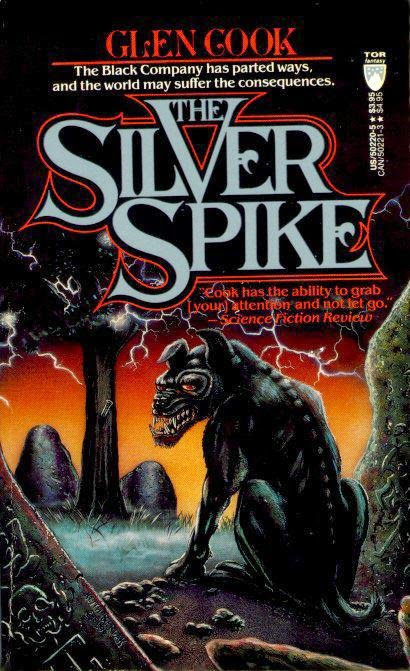
The Silver Spike (Black Company Side Novel)

 The Silver Spike by Glen Cook. Originally published September 1989. Approx. 216 pages (Tor omnibus edition).

HachiSnax note: Regarding continuity, I try to be diligent in listing books in the order they were published. I am assuming that The Silver Spike was published after Shadow Games and before Dreams of Steel, but since I am reading from the omnibuses, this time I will just stick to that format of continuity. Therefore, it is indicated as Book 6, even though it may be considered a Book 5, or not even in the Black Company sequence, since it features only former members and people within the same world. Either way, enjoy. Cheers, Hach.

Quick recap: Following the climactic battle in the Barrowland, the soul of the Dominator was trapped within a silver spike that was nailed into the sapling scion of the god Old Father Tree. The remains of the Black Company, now under a dozen members, decided to forgo accepting further commissions and fulfill their original duty of returning the Company annals to Khatovar. Newly elected Captain Croaker allowed for those wishing to renounce their Company membership to do so. Taking him up on this offer were Silent and the Torque brothers, who opted to follow Darling (aka the White Rose). Also dissolving his membership was resident badass Raven, who tried to follow Darling's group, but was ultimately rebuffed. Sulking all the way, he left with Case, with whom he had forged as close to a real friendship as someone like him could.

The Silver Spike focuses on four central storylines. Over the course of the novel, they converge, divert, and ultimately crash into each other.

First, we have the travels of Raven and Case. This gives us our only first person POV account in the book, told via a journal kept by Case. Case makes for an entertaining "annalist"; his sarcasm less of Croaker's dry cynicism and more youthful wise-assery. He is still a likable narrator, representing the poor farm boy who enlisted in the military to see the sights, learn to read, and be anything other than a potato farmer. Raven, on the other hand, has sunk to drunken lows. Only the reawakening of a familiar evil gets him back on the straight and narrow.

Next, we have the adventures of Darling, who, along with her Silent admirer (haha, I know, bad joke), as well as the myriad weird creatures of the Plain of Fear, still hunt the evils that trouble the lands. They are joined in this effort by none other than the venerable sorcerer Bomanz, who, like Raven, has been alerted to the reawakened evil.

This awakened evil is none other than the seemingly indestructible Limper, one of the last remaining original Taken. Despite a thorough decimation at the hands of Croaker at the end of the Barrowland fight, his head survived, full of unadulterated malice. Another survivor of that battle, the lesser demon Toadkiller Dog, braves the attacks of the godlike sapling to dig up the Limper's remains. His original plans involve revenge on those that have wronged him, especially Croaker and the Lady. However, his plans change later on, thanks to the actions of our final group....

Last, but not least, we have the "Spike Hunters", a quartet of low-level thieves and ex-soldiers with a poorly thought out get-rich scheme: to steal the silver spike and sell it to the highest bidder. Most of the focus of this group's story revolves around Smeds Stahl, a former Imperial soldier and general layabout that gets caught up in this half-baked plan concocted by his cousin Tully. They enlist another former soldier, Timmy, and a seasoned hunter, Old Man Fish, to head to the Barrowland and find the spike.

The Spike Hunters are actually successful in freeing the spike, yet something is wrong. The entire landscape has been razed, all the people massacred as the Limper cuts a murderous swath across civilization. They finally return home to Oar, hoping to plan the spike auction, when they begin to realize just how much they are in over their heads.

These hastily assembled plans have a tendency to omit calculations regarding the true natures and capabilities of powerful forces. The crew, laden down with looted treasures from the slaughtered areas, didn't anticipate the large Imperial presence the events triggered. This makes circulating word about the spike difficult. Also, they hadn't considered that the crowds of wizards flocking to Oar (word of it's presence did get out), including a detachment from the Tower at Charm, had absolutely no intention of participating in a civil auction. There were all people of dubious moral fiber (who isn't in Cook's world?) for whom killing the competition poses a simpler resolution.

As Oar starts to stew, Raven and Case are closing in on Croaker and the Company. Unbeknownst to them, the Limper and Toadkiller Dog are close behind, being constantly harried by Darling and the creatures of the Plain. Circumstances force a reunion of sorts, and the knowledge of the freed spike has all heading back North; the Limper hoping to absorb the Dominator's essence, and Darling working with Father Tree to purge it from this plane permanently.

The remainder of the novel focuses on the events unfolding around the four groups as we approach the inevitable climax in Oar. The Limper meanders slowly but surely on, sidestepping and barreling through traps. Raven and Case find themselves embroiled in "The Cause", a cause that neither feels fully invested in. Darling, Silent, and Bomanz do what they must to defeat the evil, and the Spike Hunters find themselves slowly unraveling. Fish establishes himself as the shrewdest and toughest of the group, Smeds becomes a fast learner, Timmy is sidelined with a malady brought on by touching the spike barehanded, and Tully falls into his old (unreliable) ways.

Even though Cook is in fine form in this book, The Silver Spike is still the weakest installment in the series so far. Don't get me wrong, there is still a good deal of the brilliance contained within. One such example is this line, which so succinctly summarizes the Limper's twisted mental state:

"It had become so self-centered, so self-involved, as to be the hub of a solipsistic universe."

Seriously, it is damn hard to find writing on par with that in most contemporary fantasy works. The first-person bits by Case are also a highlight; he usually starts off his entries in his low-born dialect, and then you see his intelligence showing through. And, as the pressure cooker of Oar reaches a bursting point (all exits become sealed, there are riots, a cholera outbreak, and the infection that affected Timmy begins to spread as well), Cook crafts extremely palpable tension. You can feel the noose tightening on the Spike Hunters as the Empire gets closer to finding them, as they feel their options running out, as if you were one among them and your rear end was in the sling as well.

Where The Silver Spike falters mostly is in its climax. It is, for lack of a better term, anti-climactic. It comes off as obligatory and tacked-on, and lacks the epic grandeur of the battles in previous books. Time would have been better spent dedicated to storyline resolutions for these characters, since we will likely not see them again in the series.

Other than that, it would have been nicer to see more nastiness being done by the Limper and Toadkiller Dog. But maybe Cook wanted to keep the focus on Oar, and the evil that man can do to his fellow man with relative nonchalance.

Here's what it is:
The Silver Spike is a greatly appreciated book that brings us up to date with (and allows us to bid farewell to) a group of characters that we had grown to love/hate earlier in the series. While not perfect, it is still a solid book, and now it is time to get back to Croaker and the gang!


Final Score:

85/100


Cover Score:

This is the last of the books in the omnibus that bears Swanland's greatest cover. I will say this, though: I really like Berdak's cover for this book. Matter of fact, I found a copy of The Silver Spike at a used bookstore last week (was tempted to pick it up but the guy was asking way too much), and I realized how good it really looks in the flesh. It seems to be easy for people these days to poke fun at Berdak's designs (I think this is the last he did in the series), but if you really look at them they are pretty good. His covers that feature the god trees are superb.

Cover Final Score (Swanland):

99/100

Saturday, March 22, 2014

Dreams Of Steel (Black Company Book 5)

 Dreams of Steel by Glen Cook. Originally published April 1990. Approx. 222 pages (Tor omnibus edition).

Where we last left off:
The Company has lost the engagement at Dejagore. Croaker has fallen, presumably dead. The Lady, fighting with a desperate fervor, ended up literally buried beneath a pile of corpses (also presumed dead). Murgen and the remnants of the Company, along with their Taglian contingent, remain inside Dejagore, now under siege by Shadowspinner and his forces. Mogaba and his forces do what they can to harry the forces of the Shadowmasters.

Dreams of Steel:
What can one expect going into this book? There were so many open storylines left open at the end of Shadow Games. This is very much a middle of the road book, carrying action along as this new story arc further develops. But middle of the road need not apply to the quality of writing (and such is not the case here, the writing is superb as always). Also, this book brings us another first: it is the first Black Company title to feature an Annalist/narrator other than our beloved Croaker. This time it is Lady; who, as already mentioned, you probably really hate or really want to get inside the head of (I'm on the latter team). How does Lady fare as a narrator? Extremely well, in my opinion. But it's not Croaker by any means. Be forewarned. Also, you might not be getting as much of Lady as you may have wanted (more on that later).

Although buried under human detritus, Lady is not dead. Battered, broken, but not dead at all. After dragging herself away from the scene of their loss, she is aided by two Taglians, Narayan and Ram. Both seemingly from meek backgrounds, there is very obviously more to them than meets the eye. Mysteries aside, they help her make her ways back north, as she attempts to reassemble their forces.

It still has not been revealed why the Radisha and her brother the Prabrindrah (along with the sorcerer Smoke) fear the Company so much. But it is obvious that they are more than happy that the Company was decimated along with the bulk of the Shadowmaster army. But the Taglian royalty is in for a big surprise. For the Lady, the one loss and presumed death of (her beloved) Croaker does not terminate their commission. She has claimed the captaincy, and demands that her supply and replenishment needs be satisfied.

To be honest, nothing really gets resolved in this book as far as the war goes. Dreams of Steel is mostly about raising armies, moving armies, harrying opposing forces, chipping away at them as you build your own strength up, etc. There is also a focus on the "spy games" going on between Longshadow, Lady, and Soulcatcher.

Wait, did I just say Soulcatcher?

It was revealed at the end of Shadow Games that the mysterious stump that had been trailing Croaker the whole book was actually the Lady's sister, Soulcatcher herself. She has been the one all along sending the crows to watch the Company (the bats were courtesy of Longshadow, and the watching shadows were sent by Spinner). It also turns out that she is the one that sent the imp Frogface on his spying and merry mischief making. This is all great news; Soulcatcher was one of the most compelling and entertaining characters of book one, and if Cook is bringing back the Taken, thank goodness she is back too. Catcher is present not to take sides, but more to sow the seeds of Chaos. Her motivations? Seeing her sister suffer as revenge, as well as letting Croaker suffer to see Lady suffer. She is also an unabashed, all around troublemaker. And so, the travels around, causing her catastrophes, bringing the convalescing Croaker in tow.

There is another aspect introduced in Dreams of Steel: the Kina storyline. As established in Shadow Games, the Taglians, although living under a monarchy, were truly under the sway of the three prevalent religions. It turns out there is another religion at work; one that is outlawed, with followers in the shadows. Kina is a goddess of Death, and her followers, the Deceivers, carry out murders in his name. There is a prophesied-about murderfest coming, known as the year of Skulls. And Lady fits into this theology. Apparently, she will be the vessel to bring Kina back into this world, and initiate the slaughter. Narayan (actually one of the highest ranking Deceivers around), Ram, and another high ranking devotee, Sindhu, have great plans for the Lady regarding the preparations for this. Lady is forced to make a tough concession; as much as she abhors religion and the impact of clerical interference, the services provided by Narayan and company are invaluable. Plus, there are the dreams, the visions. It can't be coincidence. It actually does feel as though her fate is somehow intertwined with this Kina.

Since most of the book revolves around travels, ceremonies, and some battles, enjoyment of this book really comes down to how much you enjoy Lady in the role of Annalist. Her tone is (obviously) very different from Croaker's, and she herself even warns the reader at the beginning:

"I have no training. I am no historian nor even much of a writer. Certainly I don't have Croaker's eye or ear or wit."

It is true that there is little wit in her narration. It is not her way. Croaker's sarcasm, self-admittedly, helped him get by. The Lady is no-nonsense. She does not suffer fools. She makes fools suffer. Where narrator tries to juggle egos, or find ways to distract those that distract him, Lady cuts away all nonsense. She makes a dutiful and engaging narrator, and it is enjoyable to see her military machinations. She is a natural.

Since she is writing for the Company Annals, what you do not get is any real history on who Lady is. Where did she come from, what were her desires all along, through the attempted Dominations and even her own power plays. But this is all par for the course. People joining the Company leave their pasts behind. You get confirmation that her love for Croaker is legitimate, though. Just don't expect all your answers regarding her to be satisfied.

Another plus in Dreams of Steel is that we see more character development in the supporting cast. It is interesting to see Croaker in a third-person position (not a secondary character in the series of course, but he is in this book). We see the Prabrindrah coming more into his own. Longshadow, leaders of the Shadowmasters, is fleshed out more, showing the extent of his powers, as well as his conceit and weaknesses. The trio of Swan, Cordy, and Blade, introduced with much fanfare in the last book and then left in limbo, get much more page time and depth. They finally make for intriguing assets.

Missing in action (and sorely missed) are One-Eye and Goblin. They are hiding out within Dejagore after taking their sweet time torturing and killing Shapeshifter (who, it was discovered, was the one that killed One-Eye's brother Tom-Tom while in the form of a forvalaka). Their absence, coupled with the lack of Croaker's sarcasm, sap most of the humor from this book. Any levity is provided from Soulcatcher's twisted psyche and Frogface's scampering.

I must truly commend Cook on all the work he put into the religions that he has created. The Kina apect is both sinister and believable. We are also given snippets as to how these death cults tie into the Company's history, yielding clues as to why the Taglian royalty so feared them, and why the Company standard possesses its mysterious powers.

Cook hints that the next arc of action will take place along the plain of the glittering stone, where Longshadow resides. Perhaps the final battle with the Shadowmaster will take place there. There is also the issue of Mogaba to resolve. There is some dark force causing a madness inside of this once-stellar officer, and the end result cannot be pretty. Finally, there is a nice little last chapter twist, setting the stage for some interesting events-to-be.

Just a last note, the next volume to be reviewed will be The Silver Spike, which follows those we said goodbye to after the battle in the Barrowlands. I am not sure if it was published before or after Shadow Games, but I am reading and reviewing in the order it appears in the omnibus.

Here's what it is:
The wheels keep on turning, things keep going in motion, but the events of this portion of the Company's legacy are still developing. Better than Shadow Games by a hair, but I still prefer complete entries.

Final Score:

89/100


Cover Score:

I already gushed on the majesty of this Swanland cover in my last post, so let's talk about the Berdak cover a bit. In all honesty, the background and his rendition of Soulcatcher are actually pretty good. It's the demon that he dropped the ball on. Placement and composition are totally off. But at least he tried to capture some of how Cook described the creature. 

Cover Final Score (Swanland): 

99/100