Thursday, March 7, 2019

The Empty Box And Zeroth Maria Vol. 1


The Empty Box And Zeroth Maria Vol. 1 by Eiji Mikage (translation by Luke Baker). Originally published in the U.S. by Yen On (Yen Press), 2017. Approx. 200 pages.


The Empty Box and Zeroth Maria (referenced for the remainder of the review as "Zeroth") is one of those novels which grabbed my interest from the first sighting. Boasting an intriguing title, as well as hauntingly beautiful artwork (by 415), it challenges you to look away. A seven volume light novel series which ran in Japan from 2009 to 2015, Western audiences are now being treated to this engaging, mind-bending series in the...well, is "Groundhog Day" an official genre title yet?

First, here's the blurb:

From Goodreads:

"Kazuki Hoshino leads the easy-going life of a typical high school student--until the appearance of a new girl in his class turns his world upside down! Introducing herself with a promise to "break" Kazuki is abnormal enough to make an impression, sure, but why does she seem so familiar...?"

From Yen Press' site:

"Kazuki Hoshino treasures nothing more than his ordinary life, and March 2 should have been an ordinary day. The arrival of a transfer student, the mysterious Aya Otonashi, shouldn't have shattered the world he knows. He's never seen this girl before in his life, but she says she's met him thousands of times--and declares war on him for a crime he can't even remember... As the truth begins to unravel, nothing is as it seems, and at the heart of it all is a wish powerful enough to change everything..."

There's nothing like a unsolicited declaration of war by a beautiful transfer student to throw an average high schooler's life into complete and utter turmoil.

Otonashi's personal crusade is predicated upon her search for a mysterious Box which has transformed their ordinary classroom into a 'Rejecting Classroom'; doomed to repeat the same day (March 2nd) for eternity. Said Box is in the possession of one of the classroom's students, bequeathed to them, with the promise of the ability to grant any one wish whatsoever, by a mysterious, shadowy, ethereal 'benefactor'. Otonashi, by a process of elimination narrowed down over the course of more than 13,000 jumps, has determined that Kazuki is in possession of the Box, and she will break him, take possession of it, and end the soul-crushing infinite loop.

Given a premise like that; the reader might feel as though the story is near its climax right off the bat. However, with a premise like this, there is obviously so much more than meets the eye. Eiji Mikage presents us with a story full of twists, turns, and slowly unfolding answers. His pacing over the course of the 200 pages is impeccable; keeping the reader fully engaged and invested, even when no direct answers are forthcoming.

Let’s look at the book piece by piece:

Story:
Absolutely fantastic. The concept of a vessel by which a wish (wishes) can be granted is as old as time. Also tied into the narrative is the ever-underlying moral of ‘be careful what you wish for’.

The concept of ‘re-doing’ the same day/time period over and over is not new, either (hence the earlier Groundhog Day reference). However, what Mikage has done is taken these tried and true elements and reshaped them into something entirely unique, and entirely his own.

The end result is a warped take on a 'genie in a lamp' theory; instead giving us a mysterious gamemaster, one whose motivations may not be entirely benevolent.

There are, of course, the hallmarks of many light novels present here; slice of life elements, romance, even shades of horror. Yet, what makes Zeroth superb as a story is the sense of utter urgency and reality which Mikage infuses it with. We’ve all seen stories where characters are caught in a loop. But I’ve personally never seen the psychological trauma of such a quandary depicted as well as it is with the mentally weary cast of Zeroth. It makes for a truly haunting and harrowing experience.

Throughout the story, there are feints and headfakes galore; as Otonashi and Kazuki attempt to untangle the myriad mysteries of the Rejecting Classroom. To Mikage’s credit, none of these twists are arbitrary or forced. The only concern I had came towards the end, when I feared that the proceedings would devolve into an Another-esque bloodbath - luckily, that incident wove itself into the overall narrative, moving us closer to a satisfying resolution.

In the end, the door is left open for subsequent novels; and yet, Volume 1 works wonderfully as a standalone work as well.

Characters:
The dramatis personae for Zeroth initially reads off as familiar, with nearly every “-dere” type being represented. There is an outgoing, extrovert, somewhat goofball best friend to Kazuki, a cool-as-a-cucumber rebel ace student, a female friend who is at a glance materialistic, but in actuality is sensitive and kind, and finally, you have the quiet, mysterious love interest of Kazuki. You can tell, however, that Mikage has and intimate, and very personal, level of caring invested in his crafting of these characters, and it shows in their development.

For our protagonists, especially Otonashi and Kazuki, we get to bear witness to their development from not only the point at which the narrative begins; but also their evolution from the point at which the Rejecting Classroom began its endless cycle. As mentioned earlier, we see their despondency, their emerging hopes, their dashed hopes, their dreams, and their nightmares. It is all relatable; it is nearly palpable. We witness the ebbs and flows of the emotions of these young people, feelings of love grow and wane, anger swells and dissipates, fear motivates and deters, and the knowledge of a perennially present daily disaster looms ever overhead.

Every day, the students must fight towards a return to normalcy, even if normalcy will only bring pain. Even though they might never be able to feel 'normal' after reliving the same day over twenty-seven thousand times. There are no guarantees in a return to normalcy; the only guarantee is madness and despair within the endless loop of the Rejecting Classroom.

All in all, The Empty Box and Zeroth Maria is a compelling, character-driven psychological drama, totally engrossing, and absolutely unique. Highly recommended to all light novel fans, as well as to those who might want to test the light novel waters, and want something original to sample. Grab a copy today (Amazon).

Cover/Art:

The art for Zeroth is done by 415, and the artist’s work truly captures the mood and essence of the story. These pictures are complex, beautiful, and haunting; everything the book is as well. There are gorgeous color pieces at the beginning; but sadly, only two or three interior black and white illustrations. All are fantastic, though.

Thursday, January 10, 2019

To Brave The End (Tales of the Blackshield Dogs 1)


To Brave The End (Tales of the Blackshield Dogs 1) by Frank Dorrian. A Blackshield Dogs novella, originally published by Impaled Monarch Publishing, February 2017. Approx. 142 pages.

On a recent meandering through Amazon searching for some good, dark reads, I came across The Shadow of the High King by Frank Dorrian. I was instantly intrigued: fantastic cover, loads of legit-sounding reviews, and what I read in the Look Inside sample was engaging, descriptive, and grim. Alas, I have not had time to budget to reading it just yet, but I also noticed something. Dorrian has a pair of novellas, which take place in the same world as High King. These novellas center around a mercenary group known as The Blackshield Dogs. I love good mercenary tales, so I figured; what better way to sample the work of this new (for me) author?

First, here's the blurb:


Many faces, many names, have passed through the ranks of the Blackshield Dogs. But few of them ever surpassed the bloody reputation of the man known and feared on Caermark's battlefields as Red Harry.

But before he was Red Harry, before he was anything, he was Harruvard of Werrewood, a man-at-arms sworn in service to Lord Gadrin Strael.

Injured and left for dead during a bitter conflict along Lord Gadrin’s borders, his life was saved by the kindness of a stranger. But as Harruvard's past refused to let him go, that same kindness soon would be stained red.

In the deep of winter, beneath creeping snows and biting ice, the black seeds of the monster Harruvard would become were sown by the hands of men, and nurtured by their cruelty.


Again, I went into this story not yet knowing the "Red Harry" of High King notoriety, so, I was introduced to the man in his former iteration of Harruvard, man-at-arms in the service of Lord Gadrin, and, at the point the story opens, a deserter with murderous soldiers and hounds on his tale.

Left for dead in an icy river, Harruvard is saved and nursed back to health by Daina, a widowed mother struggling to get by in Larkrun, a local logging town. Driven by her own innate kindness to assist Harry, Daina is still leery of his potential past baggage, and hesitant to allow her young son, Cenrid, to bond with him. The loss of a father to Lord Gadrin ill-planned gambits against fellow Lord Algar have left a huge vacuum in the boy's heart; and a potential father figure and competent soldier gives him two things to idolize. However, over the course of his convalescence, tensions ease, and the impromptu 'family' begins to form bonds.

Unfortunately, there are always obstacles. Every step Harry has to take is one where he must look over his shoulder, checking to see if his past has caught up to him yet. And before him lies the ugliest of small-town politics; the smarmy alderman who lords over his small demesne, bullying its residents. 

Well, I am loathe to engage in spoilers, but it isn't hard to venture a guess as to what transpires at the confluence of these various factors. Again, this is a fairly dark story.

So, how does it all stack up?

Well, the template of appearance of mysterious stranger/chipping through the tough woman's exterior to get to the gooey bits/bonding of a cool man with a sword and a boy who needs a father figure is not a new one by any means. But how many times have I reiterated that tropes are fine so long as the writing is good, the action is good, and/or the characters are compelling? Well, in To Brave The End, you get all three.

Dorrian's writing is, simply put, fantastic. His world-building is vibrant and harsh. You feel and hear the snow crunching under your feet. You suffer as your vitality is sucked away in the throes of the Sothorin River.

The characters; well, the main characters, are well done. They are flawed, they are hurting, and, in their own ways, they are fumbling desperately in the dark for the connection that they need. It lends to a palpable tension when you realize that, once the connections are made, a world such as this would never allow them to last.

Harruvard is a strong, sympathetic character. He carries the shame of being a deserter, although anyone in their right mind could see legitimate cause in the impetus of his egress. On top of that; he fights a constant battle to contain the voices which perennially jockey for control of his mind: Sorrow, Death, and The Thirst. It will be the Thirst which solidifies his legend as Red Harry.

Once we get to the antagonists, I won't say that they are one-note. They're not. But they are brutally irredeemable, making them frightfully effective in their work.

And finally, we have the action. Action scenes are simply wonderful here. They are brutal, bone-crunching, and real. There's no ballet. There's no gratuitous splatter. We get the urgent, violent clashes of those who've had everything stripped away and refuse to surrender what little bit of livelihood they have left. There's dirty, malicious fighting by men for whom killing is rote work solidified by years of practice. We get hardcore, one on one, duels to the death. And we also get grand spectacles of unrelenting violence.

There you have it. All in all, a great, quick read, and you can get it for only 99 cents over at Amazon. Highly recommended.

Cover:
While I love the gritty, grimy, realistic cover for Shadow of the High King, I must say, this trash polka inspired cover is really eye-catching.

Getting an awesome tale, with an awesome cover, for a rockbottom price, is always a good thing.

Tuesday, January 8, 2019

The Thirteenth Psalm


The Thirteenth Psalm by Peter Fehervari. A Warhammer 40K short story, originally appearing in Inferno! Vol. 2, originally published January 2019 by The Black Library. Approx. 42 pages.

HachiSnax Note: Happy New Year Everyone! Hope all of you out there reading this are doing well; and all the best to you in 2019! The first 3/4 of 2018 were pretty dead here on the blog, but I tried to get back into the rhythm of review writing at the tail end of the year and punch out some reviews.

Will the trend continue this year? Here's hoping so. What I can say is; I cannot imagine a better review to kick off the new year than one of a story written by personal fave author, as well as good friend, Peter Fehervari! This story, The Thirteenth Psalm, appears in the recently released Inferno! Vol. 2, by The Black Library. I love the idea of resurrecting the Inferno! brand; and seeing it used as a showcase for some new talent (pulled from the pool of 3500+ submissions to BL's open callout last year). Yes, Inferno! features a lot of authors I'm not crazy about, as well as a ~50% share of dreaded AoS stories, but, you can't have everything.

Alas, this means that I am picking this story out (for now) and reviewing it singly. If I ever go back and read all the other entries (doubtful), I'll add this review to that. Don't hold your collective breaths...

~Cheers, Hach.

August 2019 update: The Thirteenth Psalm has been given its standalone digital debut; buy it here. And check out the cover:


The Thirteenth Psalm, from Black Library's Inferno! Vol. 2, marks the most welcome return of the Angels Penitent, the morbid Chapter introduced to us (along with their original iteration, the Angels Resplendent) by Peter Fehervari in his profoundly deep, heart-wrenching story The Crown of Thorns.

Side note: This is for those who, perhaps, are reading a story by Fehervari for the first time. I mention this since part of the appeal of Inferno! is outreach to new readers. Peter Fehervari is, in my opinion, and in the opinion of many others, the finest, deepest, and darkest author in the Black Library stable. Throughout the course of his body of work, he has masterfully woven a bizarre, mind-twisting tapestry known as the "Dark Coil". Ergo, each of his stories are interwoven with all the others, and all contain both important bridges between them, as well as cryptic, nuanced strands and references. 

If you are going into this story as a first-timer, I'd highly recommend, at least, reading The Crown of Thorns first. That is your best primer for witnessing the fate of the Angels Resplendent, and the current state of the Angels Penitent. On a side note, a reading of the outstanding novella Fire & Ice will introduce you to the planet Oblazt, upon which the action in Thirteenth Psalm transpires. 

And now, back to the review proper.

Formerly unparalleled artisans and craftsmen, the brothers of the Angels Resplendent fell into brutal religious zealotry with the arrival of the Undying Martyr, a mysterious and terrifying figure who espoused a regime of piousness and penance. Reborn as the Angels Penitent, the brothers have adapted an iconoclastic stance - going to far as to dispatch teams to expunge the artifacts crafted in their 'former life' from points across the galaxy (their creations were highly sought after in days of old).

Heading up one particular team (Absolution Company) is Bjargo Rathana - a former Artisan Illuminant turned Chaplain Castigant (a member of the dreaded 'Crown of Thorns' - the brutal conclave of Chaplains which oversees the draconian tenets of the Angels Penitent with an iron hammer; errrr, crozius.

In The Thirteenth Psalm, Absolution Company is tasked with the censure of a particularly heinous artifact; a massive, magnificent mirror crafted by one of the most-esteemed (former) artisans. What causes their mission to be markedly more onerous is the fact that this artifact in particular is a prized piece in the the collection of an Oblazt aristocrat, one Konteza Esseker. Esseker's tastes run towards the baser pleasures; suffice to say her manse is named the 'Concupiscent Hearth' with very good reason.

Now, if you know 40K stories, then you can guess that those with carnal desires have usually brokered deals with carnal beings. And, if you know Fehervari, then you know that whenever a mirror appears, some dark, painful truths are bound to be revealed.

The Thirteenth Psalm is Fehervari in top form. As bizarre, deep, and twisting as it is, it is still remarkably accessible. Also, what helps it stand out is that it is, bar none, Fehervari's most outright 'horror' story (to be honest, I am extremely perplexed as to why Black Library did not place this under the umbrella of their fledgling 'Warhammer Horror' imprint; in my opinion this would have been a fantastic inaugural work for it).

So how do all the parts stack up?

Story:
As with most Fehervari stories, The Thirteenth Psalm unfolds via a nonlinear narrative. We open in front of the reviled mirror, as Rathana recounts the events of the mission to the double who stands before him.

The mission, of course, had been a rapid descent into madness, as Esseker's insidious presence hounded the stalwart Astartes from the moment they stepped foot in her cursed estate.

To say more would risk spoilers. This is a short story, and Fehervari, as always, makes every word count. In short, The Thirteenth Psalm is a true Warhammer 40K Space Marine haunted house story. To put it like that makes the premise seem ludicrously incongruous; yet through Fehervari's masterful writing, it is an effective and terrifying slice of horror.

Characters:
Exceptional. When dealing with Space Marines, an author has to be creative to accommodate their particular emotional palette. Fehervari works within these parameters, and still imbues his characters with gravitas, with passion, with despair. Always despair. Despair which knows no bounds; constrained by no falls, allowing emotional tumbles which are never rewarded with even the catharsis of hitting bottom.

The Angels Penitent walk the endless path of perennial contrition; their grim raison d'etre the search for absolution for their past 'transgressions'. Of course, simple censure will never remedy these vain crimes, as the pride upon which their passions were predicated remain a fixed smear upon their souls.

Of course, the Konteza, as well as her vile mirror, find fertile ground for manipulation within these troubled souls.

Action:
Fehervari has stated elsewhere that action is never the focal point of his stories. That may be true, but in each of his stories, the action, when and where it occurs, is always top-notch. I've stated before, Fehervari has a director's eye for orchestrating action setpieces, and the results are as brutal and ugly as one would expect of combat involving genetically-enhanced humans encased in ceramite armor, and wielding wicked weapons of mass destruction.

There is one blistering action scene at the climax of The Thirteenth Psalm. It is all things mentioned above; and the ramifications are disastrous for all involved. The descriptions of all that transpires in this scene are palpable, real, and terrifying.

Name Game:
One of the highlights of reading anything by Fehervari is connecting the dots between stories; as well as searching for hidden meanings (or outright Easter Eggs) behind character and place names.

The primary connection in The Thirteenth Psalm is, of course, the return to Oblazt. Oblazt is still, as we saw in Fire & Ice, in the throes of revolt as those who've opted to throw in their lot with the Greater Good are in the process of overthrowing their aristo overlords.

As for names, Fehervari chooses those, especially for the brothers of the Angels Penitent, which carry connotations of beauty as well as religious significance.

However, there is one 'name-string' which I found particularly well done; both meaningful and clever. It involves my absolute favorite character in the story, Brother-Redactor Anselm (the main reason why Anselm became a fast favorite should be absolutely no surprise at all 😁). Anselm, a beautiful name on its own (an Italian name which emerged from Germanic roots), means "with God's protection". However, it also links to to painter Anselm Kiefer, who created a profound piece named "The Hierarchy of the Angels", seen here:

...which is roughly the same size and shape of the mirror in the story. Also remember that a true "Hierarchy of Angels" stands before the mirror in the story, as we have Brothers, a Sergeant, and Bjargo, a Chaplain Castigant (the ruling faction in the Angels Penitent). Pretty cool, right?

There's a tad more. Taking Anselm's last name, Kiefer, we saunter over to Kiefer Sutherland, who starred in a movie called Mirrors, which featured a pivotal character named....Esseker.

See, not only do you get a fantastic story; you get bonus word games as well.

Get your copy of Inferno! Vol. 2. If for no other reason than to experience this story, do it. You won't be disappointed.

Here's What It Is:
Peter Fehervari finally gets to unleash his horror chops in a terrifying, atmospheric, emotional haunted house tale.

The fear is effective, keeping us peeking around every corner, pondering what horrors might lurk there. The terror becomes real when we realize the horrors have nested in our very souls.

Also, as with The Crown of Thorns, there is an oppressively pervasive sense of sorrow permeating throughout the narrative. Perhaps the true horror here is the prospect of art, of dreams, of beauty, lost forever, scorched away from the eternal annals of time.

Cover:
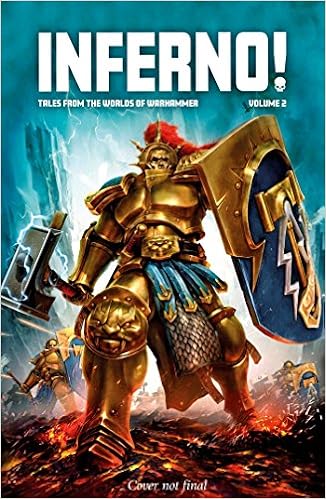
No real use in critiquing the cover, as it is for the Inferno! collection and not solely for the story. I personally like this picture though; it has a nice, classic flair to it. I think it ties in to Guy Haley's serialized installment story, but I'm not sure.

The reason I even mention this is because I knew this was being used as the UK cover, but Amazon US was floating this atrocity as the potential US cover:


And yes, I can read the "Cover not final" note. Just, and no offense to lovers of Sigmarines, I can't stand them, and my distaste begins firmly with their aesthetics.

So, cool cover. Great story. Take care, everyone!

Wednesday, December 12, 2018

Monsoon Hell Hole (The Black Eagles #16)

Monsoon Hell Hole (The Black Eagles #16) by John Lansing. Originally published in 1988 by Kensington Publishing Corp. Approx. 243 pages.

Many times have I waxed nostalgic on those halcyon days of my youth; where drugstores boasted spinner racks brimming with pulpy horror, romance, and action books. The action media we consumed in the 80's; be it in film, TV, comic book, or novel form, was packed to bursting with men's men, blistering action, and, being the height of the Cold War, the Red Menace.

There are tons of these types of pulpy short novels out there. Continuations of the old dimestore novels, and hard case detective works. Series like the Mack Bolan/Executioner series (which I believe is still ongoing), Phoenix Force, and Mac Wingate, just to name a scant few. Long-running series in which various authors share a common pseudonym, and a common theme.

This is my first foray into The Black Eagles series (I know, it's #16, but you gotta work with what you can get), and I fell for it hook, line, and sinker. I mean, first of all, look at that cover. All the covers in the series showcase that skull motif in varying poses. You could re-release the Twilight books with covers featuring a leering skull with crossed M-16s with underslung grenade launchers and there's a good chance I'd buy them.

So you've got the badass cover. Check. A leader with a G.I.Joe-worthy name (Robert Falconi). Check. A group of tough-as-nails, diverse group of hard-cases ready to pick up their government-issued M-16s and tear VC's to ribbons? Check. A buxom, beautiful Eurasian agent who drops bodies and doesn't take names? Triple check. This book has it all. Let's gander at the back cover for the blurb.


That sums it up pretty nicely. The stakes are raised by the fact that the garrison served as housing for the families of South Vietnamese soldiers recently brought into the fold. Meaning, their continued fealty to the cause is contingent on the return of their loved ones. But, most importantly, the three nurses who ran the children's hospital (monsoon season = a lot of sick kids) all have relationship ties to the Black Eagles. There is no question; they have to be rescued. They can not be allowed to languish in the hands of the Commies.

With a setup like this, you'd think what follows would be 200 pages of bullets flying. It's not. There's plenty of action, indeed, and it's done pretty well. It truly has the feel of the Delta Force and Missing In Action series rolled into one. There are plenty of questions regarding plausibility, but when the popcorn factor is satisfactory, the reader can make allowances.

Also, there's a lot of backstory. Early on, there's a roughly 20 page recap of the events of the past books (mind you, that's approximately 10% of the whole book). There's also a lot of character backstory, which was especially appreciated by someone like me who's coming into the series late in the game. 

The characters are tropey and enjoyable. Reading about the members of the Eagles, you feel like you're reading old G.I.Joe file cards. The Viet Cong and NVA leaders are interesting in their diverse methodologies, and we also have the introduction of a devious KGB agent. 

And there you have it. Real American Heroes. Deadly, conniving, Commie Scum. Patriotism. Jingoism. Robust action. Purple Prose. Machismo. Wait, was that an eagle I just heard?

If you want a real blast from the past; easy, brainless action that you could probably finish in an afternoon, track down one of these books.

Cover:

Do I really need to say any more about that cover?

Wednesday, December 5, 2018

Mercy

Mercy by Danie Ware. A Warhammer 40K short story, originally published by The Black Library, March 2018. Approx. 15 pages.

HachiSnax Note: Mercy is a story that's been on my radar for quite a while. Anyone who's been here before knows how much I love Sisters stories, and a friend of mine recommended Ware very highly to me. Seems like a win-win. The only problem has been that I really can't go for the $4.99 price point on BL short stories anymore. It was a fair intersection of price and value at $2.99 all those years ago, but not so much now (5 smackers for ~20 pages?). And that's been one of the myriad reasons why my volume of BL reviews has fallen off. Well, that, I'm not a fan of AoS, Dark Imperium, or the direction HH has gone in, a lot of the newer crop of authors don't really do it for me, plus some other reasons, but I digress. Anyway, once I saw that Mercy was getting bundled into issue one of the new Inferno!, I had my chance. On to the review...

Author Danie Ware marks her freshman foray into the grim world of 40K with a blistering, action-heavy story showcasing one of my favorite factions - the Sisters of Battle. Let's take a look at the blurb and then get to the review:

"Sister Superior Augusta of the Order of the Bloody Rose has been called to a planet in the far reaches of the Imperium, a world where no Imperial foot has stepped in thousands of year, save a missionary sent to bring the Emperor's light to the natives. On the world is a cathedral, ancient and run down – but with an icon at its heart, a warrior-woman with a bloodied rose on her chest. Is this a symbol that Saint Mina, founder of the Order, once walked on this world? Augusta is determined to find out…"

In Mercy, Sister Superior Augusta and her contingent have been dispatched to the jungle world of Lautis to liaison with Tanichus, a missionary who has been working to bring the light of the Emperor to the indigenous population. However, according to data received, there is the possibility of a holy relic being present on Lautis -  an icon of Saint Mina, founder of the Order of the Bloody Rose. Of course, the Sisters are not the only ones interested in what lies within the ruins...

Mercy is a brief short story, and it is immensely action-heavy. And, the reason why it works so damn well is that Ware is doing the Sisters and their tactics right. Let's see how it all stacks up:

Characters: Yes, there are strong characters in this action piece. It's obvious that Ware has thoughfully (and lovingly) assembled this team, fleshing out the individuals fully. This team is built with legs for the long run, not just a one-off short story (as evidenced in Augusta returning in the new novella The Bloodied Rose. Since I haven't read it yet, I can't say for sure who else is returning).

These Sisters retain all the discipline and zeal instilled in the Schola, yet remain human. They experience tests of their morale in the face of insurmountable odds, they lapse into rage-fueled battle fury. I've always said, the test for good 40K authors is adhering to the certain draconian doctrines of the Imperium, but being skillful enough to show the humanity shining through. Because no matter how oppressive a regime is, it will not quell the basic human spirit. Sisters might be among the most disciplined humans, but they're still human. And that's what will always make stories centered around the Guard or the Sisters more inherently intimate than those following the emotionally-truncated, engineered Space Marines.

Story: The story is in the synopsis....the Sisters come looking for the icon, and get ambushed by orks. It's the most basic of premise, and that's why we focus on the quality of characters and action. There's a little twist thrown in, but it's telegraphed fairly early on. There's still elements to keep the proceedings interesting.

Action: A lot of it, and it's done well. Ware pays attention to the tactics of the Sisters, and the methodology of the weapons utilized. She also has a good handle on the orks; emphasizing the "size and strength rulez" aspect of their tactical acumen. There are good descriptions of their physicality and brute ferocity. I mean, it's orks. I kind of wish she would've played with descriptions regarding the orks fungal nature, and the dank jungle that they were emerging from. Other than that, good stuff.

Overall: Mercy is an auspicious start for Danie Ware's tenure at The Black Library. These are good times when we have both plastic Sisters and solid Sisters fiction to look forward to!

You can buy Mercy as a standalone short or bundled in with Inferno! Vol. 1.


Tuesday, December 4, 2018

JK Haru Is A Sex Worker In Another World

JK Haru is a Sex Worker in Another World by Ko Hiratori. Translation by Emily Balistrieri. Originally published by J-Novel Club, September 2018. Approx. 334 pages.

The Japanese light novel genre is booming Stateside now. This is a great boon for fans of certain titles. Often, we will see recent anime being developed from light novel sources, where in the past, manga was usually the primary source. Depending on the popularity of said title, a manga adaptation might follow. This gives fans 3 venues through which they can enjoy/revisit beloved titles (light novel/manga/anime). Good times indeed.

One of the most popular sub-genres in the industry, if not the most popular, is "isekai" (another world). These are your stories, which, if you think about it, are most in touch with the true escapist element that fantasy is honestly predicated upon. Put your mundane, oppressive, boring world behind, and step off somewhere amazing, where there are no limits to who you can be or what you can do. Along the anime/manga/novel landscape, we see various methods to 'port over' to the new worlds in question...sometimes, as in SAO, it is via becoming stranded through a VR game. Often, well, it requires reincarnation.

It seems within the sub-genre of isekai, there is yet another sub-genre, that of "being reincarnated in some ludicrous manner or another". Yes, you read that right. We have people being reincarnated as slimes, spiders, and, because why not, vending machines. I mean, they do sound ridiculous, but it isn't like the premise itself is a new one...

Image result for connecticut yankee in king arthur's court
On the downside, there's zero waifu material in this title....


Another interesting note about these titles is that a good number of them arise not from commissioned publications, but as serialized stories licensed from Japanese message boards. Such is the case with today's book, JK Haru is a Sex Worker in Another World. Yes, this is assuredly an isekai title. Yes, the title is pretty outrageous and most assuredly in your face. However, the book itself is not a fluff piece. It is a fairly well-balanced work, that, despite some rough edges, offsets its levity with some dark corners and strong characters.

The title, as you most likely could figure, is not just a thesis, but an entire synopsis. Our young protagonist, Haru Koyama, wakes up in a fantasy world, after expiring in our world via the tried and true method of getting hit by a truck. She is joined by classmate Chiba, an introverted otaku who died as well attempting to push her out of the way. Like all standard fantasy alternate worlds, this one is under constant, perennial danger from an evil Demon Lord. 

However, our young heroine has bigger fish to fry. Haru learns quickly that, in this world, the cards aren't exactly stacked in favor of the fairer sex. Her former loser classmate, Chiba, courtesy of some banter with the god who guided them over, finds himself blessed with a broken skill set - one that allows him to 'level up' at 16x the normal speed. Also, the society itself is completely male-dominated. The ubiquitous Adventurers' Guild only issues permits to men. In fact, the only open paths for women seem to be as housewife, priestess/healer (the only way women can be attached to an adventurer), or, sex work. With no skills from her old life to parlay here, Haru opts for the third choice; and then does her damnedest to be the best.

So, how does it all stack up?

Story/Writing: You can tell that this was a serialized piece, which was completed in installments. It all falls under a general thematic arc, but you can still feel that with each chapter, each vignette, the progress and character evolution was more specific to that portion than the overall book. This is not a bad thing, but as each vignette has a somewhat different mood, it plays merry hell on the overall feel of continuity.

The silver lining to this is that the book is, all in all, well-written. Hiratori has put a lot of love into her protagonist, and it allows the readers ease in sympathizing with her. Haru isn't perfect; in Japan, she was one of those materialistic, face in the crowd types (the equivalent of what we call "basic bitches" here). Also, escort and sex work was not entirely new to her when she touched down in the new world. The "JK" in the title stands for "Joshi Kousei", which literally means "High School Girl". However, in recent times, the term has evolved to refer to the compensated dating scene which is prevalent in Japan; and it is basically escort work with the option for sex, and a lot of teen girls engage in it. Haru had done that sort of work to make ends meet in middle school, and she needed to reinvent herself in the wake of it. As the story progresses, Hiratori gives us peeks into Haru's heart, bit by bit, so that you can see, under the veneer, there's a sweet, sensitive, hard-working soul there. And so, by the end of the book, you end up falling in love with Haru as well.

I must also note that, for this book to be so immensely readable to me, a Western reader, a good amount of credit must go to the translator. In this case, that honor goes to Emily Balistrieri. Good job!

World Building: Two ways to look at this one. The world building itself is a bit scanty. We have those aforementioned terms, the ones used in most isekai works, tossed around like window dressing. As for serious discourse regarding industry, economics, climate, etc., it's not there. So is that bad? Not really. Remember, Haru's view is limited to her dedication to working to survive. What we do get is detailed description of life at her workplace. Ergo, we learn about the world in the same manner she does; via her customers. To be honest, that is the best fit for this type of work.

Action: Well, there's action, and there's, ummm, "action". For the former, the clang-clang sword type, there's some, including one magnificent setpiece. As for the sex, well, to be honest, I don't read a lot of that type of fiction, so I can't really appraise it. It is, erm, interesting, to say the least. I did enjoy it, so I'll just say it's well-done.

Overall: Again, all in all it's a fun, heartfelt book. Don't be dissuaded by any perceived implications behind the title. I mean, yes, there is a lot of sex in this book, and there are some precarious situations. But life, as well as this book, is about overcoming those obstacles. While the serialized structure makes it a tad less powerful than a singular piece, and the fact that there are some superfluous elements (the entire Kickin' the Can segment), JK Haru is a Sex Worker in Another World is a solid book that begs for a sequel.

Get your copy of JK Haru here.

Cover:

The artwork is pretty, to be sure, and the color palette enhances the overall effect. However, in my opinion, something along the lines of a bifurcated image - one showing elements of Haru in both worlds, would have worked immensely better.

My other complaint - unlike most other light novels, there's no interior art. Remember, most light novels have a few color plates right after the front cover, as well as an average of 5 interior B&W pics. I'm not even asking for NSFW/hentai pics, just some pics of more of the dramatis personae would have been very welcome. 

On a bright note, though, it looks like a limited comic - JK Haru "Summer", or something to that effect, has been released. Very interested in that; look at that gorgeous cover!


More info here.

Here's hoping for more from Haru - more novels, more manga, and how about an anime?

Friday, November 2, 2018

Slum Online

Slum Online by Hiroshi Sakurazaka. Originally released in America by Viz Media/Haika Soru, 2010. Approx. 203 pages.

After watching this book languish on my shelf for countless years; I finally decided to pick it up and give it a shot. An interesting bit of history behind it; as, in a way, it is something of an artifact by today's standards...somewhat obsolete.

These days, you can peruse large volumes of light novels on Amazon and at your local bookstore. There was a time this was not the case. Before the explosion of popularity in the novels predicated upon SAO's performance, the niche market for Japanese fiction was rather small. Agreed upon classics, or new releases from top bestsellers were present, but that was about it. Many of us jumped on the original release of Battle Royale in novel form, only to be stymied by horrendously stiff translation.

Later, Sakurazaka's 'All You Need Is Kill" started making some waves (before being adapted into the film Edge of Tomorrow). Picking that up, I found myself drawn in by the cover on this book. Can't exactly say what it is, but I love the aesthetic of it.

So, what exactly is "Slum Online"? I'll post the synopsis in a moment, but in a nutshell, it's about a disenfranchised young Tokyo man who spends the bulk of his time fighting to be the top dog in a popular MMO fighting game. However, the difference is that, unlike in modern light novels, it isn't an isekai work, in which the protagonist is transported or reincarnated into the game world. Also, the protagonist isn't a full-blown, anti-social NEET type. No, Slum Online has elements of a gaming novel, and a love story, all told with a nice cinematic flair by an accomplished author (bolstered by a strong translation by Joseph Reeder).

Here's the synopsis:

"Etsuro Sakagami is a college freshman who feels uncomfortable in reality, but when he logs onto the combat MMO Versus Town, he assumes the personality of "Tetsuo," a karate champ on his way towards becoming the most powerful martial artist around. While his relationship with new classmate Fumiko goes nowhere, he spends his days and nights online in search of the invincible fighter Ganker Jack. Floating in between real and virtual, at last, Etsuro finds himself face to face with his most powerful opponent..."

The writing style in Slum Online is strong and engaging. Sakurazaka draws the reader in with vivid depictions of areas dotting the Tokyo panorama; we feel transported into the quirky areas of Shinjuku, etc.. Our moods are swayed by weather patterns swaying from oppressive heat to melancholic rainfall. We feel ourselves languishing along with Etsuro in tedious university classes which he cannot bring himself to become personally invested in.

The characters here are strong as well. Etsuro is a hard sell, but Sakurazaka does it. The young man, as mentioned, is not anti-social, but he is also not proficient at social interactions. He possesses the acute logic to dissect and succeed at the games which are his passion, and he applies the same pragmatic skills of deduction to everyday life.

Etsuro finds himself a bit stymied by his developing relationship with responsible classmate Fumiko. Their budding love is the best part of this gaming novel. Where he might not have the capacity for the 'right' way to verbally communicate; we can see the endearing manner in which he regards her (case in point, the 'hamburger shop smile').

In fact, one might argue that the weakest aspects of the novel are those which revolve around Versus Town, the game with which Etsuro is obsessed. The online fighter is conceptually sound; and conceivably immersive.

However, the fight scenes (and there are quite a few), aren't always engaging. Kudos goes to Sakurazaka for doing blow by blow descriptions of the matches. The thing is; it boils down to a lot of "buffered this, dashed in, canceled out, did the lightest punch, etc.". Throughout the novel; Fumiko compares Etsuro to Newman's character in The Hustler. Imagine reading a book about a critical pool match; and it read in such a manner: "then he adjusted the stick 45 degrees, striking the cue ball on the upper left hemispherical region, etc." It just isn't that catchy. The thing is; it is understandable because that is how Etsuro's mind works (the story is told in a first-person manner). He isn't focused on the lithe animations of the snake boxers, or the stumbling-yet-lethal meanderings of the drunken boxers. His mind focusing on the mechanics of the game; and matching attacks and counters to the motions of his prey.

There is also some slight jarring in regards to the first-person narration. During the fight scenes, we are told what Tetsuo (Etsuro's character's name) is doing in the third-person. Yet, during these moments, it also switches out to first-person, if telling how Etsuro is manipulating the controls. It's not bad; just awkward at times.

Other than that; there is one minor, specific complaint that I have. This is in regards to one instance in the translation (again, the translation itself in general is extremely strong). When Etsuro meets Fumiko, he has trouble reading the kanji of her last name, Nagihara. This implies that the spelling of it (hence, the kanji used in constructing it) is uncommon. Which also implies that there might be a specific meaning behind the kanji which is used. The thing is, we are never shown her name the way her name is written. I had wanted to take it and ask my wife (who is also named Fumiko) to translate it for me. So, if anyone out there has the Japanese version of the novel, or can find a pic of it online, please throw it in the comments. Greatly appreciated.

And there you have it. A short review of an enjoyable, short read. Like previously mentioned, it is conceptually a dinosaur in the age of isekai and LITRPG works, but it is still endearing. Also, enjoy the 20 page short story, "BONUS ROUND", also included in the book (Slum Online was originally published in Japan in 2005, and BONUS ROUND 5 years later).

Check it out.

Cover:

As mentioned earlier, this cover snagged me from the get-go. Better yet, it beautifully captures one of the more endearing scenes from the novel. While not as intricate, or bright, as many other light novel/manga covers, this cover oozes emotion, and works as a great companion for the book itself. Makes you wish that the artist, toi8, had done some interior pieces as well.