Showing posts with label Novellas. Show all posts

Thursday, May 23, 2019

The Angel Of The Grave


The Angel of the Grave by Richard Writhen. Originally published by Goodz Doll$, April 2019. Approx. 171 pages.

Back in December 2017, we were treated to an excerpt from author/awesome friend Richard Writhen's then-upcoming novella, The Angel of the Grave. You can visit that post here. Well, I am happy to announce that the novella has been released (it came out in April). TAOTG serves as a prequel of sorts, a "Book Zero" of his evocative Celestial Ways Saga, of which I've read and reviewed the exceptional The Hiss of the Blade.

Just a quick recap: Writhen's Celestial Ways Saga transpires on the fictional world of Cedron; a world which has benefited immensely from the years Writhen has spent developing and polishing it. Also, Writhen has coined the term "gothdark" to describe his genre, or niche, of writing. Gothdark, as the name implies, is an amalgamation of gothic and grimdark; and it is a fitting name, as these elements are nicely delivered in voice, tone, and subject matter.

Let's take a look at the synopsis first; which is less of a synopsis, and more of a listing of the storylines which will intertwine, overlap, and converge over the body of the work:

"BECOME THE FIRE. An intelligent little girl encounters a talented witch at the local fair and finds out that it's all in the family. Interconnected by dreams, two young orphans embark on the long path to find a bloody revenge. A wealthy lady travels hundreds of miles to become a baroness, but when she consults a diviner, she finds out that she may be in way over her head."

As you can see, instead of stating a thesis, it is more a summary of what shall befall the dramatis personae. Let's take a look at the book itself.

In The Hiss of the Blade, we were treated to a lot of politicking and power plays. There was lovely, visceral violence to be had, as well as hints at magic and sects.

The focus of TAOTG (which, as mentioned, transpires long befor Hiss) is on magic, witchcraft, and divination. In the book, we are introduced to four core characters, within three character arcs. We witness them grow; no, perhaps the best word is 'evolve'. Writhen does a masterful job in not only developing these women as characters, but charting the growth and potency (and ramifications of) their particular powers.

The first story arc focuses on Hilde Sontire. Hilde is a sharp young girl who takes on work, along with her sister and sister's boyfriend, at a traveling carnival caravan. There, she comes across an enigmatic witch (introduced in one of the best transformation scenes I've read). This witch's skill set runs a bit on the, um, sanguine side; and Hilde learns that a talent for it is literally in her blood.

The second story arc introduces us to Sadine and Rebecca, two young girls living in abject poverty. Rebecca is an orphan, taken in by Sadine and her mother. The mother has to do whatever she can to feed herself and the children, including prostitution. One day, her life is snuffed out at the hands of a john. Homeless and alone, the girls travel to the city, becoming Dickensian street urchin cutpurses. Along the way, their inherent talents are noticed by a local magician, who teaches them the art of manipulating fire. However, despite the struggle to survive, despite the learning of the arts, their focus remains on finding the man who murdered their mother, and unleashing retribution upon him.

This segment was especially strong; giving us a nice view of everyday life in one of Cedron's large cities. There is also a fantastic sub-plot involving a brutal cult, which I truly wish got a few more pages dedicated to it.

The third story arc tells the tale of Marissa Wallins, a young, naive woman who travels a great distance to become the wife of a local, powerful baron. As the years start to pass by, and the romantic luster erodes; Marissa becomes aware of a new power manifesting itself within her. While exploring a cavernous storeroom in their mansion, she comes upon a book on the arts of ice magic, and her life is forever changed. She has been chosen, and she will realize her destiny.

There was a lot of character development and evolution in this arc. Perhaps the best way I can describe it is that Writhen does a great job detailing how the 'old' Marissa is deconstructed as the 'new' Marissa blooms. She is a fantastic, compelling character, ultimately serving as the linchpin of the book.

So, those are the basic arcs. I won't go into too much more detail, as it's a short novel and I want to avoid spoilers. 

As for writing style, I will be repeating some of the same points I mentioned in the review for The Hiss of the Blade. Writhen's style is very evocative, and almost poetic. There is a deep, rich voice to the narrative, and it reads as though it is legend being recounted by a sage storyteller. While I enjoyed his prose in Hiss, you can see that his skill has improved over time, become more refined. 

Action scenes are still very solid. Writhen surprises in how well he can realize brutal moments of violence. It is often as ugly and messy as it is in real life. TAOTG also features scenes of violence predicated upon the arts learned by the protagonists. Writhen has given a lot of thought to the logistics of the magics he is introducing, giving them a feel both legitimate and genuine. It's all very organic, never arbitrary.

There you have it: strong, developed characters, a rich setting, and well-thought out magic system. It all combines to a greatly enjoyable read, which I recommend 100%. For sure, check it out.

Get it at Amazon.


Thursday, January 10, 2019

To Brave The End (Tales of the Blackshield Dogs 1)


To Brave The End (Tales of the Blackshield Dogs 1) by Frank Dorrian. A Blackshield Dogs novella, originally published by Impaled Monarch Publishing, February 2017. Approx. 142 pages.

On a recent meandering through Amazon searching for some good, dark reads, I came across The Shadow of the High King by Frank Dorrian. I was instantly intrigued: fantastic cover, loads of legit-sounding reviews, and what I read in the Look Inside sample was engaging, descriptive, and grim. Alas, I have not had time to budget to reading it just yet, but I also noticed something. Dorrian has a pair of novellas, which take place in the same world as High King. These novellas center around a mercenary group known as The Blackshield Dogs. I love good mercenary tales, so I figured; what better way to sample the work of this new (for me) author?

First, here's the blurb:


Many faces, many names, have passed through the ranks of the Blackshield Dogs. But few of them ever surpassed the bloody reputation of the man known and feared on Caermark's battlefields as Red Harry.

But before he was Red Harry, before he was anything, he was Harruvard of Werrewood, a man-at-arms sworn in service to Lord Gadrin Strael.

Injured and left for dead during a bitter conflict along Lord Gadrin’s borders, his life was saved by the kindness of a stranger. But as Harruvard's past refused to let him go, that same kindness soon would be stained red.

In the deep of winter, beneath creeping snows and biting ice, the black seeds of the monster Harruvard would become were sown by the hands of men, and nurtured by their cruelty.


Again, I went into this story not yet knowing the "Red Harry" of High King notoriety, so, I was introduced to the man in his former iteration of Harruvard, man-at-arms in the service of Lord Gadrin, and, at the point the story opens, a deserter with murderous soldiers and hounds on his tale.

Left for dead in an icy river, Harruvard is saved and nursed back to health by Daina, a widowed mother struggling to get by in Larkrun, a local logging town. Driven by her own innate kindness to assist Harry, Daina is still leery of his potential past baggage, and hesitant to allow her young son, Cenrid, to bond with him. The loss of a father to Lord Gadrin ill-planned gambits against fellow Lord Algar have left a huge vacuum in the boy's heart; and a potential father figure and competent soldier gives him two things to idolize. However, over the course of his convalescence, tensions ease, and the impromptu 'family' begins to form bonds.

Unfortunately, there are always obstacles. Every step Harry has to take is one where he must look over his shoulder, checking to see if his past has caught up to him yet. And before him lies the ugliest of small-town politics; the smarmy alderman who lords over his small demesne, bullying its residents. 

Well, I am loathe to engage in spoilers, but it isn't hard to venture a guess as to what transpires at the confluence of these various factors. Again, this is a fairly dark story.

So, how does it all stack up?

Well, the template of appearance of mysterious stranger/chipping through the tough woman's exterior to get to the gooey bits/bonding of a cool man with a sword and a boy who needs a father figure is not a new one by any means. But how many times have I reiterated that tropes are fine so long as the writing is good, the action is good, and/or the characters are compelling? Well, in To Brave The End, you get all three.

Dorrian's writing is, simply put, fantastic. His world-building is vibrant and harsh. You feel and hear the snow crunching under your feet. You suffer as your vitality is sucked away in the throes of the Sothorin River.

The characters; well, the main characters, are well done. They are flawed, they are hurting, and, in their own ways, they are fumbling desperately in the dark for the connection that they need. It lends to a palpable tension when you realize that, once the connections are made, a world such as this would never allow them to last.

Harruvard is a strong, sympathetic character. He carries the shame of being a deserter, although anyone in their right mind could see legitimate cause in the impetus of his egress. On top of that; he fights a constant battle to contain the voices which perennially jockey for control of his mind: Sorrow, Death, and The Thirst. It will be the Thirst which solidifies his legend as Red Harry.

Once we get to the antagonists, I won't say that they are one-note. They're not. But they are brutally irredeemable, making them frightfully effective in their work.

And finally, we have the action. Action scenes are simply wonderful here. They are brutal, bone-crunching, and real. There's no ballet. There's no gratuitous splatter. We get the urgent, violent clashes of those who've had everything stripped away and refuse to surrender what little bit of livelihood they have left. There's dirty, malicious fighting by men for whom killing is rote work solidified by years of practice. We get hardcore, one on one, duels to the death. And we also get grand spectacles of unrelenting violence.

There you have it. All in all, a great, quick read, and you can get it for only 99 cents over at Amazon. Highly recommended.

Cover:
While I love the gritty, grimy, realistic cover for Shadow of the High King, I must say, this trash polka inspired cover is really eye-catching.

Getting an awesome tale, with an awesome cover, for a rockbottom price, is always a good thing.

Tuesday, December 26, 2017

The Hiss Of The Blade

The Hiss of the Blade (Celestial Ways Saga: Book 1) by Richard Writhen. An independently published novella, originally released January, 2017. Approx. 185 pages.

The Hiss of the Blade is the opening novella in a projected trilogy by self-published author and personal friend Richard Writhen. The interesting thing is; it is not only part of its own trilogy, but it was released as part of a "trilogy" of novellas which take place on the fictional planet of Cedron (his other two novellas, A Host of Ills and A Kicked Cur, transpire over different time periods). Further, Writhen is carving out a name for himself by writing in a genre which he terms "gothdark"- the simple take being grimdark with gothic tones. The end result is very satisfying; giving us a dark, moody tale which posits high stakes for all those involved.

Before getting into the review proper; here's a look at the current blurb (note: I had gotten the original paperback, and the blurb on that one was a bit more vague):

"Two petty mercenaries are falsely accused of switching sides in a feud between two rich and powerful magnates; an ex-miner on the run from a murder charge becomes a reaver and embroiled in a romance; an industrial lieutenant is recruited to help capture a serial killer and an entire city is in danger of being ensorcelled by an ancient monk."

That is a fairly accurate synopsis for what transpires in THotB. Part of the allure of the rich tale is that Writhen weaves seemingly unrelated threads and story lines into a central convergence point. The aforementioned mercenaries, for example, are tasked with hunting the rogue ex-miner. The story of the serial killer; which bookends the novella, and provides some of the best (and most grotesque) content, holds portents for future installments. And, everything that transpires leads back to the two magnates: a pair of union heavies (one controlling the mining industry, and the other the dairy/agriculture channels) whose game of perennial one upmanship generates waves which flood over the entire region.

Since this is a novella, too much detail leads to issues with spoilers. It's better to focus on the elements involved, especially since Writhen has a very unique authorial style.

Writhen writes in a style which he has termed as "gothdark"; which is to say that it contains elements of gothic and grimdark. The result of this genre copulation is prose which is dark, rich, and evocative. Even when the action is at its most brutal, or the most base slang words are being slung, there is something inherently poetic about the delivery; as if the entirety of the narrative is one of the baroque paintings used for the cover come to life.

Seeing as though he packed a ton of characters, as well as a multitude of story lines, into a compact page count, I also need to laud Writhen on being able to wrangle the maximum amount of detail out of the least amount of words. Honestly; there is no lack of vivid imagery throughout THotB.

The action throughout is top-notch as well. The opening scene; focusing on the serial killer at work, is orchestrated in a manner both disturbing and brutal. There are duels and fisticuffs throughout the story as well; and in each instance the events are composed in a manner both bone-crushing and balletic.

And, finally, there is the lore. One would be hard-pressed to generate a successful fantasy series without the underpinning of an intriguing backdrop. The reader gets dropped straight into THotB without preamble or fancy maps; and from there they are immediately swept up in the action. As the story progresses, however, details are revealed. We learn the basic geography, then the history, religions, etc. The best part is that it is all well-thought out, detailed, and believable.

It's laudable that Writhen is able to pack so much mythology, so many events, and so many distinct characters into a tome that is under 200 pages. In fact; if there is anything that works against the book; it's that there isn't enough room for each character to shine. Meaning; each character could carry the novella as a sole protagonist, but in the situation here they work as a fine ensemble.

So, we can look forward to the further development of these characters in Book 2.. Well, for those of the characters that made it through this installment, at least.

With a classically beautiful cover, and a name derived from the poem "The Sewing Bird" by Fitz-James O'Brien, The Hiss of the Blade delivers a deep and unique experience. Looking forward to continuing this series.

Friday, October 13, 2017

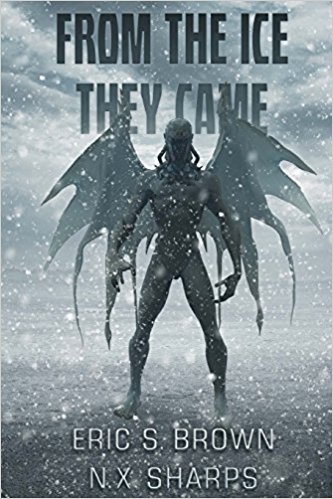
From The Ice They Came

From The Ice They Came by Eric S. Brown  and N.X. Sharps. Originally published by Severed Press, April 2017. Approx. 136 pages.

From the Ice They Came, a neat little collaborative novella by Brown and Sharps, is a fun romp that combines military action, psychic powers, and Lovecraftian influences. The end result is fast paced, self-aware, and, towards the end, absolutely drenched in blood and ichor. Before we dissect it, let's take a look at the back cover blurb, which summarizes all quite nicely:

"Without warning or explanation U.S. Army Captain Robert Gilman is escorted to a cutting-edge research base in the Antarctic tundra by the shady multinational Ward Consortium. Competent but otherwise unexceptional, it turns out that his long suppressed abilities could be the lynchpin to decrypting the enigma posed by a tablet that predates human history. Isolated from civilization, presented with the carrot and the stick by the Consortium, and surrounded by others with special abilities of their own, ultimately curiosity compels Gilman to travel down the rabbit hole. But the further he delves, the greater the strain on reality becomes, and before long he discovers the Eibon Complex may well be ground zero for an inter-dimensional invasion by forces beyond human comprehension."

Let me just start out by stating that there is nothing either "new" or groundbreaking here. FTITC cobbles together elements of Lovecraft, The Thing, X-Men, and a slew of other iconic properties into a decadent morsel of entertainment loaf. Also, as mentioned, the writing is done in an an easy, breezy, self-aware style that helps move the proceedings along quickly. This is not a deep book; but rather something akin to an old B-movie classic. This is not a damning indictment; but actually high praise.

Characters:
While our characters are instantly recognizable, they are also fairly memorable. Robert Gilman (nice 40K nod there) is a fairly even blend between military type and pop-culture referencing geek. He does his best to be a hero in the face of the unknown and impossible; all the while cultivating his dormant psychic skills.

He is, of course, given a romantic interest, as well as a pretty-boy foil. There is an interesting character in the leader of the team of red-shirts, er, military contractors tasked with guarding the base. And, the whole shebang is overseen by a classic corporate ice queen.

Again, nobody new, but still fresh.

Setting:
There's two primary settings to focus on here. First is the facility. Centered in the middle of Antarctica, it is a high-tech hub in the midst of the world's most barren tundra. The description of the facility itself is well-done, but the Antarctic wasteland is an afterthought. When writing for that setting, you want to stress how remote it is (hence cut away from help), and how brutal the weather is. This is done to a degree, but not as much as it could have been (see Alan Dean Foster's novelization of The Thing for a primer on this).

The other setting is the "dream world"; the world in which, during the middle of the story, we snatch glimpses of the bizarre landscapes in which the creatures dwell. Here Brown and Sharps flex a bit more authorial muscle; painting with Lovecraftian shades of hallucinogenic colors and impossible geometric influences.

Creatures:
Ah, yes. The "They" of the title. You actually get a lot of creature bang for your buck in this novella. There are two types on offer: lobster-mantids and brutal, overgrown space amoebas. The descriptions of the creatures themselves, as well as the devastation which they unleash, is superb.

Action/Pacing:
Again, the pacing here is nice and brisk. If you are a normal reader, you can probably finish this in the time it takes to watch a movie; a good pairing for the cinematic feel of the prose. We start with the bonding scenes of the group in the facility, move on to a few weird jaunts through the hellish dreamscapes, and then it's about thirty straight pages of explosive climax.

The action is well-done; replete with plentiful gunplay and flying gobbets. One might complain that the psychic powers of the Gifted aren't used more in the climax; but a key issue is the physical/emotional drain that usage foists upon the user.

In summary; if there is one complaint that I can offer, it is (and other reviewers have pointed it out as well) that the proofreading here is really poor. I usually don't quibble about typos here and there; but in this book we are averaging 1-2 a page. I put this on the publisher more than the authors; but still, it is a deterrent to fully enjoying the book.

So, I saved this book for October, which is when I am usually looking for a good scare or two. Alas, there are no scares here, but plenty of action and witty, self-aware quips and references. Don't take it all too seriously, and you'll have a great time.

Plus, it has a solid (open) ending.

Cover:

This is a nice enough cover, especially for a small press book. However, there are no critters like this in these pages.

At first glance, I thought that this was some sort of Cthulhoid creature, with tentacles across the mouth. Upon closer glance; well, I'm not sure. It looks sort of like a helmet and humanoid face.

Either way, it reminds me of Nemesis Enforcer from the G.I. Joe Movie.


Thursday, December 17, 2015

The Non-Review: Cybernetica


This is going to be an odd one, folks. Please forgive the twists, turns, and other nonsense. I needed some time to talk here, and so this will not be an actual review. But some of the things I need to talk about will tie into some of my concerns as I read through I Am Slaughter.

Anyway....

I finished reading Cybernetica a while ago. Why? I'm not sure. Part of it is that I usually like Sanders' stuff. Part of it is because I've been enjoying a bunch of the Adeptus Mechanicus stories that have been released. Also, perhaps I had hoped that a Horus Heresy review would steer some much needed traffic here to the blog. Sadly, I think that was a lot of it. That was the wrong way to approach it.

And so, unsurprisingly, I really didn't enjoy the novella much. It isn't that it is bad, but it really isn't great. More on that as the diatribe rolls on.

I know I've said this in one way or another in almost every 40K review: I'm not as lore-savvy as I should be. I don't read the Codexes, and I don't navigate the tangled web that is the Heresy. I have the utmost respect for those with the time, intelligence, and disposable income to get all the goodies and commit it to memory. It is a commendable feat.

Also, as I've said before regarding the 40K stuff; I find it hard to get into a lot of the Space Marines stuff. No matter how good an author is, and The Black Library has a lot of good ones, it is near impossible to write efficiently for the mindset of these transhuman (superhuman? what is the correct term?) warriors. And for those that do, let's be honest: the emotionally truncated personalities of the Astartes make them hard to be sympathetic with for the duration of a novel.

I personally believe Space Marines work best when you see them in action; reading along with a human lead, and watching the Emperor's Angels do their work. Maybe I'm in the minority there, and maybe that's why I often prefer Guard novels.

Moving on. I had tried long ago to get into the Horus Heresy. I initially held out on reading them, worried that I'd finish them too quickly and end up champing at the bit for new releases. Then, of course, the Great Cash Cow rolled off into an avalanche of short stories, audio books, special whoosits, etc. etc.. And it's too lore-heavy for me. Sorry, that's my fault. I'm getting old, and I just don't have that much reading time in a day anymore. It just got away for me, and I'm not bitching, since, to be honest, I read the first three and the quality dropped like an anvil after Horus Rising.

But still, Cybernetica came along. Ok, novella, so quick read. Sanders is good. I like the Adeptus Mechanicus. Should be a slam dunk.

So why didn't it work? Why did the whole thing feel so, I don't know, manufactured? Well, it was made on Mars....
Sorry, that was bad....

Actually, I'd love to have seen the evolutionary process behind Cybernetica. How did something that began as a novella about a Sons of Horus Techmarine penned by Aaron Dembski-Bowden end up becoming a Sanders-penned retelling of the events of Mechanicum centering on a Raven Guard Techmarine-in-training sent on a covert-ops mission by the powers that be on Terra?

It doesn't really matter. Either take is an interesting tale, if done well. I don't even remember all the details of Cybernetica at this point. A trim novella, it still took me over a week to read. After it was done, I took nothing away from it. And I hate that this all sounds negative, since there are some really good things in there.

But also, something really bugs me about it, and I'm guessing it might have something to do with the editing (again, I might be totally wrong here). There are just too many parts here that don't work, or just don't add up. There is a huge battle towards the beginning that is completely superfluous. It honestly is inserted to showcase Mechanicus unit types. And, being unnecessary, it reads as mundane. The other Techmarines-in-training that appear early on feel inserted at the last minute; as if just there to give some other Chapters some page time. They don't get enough fleshing out in their brief time to justify why it was even those Chapters represented. And, worst of all, there is a subplot with a freed heretek that goes nowhere. This character could have added so much desperately-needed emotional presence to the story, but in the end he gets relegated to a tertiary role.

Other things don't work, either. There is a big twist that can be guessed from the onset, and the dialogue of Lord Dorn and Malcador simply do not fit what one would expect from figures of their importance.

Again, too much negativity. From what I remember, the novel boasts the usual fiercely intelligent writing from Sanders. The panorama of Mars which he paints is so, so, so intricately detailed, almost mind-numbingly so.

Then, came the big problem for me. What killed this novella for me is that it is, in fact, a Space Marine book. That's right. Rob Sanders is one of those authors good enough to portray Space Marines effectively. And where Space Marines already have truncated emotional palettes, those being tinkered with by the Mechanicus are almost entirely bereft of feelings (also, add into the mix that the lead character is a Raven Guard brother who can't be sneaky because of his augmentations, so a central aspect of his persona is gone as well)

Now, picture Cybernetica as a standalone, non-Warhammer 40,000 tale. Make it like Escape from New York on Mars. Let The Carrion be a real cyborg badass, on an urgent, time-sensitive mission, with his cyber-raven and his two sleek, sexy warrior-androids in tow, blasting wild cyber-mastiffs on the blasted Mars landscape. That's a bona fide cyberpunk classic there.

Well, that's about it. I guess this is looking like equal parts rant and review. Maybe what I'm saying, in a nutshell, is that it's getting harder for me to get into some of the 40K stuff these days. I don't even know, maybe next year will tell. I will say, though, that for all of it's merits, Cybernetica has a distinct whiff of corporate control about it. And that undermines the efforts of a solid author.

Thursday, November 12, 2015

Fire And Ice

Fire and Ice by Peter Fehervari. A Warhammer 40,000 Tau novella, originally appearing in the Legends of the Dark Millenium Shas'o anthology. Originally published October, 2015. Approx. 79 pages.

I've been champing at the bit for the chance to tear into this novella since it popped up in last month's (Oc-Tau-ber) Shas'o anthology (which has received a hardback release as well, allowing readers to finally get the exceptional shorts Out Caste and A Sanctuary of Wyrms in print format). The promise of a new story by personal Black Library favorite Peter Fehervari generated a lot of excitement, to say the least. As I'm sure I've mentioned many times before, in my opinion no other author in the Black Library stable puts forward stories with the kind of twisted potential and depth that this created universe allows for. They are brutal, honest, puzzling, twisting, and unapologetically raw.

Fire and Ice takes that standard to a new high.

As a forewarning, I can only say so much regarding the structure and storyline of this tale, since that would compromise some of the wonderful and mind-boggling twists. Let me just say that it is no coincidence that the name of one of the central figures of the story, an assassinated Inquisitor, happens to be Escher. This will give you a good idea of how the narrative of Fire and Ice unfolds.


Set amidst the turmoil of the Damocles Gulf Crusade, Fire and Ice focuses on a meek Inquisitorial Interrogator named Haniel Mordaine. Mordaine is a man that truly finds himself wedged between a rock and a hard place; he is being pursued by the Inquisition's Grand Conclave for his part in allowing Escher to be assassinated, and he is still trying to do his duty by attempting to uproot the Tau influence in the sector. Along this precarious path, he is ushered and guarded by a shadowy man named Kreeger, who, along with providing safety, is preparing Mordaine for a rendezvous with his "contact", a shadowy figure known as the Calavera, who will hopefully provide some insight on quelling the blueskin menace.

His efforts reach a climax on the frozen world of Oblazt, where the Tau-engineered "Unity" revolution is born. As the hive of Vyshodd falls to the newly-minted human subscribers to the Greater Good, Mordaine beats a hasty egress aboard a maglev train (superb technological concept here) on a journey to.....well, let's just say fate.

That summary really does no justice to the the story; and, mind you, the real story begins once all the players are on that fateful train. Here, while convalescing from wounds suffered during the riot, Mordaine will work with the mysterious Calavera (obviously an Adeptus Astartes, but also obviously so much more), and he will attempt to fill the void of the fallen Escher's shoes by interviewing "the prisoner"; a Tau warrior who may or may not be the legendary Commander Farsight.

If you need a straight-forward, linear Tau story, with clearly defined actions and arcs, please refer to my last review, for Phil Kelly's Farsight (no insult there, it is a really good novella). Also, if you are looking for seeing cadres of Fire Warriors lined up, with Crisis Suits soaring overhead, go with Farsight. But if you want a representation of what it would mostly be like to deal with the confluence of Tau socialism, Inquisition dogmatic totalitarianism, and Warp-infused Chaos, then read this novella. If you want a psychological power play, and the formation of grand-scale chess match (both figuratively and literally), then read Fire and Ice. Everything is offered in carefully calculated contradiction. Everything is everything and nothing at once.

There are no easy reveals here. Like all of Fehervari's other works, the reader finds themselves sorting through tangled webs in a house of smoke and mirrors. You will be asking yourself throughout, what is the ultimate point? Why is this character being chosen for these grand trials and responsibilities? And when an answer, of sorts, posits itself, revealing its truly ugly face, it is a true shock (and a nice little nod to one of my favorite movies of all time. But like I said, no spoilers from me).

Assessing the individual parts that make the whole, Fire and Ice is, like all of Fehervari's other works, very strong. If you were to strip away each outer layer, its core fundamentals are still strong. Take away the 40K universe, and it is still strong sci-fi. Take those concepts away, and it is still a strong character piece. Peel that back, and see the dark recesses of the mind. Claw through that, and fall into the blackest valleys of the soul.

There is real strength in the words employed. Every line has structural and philosophical importance. And, like in Fehervari's other stories, there are puzzles and riddles abound. Names are a central motif here; the meanings of them, the importance of them, and the grave missteps of addressing someone by the wrong name.

World building and scenery is excellent too. The technology of the anchor hive pulses with legitimacy, as does the maglev train which serves as the vessel for a trip to Hell. The partisan politics of those who would embrace the Tau'va over Holy Terra is especially poignant given the socio-political overtones so prevalent in today's society. Indeed, there is nothing so tragically comedic as low-information consumers rebelling and fighting for the opportunity to be another regime's disposable assets.

Of course, the most important aspect of such a story as this is characters. We have a fantastic dramatis personae here. Mordaine is an well-portrayed in his role; frayed, emotionally crumbling, and yet capable of an inner strength (bolstered, perhaps, by the inner voices which plague him). His guardian, Kreeger, is also a standout character. He embodies the physical characteristics and nihilism of Fire Caste's Holt Iverson, and yet, I find it hard to believe that they are one and the same....

The real puzzles, of course, are the shadowy pupeeters: the Calavera and the traveler. Their true motives are as well-hidden as their true identities, and even when there are some reveals, their ultimate goals are still out of sight.

Fehervari also shows that he can still craft well-conceived, if somewhat unconventional Imperial Guard regiments. Here we have the Iwujii Sharks, brutal, efficient, and unabashedly more gang-like than regimental. They give us some truly memorable personalities, especially the priestess La Mal Kalfu.

There is also a very nicely done minor arc involving an outcast kroot shaper. Here, as in some of his previous stories, Fehervari has shown a real flair for portraying this alien race. He truly gets their physiology, their bearing, and their base warrior instincts.

The dialogue here is beyond amazing. Sometimes I list a favorite quote from a story, one that resonates with something deep within with its poignancy. Here, almost every line fits that bill. So, for my favorite quote, I will choose these three simple words, which come from the most welcome character in the novella:

"It's a lie."

Fans of Fire Caste will be happy to know that there are some references in Fire and Ice to that classic piece. They are not as obvious, or as directly connected as the ones in stories like The Crown of Thorns or Vanguard (which acts more of an epilogue to Fire Caste than a separate work). It is just another cold reminder of the great story cycle that might have been if the Black Library had given Fehervari another book or two to tell a story that really deserved to be heard.

I'll put forward Fire and Ice as what I believe to be required reading for Warhammer 40,000 fans. This story shows the true potential for a created universe. These stories don't need to be constrained to the depictions of the battles acted out by tabletop miniatures. What makes those stories possible are the schemes and machinations of greater forces, and that is what you get in Fire & Ice. Like Fire Caste, this story might polarize some fans, and isolate those who prefer more clear cut tales. But it is the kind of story that a legend like Farsight deserves - complex, full of deception and obfuscation, calculated and calculating, brutal, and merciless.

Here's what it is:
Alas, how terrible is wisdom when it beings no profit to the wise.

Final Score:

10/10

Cover Score:

Another Crisis Suit Codex grab, I presume. You won't be seeing it in this story. But this isn't the only story in the anthology. Not a bad pic.

Cover Final Score:

6.5/10

Saturday, November 7, 2015

Farsight

Farsight by Phil Kelly. A Warhammer 40,000 Legends of the Dark Millennium novella, originally published by The Black Library, October 2015. Approx. 108 pages.

The nice folks over at The Black Library decided to make last month into Oc-Tau-ber, with a month of Greater Goodies, some old and some new. Two offerings definitely piqued my interest; the first is this nifty novella, focusing on the iconic Tau badass (bit of an oxymoron there, no?) Commander Farsight. The other is Fire & Ice, a new short story by blog favorite author Peter Fehervari which appears in the Shas'O collection. I will be reading and reviewing that very soon.

Farsight is an action-packed novella which centers on the actions of Farsight during the Arkunasha War. Before I get into further detail, let me say this: I know that most 40K readers are read-up on the canon and lore, but if you are like me, and only have a cursory knowledge, read up on Farshight's wiki entry first. He is a very intriguing character. The big question then becomes: does the story do justice to the legend? Well, I have to say that I really, really like this novella. But it falls more firmly into the mold of actioner than character study. And I think that was the best choice here; you can't help but get sucked into and thoroughly enjoy this tale.

The Tau bio-habs of Arkunasha are under siege by the monstrous Waaagh! of Dok Toofjaw. The sheer size of the ork assaults, and the placement of the habs is starving each individual location out, as supply lines have been broken, with little hope of re-establishing. To make dread matters even more hopeless, there is a matter of a strange phenomena on the planet: deadly, violent rust storms which seemingly have a mind of their own (and which inflict rather peculiar injuries on those caught in them).

Descending into this seemingly hopeless quandary is the celebrated Farsight and his team. The would-be savior enacts some pragmatic, sneaky, fast-strike attack plans, crafted around existing knowledge of ork behavior. Unfortunately, things do not work out so well. Facing censure from his colleagues, he must re-evaluate his tactics, study the bestial xenos further, and deduce the cause of the mysterious "ghost storms", if there is to be any hope of saving the Tau citizenry.

There are many things that Phil Kelly packs into Farsight to make it a solid read. Let's look at some of them:

Characters: This might actually be the weakest category in the novella. Farsight does not sell the character, but it sells his greatness. This is satisfactory in and of itself, though. There is very little fleshing out of the characters here. Farsight himself is an enjoyable protagonist; although there is little done to make the readers feel as though they have slipped into the skin of a socialist alien. He could just as easily be human. I understand the challenge of writing for a xenos mentality; the onus is to maintain the authenticity of the alien psychology, while still weaving in some characteristics that the end-user can sympathize with. The secondary characters are pretty thin too; Commander Brightsword is a highlight, but mostly he "out-cools" the "cool" lead. Other members of the Tau hierarchy run the gamut of helpful to somewhat underhanded and conniving. There is also a side story focusing on a mentor in one of the habs that sadly goes nowhere. I don't know if the meat of that story got gutted in the editing room to make more space for action, or what.
The tau dialogue is somewhere on the level of Shao-lin philosophy via Kung Fu:The Series, punctuated with expressive hand gestures. It's kind of fun, to be honest. The story is also peppered with quotes from The Art of War, um, I mean the Tau'va. You have to love these moments of Fortune Cookie Philosophy:

Lottery numbers on rear.

Creatures: The orks, on the other hand, are masterful here. These are classic, brutal and comical greenskins. Better yet, Kelly is not just writing for Tau legends here. In Farsight, we get to see some Ork heavyweight bosses as well. Toofjaw makes a fine antagonist, way smarter than the average ork. All in all, I enjoyed this story much more for the orks than for the Tau.

Action: There is tons of action in this novella. It is, by and far, the best selling point. Kelly presents the lore here very well: we really get great representations of the weaponry and vehicles. Some of the best moments are those which involve battlesuits. Here, Kelly alternates between the exhilarating action taking place outside with the split-second decisions being made within the piloting cocoons on the command suites. This "back and forth" technique worked so successfully in the Iron Man movies, and allows the reader a nice sense of immersion.
Kelly also makes sure to incorporate a wide spectrum of unit types in the story, and he makes them pop off the page as well with vivid descriptions. I really cannot give him enough credit on that front.

Other Factors: The pacing in Farsight is nice and brisk. The story does not lag in any parts, or rush matters. There are even some well-placed, clever parts as well. Some of my personal favorite scenes are a Tau-Ork parley (which goes exactly as expected), and a Tau autopsy of an ork cadaver (which goes exactly as expected). Even in these scenes, where the outcome is never in doubt, the ride is just too enjoyable to resist.

In closing, don't pick up Farsight expecting to see the finer nuances of the psychology of the Tau's greatest warrior to be explored. Read it to experience first-hand just how consummate he is in battle, and enjoy each page of this blistering actioner.

Final Score:

8.5/10


Cover Score:

A close up of a picture of Farsight in his custom XV8 Crisis Battlesuit. I'm pretty sure the original pic is from the Codex. They should've just used the whole original pic, instead of this odd crop job.

Cover Final Score:

6.5/10

Sunday, September 13, 2015

The Crossings

The Crossings by Jack Ketchum. Originally published by Cemetary Dance Publications, June 2003. Approx. 110 pages. 


I was recently trying to make a shortlist of potential horror tales to review for Halloween season, and a friend of mine recommended Jack Ketchum. If I remember correctly, I leafed through The Girl Next Door years ago after watching the movie. Going through some of Ketchum's library of works, The Crossings jumped out at me. A taut novella set in the brutal, real Old West? Sounded good. Since it turned out to be more of a revenge tale than a horror story, I figured I'd put the review up now.

To get things rolling, I am going to start by posting the blurb for the story. I know that I don't usually do this, but this is one of the cases where the blurb sets a far better primer than I could ever hope to type up.

"It's the Arizona Territory. The year, 1848. The year the Mexican War ended. Fate and blazing pistols have just thrown together reporter and part-time drunk Marion T. Bell and the very nearly legendary John Charles Hart, mustanger and scout, in the Little Fanny Saloon. Plying the river-trade across the Colorado to the gold fields of California in the north, and war-torn Mexico to the south, the town of Gable's Ferry has sprung up overnight;lacking only a church, a schoolhouse and a jail.

Though some would say that only the jail was needed.

A rough place in a lawless era. About to become a hell of a lot more so one night when Hart, Bell and the easy-going giant Mother Knuckles stumble upon Elena, a fierce, young, badly wounded Mexican woman near the banks of the Colorado. She's naked. She's been bullwhipped, knifed and branded. And she tells them about the kidnap, rape and servitude she and her sister have endured at the hands of las hermanas de lupo, the deadly Valenzura Sisters and their henchman, the deserter Paddy Ryan, at the well-manned slave-camp across the river aptly called Garanta del Diablo; Mouth of the Devil.

It's just three hundred years since Cortez. Only three hundred years since the Old Gods of Mexico were in their full and fearsome flower.

Tezcatlipoca, god of the moon and the night. Tlazolteotl, Eater of Filth. Xipe, Lord of the Flayed.

Blood for rain. Blood for bounty.

For many, like the Valenzura Sisters, they have never died.

And Elena's sister's still there."

Going from this, let's talk about the things that work well, and the elements that, well, don't work so much.

Ketchum has an exciting writing style. Even though this novella is riddled with tropes and predictable scenarios, the setting is a scorching painting of the Old West; and the characters, familiar as they may be, still elicit a sympathetic emotional investment from the reader.

What I am guessing most people expect from Ketchum is brutal, visceral action and shocking sexual situations. On both fronts, prepare to be satisfied. Blood streams forth in rapid streams, and some sexual boundaries are pushed.

And yet, there is something missing here. Like a finely sculpted chocolate Easter Bunny that you find out after biting into it that it is hollow.

As likable as the characters are, there is just as strong a lack of depth about them. The abysmal fathoms of Hart's inner loss is never charted, the testing of Hart's purity against the horrors he sees before him is not truly contrasted, and there is no tempering of Mother Knuckles' inner softness with the potential destructiveness of his physical bearing.

This failing is felt even more so on the side of the villains. In a story where the good guys teeter on the side of being cardboard cutouts, the bad guys should have a chance to run carte blanche with their wicked whims. Not so much here. The parameters set for Paddy Ryan and the Valenzura Sisters leave endless potential for depravity and plain, nasty old evil, but it isn't optimized. Instead, we get some fairly linear action scenes. Well-written ones, yes. But nothing to make us feel as though these are the very real bogeymen that frighten even our adult souls. Compare Paddy Ryan to Judge Holden in Cormac McCarthy's Blood Meridian. Holden is the face of terror, while Ryan is just a terrifying face. And no, this isn't the last time I'll be comparing The Crossings to Blood Meridian. More on that later.

It is not only the characters that suffer from a lack of depth. There is so much missed potential in other themes as well. I was pretty excited at the proposal of weaving the gods of Old Mexico into the tumultuous New Land. But let's be honest; for the climactic portions, those gods are simply name dropped. There is no intricate weaving of them as essential elements into the narrative. The ceremonies, both sacrificial and sexual, done in their name are more exploitative than haunting. And I say this because earlier on, Elena, the aforementioned escapee, performs an erotically charged ritual; and this scene does in fact capture the spirituality that is sorely missing in the latter portions.

Now, I make a comparison between The Crossings and Blood Meridian before, and I just want to expand on that. I am in no way saying that McCarthy's magnum opus is the sole reference point for brutal Westerns, just the definitive one. Also, I am not a seasoned enough reader of Ketchum's works to dare dictate what is "his" writing style. That's a level of self-important hubris I simply hope I don't have. What I am saying is that looking over the story; the scene building portions are detailed much better when Ketchum writes in a direct, succinct manner. He manages to paint extremely vivid panoramas of not just the place, but also the time. But then, there are some rambling, run-on, pseudo-poetic sentences which just read as experimental toe-dipping in Blood Meridian's pool.

Maybe it's just my interpretation. Believe me, I am fully aware that I am more often wrong than right.

For all the nit-picking I may have done here, trust me, this is a fun, exciting read. I am just pointing out what would have made it great. Take an afternoon or two, and enjoy the hell out of it. But also tell me that from the get-go you couldn't guess who was going to live, and who was going to die, and in what order.

Here's what it is:
A fairly standard revenge tale gets elevated by the prose of a master of writing sex and violence. A must-read if you like stories of the Mean Old West.

Final Score:

7/10

Cover Score:

Middle of the road here. You have Elena and the cowboys at the titular crossings, and a shadowy image of Old Eva. Nothing bad, but nothing eye-popping either.

Cover Final Score:

5/10

Wednesday, July 29, 2015

The Gates Of Azyr

The Gates of Azyr by Chris Wraight. The first Warhammer Age of Sigmar novella, originally published by the Black Library, July 2015. Approx. 90 pages.


I had come to pillory The Gates of Azyr.

For every perceived transgression committed by Games Workshop with their Age of Sigmar release against my inner child, I was prepared to show the world that there was no way that this gimmicky nonsense would translate into good fiction.

In short, I was ready to hate The Gates of Azyr.

I cannot say I was right. I also cannot say I was wrong.

The Gates of Azyr is a decently written novella with a paper-thin premise. Chris Wraight has always been a solid author, so I wasn't expecting total rubbish. It's just that in the end, he was handed a square wheel and tasked with making it roll. Let's take a look at what we have here.

First things first. I am not writing up a primer on this ridiculous Warhammer: Edgy Reboot. All you need to know can be told to you in a much better and more eloquent fashion than I would be able to convey by the nice folks at 1d4chan.

In short, Nagash, the AntiSigmar, rose up and everything got End Timesed. At the last moment, Sigmar himself plucks the worthiest warriors from the hellish near-apocalypse, bringing them to his celestial realm. Everybody else is.....wait for it......

Warhammer: Age of Rapture begins.

Sigmar has a plan though: he will rebuild these warriors. He will armor them in gold and cobalt overkill. He will give them all mighty warhammers and convenient comet fire to shoot from their palms. Behold! The Reforged!!!!

And I shall render their visages in my own glorious image!

So, anyway, the time has come for the Reforged to Retake the charred remains of the world, now renamed Aqshy, because don't even get me started, from the blood saturated minions of Khorne. And so, the forces of Sigmar teleport from Asgard, and ride the Bifrost Bridge down to Earth (I'm not typing Aqshy again in my life).

It's just...ugh, nevermind.

Alright, now that I've had a few paragraphs and puerile images to sate my dissatisfaction with the Age of Sigmar concept, let's look at the actual novella.

Everything I said already, plus due to a need for even more convenient/illogical gimmicks, the Gate of Azyr (which is the portal needed to reenter the sundered world) needs to be hit with magic from both sides in order to open. So, a smaller force of Reforged are teleported worldside in order to hold the line against the obligatory pre-massed horde of Khornites (named the Goretide, proving that 'excess' and 'cornball' are two words never introduced to Games Workshop employees), while some of their comrades "magic the Gate". 

With this in place, the book essentially becomes a battle report. I mean, let's be honest: this book isn't meant to introduce us to the literary possibilities of the Age of Sigmar setting, it is really just a tie-in novel to the box set, like Island of Blood or Dark Vengeance were for their respective sets (a bit of advice; if you aren't familiar with how the units and such look, take a gander at the set itself. Trust me, all the units are in the novella). Reserving yourself to that fact, and lowering your expectations in turn, will heighten your appreciation for what it is. Again, Wraight is a solid author, who writes vivid, bold scenarios. So let's look bit by bit at what he put together.

World Building:
Like I said, Wraight writes in colorful strokes. The world is a dismal, sundered landscape. Everything is saturated in red, the water is poisonous, vegetation in desiccated, ominous lightning crackles perennially overhead, etc. It's a post-apocalyptic wasteland. And Wraight portrays it all well. So, good marks here.

Characters:
What characters? Anyway. This here is the crux of the problem. Warhammer Fantasy allowed for characters to live and thrive. Even when there was the constant threat of war and evil, there was civilization, industry, etc. And thus, characters are born. Here, everything is about the mission. The Khornites are thoroughly evil. Wraight is wise enough to put any humor in the book into the conversations between the Goretide executives. There is some fun banter. 

The Reforged, on the other hand, are as dry as burnt toast. Our leader, Vandus, is understandably focused solely on his duty (another potential hamstring to future works featuring the Reforged: Space Marines of Future Past). To compensate, Wraight inserts scenes where Vandus' "previous life" hiccups some distant memories. It's pretty silly and generic, but something needed to be introduced to let the audience form an emotional bond with him. The rest of Sigmar's army, forget it. There is the Chaplain type who grunts out cryptic observations. He is also known as the Cryptborn. There is the leader of the sky units, I mean the Skyhost. The limit of his characterization is that his heart soars as he does. And that's it.

There are also some arbitrary humans scurrying about. They are standard post-apocalyptic types; there is a tough, grizzled female leader, a whiner/worrier, and some others. They offer little overall contribution other than ushering the bad guys towards where the action will take place. Once the hammers and axes start swinging (from about a third into the story until five pages from the end), these apocalypse urchins literally lay down to take a nap. 

Action:
I want to say this category is a home run. The mechanics of the fighting is portrayed very well. However, Wraight is again hamstrung by the materials. There are only so many ways you can talk about killing people with warhammers before careening ass over appetite into redundancy (he swung the warhammer in a wider arc, his warhammer scythed out, etc.). Any time a Reforged starts prepping for a comet-fire hadouken, the tendency is to groan, not become excited. Again, subject matter, not writing skill.

What I do have a problem with is some of the in-battle dialogue. Most of the time, it is harmless, standard growls, taunts, threats, and rallying cries. There was just one moment where Vandus made a declaration to a leader of the Goretide and basically told him "If you leave now, you will live to see another day. If you stay, you will surely die." Hold the phone, the entirety of your being transported from another goddamn realm is to purge these creatures from the scorched earth! Why are you giving options to daemon-spawn????

Other Issues:
Not much. There's some obvious padding. More than a few times we here the same thematic elements of how this is the start of the true battle, and how for the Khornites they had gotten bored living for a few thousand years off of refugee scraps, and their zest is now renewed. It gets tiresome, but given the world setting, what does Wraight really have to use to evoke emotion from the reader?

In the end, it has been a lot of fun ribbing this novella. Hubris may eventually sink Games Workshop, and Age of Sigmar seems an accommodating iceberg. Then again, I am known as a perennial pessimist. 

Pictured: Your humble blogger.

But I don't want to come off like I am insulting Chris Wraight as an author. Again, to stress the merits of this novella, the very distinct world concept is portrayed very well. There is a lot of action, and it is written in an exciting manner. The villains are very enjoyable. And we all know that a fun psychopath can more than compensate for a white bread hero.

Here's what it is:
The Gates of Azyr is a bit better than you would expect for a box set tie-in novella. The premise is paper thin, the action is non-stop. The fact that the good guys are pretty much devoid of emotion promises to be a hurdle for future authors and stories, but hey, I can still enjoy a yearly viewing of March of the Wooden Soldiers, so there is always hope, right?

For Sigmaaaaaaar!!!!!!

Wraight obviously does the best that he can with what he has to work with. I am not saying he is absolved of any blame associated with the final product, but he did take some garbage ingredients and serve up a palatable dish.

Final Score:

5/10


Cover Score:

A snippet of the box set art for the Age of Sigmar set (although if you buy the set, you get a spiffy little hardback). I can't really deduct points for it not jiving with my personal aesthetics; the composition, artwork, and color saturation are all strong. Wise choice to crop it to showcase the duel between Vandus and Khul.

Cover Final Score:

7/10

Monday, February 9, 2015

Tempestus

Tempestus by Braden Campbell. A Warhammer 40K Shield of Baal novella, originally published by The Black Library, November 2014. Approx. 89 pages.


Tempestus is a novella recently released by The Black Library to coincide with their "Shield of Baal" campaign (I am not sure on the specifics of SoB, but I know it involves a lot of Tyranids, and that is a good thing). This story was made more alluring by the prospect of Stormtrooper-heavy action, and a truly badass cover. So how did it fare? Well, not too bad. Not great, but definitely a solid little actioner. Let's take a closer look.

Inquisitor Ulrich, of the Ordo Xenos, is en route to Lysios, a planet in the Cryptus System with a rather unique climate. The intense pull of its local moon, Ixoi, causes one half of the planet to be perennially waterlogged, with a vertical ocean, while the rest of the world remains parched. Somewhere in the watery depths, there is rumored to be a great, mysterious creature, one that is intertwined with a local heretical cult (known as the Shelsists). Ulrich's mission is one of self-promotion; to find the beast, capture it, catalog it, and enjoy the resultant fame.

Also in the mix are the Sisters of Battle, who toil day in and day out to eliminate the Shelsist worshipers of the Brine Goddess. Their Canoness acts in the place of a Planetary Governor who has absconded in the midst of all the goings on.

So what works in Tempestus and what doesn't? Well, I have issues with a few things, but bear in mind it is still a fun read.

First, this story did not need to be a novella. For the story it aims to tell, it would've best fit in the fifty to sixty page range, longer than most shorts and too lean for a novella. So I feel it was plumped up a bit. And it gives off that feel. You know from the get go who is honorable, who is odious, who is just doing their jobs, and how it will all essentially pan out.

Second, there was little need to make this a Temepstus Scions story. I get that they would be involved by default, as they are attached to the Inquisitor. But the fact of the matter is, they are not the focal points. The Inquisitor, Ulrich, and the Sister Dialogus, Margene, serve better as emotional compasses. The detachment of Sororitas also get strong page time, which is a good thing, as Campbell writes for them very well.

But what hurts the depiction of the stormtroopers is that there is nothing spectacular about their field tactics. This is a problem that plagued another Tempestus story, The Trophy. We see examples of their superior endurance and toughness, and one display of resourcefulness (the Taurox vs. the flood scene). But the battles all pretty much read the same: stormtroopers square off with enemy, let loose the firepower, the guy with the volley gun unleashes merry hell, the enemies die, and we read who has been hurt/killed. Now don't get me wrong, Campbell makes the scenes a bit more exciting than that, and his descriptions of flying gobbets and gore, and brutal injuries are all very good. But there is never a scene where a strong strategy yielded a great response, prompting the reader to proclaim "See, that's why the Tempestus Scions are a force to be reckoned with". No, what this is amounts to traditional tie-in book rote: a commercial in prose.

So, for each strong aspect, a weak facet. The Inquisition and Sisters of Battle are done well, the titular Stormtroopers, not so much. The concept of the Shelsist cult is strong, the execution of the cultists, no. The tyranids are described with disgusting flair, yet there isn't enough of them. Too much time is spent pussyfooting with human opposition that doesn't stand a chance from the get-go.

Tempestus is a mixed-bag for sure. Get it if you are a completist, or tend to jump on all things Imperial Guard. There are good fight scenes, but no memorable characters to bond with.

Here's what it is:

Decent bolter porn.


Final Score:

63/100


The Cover:

This is a great cover by Kai Lim that sells the book better than the content. Does this pic come from one of the supplements? I don't know. But I do know it sums up Stormtrooper vs. 'Nid action.


Cover Score:

89/100

Tuesday, August 19, 2014

The Cheese Stealer's Handbook

The Cheese Stealer's Handbook by Shoshaku Jushaku. Originally published by Pretati Press, February 2014. Approx. 112 pages.

HachiSnax Note: I received a free e-copy of this book in exchange for a fair and honest review. And here it is....

The Cheese Stealer's Handbook is by and far one of the more unique things I have ever read. Darkly acidic humor that in the end burns through your heart, you may not give this novella repeat readings but I think everyone should give it a look at least once.

How to describe this work? The Cheese Stealer's Handbook reads less like a journal than it does a drugged-up Catcher in the Rye with elements of Rodney Dangerfield. Our narrator quips, bitches, gets tripped out of his head, eviscerates the banalities of everyday life, and burns bridges.

We follow our drug-addict/alcoholic narrator as he more than efficiently lives up to his namesake (roughly translated as a life succession of mistake after mistake). He lives a sort of bohemian lifestyle, stumbling from fix to fix, planning to write a great novel, but having no idea how to do it. The book starts after one ugly breakup, and halfway through, he enters into another relationship, with a woman way too good for him, and that it is a foregone conclusion he will royally screw up.

In theory, you think to yourself, what's the point of all this? Why would I want to read about this unlikable, seemingly irredeemable, perpetually wasted young man?

And, as it starts, you don't like him. You can laugh at his quips (although some of the humor/situations seem a bit forced), sure, but you wonder why you should even care. Especially when you know that he will ultimately do nothing but harm those that would do good for him.

The thing is, as the book progresses, you see the tragedy of the narrator, of perhaps most addicts, most directionless people. The square pegs. The self-saboteurs.

Whenever the narrator even half-heartedly tries to pull himself up, his demons happily yank him down. After a while, there seems no motivation to make himself "normal". What is normal anyway? It was never a term that applied to him anyway. Trying to work on his dream, his novel, puts him back in the throes of his vices, as he cannot effectively put his emotions into prose. Having something great, something he indeed loves, but knows full well he'll never be what it needs? Back to coke. And beer. And whatever else is in reach.

And then you realize: all the a$$hole-ish humor, it's just a coping mechanism. What else can you do when you have good qualities but just don't belong? Obviously the narrator has charm and intellect. This allows himself to always find a subsidizer/enabler. Mutually destructive symbiosis. Or something along those lines.

Shoshaku Jushaku is a masterful writer in that he either is a drug addict that can write coherently, or, just a good writer that nailed a mindset. I've known people like the narrator. Their behavior gets to be paint-by-numbers after a while. Now I've seen inside their heads.

Credit goes to the author, also, for some insightful and well-placed quotes at the beginning of each chapter. The only other author who I've seen properly uses quotations by Paul Valery is Cormac McCarthy, and that's no small praise.

So yes, I recommend this story, but don't expect a feel-good piece. The narrator ultimately succeeds at one goal; his work does not entertain his audience, but it surely changes them.

Here's what it is:
A free trip inside the head of someone you may have looked down on, sneered at, or gotten annoyed by. A first-person view of the life of someone suffering addiction, and the soul-crushing effects of it.

Final Score: 

91/100


Cover Score:

Nice and simple cover for this short tale. Stark white cover. Font looks hand written and the illustration looks hand sketched. But the best part is the back cover, where you find the recipe for Jamie's fudge.


Gotta try that soon. Just a little reminder that there is some heart in this story, even though you might think at times that the narrator doesn't have one.

Cover Final Score:

63/100

Tuesday, July 29, 2014

Traitor's Gorge

Traitor's Gorge by Mike Lee. A Warhammer 40K Crimson Fists novella, originally published by The Black Library, 2013. Approx. 105 pages.

Put into general release last year and recently relegated to the Black Library Vault (although now SOLD OUT), Traitor's Gorge is a ~30,000 word novella by Mike Lee, once again writing about the post-Rynn's World Crimson Fists. Traitor's Gorge focuses on Chapter Master Pedro Kantor, who, along with Sternguard and Terminator squads, continue the arduous purge of the orks from their devastated home world.

This will be a relatively short review, since the execution is nearly identical to what we saw in The Few. Ergo, what worked there, works here; and what was lacking there is on full display.

The events of Traitor's Gorge take place roughly two years after the attack on the Crimson Fists home planet, Rynn's World. Snagrod has left, and the remaining humans (the roughly 1% that survived), and the last hundred Fists are still expunging the greenskin taint. After finishing up a sweep of xenos filth, they receive word that an exploratory group (dispatched by the nobles at New Rynn City to obtain some agricultural equipment) have gone missing. Given the amount of time since they disappeared, Kantor knows chances for a rescue are dim. There is, however the chance to honor them with retribution. Exhausted and frighteningly low on ammunition, the Fists head off for a snaking riverbed known as Traitor's Gorge.

Unbeknownst to both the Fists and the orks, a third party has a vested interest in the events developing on Rynn's World. Eldar farseer Sethyr Tuannan, of the Alaitoc, has seen some grim portents. She sees the rise of a new ork warboss, one filled with enough malicious intelligence to supplant the mighty Snagrod. And so, embracing the age-old mantra that "the enemy of my enemy is my ally", she takes a contingent of rangers and warp spiders to the Gorge.

As mentioned, as it was in The Few, there is little to no characterization going on in Traitor's Gorge. Kantor spits out some cinematic rally calls, and Sethyr contributes some arbitrarily obscure riddles. There is an interesting "Yogi Bear" greenskin (he's smarter than the average ork). The rest of the cast list is names and unit types. It's all fine though, for the physical descriptions and action scenes are done very well.

Lee understands the very different physical traits of these three races, and integrates this into the tactics employed and battle scenes written. There is a lot of crushing hand to hand combat between orks and Astartes, due to depleted ammo stores. The eldar fight with their trademark grace and obfuscation. Intense detail is paid to weapons and uniforms; the scene where Kantor is introduced contains such a vivid description of his custom armor that I felt he was standing before me.

If there is any one thing I can pin down as a flaw it is the "ork chapters". At the beginning of each chapter is a small icon which lets you know which race it will focus primarily on. While these are not first-person POV's, for some reason, the ork chapters utilize a smattering of "orky" terms, like "hard shells" (for the Space Marines. Parker had used that term as well in Rynn's World). It just seems odd to have random ork words thrown in. It's not like the narrative was following some orkish stream of consciousness. It's like those old 80's movies which, when they showed Soviets, they would be speaking in English (under the assumption that the audience understood it was supposed to represent native tongue), and yet, for no real reason, instead of saying "no", someone would say "nyet". It just doesn't feel right.

So that's it. If you love a lot of action in your WH40K books, then you should love Traitor's Gorge. You are getting 100 pages of well-written battle scenes with some obligatory moments of exposition tucked in. The back and forth gets mind-numbing after a while, but never dull.

Here's what it is:
The depleted Crimson Fists and the crafty eldar "team up" to unleash holy hell on the some not-exactly dumb orks in a pure action novella. If you want a ton of graphic carnage, this is for you.


Final Score:

78/100

Cover Score:

This is a nice cover at first glance. The posing is solid, the colors are vibrant. But sorry, the more I look at Kantor's power fist, the more cartoony it seems. I know the technology is canon, I know armoured Space Marines take, ah, liberties with anatomical correctness, but it looks like those Tex Avery/Tom & Jerry type shorts where a character blows into his thumb to inflate his fist before socking someone in the mouth. Maybe some electric crackling would distract from how balloon-like it looks?

Cover Final Score:

73/100

Wednesday, July 31, 2013

Flesh Of Cretacia

Flesh of Cretacia by Andy Smillie. A Space Marines Battles novella featuring the Flesh Tearers. Originally published November 2012. Approx.116 pages.

Andy Smillie has kind of burst onto the Black Library writing scene with the sudden ferocity of an Astartes drop pod, and has been very prolific in the short story sector. He is also the current authorial authority on the Flesh Tearers chapter, and most of his works have featured them. Now, it can be great if a talented author adopts a Chapter in such a manner; however, in the hands of a less capable author......I'll just say that I am glad that I am not a Salamanders fan.

So far, my experience with Smillie has been minimal. I think he was the fierce looking little bald guy with Aaron Dembski-Bowden when he was doing signings at the East Village (NYC) Games Workshop location in June, 2011. Other than that, I read his "Immortalis", which was his entry in the Black Library 15th Birthday Collection. At around 1,000 words (like all the shorts in that series), it was an intense tale, told with the pacing of a real-time fistfight. It was the perfect way to depict this Chapter.

The question is, was Smillie ready to apply his obvious knowledge of this Chapter to a larger format, with a larger cast of characters, and dialogue too? Andy excels at writing violence, and he seamlessly incorporates the martial, hand to hand aspect that the Flesh Tearers lean more towards. Unfortunately, his efforts at creating dialogue that seem natural, relevant, and believable fall short. In essence, he becomes a bit like James Cameron; a maestro at orchestrating glorious violence, but God help you if he penned the screenplay.

Two points to note at this time; first, this story takes place shortly after the Horus Heresy. This is no time indicator at the beginning of the tale, but there are some references to the closure of the Heresy and the recent introduction of the Codex Astartes. Second, this being a Space Marines Battles title, a story recap is not necessarily a spoiler. So, let us proceed.

Chasing some ork stragglers knocked out of orbit, a group of Flesh Tearers under Chapter Master Amit find themselves on a Death World, a world seemingly malicious and hell-bent on destroying any intruders. Setting up a defensive perimeter, while sending out scout teams, the Flesh Tearers find the the orks are the least of their problems; the planet has already taken care of the xenos filth, and now it aims to take care of them.

Flesh of Cretacia focuses on three central groups; the Flesh Tearers holding their defensive circle, and the hordes of creatures they face, a Scout group, and the planetary horrors they encounter, and a lone Marine, who finds himself negotiating an understanding with the native tribes.

In the end, some of the worst of the creatures are slain, and out of left field, Amit declares that this planet, now dubbed "Cretacia" (Baal for 'Birth of Wrath'), will be this newly formed Chapter's (remember the timeline) Homeworld, a place where they can pluck future aspirants from. The End.

What works in Cretacia is, first and foremost, the action. This is, as already mentioned, brutal, fists flying, knees taken out, wince as you are reading it combat. The bolter action is sharp too. And, as already mentioned, Smillie knows Flesh Tearer lore. Many of their unique ceremonies get detailed treatment; but, like with the dialogue, they feel placed in the story 'just to be there'. It's as if Smillie had a checklist of ceremonies and rituals to include and just started ticking away. In his favor, his depiction of the Black Rage and the hold it takes over those afflicted is chilling and authentic.

Now, what doesn't work. The dialogue. Look, I get it. These aren't friendly, lovable space giants. It's like the scene from the latest (atrocious) Die Hard movie: "We're not a hugging family." But, a lot of the dialogue here comes off as forced; as if Smillie is trying to make the Flesh Tearers sound 'killer-cool'. Maybe it's just me. A lot of the Tearers are essentially unlikable, but again, that's there nature. And again, it's the author's burden to make us care. Especially with Amit, however, once I started visualizing him like Matthew McConaughey's character in Reign of Fire, I warmed up to him quite a bit.

In the Top 10 for "Best Cinematic Sequence Ever"

To be honest, a lot of the characters were considerably cooler once the action heated up. So maybe Flesh is just a slow starter?

Well, matter of fact, pacing was another slight issue for me. Flesh of Cretacia starts off nicely from the point of view of Tamir, the strongest tribesman of the planet's natives. Through his eyes the reader sees the orks make planetfall. We then cut to the battle in space, which sent said orks reeling down with the Tearers in hot pursuit. The entire bridge sequence on the Victus is a bit jerky and forced. The novella would have been more seamless if all the events transpired on Cretacia itself, with any reference to the Victus being in flashback form. Also, in that opening scene, the planet is already referred to as Cretacia, even though the Flesh Tearers are yet to step foot on it.

Another minor niggle is the whole "Homeworld" aspect. Throughout the story, Amit is being a standoffish asshat with all his captains who implore him to give up the ork chase and commit to larger endeavors. His position is that they are there for the fight, they need the release of the fight, so they will stay and fight. Then when all is said and done, he has a near-literal "I claim this land for Spain" moment, and says the Flesh Tearers no longer have to roam the stars without their own world. Even if Amit had his own reasons to keep his plan secret, at no point in the novella does the reader have any notion whatsoever that the Flesh Tearers are homeless vagabonds. So, I mean, great little slice of Warhammer 40,000 history, but the casual reader may have no idea why it is historical.

I really don't want to sound like I am harping on this novella. I cannot reiterate enough; this is what Warhammer 40K action should be written like. However, as Smillie hones the knife of his craft, he has some work yet to do on characterization and dialogue.

Here's what it is:
The Flesh Tearers kick ass. And after a slow start, they do nothing but kick ass for about 80 pages. But some stuff doesn't kick ass. And that comes off the score.

Final Score:

69/100


Cover Score:

Usually Space Marine Battle books feature covers by Jon Sullivan, but Flesh of Cretacia sports a cover by the excellent Clint Langley. Langley is peerless in rendering Astartes armor, and this is no exception. On the front, Amit strides towards the reader, chainfists buzzing. Looking at the full cover, the placement seems off. The standard bearer (I forget that captain's name) seems there just to occupy space, and it would have been nice to see some image or hint of Cretacia's beasts. Solid, not stellar.

Cover Final Score:

82/100