Saturday, April 12, 2014

Worms Of The Earth

Worms of the Earth by Robert E. Howard. Originally published in Weird Tales Magazine, November 1932. Approx. 42 pages (with pictures), DelRey edition.


Worms of the Earth has been regarded as one of Robert E. Howard's greatest stories for a number of reasons. For one thing, it is probably his most successful venture dabbling within the Lovecraftian mythos. Second, although it features one of Howard's more hotheaded and bombastic protagonists, Howard infuses some real gravitas into the proceedings. Part parable and part creepfest, Worms is one of the more enjoyable yarns you can spend an hour reading.

Worms begins quite memorably as we witness the crucifixion of a Pictish criminal undertaken at the command of Titus Sulla, Roman governor of Eboracum. In attendance to the act is a Pictish emissary. Sulla makes sure to turn the execution into a spectacle, further rubbing salt into the moral wounds of the conquered populace.

What Sulla fails to realize is that the emissary is none other than Bran Mak Morn, the last king of the Picts. And on this day, he has decided that his people have suffered their final indignity at the hands of the Roman interlopers. He sets some plans into motion, including tasking the Gaels with some harrying skirmishes. But, for the purpose of tendering justice unto Sulla, he decides to go with an unconventional method.

Riding westwards towards the gloomy fens of Wales, Bran seeks the assistance of the half-human witch Atla in contracting the services of some true nightmare creatures: the legendary (and titular) Worms of the Earth. These fabled Worms are subterranean denizens, the descendants of a people driven from the landscape by Morn's Pictish ancestors. Any retained humanity in them is dubiously questionable at best. And, of course, as in any bargain there is a price. Not surprisingly, one may expect a terrible price for a terrible service.

It is well known that Howard was a friendly correspondent of Lovecraft; and he has dabbled in Lovecraftian tales. Although I like most of Howard's horror offerings, I always thought that the horrifying, disconcerting, and cerebral nuances of the Lovecraftian mythos were out of his comfort zone. But he really delivers in Worms. He makes the wise choice to stress atmosphere over cheap shocks. The scenery is what gets you here; the claustrophobia of descending the tunnels under the barrows; the pervading, lonely desolation of the fens. Also, the true horrors of the Worms, including their sickening physical appearance, is mostly kept just out of view, so as to maximize the horror factor.

Howard's dialogue is superb here, although a lot of the bombast has been curbed. The back and forth verbal sparring between Morn and Atla is enjoyable, but best of all are two scenes; one where Bran Mak Morn issues both a decree and a challenge to the Worms, and later when he hears the last words of a dying legionary.

Sadly, it seems that any discussion of Howard's work needs to be prefaced with some apology of sorts for the racial views the he and many of his contemporaries seemed to have. I am personally not much of an apologist. This generation needs to accept that people close to a century ago had very different mindsets. Or did they? While it is seemingly passé to stereotype based on race these days, it is more than commonplace to judge and perform character assassinations based on political affiliation, geography of birth, social class, or religion. Point being, bigotry in all its ugly forms is supposed to be wrong, no? But I digress. I will just say this to anyone willing to put down Howard due to his perceived views; this masterful story was published when he was just 26 years old. (Some of) The youth of today need health care laws rewritten to keep them tethered to their parents' insurance until they are that same age. Enough said.

The reason I mention the racial aspect is because some readers/reviewers take umbrage with Bran Mak Morn's racial pride. He looks down upon the Gaels and other Caledonians for their mixed bloodlines. Now, is this a racial superiority complex? I think not. It seems fairly common that conquered people hold tightly to cultural pride; on the simple basis that they believe everything else is being torn away from them and diluted into a larger, communal, collective pot. Bran Mak Morn can expound until he is blue in the face on the purity of the Picts; in the end it is simply the injured pride talking. 

And we all know that pride comes before the fall. 

In essence, that is the pervading message of Worms of the Earth. To salve his impotence as his people's savior, Bran Mak Morn makes a deal with a Lovecraftian Devil. Regardless of the theological construct, the Devil must still have His due. And this is something that Bran Mak Morn realizes too late in Worms of the Earth. You will get what you bargained for, even if you do not get what you wish for.

Well, as they say.....


Here's what it is:
Legendary pulp writer Robert E. Howard crafts a creepy tale of the tragic decision of a desperate king, and the creatures and horrors that are unleashed as a result.

One last thing:
As mentioned, this is one of Howard's more popular works. I own the DelRey Bran Mak Morn edition, but there are plenty of other compilations out there that you can find Worms of the Earth in. One I found is this: The Cthulu Mythos Megapack. There's no illustrations in it, but you get 40 old time tales for 99 cents. You really can't beat that.


Final Score:

93/100


Cover Score:


I really like Gary Gianni's work in this volume, from the cover to the interior illustrations. They are one of the reasons that I am glad to have the DelRey compilation. This is exactly how I pictured that squat, powerful, swarthy Bran Mak Morn looking. My only complaint on the cover is that a little more contrast in the color scheme would have helped make the figure stand out. The closer you look at the figure, the more you realize that it looks like something that would have worked better as a pencil or pen sketch, but ended up being painted after being selected as the cover piece.

Cover Final Score:

82/100

Sunday, April 6, 2014

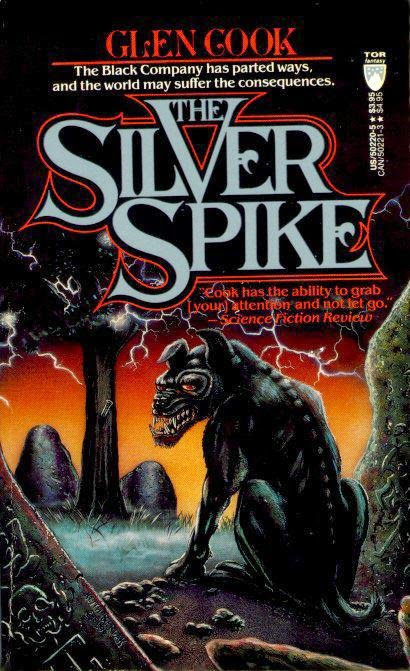
The Silver Spike (Black Company Side Novel)

 The Silver Spike by Glen Cook. Originally published September 1989. Approx. 216 pages (Tor omnibus edition).

HachiSnax note: Regarding continuity, I try to be diligent in listing books in the order they were published. I am assuming that The Silver Spike was published after Shadow Games and before Dreams of Steel, but since I am reading from the omnibuses, this time I will just stick to that format of continuity. Therefore, it is indicated as Book 6, even though it may be considered a Book 5, or not even in the Black Company sequence, since it features only former members and people within the same world. Either way, enjoy. Cheers, Hach.

Quick recap: Following the climactic battle in the Barrowland, the soul of the Dominator was trapped within a silver spike that was nailed into the sapling scion of the god Old Father Tree. The remains of the Black Company, now under a dozen members, decided to forgo accepting further commissions and fulfill their original duty of returning the Company annals to Khatovar. Newly elected Captain Croaker allowed for those wishing to renounce their Company membership to do so. Taking him up on this offer were Silent and the Torque brothers, who opted to follow Darling (aka the White Rose). Also dissolving his membership was resident badass Raven, who tried to follow Darling's group, but was ultimately rebuffed. Sulking all the way, he left with Case, with whom he had forged as close to a real friendship as someone like him could.

The Silver Spike focuses on four central storylines. Over the course of the novel, they converge, divert, and ultimately crash into each other.

First, we have the travels of Raven and Case. This gives us our only first person POV account in the book, told via a journal kept by Case. Case makes for an entertaining "annalist"; his sarcasm less of Croaker's dry cynicism and more youthful wise-assery. He is still a likable narrator, representing the poor farm boy who enlisted in the military to see the sights, learn to read, and be anything other than a potato farmer. Raven, on the other hand, has sunk to drunken lows. Only the reawakening of a familiar evil gets him back on the straight and narrow.

Next, we have the adventures of Darling, who, along with her Silent admirer (haha, I know, bad joke), as well as the myriad weird creatures of the Plain of Fear, still hunt the evils that trouble the lands. They are joined in this effort by none other than the venerable sorcerer Bomanz, who, like Raven, has been alerted to the reawakened evil.

This awakened evil is none other than the seemingly indestructible Limper, one of the last remaining original Taken. Despite a thorough decimation at the hands of Croaker at the end of the Barrowland fight, his head survived, full of unadulterated malice. Another survivor of that battle, the lesser demon Toadkiller Dog, braves the attacks of the godlike sapling to dig up the Limper's remains. His original plans involve revenge on those that have wronged him, especially Croaker and the Lady. However, his plans change later on, thanks to the actions of our final group....

Last, but not least, we have the "Spike Hunters", a quartet of low-level thieves and ex-soldiers with a poorly thought out get-rich scheme: to steal the silver spike and sell it to the highest bidder. Most of the focus of this group's story revolves around Smeds Stahl, a former Imperial soldier and general layabout that gets caught up in this half-baked plan concocted by his cousin Tully. They enlist another former soldier, Timmy, and a seasoned hunter, Old Man Fish, to head to the Barrowland and find the spike.

The Spike Hunters are actually successful in freeing the spike, yet something is wrong. The entire landscape has been razed, all the people massacred as the Limper cuts a murderous swath across civilization. They finally return home to Oar, hoping to plan the spike auction, when they begin to realize just how much they are in over their heads.

These hastily assembled plans have a tendency to omit calculations regarding the true natures and capabilities of powerful forces. The crew, laden down with looted treasures from the slaughtered areas, didn't anticipate the large Imperial presence the events triggered. This makes circulating word about the spike difficult. Also, they hadn't considered that the crowds of wizards flocking to Oar (word of it's presence did get out), including a detachment from the Tower at Charm, had absolutely no intention of participating in a civil auction. There were all people of dubious moral fiber (who isn't in Cook's world?) for whom killing the competition poses a simpler resolution.

As Oar starts to stew, Raven and Case are closing in on Croaker and the Company. Unbeknownst to them, the Limper and Toadkiller Dog are close behind, being constantly harried by Darling and the creatures of the Plain. Circumstances force a reunion of sorts, and the knowledge of the freed spike has all heading back North; the Limper hoping to absorb the Dominator's essence, and Darling working with Father Tree to purge it from this plane permanently.

The remainder of the novel focuses on the events unfolding around the four groups as we approach the inevitable climax in Oar. The Limper meanders slowly but surely on, sidestepping and barreling through traps. Raven and Case find themselves embroiled in "The Cause", a cause that neither feels fully invested in. Darling, Silent, and Bomanz do what they must to defeat the evil, and the Spike Hunters find themselves slowly unraveling. Fish establishes himself as the shrewdest and toughest of the group, Smeds becomes a fast learner, Timmy is sidelined with a malady brought on by touching the spike barehanded, and Tully falls into his old (unreliable) ways.

Even though Cook is in fine form in this book, The Silver Spike is still the weakest installment in the series so far. Don't get me wrong, there is still a good deal of the brilliance contained within. One such example is this line, which so succinctly summarizes the Limper's twisted mental state:

"It had become so self-centered, so self-involved, as to be the hub of a solipsistic universe."

Seriously, it is damn hard to find writing on par with that in most contemporary fantasy works. The first-person bits by Case are also a highlight; he usually starts off his entries in his low-born dialect, and then you see his intelligence showing through. And, as the pressure cooker of Oar reaches a bursting point (all exits become sealed, there are riots, a cholera outbreak, and the infection that affected Timmy begins to spread as well), Cook crafts extremely palpable tension. You can feel the noose tightening on the Spike Hunters as the Empire gets closer to finding them, as they feel their options running out, as if you were one among them and your rear end was in the sling as well.

Where The Silver Spike falters mostly is in its climax. It is, for lack of a better term, anti-climactic. It comes off as obligatory and tacked-on, and lacks the epic grandeur of the battles in previous books. Time would have been better spent dedicated to storyline resolutions for these characters, since we will likely not see them again in the series.

Other than that, it would have been nicer to see more nastiness being done by the Limper and Toadkiller Dog. But maybe Cook wanted to keep the focus on Oar, and the evil that man can do to his fellow man with relative nonchalance.

Here's what it is:
The Silver Spike is a greatly appreciated book that brings us up to date with (and allows us to bid farewell to) a group of characters that we had grown to love/hate earlier in the series. While not perfect, it is still a solid book, and now it is time to get back to Croaker and the gang!


Final Score:

85/100


Cover Score:

This is the last of the books in the omnibus that bears Swanland's greatest cover. I will say this, though: I really like Berdak's cover for this book. Matter of fact, I found a copy of The Silver Spike at a used bookstore last week (was tempted to pick it up but the guy was asking way too much), and I realized how good it really looks in the flesh. It seems to be easy for people these days to poke fun at Berdak's designs (I think this is the last he did in the series), but if you really look at them they are pretty good. His covers that feature the god trees are superb.

Cover Final Score (Swanland):

99/100

Tuesday, April 1, 2014

Swords & Dark Magic

Swords & Dark Magic: The New Sword and Sorcery. A fantasy anthology edited by Jonathan Strahan and Lou Anders. Originally published June 2010. Approx. 517 pages.

It's very rare that I actually finish an anthology cover to cover. Usually there are only one or two authors with contributions that interest me, and maybe one or two that I never read before will spark my interest. Often, though, there is too much that fails to compel me. It takes a certain flair to write a good short story. Still, seeing this anthology at the library, I was more than a bit intrigued by the list of authors represented. So, hopefully I will be able to finish reviewing them by their due date. Let's see how these stories stack up....

Goats of Glory by Steven Erikson (37pgs):
Not many better ways to start an anthology than with an entry by Erikson, author of the popular Malazan series (which may well be next year's reading challenge). Let me start by saying that I do not know if this story ties into the Malazan world in any form. In Goats, we have a quintet of weary soldiers returning from the Demon Wars. Their badges identify them as Rams, but in their decimated state, they are no more than Goats. They come upon a piss-poor town known as Glory (hence the title), which has the means to quench their thirst and whet their sexual appetites, but little in the way of food, lodging, or stables. Their are guided, however, by the oh so helpful townsfolk towards that oh so ominous keep a little over yonder. Of course there is evil in the keep. Evil in the form of demons. Then again, these Goats have just returned from a campaign spent killing demons, so the odds are not so sharply skewed.
This story is a lot of fun. And it's meant to be so. The banter is a little too playful at times, the fighting a smidge overdone, but still wonderfully choreographed. An exercise in delightful excess. Erikson's writing is engaging from page one on, and you can see some of the inspirations he's taken form Glen Cook (who he has mentioned as an inspiration) in his sentence structure, and in how he names the actors in this bloody play. Some reviews say this story gets off to a slow start; it doesn't. The time in Glory in enjoyable, and is reminiscent of the scene in so many horror movies where the last place the group finds before heading into "The Woods" is an antiquated gas station manned by inbred hillbillies. Kudos also to Erikson for making an engaging group that is mixed male/female. Would like to see more of these Goats one day.
Score: 89/100

Tides Elba by Glen Cook (35pgs):
Not only does this anthology boast a Glen Cook story, it is a Black Company short as well. While stationed in a city called Aloe, recently brought under the Lady's wing, Croaker and Company spend the days drinking, playing tonk, and satisfying baser needs. However, everyone whiffs trouble brewing, and, sure enough, the Company is graced by a visit and mission by their least favorite of the Taken, the Limper (who is still stewing with vengeful rage at the Company). The mission, as it is, is to find a woman by the name of Tides Elba (pronounced Tea-dace), who is of some unspecified importance to the Rebel movement.
The rest of the narrative is comprised of Croaker and his friends doing some detective work to try and find out who Tides Elba is, and thereby guess her importance to the Lady. Also, they are seeking to screw the Limper over before he has a chance to screw them. Because it's a certainty that that is his plan.
Cook's writing for the Company is on point as always. Croaker, Elmo, One Eye, and Goblin bitch, complain, taunt each other and crack wise. There is conniving, more conniving, and some sharp-eyed guesswork. Black Company tales work well in the short story format as well; it bears remembering that Chapter 3 of the first book had appeared as a standalone story before the novel was published. Always a good time with Croaker & Co. (the timeline of the events in Tides Elba probably occur between Book 1 and Shadows Linger).
Score: 91/100

Blood Sport by Gene Wolfe (16pgs):
Gene Wolfe is one of those authors that I just need to get around to reading more of. Fiercely intelligent, he writes with a mystical, lyrical fluidity. However, he also often teeters into the obscure, and things start to seem muddled. That is what forced me to put down his "The Knight" a few years ago, but his "Sun" series remains on my to read list. Wolfe's contribution here is a very short tale, and a very imaginative scenario. A weary, melancholy narrator tells a wandering traveler his tragic tale, of when he was a younger knight playing in the "games". These games are actually a live version of a chess variant, where oftentimes bested players were slain. He tells of the promising start of his career, and of a pawn that bested him several times (how Wolfe realizes the physicality of the pawn piece is amazing; I wish he had time to do this for every game "piece"). However, their kingdom soon falls to the hands of marauders, and this same duo finds themselves allies in first retaliating against the raiders, and then journeying to a mystical palace where a prophesy is to be realized.
Wolfe's switches up his style (again) as the narrative goes from linear to uncharted waters (the palace/prophesy finale). And while we can not exactly pinpoint why the ending transpired as it did, it is nice to watch the developing relationship of this incongruous pair, even if you can tell from the outset that things will not end well. I will say this, there is a very touching paragraph at the end, where Valorius tells the travel where each direction will take him. It might not seem poignant on its own, but spoken from a narrator as tinged with regrets as he, it tears the heart up.
Score: 88/100

The Singing Spear by James Enge (11pgs):
Here we have a very short entry from an author that I have never read before. A little research shows that Enge's Morlock Ambrosius books are held in high regard though. Turns out this Morlock Ambrosius (aka Morlock the Maker) is a great fighter (of course) and sorcerer, with a gift for making tools and items with wonderful properties. In this tale, the titular spear, which itself imprisons a vicious demon, has fallen into the hands of a marauding pirate, sending him on a spree of bad actions (but mostly killing). At first, Morlock is hesitant to help, being preoccupied with drinking himself in and out of stupors. However, when the stakes get raised by way of his bartender getting involved, the gloves come off. There is a great premise here, and excellent writing throughout, but Enge fills this tale (and I'm guessing his other writing) with too much of what I assume he thinks is smart, cheeky humor. It doesn't work for me, maybe for my younger me, but not middled-aged Hach. Morlock is presented as one of those stock anime tropes, like Ryo from City Hunter, who seems silly and all throughout the episode, and then is picking off people with pinpoint precision at the end. You get tired of things when you see them coming twenty miles away. A good cup of tea, but not my cup of tea. Score is my take, add 20 points if you are a previous fan of Enge.
Score: 73/100

A Wizard in Wiscezan by C.J. Cherryh (33pgs):
Cherryh is one of those authors whose works I would always see chunks of stuff by during lunchtime visits to the bookstore. One of those authors I would swear to start reading one day, I just had to figure out where to begin. Well, I am glad this anthology gave me something to introduce me to her work. Wizard is one of the longer entries in this work, and it is a solid read. A duke has acquired lordship of a wharf town through some rather sneaky means, and it turns out that the real danger behind him is a nasty, dark wizard. Making the business with the wizard even nastier is the fact that he is in cahoots with a demon. But there is also a resident master wizard, with some charges under his wing. One of his charges, a journeyman illusionist named Willem, is tasked by a lord from a neighboring town with aiding the local king in taking Wiscezan back from the corrupt duke. Wizard is many things in one well-written tale; a coming of age tale, a well-thought out commentary on the politics and machinations of sorcery, and some rousing sword action to boot. Cherryh's style is commendable; she is not too sparse, nor overindulgent. The effect is one where you can see the events transpiring around you; therefore, when there is spectacle, you see it, and when there is confusion, you feel it too. Very well done. Would gladly read more tales with Willem and Tewk in the future.
Score: 90/100

A Rich, Full Week by K.J. Parker (29pgs):
Maybe I don't need to keep pointing out the authors that I am reading for the first time in this anthology, since honestly, this is my first time out with most of them. Parker, like Enge, is an author whom I was just not familiar with before this anthology. However, many reviews of this compilation highly laud this tale, and the author's other works seem rated very high as well.
I'm pretty torn on this story. A Full, Rich Week is about a wizard dispatched to a farming town to address a situation involving the living dead. What does Parker do right? World-creating. The world of "Week" is very ordered; where "wizard" and "magic" are just colloquialisms for philosophy and undefined sciences. There is a patriarchal order, akin to a Catholic construct, replete with schools, commissions, and all sorts of officiating governing these sciences. The way that Parker describes applications of magic are excellent as well; there is extensive use of imagination, theory, and geometry. Also, the "creature" being hunted presents an interesting take on the traditional zombie mythos.
Now before I go on to what doesn't work in the story, I will say this: prepare for a thoroughly unlikable protagonist. The main character, a Father (wizard) in this Order, provides the first-person narration. And he is admittedly not a very nice person. Nor is he the best at what he does, also self-admittedly. There is nothing wrong with having a main character who is, for lack of a better term, an asshole. There are jerks in every calling; an no one said heroes all have to be brave, kind, noble, etc. My problem isn't with the personality type; it is with the eventual (mostly inner) dialogue. I get that this wizard has hang-ups over his upbringing in a coffin-like turf house on a farm, and over his poor scorings at the equivalent of wizard school. But there is a level of nastiness and condescension within the narrative which seems to transcend the established parameters of the character. I have no problem with sarcasm, but what starts out as disdain goes towards trope-bashing and some nasty commentary on social class. But maybe that is the point; maybe the point of the story is that the Father is the bad guy that becomes good by the end. All I'm saying is that there are certain points where it seems less an inner monologue and more an author making fun.
Where Rich Full Week falls apart is at the end. The two main parts of the story; which deal with the narrator's two dispatches, are linked plot-wise. Going from there, the ending is fairly well telegraphed, which results in a rushed, half-page ending, with a truly groan-inducing last line.
Overall, very rich world, very intelligent writing, but also a very unlikable lead, nasty dialogue, and a cornball ending.
Score: 65/100

A Suitable Present For a Sorcerous Puppet by Garth Nix (16pgs):
My readings of YA material are few and far between (I just never get the time, although I know there are so many good YA offerings available), but I have Nix's work set on the horizon for my next venture. That being said, with his specialty being in the YA department, I didn't really know what to expect in this entry. Here we have a short tale, featuring established characters Sir Hereward and Mister Fitz (a knight and a "sorcerous puppet" which is an enchanted, very powerful magical entity; a papier-mache doll brought to life, and capable of sorcery and strong physical feats). In Suitable Present, Sir Hereward is convalescing a broken foot, when he comes upon an archaic tome suggesting that a "birthday present" is due for his dear Mister Fitz. However, the present selected has a nasty surprise inside. I really can't give away any more particulars, as it is really a short story.
As I started reading Suitable Present, my first thought was that I really wasn't in the mood for any light-hearted, cheeky writing. But Nix has such an enthusiastic style that it is infectious and irresistible. The worlds he creates in his head are obviously his playground, and he seems to gleefully romp around them. He is very playful with naming things, but also employs some fairly "big" words. It's all about contrasts; writing with a light touch on heavy subjects, comedic notes during dangerous moments. So many authors can't pull it off, Nix does. It still does get a little typical at times though.
The story resolves quickly, then leaves an open-ended segue to the next adventure. Maybe I need to follow up on this pair, but I think these tales are best told in small doses.
Score: 83/100

Red Pearls by Michael Moorcock (53pgs):
Smack-dab in the middle of this anthology is a new Elric novella. I can see this being a source of much rejoicing for diehards. I was a little hesitant, however. I mean, I love classics by the masters (I've read a good deal, but I won't lie and say that I've read all of Appendix N), but for some reason, on previous attempts, I just couldn't get into the Elric tales. So it was a little daunting for me, this 50+ page novella a hump I had to overcome. Now, I can say that I am glad for it. Whether it was the writing of this particular tale, or if this is just the right time for me to start with Elric, I tore through this story, completely immersed as the pages melted away.
In Red Pearls, Elric is traveling with companions Moonglum and the beautiful Princess Nauha in a ship, destined to travel off the edge of the world and embark on a trading expedition in the World Above (or is it the World Below). There, they meet with the myseterious Lady Fernrath, an albino of pure Phoorn blood whom Elric has met in either the past or the future. Fernrath possesses a mystical sword which Elric covets, a sword of light, a stark counterpart to his own dark sword Stormbringer. the price of this majestic blade? The treasures which are the titular Red Pearls, tucked away in the fortress of fellow Phoorn Addric Heed, a brutal slave trader who scourges the seas in a mysterious living ship.
Moorcock pens this tale with a style that is lyrical, fluid, and ethereal. You get caught up in poetic descriptions that make for excellent world-building. And then there are the characters. I can see Elric being a polarizing character. he is the epitome of "quiet-cool", tall, lean, dressed all in black, and totally bad-ass. He has a living sword that consumes souls, for chrissakes. Then I see people reviewing Elric books recently, ridiculing him as "emo" or "goth". Why, because he is taciturn or because of his style of dress? Is it because he is distant and of haughty demeanor? What I am thinking is that Elric might be a tough sell for some fantasy fans these days, since it is true fantasy: lofty notions, larger than human characters, spectacular magic. Today's fantasy seems more geared towards historical fiction with fantastic elements. But these trends are cyclical, and some things never go out of style. But I digress. This novella is a fine way to pad out the center of this anthology.
Score: 89/100

The Deification of Dal Bamore by Tim Lebbon (24pgs):
Whenever I hear Tim Lebbon's name, I usually associate it with tie-in fiction (Aliens, Star Wars), and movie novelizations, two genres which I do not often dabble in (save Warhammer stuff). I really did not know about his standalone or horror works, and knew nothing of his Echo City tales. Deification occurs in the Echo City mythos, but prior reading is not necessary. I will say that I really enjoyed the majority of this short. Read on....
Jan Ray Marcellan is a priestess of the deity Hanharan, and on this day she is overseeing the transportation of a very dangerous person to a special gaol. Said person is the titular Dal Bamore, en route to stand trial for, and presumably be crucified for, acts of heresy. Of what heresy is he guilty? Bamore is something both hated and feared, scarce and dangerous. His very being can instigate waves of dissent and revolution. He is a sorcerer. A sorcerer in a place where magic is sort of a dark urban legend.
The story alternates between two events; focusing on the ill-fated prisoner transport and in the recent past, following Bamore's interrogation/torture, which is when Jan Ray realized the enormity of what she was dealing with.
Lebbon excels in action scenes, and brutal, colorful descriptions of blood, gore, and violence. It is deliciously gruesome. There are also some genuine moments of real tension (and that is praise that I do not hand out lightly). Jan Ray makes a likable hero, but Bamore makes for quite a hammy villain, all full of snide, condescending contempt. Baddies who continuously sigh and say things like "so typical" are kind of corny in my opinion. But the deification angle is well done, as is the whole concept of religion vs. magic. You can't beat this for the amount of bloody action you get in less than thirty pages. Not for the squeamish.
Score: 85/100

Dark Times at the Midnight Market by Robert Silverberg (25pgs):
I'm more than a little embarrassed to admit that I was not familiar with Silverberg's name; I had heard of Majipoor, but I had no idea of the scope of the tales of it. I was very impressed by the list of accolades on Silverberg's author intro, so it was exciting to see what kind of tale was in store.
In Dark Times, we meet Ghambivole Zwoll, a tentacled sorcerer of the Vroon race. He runs a struggling shop in a marketplace that showcases many arcane wares and services.  is commissioned by an arrogant aristocrat (rich, but still rather low ranking on the highbrow totem pole) to concoct a potion to help him seduce a beautiful young lady of quite high social standing. A bad idea to be sure, and things pan out in interesting ways....
That's all I can really say without ruining everything. To be honest, it is all fairly predictable, and the ending is downright silly. But Silverberg writes with such skill and enthusiasm that you can't help enjoy it. The story is more about him romping in the playground that is his created world than anything else. He has fun creating odd races with weird appearances and extra appendages. He gleefully names mystic ingredients for magical potions. And the whole tale is written with genuine good humor.
So in the end, immensely readable, good-natured, well-written, but predictable and a little silly.
Score: 76/100

The Undefiled by Greg Keyes (14pgs):
I am mostly familiar with Keyes from his Thorn and Bone books, as well as some tie-in fiction. Undefiled features another of his established characters, Fool Wolf. From what I can gather, Wolf is a shaman/warrior of sorts, who is possessed by a powerful, malicious female spirit. They maintain a perpetual inner dialogue, as she champs at the bit, looking to be unleashed and cause horrifying acts of violence and mayhem. With glee. He is also apparently traveling with a female (love interest?) named Inah.
In Undefiled, Fool Wolf and Inah find themselves captive in the land of QashQul, so named for the opposing gods that rule over it. Wolf is offered freedom by the Qash people in exchange for a service; to retrieve a sword used in the sacrificial rites which preserve their vitality. Wolf accepts and sets off....
This is a short story packed with a lot of grand ideas. Keyes weaves a poetic, spectral tale of gods interwoven into all physical things, and the symbiotic relationship that results. There are also a lot of dark themes, and somewhat of a dark tone tempered by dry sarcasm.
I really couldn't bring myself to sympathize with Fool Wolf; yes it is humorous that on appearance he isn't much more than a laid back horndog. And his literal inner demon makes things very interesting, even if her dialogue is overblown and hammy. But I needed a few more sentences of backstory to actually give a hoot about him. This should be a given if you are throwing a tale of an established figure into an anthology; give a little something to help new readers get acquainted. As it is, when I think of shaman + wolf + lazy lecher + demonic possession, I immediately think of Rose Estes' Mika-Oba books.
I appreciated this tale a lot more on the second reading. Being as though it is so short, you can afford a quick re-read. This helps Keyes style to set in and gel a little better.
Score: 77/100

Hew the Tintmaster by Michael Shea (38pgs):
Veteran author Shea gives us a decent length story here set in Jack Vance's Dying Earth universe. It is even billed on the back cover as being a "fully authorized" Cugel the Clever story. First things first; I have not read anything by Shea, and I was never able to get into Vance in my younger days (I know, pure sacrilege, maybe a revisit is in order), so I wasn't excited for this story. To be honest, I started this tale and then walked away from it for about two weeks, delaying the review even more. I'll just say it now; this is not my type of story. It is well-written (but I am in no position to confirm it being Vancian), but.....
Esteemed sorcerer Kadaster enlists the services of warrior Bront and master house painter Hew (hailing from the land of Helix, where colors are very important in social class) to travel to another realm. They will recruit help in a town called Minion, and from there journey to the mysterious Crystal Combs, where Hew will undertake a very special painting task.
This is a fairly light-hearted tale. Shea obviously loves writing in this world, and he is a sound wordsmith. Color is a motif that permeates the entire tale, peppering descriptions throughout. He also accomplishes a difficult task; successfully writing physical comedy. He creates a sound villain in a spooky "future wraith" as well. But a lot of the storytelling is forced as well; especially with the overly earnest, or corny, dialogue.
As for the Vance aspect, I'd love some reader feedback. This should be billed as a Dying Earth adventure, not a Cugel one. Cugel appears in a supporting role so minute it is damn near a cameo. Other than that, does Shea tap Vance's vein? All I know is that I personally do not feel compelled to run out and get anything further by either. Plus, even if I was an established fan, I imagine I'd feel ripped off by how little Cugel is in the Cugel tale. Not my cup of tea, feel free to add more points if you are a Dying Earth fan.
Score: 72/100

In the Stacks by Scott Lynch (48pgs):
Wow, what a pleasant surprise this story was. This tales centers around four wizard aspirants at the High University of Hazar, and focuses on them passing their fifth year final exam. The task at hand for a passing score? Simply returning a library book to the Living Library.
Sentient libraries in magic schools are not a new concept, and I had honestly thought that no one would top Pratchett at depicting them, but I was wrong. Lynch writes with a furious delight here, and satisfies all the criteria for a story in this anthology; magic, swordplay, some humor, some gruesome violence. His concepts and theories are solid, and well realized. Pacing is stellar; I cannot stress this enough. This being one of the longer entries in the book, I barely noticed as page after page flew by. Maybe the words were infused with the same thaumaturgical sentience as the grimoires in Stacks.
There are some weaknesses to this tale, however. The quality of the characters never rises to the lofty standards of the settings. There are trope and/or uninteresting; sufficiently resourceful or useless as each situation necessitates. Our protagonist, Laszlo, who possesses more quality of character than magical ability, is a slice of amicable milquetoast. And finally, the ending sequence feels very much tacked-on and unnecessary, as if the concept itself was insufficient on its own merits.
Still, I highly recommend this tale. I do not know if any of the people or places tie into Lynch's Locke Lamora stories.
Score: 86/100

Two Lions, a Witch, and the War-Robe by Tanith Lee (34pgs):
Two wandering adventurers, so close in appearance that they might be brothers, converge upon the mystical city of Cashloria by way of opposing banks of its roaring Ca river. After enduring similar encounters with brutish soldiers of the local ruler, the "False Prince" (both scenarios ending with thoroughly dead guards), they are charged by said Prince with a geas. The pair is charged with retrieving a lost garment of legendary power; a robe with magic properties. The theft of this robe has caused the prince to age at an exponential rate, and led his mind down its bitter path. Of course, there are obstacles to bar retrieval of the garment; challenges which have claimed the lives of the last fifty brave adventurers that have tried. And there is also the matter of that odd mansion in the labyrinthine woods....
From the opening lines of this story, veteran scribe Lee hooks you with lush descriptions and world-building. This is pure fantasy; evocative, fantastical, and immersing. To be honest, when I first met the two leads, I thought that their dialogue was a little overwrought, like a forced attempt at cleverness. But once they get together, they make a great pair with a great rapport. The magic is, well, magical, and the swordplay (and other action) is brisk and engaging. There is very little to complain about here, other than the last line being a forced proverb. Still, one of the better tales in the book. And it gets my vote for having the best story title with the playful dedication to C.S. Lewis.
Score:87/100

The Sea-Troll's Daughter by Caitlin R. Kiernan (30pgs):
This is a very interesting tale that Kiernan brings. Like Cook's Tides Elba, there is no real swordplay or grand displays of magic here (save communicating in dream states), but the world she has crafted is one where these things, as well as monsters, are integral facets of society.
A stranger has arrived in the small fishing village of Invergo. A fighting woman from the southern lands, who claims to have succeeded in an unbelievable task: that she has slain the sea-troll who has for so long plagued the village on the bay. She is met with doubt and disbelief until the corpse of said creature washes up on the shore. Then it is turned into a public spectacle. Meanwhile Malmury, the heroine, spends her days at the local tavern, drinking and embellishing her tale further and further each day as she awaits her promised reward.
Eventually, a very much feared crone comes to warn the villagers that their actions have inevitable consequences. There are other trolls which may take umbrage with the murder of one of their own; and, more immediately, said sea-troll has a daughter (sired upon a human woman), that may have her own ideas about payback and settling accounts.
The basic life lesson in The Sea-Troll's Daughter is simple; that the "monsters" are quite capable of fairness and humanity, while the more "civilized" people are often petty and, well, monstrous. But while not thematically groundbreaking, this is a well-written tale that sticks with you. Kiernan's scientific pedigree coupled with evocative, haunting storytelling really brings this world to life. The characters are well fleshed out as well; especially Saehldr, the titular daughter of the troll, Dota, a kind-hearted, responsible barmaid, and Malmury, our boastful, whoring, hard-drinking "hero".
Solid concept, solid execution, detailed, gruesome descriptions. Good job.
Score: 88/100

Thieves of Daring by Bill Willingham (7pgs):
You know, I really don't know what to say about this story. Not at all. It's a decently written tale, but there is no real point to it. If it was all some set up to a great knockout of an ending, I could get it, but nothing. Thieves focuses on a character named Septavian (I have no idea if he appears in any of Willingham's graphic novels or printed fiction), who is a master thief and swordsman of a specific order. Apparently he is so well known that this story begins with an excerpt from his compiled history. In Thieves, Septavian and his cohorts have decided to rob the estate of a local wizard. The story begins as his partners in crime are dead and dying. Septavian then speaks to the master of the house. There's some action, then it's over. Seriously, that's it.
Like I said, the story is written in an engaging enough manner, and does feature swords and sorcery. Willingham writes with a real flair, even though the story it ultimately unnecessary. I don't dabble much in comics, so I haven't read his Fables works, but I was pleasantly surprised to find out that it was he who drew so many of my favorite classic D&D pics:


So, yes, not a bad story but there is also no reason for it.

Score: 63/100

The Fool Jobs by Joe Abercrombie (25pgs):
Joe Abercrombie's First Law trilogy is stacked on a certain shelf in my mind labelled both "To Read" and "What the Hell is taking you so long to get to this????". It was a real challenge not to skip to the end of this anthology just to read this story first. So, that being said, what a great way to close this book! This little gem combines all the ingredients that make good fantasy; swordplay, magic, memorable characters, and even some well-placed comedic touches.
I am assuming that Abercrombie was trolling a bit when he made the story structure of Fool Jobs. It is about a band of hired ne'er-do-wells sent on a mission to a village to grab a 'thing'. Literally. This lethal septet is led by Craw, who's been doing this longer than he can remember and who is getting weary of catching the missions left pooling around the lower portion of the totem pole.
As mentioned before, all the components work here. There is enough description to satisfy feasible world building. We get an abundance of swordplay, depicted in such a manner that the results become vivid red splatters dashed across our imaginations.
Best of all is how Abercrombie writes for the characters. Let me say now, this band has its share of stock personalities. There is the quick, sneaky one, the quiet, lethal one, the knife pro, the tough as nails girl, and some big, burly, irritable lugs. And yet, it is Abercrombie's attention to the details of the workings of the inner mind, all those nuances, that grant his characters immediate authenticity. Craw is an efficient thug (for lack of a better term), but he has worries, dreams (red socks!), and fixations. Certain situations, such as the nervous anticipation that precedes a potentially deadly fight, are rendered so realistically that you can feel your stomach knot.
So there you have it; simplest plot structure, stock character types, and a predictable ending. But all made great with realistic, sympathetic characters, and good action scenes. Nice closing piece.
Score: 88/100

Final Thoughts:
This one took me quite a while to finish, but I am more than happy that I did. I recommend this anthology highly for event he most casual fantasy fan, and here's some reasons why:

  • It features some real A-list authors.
  • It features all new works, not rehashes of previous ones.
  • While some things aren't my taste per se, there are no poorly written stories here.
Highly recommended. And now I have a decent sized list of authors I need to read more stuff by.

Cover Score:

To be frank, the worst thing about this book is the cover. The background color is a nauseating green mess. Our heroic pair looks like an intrepid duo of LARP-ing, photogenic, Marketing Department workers. This is the kind of cover you'd expect on a self-published title, not an anthology of this caliber.

Cover Final Score:

36/100

Tuesday, March 25, 2014

My First Guest Review!

I'm very happy to say that today marks my very first guest review on another blog site.

My review of David Annandale's Black Dragons short story "The Tribute of Flesh" can be read over here:


If you've never been there, take a look around. It's one of the more informative wargaming sites I've seen, and I am happy that they chose to post this review, and hopefully some more in the future.

Cheers All! ~Hach.

Saturday, March 22, 2014

Dreams Of Steel (Black Company Book 5)

 Dreams of Steel by Glen Cook. Originally published April 1990. Approx. 222 pages (Tor omnibus edition).

Where we last left off:
The Company has lost the engagement at Dejagore. Croaker has fallen, presumably dead. The Lady, fighting with a desperate fervor, ended up literally buried beneath a pile of corpses (also presumed dead). Murgen and the remnants of the Company, along with their Taglian contingent, remain inside Dejagore, now under siege by Shadowspinner and his forces. Mogaba and his forces do what they can to harry the forces of the Shadowmasters.

Dreams of Steel:
What can one expect going into this book? There were so many open storylines left open at the end of Shadow Games. This is very much a middle of the road book, carrying action along as this new story arc further develops. But middle of the road need not apply to the quality of writing (and such is not the case here, the writing is superb as always). Also, this book brings us another first: it is the first Black Company title to feature an Annalist/narrator other than our beloved Croaker. This time it is Lady; who, as already mentioned, you probably really hate or really want to get inside the head of (I'm on the latter team). How does Lady fare as a narrator? Extremely well, in my opinion. But it's not Croaker by any means. Be forewarned. Also, you might not be getting as much of Lady as you may have wanted (more on that later).

Although buried under human detritus, Lady is not dead. Battered, broken, but not dead at all. After dragging herself away from the scene of their loss, she is aided by two Taglians, Narayan and Ram. Both seemingly from meek backgrounds, there is very obviously more to them than meets the eye. Mysteries aside, they help her make her ways back north, as she attempts to reassemble their forces.

It still has not been revealed why the Radisha and her brother the Prabrindrah (along with the sorcerer Smoke) fear the Company so much. But it is obvious that they are more than happy that the Company was decimated along with the bulk of the Shadowmaster army. But the Taglian royalty is in for a big surprise. For the Lady, the one loss and presumed death of (her beloved) Croaker does not terminate their commission. She has claimed the captaincy, and demands that her supply and replenishment needs be satisfied.

To be honest, nothing really gets resolved in this book as far as the war goes. Dreams of Steel is mostly about raising armies, moving armies, harrying opposing forces, chipping away at them as you build your own strength up, etc. There is also a focus on the "spy games" going on between Longshadow, Lady, and Soulcatcher.

Wait, did I just say Soulcatcher?

It was revealed at the end of Shadow Games that the mysterious stump that had been trailing Croaker the whole book was actually the Lady's sister, Soulcatcher herself. She has been the one all along sending the crows to watch the Company (the bats were courtesy of Longshadow, and the watching shadows were sent by Spinner). It also turns out that she is the one that sent the imp Frogface on his spying and merry mischief making. This is all great news; Soulcatcher was one of the most compelling and entertaining characters of book one, and if Cook is bringing back the Taken, thank goodness she is back too. Catcher is present not to take sides, but more to sow the seeds of Chaos. Her motivations? Seeing her sister suffer as revenge, as well as letting Croaker suffer to see Lady suffer. She is also an unabashed, all around troublemaker. And so, the travels around, causing her catastrophes, bringing the convalescing Croaker in tow.

There is another aspect introduced in Dreams of Steel: the Kina storyline. As established in Shadow Games, the Taglians, although living under a monarchy, were truly under the sway of the three prevalent religions. It turns out there is another religion at work; one that is outlawed, with followers in the shadows. Kina is a goddess of Death, and her followers, the Deceivers, carry out murders in his name. There is a prophesied-about murderfest coming, known as the year of Skulls. And Lady fits into this theology. Apparently, she will be the vessel to bring Kina back into this world, and initiate the slaughter. Narayan (actually one of the highest ranking Deceivers around), Ram, and another high ranking devotee, Sindhu, have great plans for the Lady regarding the preparations for this. Lady is forced to make a tough concession; as much as she abhors religion and the impact of clerical interference, the services provided by Narayan and company are invaluable. Plus, there are the dreams, the visions. It can't be coincidence. It actually does feel as though her fate is somehow intertwined with this Kina.

Since most of the book revolves around travels, ceremonies, and some battles, enjoyment of this book really comes down to how much you enjoy Lady in the role of Annalist. Her tone is (obviously) very different from Croaker's, and she herself even warns the reader at the beginning:

"I have no training. I am no historian nor even much of a writer. Certainly I don't have Croaker's eye or ear or wit."

It is true that there is little wit in her narration. It is not her way. Croaker's sarcasm, self-admittedly, helped him get by. The Lady is no-nonsense. She does not suffer fools. She makes fools suffer. Where narrator tries to juggle egos, or find ways to distract those that distract him, Lady cuts away all nonsense. She makes a dutiful and engaging narrator, and it is enjoyable to see her military machinations. She is a natural.

Since she is writing for the Company Annals, what you do not get is any real history on who Lady is. Where did she come from, what were her desires all along, through the attempted Dominations and even her own power plays. But this is all par for the course. People joining the Company leave their pasts behind. You get confirmation that her love for Croaker is legitimate, though. Just don't expect all your answers regarding her to be satisfied.

Another plus in Dreams of Steel is that we see more character development in the supporting cast. It is interesting to see Croaker in a third-person position (not a secondary character in the series of course, but he is in this book). We see the Prabrindrah coming more into his own. Longshadow, leaders of the Shadowmasters, is fleshed out more, showing the extent of his powers, as well as his conceit and weaknesses. The trio of Swan, Cordy, and Blade, introduced with much fanfare in the last book and then left in limbo, get much more page time and depth. They finally make for intriguing assets.

Missing in action (and sorely missed) are One-Eye and Goblin. They are hiding out within Dejagore after taking their sweet time torturing and killing Shapeshifter (who, it was discovered, was the one that killed One-Eye's brother Tom-Tom while in the form of a forvalaka). Their absence, coupled with the lack of Croaker's sarcasm, sap most of the humor from this book. Any levity is provided from Soulcatcher's twisted psyche and Frogface's scampering.

I must truly commend Cook on all the work he put into the religions that he has created. The Kina apect is both sinister and believable. We are also given snippets as to how these death cults tie into the Company's history, yielding clues as to why the Taglian royalty so feared them, and why the Company standard possesses its mysterious powers.

Cook hints that the next arc of action will take place along the plain of the glittering stone, where Longshadow resides. Perhaps the final battle with the Shadowmaster will take place there. There is also the issue of Mogaba to resolve. There is some dark force causing a madness inside of this once-stellar officer, and the end result cannot be pretty. Finally, there is a nice little last chapter twist, setting the stage for some interesting events-to-be.

Just a last note, the next volume to be reviewed will be The Silver Spike, which follows those we said goodbye to after the battle in the Barrowlands. I am not sure if it was published before or after Shadow Games, but I am reading and reviewing in the order it appears in the omnibus.

Here's what it is:
The wheels keep on turning, things keep going in motion, but the events of this portion of the Company's legacy are still developing. Better than Shadow Games by a hair, but I still prefer complete entries.

Final Score:

89/100


Cover Score:

I already gushed on the majesty of this Swanland cover in my last post, so let's talk about the Berdak cover a bit. In all honesty, the background and his rendition of Soulcatcher are actually pretty good. It's the demon that he dropped the ball on. Placement and composition are totally off. But at least he tried to capture some of how Cook described the creature. 

Cover Final Score (Swanland): 

99/100

Wednesday, March 12, 2014

The Myriad (Tour Of The Merrimack #1)

The Myriad (Tour of the Merrimack #1) by R.M. Meluch. Originally published by DAW in 2005. Approx. 310 pages (hardcover).

A few years back, I was intrigued by the cover of a book called "The Sagittarius Command" by R.M. Meluch (I was not familiar with her books at the time). I realized that it was the third book in the series, but going back, the cover of the first book kind of put me off from starting the series (puerile as it may be, I will admit that a cover will often make or break my purchase. Isn't that what it's there for?). Fast forward to now, and I did a search of my local library system for book one. Figuring that I can't go wrong reading a book with a bad cover as a loaner, I dove right in. 

Suffice to say, it has been a unique journey. The Myriad is one of the most original sci-fi works that I have ever read, bar none. It is a work that juggles classic (arguably antiquated) character tropes with theoretical astrophysics. Meluch juggles with skill, though; skill and deft prose.

Here's an example of some of Meluch's spot-on wordsmithing, as she describes one girl's lowborn roots:

"Trailer park. An idyllic name for a slum where the landless lived in their mobile shelters stacked three high in the unpretty part of town with hard men, slutty women, and mongrel dogs."

The Myriad follows the adventures of the USS Merrimack, a space-borne U.S. battleship (at this point, the United States is the dominant world power) on its mission to destroy the Hive; an all-powerful, all-consuming, collective minded alien entity. To assist them in this mission, the Roman Empire attaches a "patterner" to the Merrimack.

Wait a minute....Patterner? Roman Empire? In the future? What's going on here?

I will probably mention again and again, Meluch has infused this tale with a good deal of interesting, clever, and fun ideas. One of these is the Palatine Empire (Rome). It turns out that all the intelligentsia of Earth which still used Latin in their professions (lawyers, doctors, etc.) were all along perpetuating the next rise of glorious Rome. Taking off from Earth, they colonized their own planet (as well as a few others). And for the next 150 years, Rome and Earth were at war; that is, until the arrival of the Hive. Rome, suffering great losses to this alien threat, sued for a tenuous peace.

Back to the Merrimack and her crew, interesting mix that they are. The Mack is led by one Captain John Farragut, the kind of stalwart, dashing, brave, good ol' boy that people can't help but fall victim to the charms of. A large focus also falls upon the company of Marines stationed on the ship, led by Lt. Col. Steele. Another character of note is Flight Sergeant Kerry Blue, a promiscuous young beauty with a tender heart. Added to the mix is the Roman patterner Augustus (just to clarify, a patterner is an augmented human with the ability to "plug in" and solve complex data problems of a wide spectrum. Their physical attributes are enhanced as well. All the tinkering is apparently quite traumatic on the patterned, though). Augustus is far and away the most dynamic character in the story; beneath his condescending veneer, he is obviously quite troubled. He has his ingrained, unquestionable fealty to Rome, and yet he lives his life knowing that they mercilessly tinkered with him as no more than a commodity. He is then attached to this crew of intellectual inferiors, knowing that these mental midgets are the ones that Rome essentially surrendered to. 

Ok, that's the gist of the backstory. So what is this book about, and what is "The Myriad"? Well, early on, the crew of the Merrimack comes across something of an anomaly; a cluster of three planets bearing intelligent, humanoid life. This is odd since this group of planets was overlooked by the Hive, even though they were in their path. This group of planets is known as The Myriad, and the humanoids are led be an Archon named Donner; a prideful, yet benevolent dictator. Farragut establishes a rapport with him; neither side wanting to show all of their cards, yet both greatly respecting each other. It's just that there are some happenings going on involving the Myriad that goose normal conceptions of space and time.

One initial mystery involves the modes of transit and communication available to the aliens. They are something of a low-tech species, with most of their ships only attaining sub-light capabilities. And then there are the kzachin. Surrounding the planets of the Myriad are portals, similar to wormholes (except they do not collapse after usage). These transit tubes are what defies all known logic, and as the crew attempts more and more to dissect their import, they realize the potential for trouble; a real time paradox. 

Around this time, the action really gets moving. A troublesome ship full of talking head dignitaries from Earth shows up, promising to undo all the goodwill established with their incessant meddling. Farragut is compelled to continue on his original mission, to hunt down the Hive. There is some decent human vs. alien action, and then, well, new problems arise.

This is all just a basic summary. I cannot do justice in this review to the scientific romping that Meluch experiments with, but it involves tweaking notions of spatial distance, as well as distance measured in time. There are interesting takes on technology, blending elements of low-tech concepts (Battleships and swordfights in space. Ships that conduct broadside assaults with projectile weapons in deep space) with legitimate discussions on gravitational pulls, faster than light travel, uses for antimatter, etc. Point being, there is a lot of thought put into the scientific aspects of this work.

Perusing some other reader reviews of this book, a lot of people take jabs at the dialogue and character interaction. The biggest complaint is that it is somewhat hokey, a throwback to the pulp novel era (as if that would be a bad thing). Trust me, Meluch is an intelligent writer, and every word in this book is purely intentional. The situations are reminiscent of a novelization of a popular sci-fi show or movie, from the accessible characters to the easy, snappy banter. The technology of "beaming up and down" and the "nearly human" aliens have a real Star Trek taste to them, and Farragut and Augustus give off a nice Kirk and Spock vibe, even if Farragut is more lethal than lothario and Augustus' aloofness is a by-product of tinkering, not birth. His sarcasm is 100% genuine, though. All the supporting cast fares well too; they may be trope, but Meluch fleshes them out well beyond the cardboard cutout realm. Exceptions to this include the character "Cowboy", who serves more as a metaphor for self-destructive machismo than anything else. His baseness, in the end, only serves to make him into an intentional running joke.

There isn't much that can be said that does not work well in The Myriad. Once affairs start on planet Arra, they feel as though they drag a bit, but not too much. Also, as enjoyable as the characters and technical aspects are, the alien battle scenes were a little lackluster. The descriptions of them are decent enough, but there is no tension, no blistering, edge of your seat effect in either the space battles or boarding scenes (in fact, the best action sequence involves an ambassador being assaulted with a muffin. Yes, you read that correctly). Again, the technical aspect is what makes the aliens interesting; such as the fact that they can "insinuate" through force fields, and how they home in on human "resonance". Another issue that I've seen being raised is perceived misogyny, or sexism. There are some pretty cold jokes made at the expense of Kerry Blue's ah.....promiscuity. It didn't rub me the wrong way, but if you have tender sensibilities, I guess you can consider yourself warned.

Some spoiler-y stuff below.
.....

....

...

..

.
Captain Farragut! Incoming spoilers!

I'll be honest, I hadn't realized that I had grown so attached to these characters until Act III (aka the last chapter), where Meluch essentially hits the reset button (trust me, there is a reason). It is at this point that we lose Augustus, the most compelling character by far (who had just, in a heartbreaking scene, revealed himself as a homosexual in love with Farragut). Meluch also throws some subtle emotional jabs regarding Farragut and his first love in that chapter. But she also shows that even though things change, certain aspects remain cyclical. Is it enough to bring me back for book two? I don't know; I am pretty emotionally spent right now.

End Spoilers

.

..

...

....

.....

......

Here's what it is:
R.M. Meluch returns from a multi-year hiatus with a bold series that entertains and twists logic into pretzels (you'll get that reference after reading the book). Easy dialogue, spiffy science, and an emotional wallop at the end.


Final Score:

87/100

Cover Score:
As mentioned in the opening, this cover is what deterred me from reading this book for so long. Even while reading it now, I wouldn't carry this book in public. The color scheme is ok, the rendition of the gorgons (the aliens) is fairly nice, but I really don't like the portrayals of Farragut (or is that supposed to be Steele), Augustus, or the girl that I am assuming is Kerry Blue.
On a bright now, they've bundled the first four books into two book omnibuses. So you can now get the first two books with this neat cover:

I'd go this route.

Cover Final Score:

25/100

Monday, March 10, 2014

A Sanctuary Of Wyrms

A Sanctuary of Wyrms by Peter Fehervari. Originally published by The Black Library, April 2013. Approx. 24 pages.

I've had Sanctuary of Wyrms sitting on the back burner for a good while now. I've truly enjoyed the stories by Fehervari that I've read so far, but he has only so many stories in the 40K universe that I get wary of running out. But given that it is already the 10th of March, and I have no posts up (plus I am only two-thirds done with the book I am currently reading), I was pooling through the archives for a short work to read and review. So here we are. How does Wyrms stack up with other Fehervari works (here, here, and here)? Very well in fact; and it is bolstered by the return of a familiar character and a great setting.

A Sanctuary of Wyrms tells the tale of Asharil, an ambassador of the Tau's water caste. Hailing from a long line of water caste servants, she holds in interest in the gue'la, the colonial xenos race known as the "humans". She finds herself commissioned to a world known among the Tau as Fi'draah, a harsh jungle environment referred to by the humans as "the Coil".

The Coil...Fi'draah.....Phaedra. Oh yes, back to the Dolorosa Coil!

Fire Caste had so many great things going for it; great characters, a twisty plot, and plenty of Easter Eggs and puzzles to play mind games with you. But one of the things which I enjoyed the most was the whole "living, breathing (hating), jungle" motif, inspired by iconic works like Heart of Darkness and Apocalypse Now. Well, it pleases me to say that Phaedra is here in all of its magnificent, teeming malice. 

Asharil is attached to some earth caste cartographers, and, for security, they are provided with a fire caste shas'ui in charge of a contingent of Imperial defectors. This shas'ui is a jaded female warrior named Jhi'kaara. Yes, the "broken mirror" herself.

The group upon an ominous, bunker-like structure known by the frog-face locals as the "Sanctuary of Wyrms". It is determined that it is both an Imperial structure, as well as a means to "keep something inside". A saunter inside reveals signs of great struggle, of terrible loss, and of great evil. It turns out that the designation on the Sanctuary, the stylized gue'la character "I", identifying the bunker as the business of the dread Inquisition. And as we all know, where the Inquisition is involved, dread things await.

After sifting through the remains of the inner struggles, the tau team makes some great discoveries. First, they find the warped and distended remains of the former inhabitants of the structure. Second, amongst the scattered remains lay fallen gods. Members of the revered (reviled) Astartes. But the space marines are different; their pauldrons bear different markings. All have a version of the "I" seen above, but they also bear separate Chapter markings as well. A true mystery to the Tau; members of the covert Deathwatch. 

Lastly, the Tau comes upon the horror that started the whole massacre; a bastardization of an ancient evil compounded by the hateful humor of Phaedra herself. And foolishly, the allow it a chance to stretch its tendrils. There is no spoiler in saying that; from the onset of the story, we already know that things did not go well, and that this will indeed be Asharil's final account.

As always, Fehervari employs a descriptive style the perfectly matches the brutal, dark nature of this universe. He also shows some chops for horror here, creating some tension in scenes where the group explores the Sanctuary. 

Asharil makes for an interesting protagonist. She strikes a sort of rapport with Jhi'kaara over time, as they share some common traits. They both rely upon and trust their intuition, where logic might be more in tune with the ways of the Tau. Also, they are both sensitive to the ways of the gue'la; Asharil chooses to study them, while Jhi'kaara always had the talent to 'understand' her enemies, especially the humans.

And yet, as interesting as she might be, she is not nearly as compelling as, well, Jhi'kaara. Or Commissar Iverson. And that's too bad. I would've loved another chance to see inside of Jhi'kaara's head again, but that could not be, as this is a first person POV. Maybe one day we'll get a Jhi'kaara solo novel....

Another point to mention, we only get to glimpse the panorama of Phaedra at the beginning of the story. The rest of the tale shifts to the "haunted house" feel of the Sanctuary. Like mentioned before, these scenes are tense and well-done. I just like the hateful living planet better.

Here's what it is:
Peter Fehervari delivers another sound Tau outing, with an emphasis on the old "enemy of my enemy" flair to it. Great to see Jhi'kaara and Phaedra again as well.


Final Score:

86/100


Cover Score:
Here we have a few fire caste warriors in formation, blasting away, with a monochromatic saturation. All fine and dandy, but there are not that many Tau warriors in the story. The picture looks like a grab from a codex, or supplement. But it's fine for the price. Best bet? Get the Deathwatch: Xenos Hunters edition so you can enjoy this gem of a cover:


Cover Final Score:

30/100